Japan Agricultural Microbials Market Size, Share, By Type (Bacteria, Fungi, Others), By Function (Biofertilizers, Biopesticides, Others), By Application (Grains, Cereals, Pulses, Oilseeds, Fruits & Vegetables, Others), By Mode of Application (Soil Treatment, Foliar Spray, Seed Treatment, Others), By Formulation (Liquid, Dry), Japan Agricultural Microbials Market Insights, Industry Trend, Forecasts to 2035
Industry: Agriculture
Japan Agricultural Microbial Market Insights Forecasts to 2035
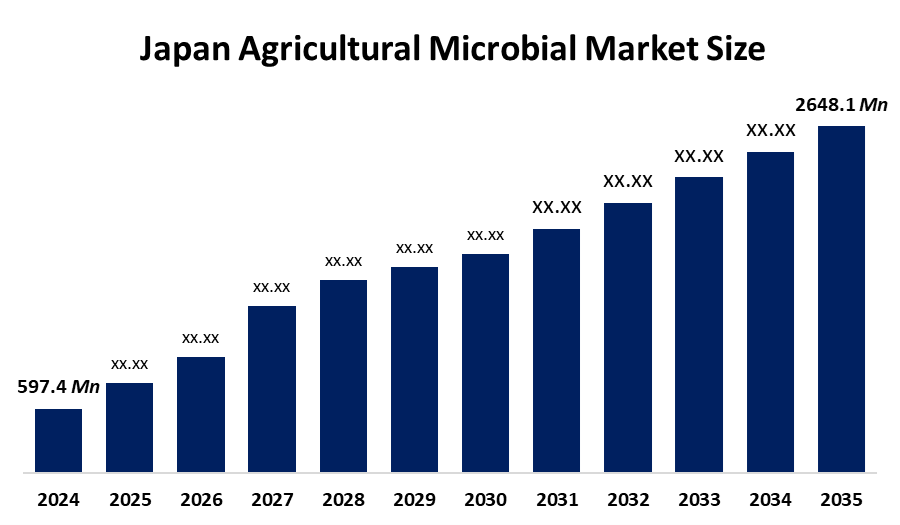
- Japan Agricultural Microbial Market Size 2024: USD 597.4 Million
- Japan Agricultural Microbial Market Size 2035: USD 2648.1 Million
- Japan Agricultural Microbial Market CAGR 2024: 14.5%
- Japan Agricultural Microbial Market Segments: Type, Function, Application, Mode of Application, and Formulation
Get more details on this report -
The Japan agricultural microbials market deals with the use of beneficial microorganisms to improve crop yield in the country. Microbials exist as biofertilizers and biopesticides and enhancers which farmers use to protect their crops of grains and cereals and pulses and oil crops and fruits and vegetables in both their fields and home gardens. The need for nutrient-rich products and the move towards organic and precision agriculture are the drivers for the market.
The Japanese government facilitates the adoption of microbes by introducing the Green Food System Strategy, also known as MeaDRI, targeting a 50% reduction in chemicals and a 25% increase in organic farmlands by 2050. It also incentivizes biofertilizers and biopesticides through the MAFF. Japan’s digital shift in agriculture also boosts the adoption of AI and drones, which optimize the application of microbes. The regulatory environment has been liberalized by the Agricultural Chemicals Regulation Act to cater to the use of safer microbes. The use of sewage sludge also aids the enhancement of the microbiome in the soil.
Innovations in technologies facilitate growth, with technologies like AI-driven microbial strain detection, CRISPR-Cas genome editing, IMC functional hydrogel for soil substitutes, integration with IoT sensors for efficient farming practices, as the rewards of high efficiency are equalled by high yields. Future opportunities are inorganic farming, greenhouse farming, promoting climate-resilient microbial strains, urban and home gardening, as well as the uptake of precision agriculture to boost the efficiency and sustainability of agriculture in Japan.
Market Dynamics of the Japan Agricultural Microbial Market:
The driving factor of the Japan agricultural microbials market is the increasing crop requirement for sustainable and nutrient-enriched crops with the adoption of organic and precision farming techniques. Farmers are adopting microbial solutions such as biofertilizers and biopesticides to enhance crop productivity while minimizing the application of chemical-based products. The government is promoting the application of microbial solutions through initiatives such as the Green Food System Strategy (MeaDRI) and MAFF schemes. Technology such as AI and IoT plays a vital role in the introduction of smart techniques in the application of microbial compounds.
The market also faces restraints, which include high production and registration costs, susceptibility to climate changes, lack of certified microbial strains, as well as difficulties in supply. For small-scale farmers, the technology of microorganisms may be hard to access, which may prohibit the growth of the market.
Opportunities for future growth lie in the expansion of organic as well as greenhouse farming technology, developing strains resistant to climate conditions using microbes, and adopting technology related to precision agriculture. Urban farming, home gardening activities, and knowledge related to the benefits of nutrition also provide opportunities for growth in the future. Inclusion of AI and CRISPR technology for developing strains and formulation techniques is another area for growth with regard to the production of crops in Japan.
Japan Agricultural Microbial Market Report Coverage
| Report Coverage | Details |
|---|---|
| Base Year: | 2024 |
| Market Size in 2024: | USD 597.4 Million |
| Forecast Period: | 2024-2035 |
| Forecast Period CAGR 2024-2035 : | CAGR of 14.5% |
| 2035 Value Projection: | USD 2648.1 Million |
| Historical Data for: | 2020-2023 |
| No. of Pages: | 210 |
| Tables, Charts & Figures: | 90 |
| Segments covered: | By Type |
| Companies covered:: | Sumitomo Chemical Co., Ltd., Mitsui Chemicals Agro, Inc., Bayer AG, BASF SE, Syngenta Crop Protection AG, Nihon Nohyaku Co., Ltd., Kumiai Chemical Industry Co., Ltd., OAT Agrio Co., Ltd., Koppert B.V., and Other key players |
| Pitfalls & Challenges: | COVID-19 Empact, Challenge, Future, Growth, & Analysis |
Get more details on this report -
Market Segmentation
The Japan agricultural microbial market share is classified into type, function, application, mode of application, and formulation.
By Type:
The Japan agricultural microbial market is divided by type into bacteria, fungi, and others. Among these, the bacteria segment dominated the share in 2024 and is anticipated to grow at a remarkable CAGR during the forecast period. Bacteria are dominating due to their affordability, compatibility with multiple crops, ease of application with the use of modern irrigation methods, and popularization among both extensive and small-scale farming; their efficiency in improving soil fertility and yields has also been consistently proved in Japanese agriculture.
By Function:
The Japan agricultural microbial market is divided by function into biofertilizers, biopesticides, and others. Among these, the biofertilizers segment dominated the share in 2024 and is anticipated to grow at a remarkable CAGR during the forecast period. Biofertilizers are dominating because of their increasing soil nutrient content naturally, reducing dependency on chemical fertilizers, improving the quality of crops, meeting Japan's policy on sustainable agriculture, and being more yield-increasing in commercial and greenhouse farming.
By Application:
The Japan agricultural microbial market is divided by application into grains, cereals, pulses, oilseeds, fruits & vegetables, and others. Among these, the fruits & vegetables segment dominated the share in 2024 and is anticipated to grow at a remarkable CAGR during the forecast period. Fruits & Vegetables lead the forefront because high-value crops require precision nutrition, microbial interventions improve yield and shelf-life, consumer demand for safe produce is on the rise, and controlled environment farming adoption is growing rapidly across Japan.
By Mode of Application:
The Japan agricultural microbial market is divided by mode of application into soil treatment, foliar spray, seed treatment, and others. Among these, the soil treatment segment dominated the share in 2024 and is anticipated to grow at a remarkable CAGR during the forecast period. Application methods for soil treatment are predominant, as it improves nutrient availability directly in the root zone, favors microbial colonization, improves soil health in the long run, enhances resilience against climatic variability, and ensures crop performance at all scales of farms.
By Formulation:
The Japan agricultural microbial market is divided by formulation into liquid and dry. Among these, the liquid segment dominated the share in 2024 and is anticipated to grow at a remarkable CAGR during the forecast period. Liquid formulations dominate the segment due to their easy application through irrigation systems, fast microbial activity, uniform application, efficient crop nutrient uptake, and high-value and precision farming practiced across Japan.
Competitive Analysis:
The report offers the appropriate analysis of the key organisations/companies involved within the Japan agricultural microbial market, along with a comparative evaluation primarily based on their product offering, business overviews, geographic presence, enterprise strategies, segment market share, and SWOT analysis. The report also provides an elaborative analysis focusing on the current news and developments of the companies, which includes product development, innovations, joint ventures, partnerships, mergers & acquisitions, strategic alliances, and others. This allows for the evaluation of the overall competition within the market.
Top Key Companies in Japan Agricultural Microbial Market:
- Sumitomo Chemical Co., Ltd.
- Mitsui Chemicals Agro, Inc.
- Bayer AG
- BASF SE
- Syngenta Crop Protection AG
- Nihon Nohyaku Co., Ltd.
- Kumiai Chemical Industry Co., Ltd.
- OAT Agrio Co., Ltd.
- Koppert B.V.
- Others
Key Target Audience
- Market Players
- Investors
- End-users
- Government Authorities
- Consulting and Research Firm
- Venture capitalists
- Value-Added Resellers (VARs)
Market Segment
This study forecasts revenue at the Japan, regional, and country levels from 2020 to 2035. Spherical Insights has segmented the Japan agricultural microbial market based on the below-mentioned segments:
Japan Agricultural Microbials Market, By Type
- Bacteria
- Fungi
- Others
Japan Agricultural Microbials Market, By Function
- Biofertilizers
- Biopesticides
- Others
Japan Agricultural Microbials Market, By Application
- Grains
- Cereals
- Pulses
- Oilseeds
- Fruits & Vegetables
- Others
Japan Agricultural Microbials Market, By Mode of Application
- Soil Treatment
- Foliar Spray
- Seed Treatment
- Others
Japan Agricultural Microbials Market, By Formulation
- Liquid
- Dry
Frequently Asked Questions (FAQ)
-
What is the Japan agricultural microbial market size?Japan agricultural microbial market is expected to grow from USD 597.4 million in 2024 to USD 2648.1 million by 2035, growing at a CAGR of 14.5% during the forecast period 2025-2035.
-
What are the key growth drivers of the market?Market growth is driven by increasing adoption of biofertilizers and biopesticides to improve crop yields, the rising demand for nutrient-rich and sustainable produce, government initiatives supporting microbial adoption, and the integration of advanced technologies such as AI, CRISPR, and IoT in precision farming.
-
What factors restrain the Japan agricultural microbial market?Restraints include high production and registration costs, susceptibility to climate variability, scarcity of certified microbial strains, supply chain challenges, and limited access to microbial technology for small-scale farmers, which can slow market expansion.
-
Who are the key players in the Japan agricultural microbial market?Key companies include Sumitomo Chemical Co., Ltd., Mitsui Chemicals Agro, Inc., Bayer AG, BASF SE, Syngenta Crop Protection AG, Nihon Nohyaku Co., Ltd., Kumiai Chemical Industry Co., Ltd., OAT Agrio Co., Ltd., Koppert B.V., and Others.
-
What are the recent developments in the market?In October 2025, Fermelanta raised ¥2 billion to support advancements in fermentation-based natural compound development and announced plans to build a pilot plant in Japan in 2026, aimed at accelerating microbial technology adoption for agricultural applications
Need help to buy this report?