Japan Agricultural Enzymes Market Size, Share, By Product Type (Phosphatases, Dehydrogenases, Ureases, Proteases, Cellulases, Oxidoreductases, and Others), By Crop Type (Cereals & Grains, Oilseeds & Pulses, Fruits & Vegetables, Turf & Ornamentals, and Others), By Functionality (Nutrient Cycling Enzymes, Soil Health Improvement Enzymes, Growth Stimulation Enzymes, Stress Tolerance Enzymes, and Others), By Application Method (Soil Treatment, Seed Treatment, Foliar Spray, and Others), Japan Agricultural Enzymes Market Insights, Industry Trend, Forecasts to 2035
Industry: Agriculture
Japan Agricultural Enzymes Market Size Insights Forecasts to 2035
- Japan Agricultural Enzymes Market CAGR 2024: 9.57%
- Japan Agricultural Enzymes Market Segments: Product Type, Crop Type, Functionality, and Application Method
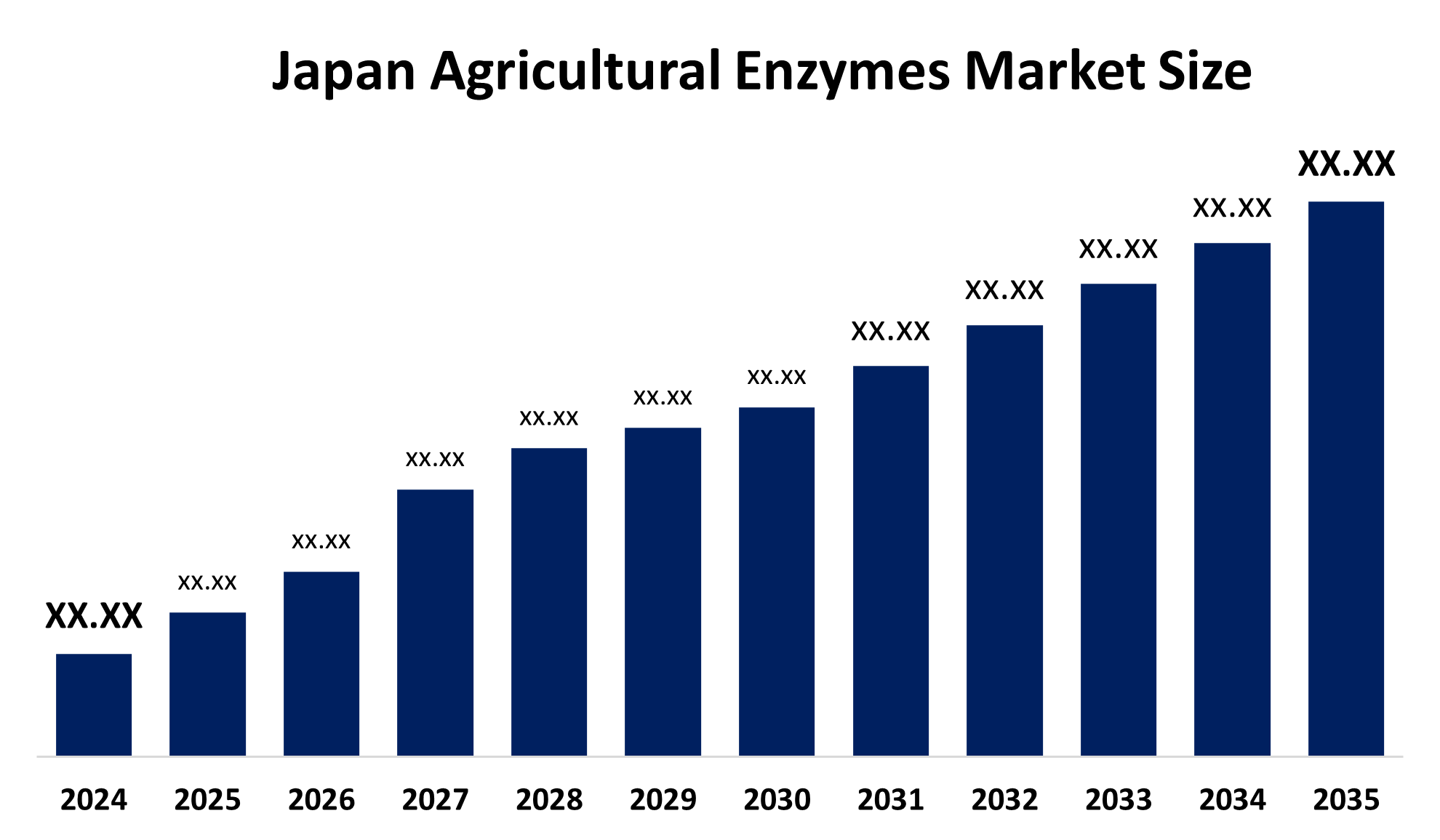
Get more details on this report -
Japan Agricultural Enzymes Market refers to the biological catalysts produced by microbes or naturally existing biochemical sources used for the improvement of soil, nutrients, and agriculture productivity in the present-day agricultural scenario. These catalysts facilitate the efficient decomposition of organic matter in the soil with the help of microbes, thereby increasing productivity in the cultivation of crops like cereals & grains, fruits & vegetables, oil seeds & pulses, and specialty crop cultivation with the help of soil treatment, seed dressings, or foliage application in greenhouse farming, open-field farming, precision farming, etc. The increasing attention towards the present-day scenario of sustainable agriculture as well as soil fertility is acting as a key growth driver for the market.
Advancements in the technology of enzyme engineering, microbial fermentation, and formulations offer greater product stability, efficiency, and effectiveness of the product on crops. The integration of innovative product technology, along with technological platforms of digital agriculture, precision nutrients, etc., would further provide optimized use of the product, thus offering greater yields. New opportunities can be captured through advancements in the use of regenerative agriculture, the demand for green products, and the adoption of precision farming technologies in support of high-value, sustainable agriculture in Japan.
Market Dynamics of the Japan Agricultural Enzymes Market:
The Japan Agricultural Enzymes Market is influenced by increasing demand for sustainable soil management, improved nutrient cycling rates, and higher crop productivity with reduced dependence on chemicals. The growth rate of organic farming and precision agriculture, along with increasing focus on improved soil health conditions, influences the demand and usage rates of agricultural enzymes in major crops.
The Japan Agricultural Enzymes Market is restrained due to high formulation costs, stringent biological input regulations, limited awareness among farmers, product variability under different climatic conditions, storage stability challenges, and product pricing, as it is higher compared to conventional fertilizer products.
The future opportunities would depend upon the developments in biotechnology, innovations in enzyme engineering, and the integration of digital agriculture technology. Scope exists in the expansion of greenhouse farming, CEA, and increasing consumer demand for residues-free products. The formulation of climate-resilient enzyme solutions along with combinations of microbes and enzymes will help in increasing the use of the product in Japan.
Japan Agricultural Enzymes Market Report Coverage
| Report Coverage | Details |
|---|---|
| Base Year: | 2024 |
| Forecast Period: | 2025-2035 |
| Forecast Period CAGR 2025-2035 : | 9.57% |
| Historical Data for: | 2020-2023 |
| No. of Pages: | 198 |
| Tables, Charts & Figures: | 102 |
| Segments covered: | By Product Type, By Crop Type |
| Companies covered:: | Amano Enzyme Inc., Nagase & Co., Ltd., Novozymes A/S, BASF SE, Kyowa Hakko Bio Co., Ltd., DSM-Firmenich, Chr. Hansen Holding A/S, and Other Key Players |
| Pitfalls & Challenges: | and COVID-19 Impact Analysis |
Get more details on this report -
Market Segmentation
The Japan agricultural enzymes market share is classified into product type, crop type, functionality, and application method.
By Product Type:
The Japan Agricultural Enzymes Market is divided by product type into phosphatases, dehydrogenases, ureases, proteases, cellulases, oxidoreductases, and others. Among these, the phosphatases segment dominated the share in 2024 and is anticipated to grow at a remarkable CAGR during the forecast period. Phosphatases are driving growth due to the rise of phosphorus-deficient soil regions in Japan, the growing trend of precision management of nutrients, high demand for its application in the solubilization of phosphate nutrients for intensification of cereal production systems, and the regulatory push to optimize the consumption of fertilizers in regions of intensive agricultural production.
By Crop Type:
The Japan Agricultural Enzymes Market is divided by crop type into cereals & grains, oilseeds & pulses, fruits & vegetables, turf & ornamentals, and others. Among these, the cereals & grains segment dominated the share in 2024 and is anticipated to grow at a remarkable CAGR during the forecast period. Cereals and grains dominate because Japan focuses on rice and wheat yields, necessitating enzyme-based soil enrichment to boost nutrient assimilation for the continuation of cultivation cycles while maintaining soil fertility with limited arable land availability.
By Functionality:
The Japan Agricultural Enzymes Market is divided by functionality into nutrient cycling enzymes, soil health improvement enzymes, growth stimulation enzymes, stress tolerance enzymes, and others. Among these, the nutrient cycling enzymes segment dominated the share in 2024 and is anticipated to grow at a remarkable CAGR during the forecast period. Nutrient cycling enzymes are dominant due to the concentration of Japanese farmers on improving nutrient availability via biological processes, reducing chemical fertilizer concentration, promoting microbial soil activity, maintaining soil productivity over long periods, and promoting sustainable agriculture according to environmental goals.
By Application Method:
The Japan Agricultural Enzymes Market is divided by application method into soil treatment, seed treatment, foliar spray, and others. Among these, the soil treatment segment dominated the share in 2024 and is anticipated to grow at a remarkable CAGR during the forecast period. This is due mainly to the emphasis placed on soil treatment in Japanese agriculture as the practice allows for balanced soil conditioning, the development of ecosystems in the soil, improvement of nutrient mineralization, as well as an enhancement of the work of roots in the soil to ensure crop productivity over the years, thereby addressing the issue of soil degradation in areas of limited cultivation.
Competitive Analysis:
The report offers the appropriate analysis of the key organisations/companies involved within the Japan Agricultural Enzymes Market, along with a comparative evaluation primarily based on their product offering, business overviews, geographic presence, enterprise strategies, segment market share, and SWOT analysis. The report also provides an elaborative analysis focusing on the current news and developments of the companies, which includes product development, innovations, joint ventures, partnerships, mergers & acquisitions, strategic alliances, and others. This allows for the evaluation of the overall competition within the market.
Top Key Companies in Japan Agricultural Enzymes Market:
- Amano Enzyme Inc.
- Nagase & Co., Ltd.
- Novozymes A/S
- BASF SE
- Kyowa Hakko Bio Co., Ltd.
- DSM-Firmenich
- Chr. Hansen Holding A/S
- Others
Key Target Audience
- Market Players
- Investors
- End-users
- Government Authorities
- Consulting and Research Firm
- Venture capitalists
- Value-Added Resellers (VARs)
Market Segment
This study forecasts revenue at the Japan, regional, and country levels from 2020 to 2035. Spherical Insights has segmented the Japan Agricultural Enzymes Market based on the below-mentioned segments:
Japan Agricultural Enzymes Market, By Product Type
- Phosphatases
- Dehydrogenases
- Ureases
- Proteases
- Cellulases
- Oxidoreductases
- Others
Japan Agricultural Enzymes Market, By Crop Type
- Cereals & Grains
- Oilseeds & Pulses
- Fruits & Vegetables
- Turf & Ornamentals
- Others
Japan Agricultural Enzymes Market, By Functionality
- Nutrient Cycling Enzymes
- Soil Health Improvement Enzymes
- Growth Stimulation Enzymes
- Stress Tolerance Enzymes
- Others
Japan Agricultural Enzymes Market, By Application Method
- Soil Treatment
- Seed Treatment
- Foliar Spray
- Others
Frequently Asked Questions (FAQ)
-
Q: What is the Japan agricultural enzymes market growth outlook?A: Japan Agricultural Enzymes Market is expected to grow at a CAGR of 9.57% during the forecast period 2025-2035.
-
Q: What are the key growth drivers of the market?A: Market growth is driven by increasing focus on sustainable agriculture, rising demand for improved soil health and nutrient efficiency, expansion of precision farming, growth of organic cultivation, and adoption of biological solutions that reduce dependence on chemical fertilizers.
-
Q: What factors restrain the Japan agricultural enzymes market?A: Constraints include high formulation and product costs, strict biological input regulations, limited farmer awareness, performance variability across climatic conditions, storage stability challenges, and relatively higher pricing compared to conventional agrochemical inputs.
-
Q: Who are the key players in the Japan agricultural enzymes market?A: Key companies include Amano Enzyme Inc., Nagase & Co., Ltd., Novozymes A/S, BASF SE, Kyowa Hakko Bio Co., Ltd., DSM-Firmenich, Chr. Hansen Holding A/S, and Others.
-
Q: Who are the target audiences for this market report?A: The report targets market players, investors, end-users, government authorities, consulting and research firms, venture capitalists, and value-added resellers (VARs).
Need help to buy this report?