Italy Luxury Goods Market Size, Share, and COVID-19 Impact Analysis, By Product Type (Clothing & Apparel, Footwear, Eyewear, Leather Goods, Jewelry, Watches, Beauty & Personal Care), By End User (Men, Women, & Unisex), By Distribution Channel (Single-Brand Stores, Multi-Brand Stores, & Online Stores), and Italy Luxury Goods Market Insights, Industry Trend, Forecasts to 2035
Industry: Consumer Goods
Italy Luxury Goods Market Insights Forecasts to 2035
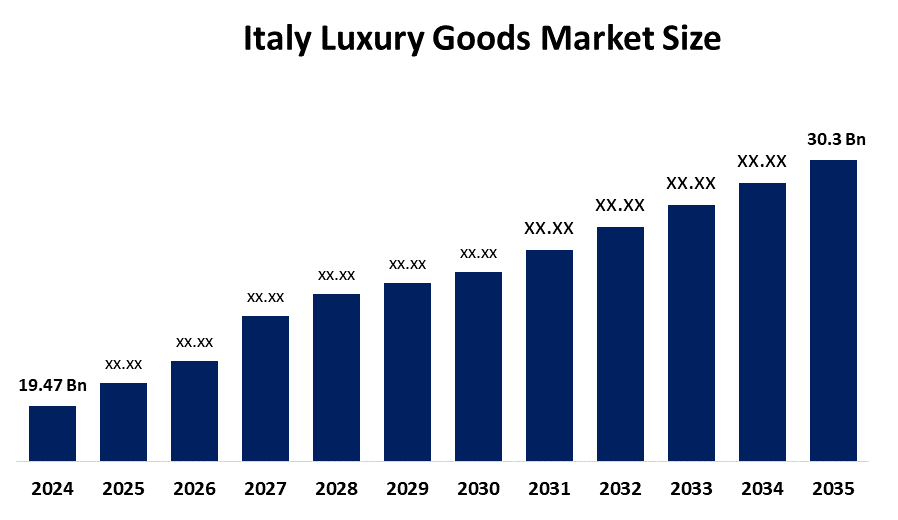
- The Italy Luxury Goods Market Size Was Estimated at USD 19.47 Billion in 2024
- The Market Size is Expected to Grow at a CAGR of Around 4.1% from 2025 to 2035
- The Italy Luxury Goods Market Size is Expected to Reach USD 30.3 Billion by 2035
Get more details on this report -
According to a research report published by Spherical Insights & Consulting, The Italy Luxury Goods Market Size is anticipated to reach USD 30.3 Billion by 2035, Growing at a CAGR of 4.1% from 2025 to 2035. The Italy luxury goods market is driven by rising disposable income, increasing tourism, strong demand for premium fashion, jewelry, and accessories, digitalization of retail, growing brand consciousness, and a preference for high-quality, exclusive products among affluent consumers.
Market Overview
The Italy luxury goods market encompasses high-end products, including fashion, leather goods, jewelry, watches, cosmetics, and accessories, characterized by premium pricing, superior quality, craftsmanship, and brand prestige. It caters to affluent consumers seeking exclusivity, status, and personalized experiences, driven by heritage brands, global recognition, and increasing demand from both domestic buyers and international tourists. Furthermore, the growth of Italy’s luxury goods market is driven by rising disposable incomes, increasing international tourism, strong demand for premium fashion and accessories, digital retail expansion, brand loyalty, and a growing preference for exclusive, high-quality, and personalized luxury products.
In Italy, the government's policies in the luxury goods sector aim to enhance Italy's image as the center of top, quality luxury products. The measures are centered on the preservation of traditional skills and heritage, fighting counterfeit goods, and providing transparency and fair competition among brands. Besides that, the government is also encouraging sustainable practices and ethical sourcing, thus keeping in line with the global trend of corporate social responsibility. These policy frameworks facilitate the innovation, heritage duet and based on a trio of quality, authenticity, and ethical standards, Italy continues to be a dominant player in the global luxury goods market.
A significant trend in the Italian luxury goods market is the increased focus on sustainability and ethical production as customers are progressively showing their preference for environmentally friendly and responsibly sourced products. Another layer of transformation is through digitalization, as brands utilize online stores and social media to sell and market their products. Furthermore, personalization and customization are becoming more central by the day; hence more and more bespoke products/services and unique experiences are being offered. Collaborating with influencers makes it easier to reach the younger demographic. Innovation in luxury experiences, on the other hand, allows brands to offer more than just products. To sum up, these trends are the drivers of growth and the alignment of Italian luxury with the global consumer taste evolution, at the same time.
Report Coverage
This research report categorizes the market for the Italy luxury goods market based on various segments and regions, and forecasts revenue growth and analyses trends in each submarket. The report analyses the key growth drivers, opportunities, and challenges influencing the Italy luxury goods market. Recent market developments and competitive strategies, such as expansion, product launch, development, partnership, merger, and acquisition have been included to draw the competitive landscape in the market. The report strategically identifies and profiles the key market players and analyses their core competencies in each sub-segment of the Italy luxury goods market.
Italy Luxury Goods Market Report Coverage
| Report Coverage | Details |
|---|---|
| Base Year: | 2024 |
| Market Size in 2024: | USD 19.47 Billion |
| Forecast Period: | 2025-2035 |
| Forecast Period CAGR 2025-2035 : | CAGR of 4.1% |
| 2035 Value Projection: | USD 30.3 Billion |
| Historical Data for: | 2020-2023 |
| No. of Pages: | 210 |
| Tables, Charts & Figures: | 95 |
| Segments covered: | By Product Type, By End User |
| Companies covered:: | Giorgio Armani, Moncler, Dolce & Gabbana, Valentino, Versace, Fendi, Salvatore Ferragamo, Ermenegildo Zegna, Loro Piana, Others, and Key Players |
| Pitfalls & Challenges: | COVID-19 Empact, Challenge, Future, Growth, & Analysis |
Get more details on this report -
Driving Factors
The Italy luxury goods market is driven by several key factors. Rising disposable incomes and increasing affluent consumer populations boost demand for high-end products. Strong brand reputation and the heritage of Italian craftsmanship attract both domestic and international buyers. Tourism, especially from luxury-seeking travelers, contributes significantly to sales. The market also benefits from digitalization, with e-commerce and social media enhancing brand reach and engagement. Additionally, growing consumer preference for exclusive, high-quality, and personalized products fuels market expansion, while innovation in design and sustainable practices further strengthens Italy’s position in the global luxury sector.
Restraining Factors
The Italy luxury goods market faces restraining factors such as economic uncertainties, which can reduce consumer spending on high-end products. High product prices limit accessibility for a broader audience. Additionally, intense competition among luxury brands, counterfeiting issues, and changing consumer preferences pose challenges. Regulatory compliance and the need for continuous innovation also add pressure, potentially slowing market growth.
Market Segmentation
The Italy luxury goods market share is classified into product type, end user, and distribution channel.
- The clothing & apparel segment accounted for the largest revenue market share in 2024 and is expected to grow at a significant CAGR during the forecast period.
The Italy luxury goods market is segmented by product type into clothing & apparel, footwear, eyewear, leather goods, jewelry, watches, beauty & personal care. Among these, the clothing & apparel segment accounted for the largest revenue market share in 2024 and is expected to grow at a significant CAGR during the forecast period. Clothing and apparel dominate the market due to the country’s long-standing reputation as a global fashion leader. Renowned Italian fashion houses, such as Gucci, Prada, and Armani, drive strong demand domestically and internationally. Continuous innovation, seasonal collections, and high-quality craftsmanship enhance brand prestige. Additionally, clothing and apparel appeal to a broad luxury consumer base seeking status, style, and exclusivity. The combination of heritage, global recognition, and consistent consumer preference makes this segment the largest contributor to Italy’s luxury market revenue.
- The women segment accounted for the largest revenue share in 2024 and is expected to grow at a significant CAGR during the forecast period.
The Italy luxury goods market is segmented by end user into men, women, & unisex. Among these, the women segment accounted for the largest revenue share in 2024 and is expected to grow at a significant CAGR during the forecast period. The women’s segment dominates the market due to higher spending on fashion, accessories, jewelry, and beauty products compared to other consumer groups. Italian luxury brands design extensive collections specifically for women, emphasizing style, elegance, and exclusivity. Strong brand loyalty, frequent product launches, and the appeal of Italian craftsmanship attract both domestic and international female consumers. Additionally, tourism-driven demand further boosts sales in this segment, making women the primary contributors to revenue and growth in Italy’s luxury goods market.
- The single-brand stores segment accounted for the largest revenue share in 2024 and is expected to grow at a significant CAGR during the forecast period.
The Italy luxury goods market is segmented by distribution channel into single-brand stores, multi-brand stores, & online stores. Among these, the single-brand stores segment accounted for the largest revenue share in 2024 and is expected to grow at a significant CAGR during the forecast period. Single-brand stores dominate the market because they offer a controlled, exclusive environment that reflects each brand’s prestige and identity. These stores provide personalized services, immersive shopping experiences, and full access to the brand’s product range, enhancing customer loyalty. Italy’s reputation as a fashion and luxury hub, coupled with high tourist traffic, further drives footfall to these boutiques. The combination of brand heritage, premium service, and the ability to showcase exclusivity makes single-brand stores the leading distribution channel in the market.
Competitive Analysis:
The report offers the appropriate analysis of the key organizations/companies involved within the Italy luxury goods market, along with a comparative evaluation primarily based on their product offering, business overviews, geographic presence, enterprise strategies, segment market share, and SWOT analysis. The report also provides an elaborate analysis focusing on the current news and developments of the companies, which includes product development, innovations, joint ventures, partnerships, mergers & acquisitions, strategic alliances, and others. This allows for the evaluation of the overall competition within the market.
List of Key Companies
- Giorgio Armani
- Moncler
- Dolce & Gabbana
- Valentino
- Versace
- Fendi
- Salvatore Ferragamo
- Ermenegildo Zegna
- Loro Piana
- Others
Key Target Audience
- Market Players
- Investors
- End-users
- Government Authorities
- Consulting and Research Firm
- Venture capitalists
- Value-Added Resellers (VARs)
Recent Developments:
In September 2023, Richemont SA launched Laboratoire de Haute Parfumerie et Beauté, a brand-new beauty division.
In September 2023, Ralph Lauren launched its first upscale physical location and a specialized e-commerce site in Canada to increase its brand awareness.
Market Segment
This study forecasts revenue at the Italy, regional, and country levels from 2020 to 2035. Spherical Insights has segmented the Italy luxury goods market based on the below-mentioned segments:
Italy Luxury Goods Market, By Product Type
- Clothing & Apparel
- Footwear
- Eyewear
- Leather Goods
- Jewelry
- Watches
- Beauty & Personal Care
Italy Luxury Goods Market, By End User
- Men
- Women
- Unisex
Italy Luxury Goods Market, By Distribution Channel
- Single-Brand Stores
- Multi-Brand Stores
- Online Stores
Frequently Asked Questions (FAQ)
-
Q1:What is the Italy luxury goods market?The Italy luxury goods market includes high-end products such as clothing & apparel, footwear, eyewear, leather goods, jewelry, watches, and beauty & personal care, catering to affluent consumers seeking exclusivity and premium quality.
-
Q2:What are the driving factors of the Italy luxury goods market?The market is driven by rising disposable incomes, strong brand reputation, tourism, digitalization, and growing demand for exclusive, high-quality, and personalized products.
-
Q3:What are the key trends in the Italy luxury goods market?Key trends include sustainability and ethical production, digitalization and e-commerce, personalization and customization, influencer engagement, and innovation in luxury experiences.
-
Q4:Which product segment dominates the Italy luxury goods market?Clothing & apparel is the dominant segment due to Italy’s fashion heritage, global brand recognition, and high consumer demand.
-
Q5:Which end-user segment is the largest in the Italy luxury goods market?The women’s segment dominates, with strong demand for fashion, accessories, jewelry, and beauty products.
-
Q6:Which distribution channel is most dominant in the Italy luxury goods market?Single-brand stores lead the market, providing exclusive, high-end shopping experiences and personalized services.
Need help to buy this report?