Italy Geospatial Analytics Market Size, Share, and COVID-19 Impact Analysis, By Type (Surface Analysis, Network Analysis, Geo Visualization), By End-user Vertical (Agriculture, Utility and Communication, Defense and Intelligence, Government, Mining and Natural Resources, Automotive and Transportation, Healthcare, Real Estate and Construction, Other), By Technology (GIS Software, Remote-Sensing and Earth Observation, Other), and Italy Geospatial Analytics Market Insights, Industry Trend, Forecasts to 2035
Industry: Information & Technology
Italy Geospatial Analytics Market Insights Forecasts To 2035
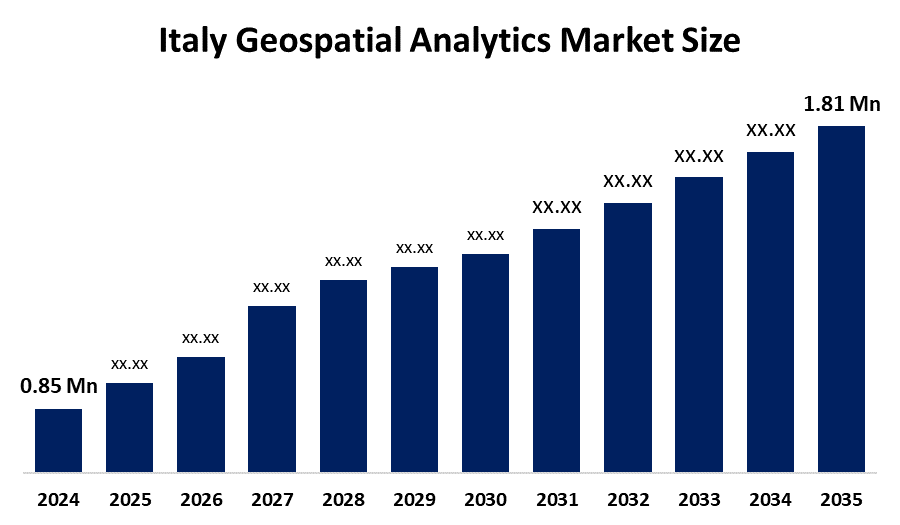
- The Italy Geospatial Analytics Market Size Was Estimated At USD 0.85 Billion In 2024
- The Market Size Is Expected To Grow At A CAGR Of Around 7.11% From 2025 To 2035
- The Italy Geospatial Analytics Market Size Is Expected To Reach USD 1.81 Billion By 2035
Get more details on this report -
According To A Research Report Published By Spherical Insights & Consulting, The Italy Geospatial Analytics Market Size Is Anticipated To Reach USD 1.81 Billion By 2035, Growing At A CAGR Of 7.11% From 2025 To 2035. Italy’s geospatial analytics market is driven by rising smart city initiatives, the increasing adoption of GIS in urban planning, strong demand from transportation and infrastructure projects, environmental monitoring needs, and the growing use of location-based intelligence by governments and enterprises.
Market Overview
Geospatial Analytics Is The Process Of Collecting, Processing, And Analyzing Location-Based Data To Identify Patterns, Relationships, And Trends. It combines geographic information systems (GIS), satellite imagery, GPS data, and spatial modeling to support informed decision-making across various industries, including urban planning, transportation, agriculture, defense, and environmental management. Furthermore, Key growth factors include increasing adoption of location-based services, expansion of smart city projects, advancements in satellite and drone technologies, rising use of big data and AI in spatial analysis, and growing demand for real-time geographic insights across industries.
Italy Is Leveraging Technologies Such As AI, Iot, And Home Automation, Supported By The Expanding 5G Mobile Data Network, To Develop Cities That Are Innovative, Sustainable, And Citizen-Focused. The objective is to utilize technology to improve citizens' quality of life and enhance service efficiency. According to GSMA, 5G connections in Italy are forecast to grow, potentially reaching 86% of total connections, which is expected to drive market growth significantly.
The Government And Private Firms Are Increasingly Turning To Surface Analysis Services For Infrastructure Projects, Assessing Water Flow, And Crafting Drainage Systems. Beyond these applications, the agriculture sector employs this geospatial analytics service to study topsoil erosion. Geographic Information System (GIS) technology is increasingly being deployed in smart city projects to support geospatial and spatiotemporal data analysis, spatial statistics, and surface evaluations. These applications enhance the bidirectional flow of information, equipping decision-makers with the tools needed to make well-informed decisions regarding specific urban development projects and initiatives.
Report Coverage
This Research Report Categorizes The Market Size For The Italy Geospatial Analytics Market Based On Various Segments And Regions, And Forecasts Revenue Growth And Analyses Trends In Each Submarket. The report analyses the key growth drivers, opportunities, and challenges influencing the Italy geospatial analytics market. Recent market developments and competitive strategies, such as expansion, product launch, development, partnership, merger, and acquisition have been included to draw the competitive landscape in the market. The report strategically identifies and profiles the key market players and analyses their core competencies in each sub-segment of the Italy geospatial analytics market.
Italy Geospatial Analytics Market Report Coverage
| Report Coverage | Details |
|---|---|
| Base Year: | 2024 |
| Market Size in 2024: | 0.85 Billion |
| Forecast Period: | 2020-2023 |
| Forecast Period CAGR 2020-2023 : | 7.11% |
| 2023 Value Projection: | 1.81 Billion |
| Historical Data for: | 2020-2023 |
| No. of Pages: | 180 |
| Tables, Charts & Figures: | 120 |
| Segments covered: | By Type By End-user |
| Companies covered:: | e-Geos S.p.A., Telespazio S.p.A., Planetek Italia S.r.l., ESRI Italia S.r.l., Hexagon AB, Flypix AI GmbH, Eoliann S.r.l., Trilogis S.r.l., IPTSAT S.r.l., and Others, Key Players |
| Pitfalls & Challenges: | COVID-19 Empact, Challenge, Future, Growth, & Analysis |
Get more details on this report -
Driving Factors
The Geospatial Analytics Market Size Is Driven By Rapid Urbanization And The Growing Need For Efficient City Planning And Infrastructure Management. Increased Adoption Of Smart City Initiatives, Rising Use Of Location-Based Services, And Demand For Real-Time Spatial Intelligence Support Market Growth. Advancements in satellite imaging, drones, AI, and big data analytics enhance data accuracy and usability. Additionally, government investments, environmental monitoring requirements, and the need for better disaster management and resource optimization further accelerate adoption across multiple sectors.
Restraining Factors
The Geospatial Analytics Market Size Faces Restraints Such As High Implementation And Maintenance Costs, Complexity Of Integrating Geospatial Data With Existing It Systems, And A Shortage Of Skilled Professionals. Data privacy concerns, regulatory restrictions, and limited awareness among small and medium enterprises also hinder widespread adoption.
Market Segmentation
The Italy geospatial analytics market share is classified into type, end-user vertical, and technology.
- The geo visualization segment accounted for the largest revenue market share in 2024 and is expected to grow at a significant CAGR during the forecast period.
The Italy Geospatial Analytics Market Size Is Segmented By Type Into Surface Analysis, Network Analysis, And Geo-Visualization. Among these, the geo visualization segment accounted for the largest revenue market share in 2024 and is expected to grow at a significant CAGR during the forecast period. Geo visualization dominates because it enables clear and intuitive representation of complex spatial data through maps, dashboards, and 3D models. It is widely adopted in smart city projects, urban planning, transportation optimization, and environmental monitoring. Government agencies and enterprises prefer geo-visualisation tools as they support faster decision-making, improved data interpretation, real-time monitoring, and effective communication of insights to stakeholders.
- The government segment accounted for the largest revenue share in 2024 and is expected to grow at a significant CAGR during the forecast period.
The Italy Geospatial Analytics Market Size Is Segmented By End User Vertical Into Agriculture, Utility And Communication, Defense And Intelligence, Government, Mining And Natural Resources, Automotive And Transportation, Healthcare, Real Estate And Construction, And Other. Among these, the government segment accounted for the largest revenue share in 2024 and is expected to grow at a significant CAGR during the forecast period. The government segment dominates due to strong adoption across urban planning, smart city development, land administration, and infrastructure management. Italian public authorities extensively use geospatial analytics for environmental monitoring, disaster management, transportation planning, and public safety. Continuous government investment in digital transformation, open geospatial data initiatives, and national mapping programs increases demand. Additionally, regulatory requirements and the need for accurate spatial data to support policy decisions further strengthen government sector dominance.
- The GIS software segment accounted for the largest revenue share in 2024 and is expected to grow at a significant CAGR during the forecast period.
The Italy Geospatial Analytics Market Size Is Segmented By Technology Into GIS Software, Remote-Sensing And Earth Observation, And Other. Among These, The GIS Software Segment Accounted For The Largest Revenue Share In 2024 And Is Expected To Grow At A Significant CAGR During The Forecast Period. GIS software dominates because it serves as the core platform for collecting, integrating, analyzing, and visualizing spatial data. Italian government agencies, utilities, and urban planners rely heavily on GIS for infrastructure planning, land management, and smart city initiatives. Its compatibility with multiple data sources, ease of use, and growing integration with AI and cloud technologies further strengthen adoption compared to other technologies.
Competitive Analysis:
The Report Offers The Appropriate Analysis Of The Key Organizations/Companies Involved Within The Italy Geospatial Analytics Market Size, along with a comparative evaluation primarily based on their product offering, business overviews, geographic presence, enterprise strategies, segment market share, and SWOT analysis. The report also provides an elaborate analysis focusing on the current news and developments of the companies, which includes product development, innovations, joint ventures, partnerships, mergers & acquisitions, strategic alliances, and others. This allows for the evaluation of the overall competition within the market.
List of Key Companies
- e-Geos S.p.A.
- Telespazio S.p.A.
- Planetek Italia S.r.l.
- ESRI Italia S.r.l.
- Hexagon AB
- Flypix AI GmbH
- Eoliann S.r.l.
- Trilogis S.r.l.
- IPTSAT S.r.l.
- Others
Key Target Audience
- Market Players
- Investors
- End-users
- Government Authorities
- Consulting and Research Firm
- Venture capitalists
- Value-Added Resellers (VARs)
Recent Developments:
In March 2023, the Italian space agency and NASA collaborated to build and launch the Multi-Angle Imager for Aerosols mission, an effort to investigate the health impacts of tiny airborne particles polluting cities through analyzing data collected from satellite-based observatories, which would fuel the demand for the geospatial analytics market in the country.
Market Segment
This study forecasts revenue at the Italy, regional, and country levels from 2020 to 2035. Spherical Insights has segmented the Italy geospatial analytics market based on the below-mentioned segments:
Italy Geospatial Analytics Market, By Type
- Surface Analysis
- Network Analysis
- Geo Visualization
Italy Geospatial Analytics Market, By End-user Vertical
- Agriculture
- Utility and Communication
- Defense and Intelligence
- Government
- Mining and Natural Resources
- Automotive and Transportation
- Healthcare
- Real Estate and Construction
- Other
Italy Geospatial Analytics Market, By Technology
- GIS Software
- Remote-Sensing and Earth Observation
- Other
Frequently Asked Questions (FAQ)
-
What is geospatial analytics used for in Italy?It is used for urban planning, smart cities, transportation management, environmental monitoring, disaster management, and infrastructure development across public and private sectors.
-
Which sector drives demand in Italy?Government agencies are the primary drivers due to heavy use in land management, public infrastructure planning, environmental protection, and national digital transformation initiatives
-
Which technology is most widely adopted?GIS software is most widely adopted because it supports spatial analysis, data integration, visualization, and decision-making across multiple applications.
-
What are the key growth drivers in Italy?Smart city projects, infrastructure modernization, increasing use of satellite data, and rising demand for location-based intelligence drive market growth.
-
What challenges does the market face?High implementation costs, data privacy concerns, system integration complexity, and a limited skilled workforce restrain wider adoption.
Need help to buy this report?