Italy E-Commerce Market Size, Share, and COVID-19 Impact Analysis, By Device Type (Smartphone / Mobile, Desktop & Laptop, Other), By Payment Method (Credit / Debit Cards, Digital Wallets, BNPL, Other), By B2C Product Category (Beauty & Personal Care, Consumer Electronics, Fashion & Apparel, Food & Beverages), and Italy E-Commerce Market Insights, Industry Trend, Forecasts to 2035
Industry: Information & Technology
Italy E-Commerce Market Insights Forecasts to 2035
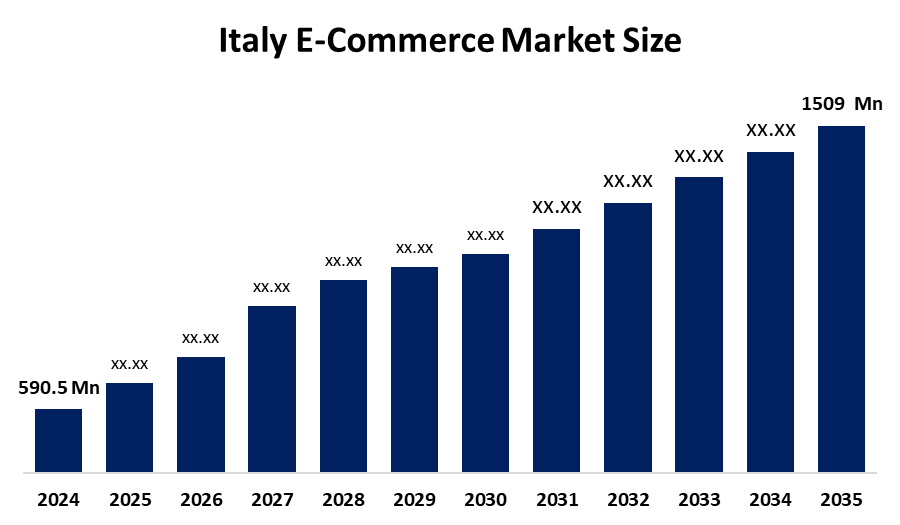
- The Italy E-Commerce Market Size Was Estimated at USD 590.5 Million in 2024
- The Market Size is Expected to Grow at a CAGR of Around 8.9% from 2025 to 2035
- The Italy E-Commerce Market Size is Expected to Reach USD 1509 Million by 2035
Get more details on this report -
According to a research report published by Spherical Insights & Consulting, The Italy E-commerce Market Size is Anticipated to reach USD 1509 Million by 2035, Growing at a CAGR of 8.9% from 2025 to 2035. Italy’s E-commerce market is driven by rising internet and smartphone penetration, growing consumer preference for convenience, expanding digital payment adoption, improved logistics networks, and strong demand for fashion, electronics, and grocery online shopping, supported by post-pandemic digital buying habits.
Market Overview
Italy’s E-commerce market refers to the buying and selling of goods and services through online platforms and digital channels within the country. It includes business-to-consumer and business-to-business transactions across sectors such as retail, fashion, electronics, travel, and groceries, supported by digital payments, logistics, and internet infrastructure. Furthermore, Italy’s E-commerce market growth is driven by rising internet and smartphone usage, increasing digital payment adoption, improved logistics and last-mile delivery, growing preference for convenient shopping, expanding online grocery and fashion demand, and the strong influence of mobile commerce and marketplaces.
According to Italy’s government data, numerous initiatives to support the growth of the E-commerce Market has been including funding programs for digital startups and tax incentives for businesses investing in E-commerce and technology. The implementation of the Digital Strategy for Italy 2025 focuses on increasing digital infrastructure and fostering digital skills across the country. Additionally, Italy’s compliance with the EU's General Data Protection Regulation (GDPR) ensures better data privacy and security practices for businesses and consumers alike.
Italy’s E-commerce market is evolving rapidly due to several key trends shaping consumer behavior and retail strategies. Mobile commerce growth is accelerating as smartphone penetration increases, allowing consumers to shop anytime and anywhere with greater convenience and accessibility. Omnichannel retailing is gaining strong momentum, with retailers integrating physical stores and digital platforms to deliver seamless, consistent shopping experiences across all touchpoints. AI integration in E-commerce is transforming the customer journey through personalized product recommendations, AI-powered chatbots, and predictive analytics, which enhance engagement, improve decision-making, and boost sales performance. Additionally, subscription-based business models are expanding, especially in beauty and personal care, food and beverage, and lifestyle products. These models offer recurring value, cost savings, and convenience, encouraging long-term customer loyalty and stable revenue growth for E-commerce companies.
Report Coverage
This research report categorizes the market for the Italy E-commerce market based on various segments and regions, and forecasts revenue growth and analyses trends in each submarket. The report analyses the key growth drivers, opportunities, and challenges influencing the Italy E-commerce market. Recent market developments and competitive strategies, such as expansion, product launch, development, partnership, merger, and acquisition have been included to draw the competitive landscape in the market. The report strategically identifies and profiles the key market players and analyses their core competencies in each sub-segment of the Italy E-commerce market.
Italy E-Commerce Market Report Coverage
| Report Coverage | Details |
|---|---|
| Base Year: | 2024 |
| Market Size in 2024: | USD 590.5 Million |
| Forecast Period: | 2024-2035 |
| Forecast Period CAGR 2024-2035 : | CAGR of 8.9% |
| 2035 Value Projection: | USD 1509 Million |
| Historical Data for: | 2020-2023 |
| No. of Pages: | 210 |
| Tables, Charts & Figures: | 90 |
| Segments covered: | By Device |
| Companies covered:: | Amazon Italy, eBay Italy, Zalando, Yoox Net-a-Porter, Esselunga, Unieuro, MediaWorld, IBS.it, Eprice, and Other key players |
| Pitfalls & Challenges: | COVID-19 Empact, Challenge, Future, Growth, & Analysis |
Get more details on this report -
Driving Factors
Italy’s E-commerce market is driven by rising internet and smartphone penetration, increasing consumer preference for convenient and time-saving shopping options, and rapid adoption of digital payment solutions. Improvements in logistics, warehousing, and last-mile delivery have enhanced service reliability and speed. Strong demand for online fashion, electronics, groceries, and beauty products further supports growth. Additionally, omnichannel retail strategies, growing trust in online platforms, competitive pricing, promotional offers, and the influence of social media and mobile commerce are accelerating online purchasing behavior across Italy.
Restraining Factors
Italy’s E-commerce market faces restraints such as logistics challenges in remote areas, high delivery and return costs, and concerns over data privacy and cybersecurity. Limited digital skills among small retailers, strong competition from traditional stores, complex regulations, and lower trust among older consumers also slow overall market growth.
Market Segmentation
The Italy E-commerce market share is classified into device type, payment method, and B2C product category.
- The smartphone/mobile segment accounted for the largest revenue market share in 2024 and is expected to grow at a significant CAGR during the forecast period.
The Italy E-commerce market is segmented by device type into smartphone/mobile, desktop & laptop, and other. Among these, the smartphone/mobile segment accounted for the largest revenue market share in 2024 and is expected to grow at a significant CAGR during the forecast period. The smartphone/mobile segment dominates the market because of high smartphone penetration and widespread use of mobile internet. Consumers prefer shopping through mobile apps due to convenience, speed, and easy price comparison. Secure mobile payment options, digital wallets, and app-exclusive discounts encourage mobile purchases. Additionally, social media integration, push notifications, and personalized offers make mobile shopping more engaging, driving higher transaction volumes compared to desktop and laptop usage.
- The credit/debit cards segment accounted for the largest revenue share in 2024 and is expected to grow at a significant CAGR during the forecast period.
The Italy E-commerce market is segmented by payment method into credit/debit cards, digital wallets, BNPL, and other. Among these, the credit/debit cards segment accounted for the largest revenue share in 2024 and is expected to grow at a significant CAGR during the forecast period. The dominance of credit and debit cards is driven by their widespread availability and strong consumer trust. Cards offer secure, fast, and convenient online transactions, accepted by almost all E-commerce platforms. Many consumers prefer cards for their ease of use, rewards programs, and buyer protection features. Additionally, banks and payment processors provide robust fraud prevention measures, further boosting confidence. This makes credit and debit cards the most popular and reliable payment methods for online shopping in Italy.
- The fashion & apparel segment accounted for the largest revenue share in 2024 and is expected to grow at a significant CAGR during the forecast period.
The Italy E-commerce market is segmented by B2C product category into beauty & personal care, consumer electronics, fashion & apparel, and food & beverages. Among these, the fashion & apparel segment accounted for the largest revenue share in 2024 and is expected to grow at a significant CAGR during the forecast period. The dominance of the fashion & apparel segment is due to strong consumer demand for clothing, footwear, and accessories. Online platforms offer convenience, a wide product variety, easy price comparisons, and frequent promotions, attracting shoppers. Influencer marketing, social media engagement, and seasonal trends further boost online purchases. Additionally, Italian consumers increasingly prefer home delivery and hassle-free returns, making fashion & apparel the most popular category for B2C E-commerce transactions in Italy.
Competitive Analysis:
The report offers the appropriate analysis of the key organizations/companies involved within the Italy E-commerce market, along with a comparative evaluation primarily based on their product offering, business overviews, geographic presence, enterprise strategies, segment market share, and SWOT analysis. The report also provides an elaborate analysis focusing on the current news and developments of the companies, which includes product development, innovations, joint ventures, partnerships, mergers & acquisitions, strategic alliances, and others. This allows for the evaluation of the overall competition within the market.
List of Key Companies
- Amazon Italy
- eBay Italy
- Zalando
- Yoox Net-a-Porter
- Esselunga
- Unieuro
- MediaWorld
- IBS.it
- Eprice
- Others
Key Target Audience
- Market Players
- Investors
- End-users
- Government Authorities
- Consulting and Research Firm
- Venture capitalists
- Value-Added Resellers (VARs)
Recent Developments:
In June 2024, Coop Alleanza unveiled a new and advanced E-commerce solution to improve the online buyer experience.
In April 2025, Esselunga a Casa has strengthened its position in Italy's competitive E-commerce grocery market by launching an updated mobile app with AI-powered personalized shopping recommendations and expanded same-day delivery options in northern Italian cities.
Market Segment
This study forecasts revenue at the Italy, regional, and country levels from 2020 to 2035. Spherical Insights has segmented the Italy E-commerce market based on the below-mentioned segments:
Italy E-Commerce Market, By Device Type
- Smartphone / Mobile
- Desktop & Laptop
- Other
Italy E-Commerce Market, By Payment Method
- Credit / Debit Cards
- Digital Wallets
- BNPL
- Other
Italy E-Commerce Market, By B2C Product Category
- Beauty & Personal Care
- Consumer Electronics
- Fashion & Apparel
- Food & Beverages
Frequently Asked Questions (FAQ)
-
What is the Italy E-commerce market?It refers to the buying and selling of goods and services online in Italy, including B2C and B2B transactions across various product categories.
-
What drives the growth of Italy’s E-commerce market?Growth is driven by rising internet and smartphone usage, digital payment adoption, improved logistics, mobile commerce, and demand for convenience.
-
Which device is most used for online shopping in Italy?Smartphones and mobile devices are the most dominant for E-commerce transactions
-
Which payment method is most popular in Italy’s E-commerce?Credit and debit cards are the most widely used payment methods
-
Which product category dominates Italy’s B2C E-commerce market?Fashion & apparel is the leading category in Italy’s online retail space.
Need help to buy this report?