Global Intelligence Surveillance Reconnaissance Market Size, Share, and COVID-19 Impact Analysis, By Component (Hardware, Software, and Services), By Platform (Land, Naval, Airborne, and Space), By End Use (Defense & Military, Government, and Commercial), and By Region (North America, Europe, Asia-Pacific, Latin America, Middle East, and Africa), Analysis and Forecast 2025 - 2035
Industry: Aerospace & Defense
Global Intelligence Surveillance Reconnaissance Market Insights Forecasts to 2035
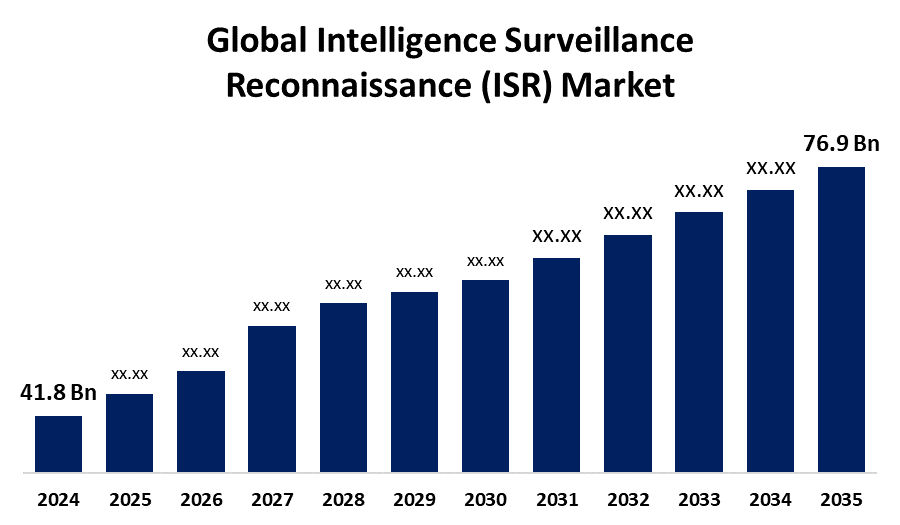
- The Global Intelligence Surveillance Reconnaissance Market Size Was Estimated at USD 41.8 Billion in 2024
- The Market Size is Expected to Grow at a CAGR of around 5.7% from 2025 to 2035
- The Worldwide Intelligence Surveillance Reconnaissance Market Size is Expected to Reach USD 76.9 Billion by 2035
- Asia Pacific is expected to grow the fastest during the forecast period.
Get more details on this report -
According to a research report published by Spherical Insights and Consulting, The Global Intelligence Surveillance Reconnaissance Market Size Was Worth Around USD 41.8 Billion In 2024 And Is Predicted To Grow To Around USD 76.9 Billion By 2035 With A Compound Annual Growth Rate (CAGR) Of 5.7% From 2025 To 2035. Global adoption of unmanned aerial vehicles, advancements in AI/ML for data analytics, integrating space-based surveillance, and adopting network-centric warfare capabilities are all driving opportunities in the intelligence surveillance reconnaissance market.
Market Overview
The global industry segment focused on technologies, platforms, and services used to collect, analyze, and deliver critical information about activities, threats, environments, and targets for defense, security, and strategic decision-making is known as the intelligence surveillance reconnaissance market. These include a wide range of platforms, equipment, software, and support services, such as manned and unmanned aerial ISR platforms, space-based satellites, ground surveillance systems, maritime monitoring systems, electro-optical and infrared sensors, radar and signals intelligence technologies, data processing and analytics software, and command-and-control systems.
In June 2025, the U.S. Department of Defense procurement budget, specific acquisition programs include purchases of ISR systems and related equipment under the Military Intelligence Program to support irregular warfare and intelligence operations. This demonstrates continued government investment in ISR technologies.
In December 2025, the Ministry of Defense (Japan) allocated about ¥282.2 billion (approximately USD 1.8 billion) for a five-year program to develop a new intelligence, surveillance, and reconnaissance satellite constellation to strengthen space-based monitoring and national security capabilities. The project focuses on collecting high-resolution imagery data for defense and maritime monitoring, which significantly increases demand for ISR technologies such as satellites, sensors, and analytics platforms.
Report Coverage
This research report categorizes the intelligence surveillance reconnaissance market based on various segments and regions, forecasts revenue growth, and analyzes trends in each submarket. The report analyses the key growth drivers, opportunities, and challenges influencing the intelligence surveillance reconnaissance market. Recent market developments and competitive strategies, such as expansion, product launch, development, partnership, merger, and acquisition, have been included to draw the competitive landscape in the market. The report strategically identifies and profiles the key market players and analyses their core competencies in each sub-segment of the intelligence surveillance reconnaissance market.
Global Intelligence Surveillance Reconnaissance Market Report Coverage
| Report Coverage | Details |
|---|---|
| Base Year: | 2024 |
| Market Size in 2024: | USD 41.8 Billion |
| Forecast Period: | 2025-2035 |
| Forecast Period CAGR 2025-2035 : | 5.7% |
| 2035 Value Projection: | USD 76.9 Billion |
| Historical Data for: | 2020-2023 |
| No. of Pages: | 250 |
| Tables, Charts & Figures: | 110 |
| Segments covered: | By Component, By Platform, By End Use |
| Companies covered:: | Lockheed Martin Corporation, Northrop Grumman Corporation, BAE Systems plc, The Boeing Company, RTX Corporation, L3Harris Technologies Inc., General Dynamics Corporation, Elbit Systems Ltd., Thales S.A., Leonardo S.p.A., General Atomics Aeronautical Systems, Inc., CACI International Inc., Rheinmetall AG, Israel Aerospace Industries, Kratos Defense & Security Solutions, Inc., Others |
| Pitfalls & Challenges: | COVID-19 Empact, Challenges, Future, Growth, & Analysis |
Get more details on this report -
Driving Factors
Rapid technological innovation is one of the main drivers of the intelligence surveillance reconnaissance market's growth. Increasing need for advanced situational awareness, national security, and real-time intelligence gathering across military and government agencies worldwide is the main factor driving the market for intelligence surveillance reconnaissance. In addition, rapid technological advancements in unmanned aerial vehicles (UAVs), artificial intelligence–based analytics, high-resolution sensors, radar systems, and satellite imaging are enhancing the efficiency and accuracy of surveillance operations, further accelerating market demand.
In April 2025, Lockheed Martin’s Skunk Works division collaborated with Arquimea to demonstrate AI-enabled anomaly detection capabilities for ISR platforms. The system uses electro-optical and infrared data combined with machine learning to detect unusual patterns and environmental changes during surveillance missions, improving detection and decision-making in ISR operations.
Restraining Factors
High development and deployment costs, strict government regulations and privacy concerns related to surveillance activities, technical complexity in processing large volumes of intelligence data, cybersecurity risks and vulnerabilities in ISR networks, and risk of operational disruption during system failures are the main factors restricting the intelligence surveillance reconnaissance.
Market Segmentation
The intelligence surveillance reconnaissance market share is classified into component, platform, and end use.
- The hardware segment dominated the market in 2024, approximately 57%, and is projected to grow at a substantial CAGR during the forecast period.
Based on the component, the intelligence surveillance reconnaissance market is divided into hardware, software, and services. Among these, the hardware segment dominated the market in 2024, approximately 57%, and is projected to grow at a substantial CAGR during the forecast period. High demand for advanced sensors, imaging systems, and platforms required for real-time data acquisition and transmission, fueled by defence modernization programs and reliable physical equipment, is driving the hardware industry.
- The airborne segment accounted for the largest share in 2024, approximately 38%, and is anticipated to grow at a significant CAGR during the forecast period.
Based on the platform, the intelligence surveillance reconnaissance market is divided into land, naval, airborne, and space. Among these, the airborne segment accounted for the largest share in 2024, approximately 38%, and is anticipated to grow at a significant CAGR during the forecast period. The need for rapid deployment, wide area coverage, rising adoption of high altitude and medium altitude drones, and integration of advanced sensors enhancing situational awareness is driving the airborne industry.
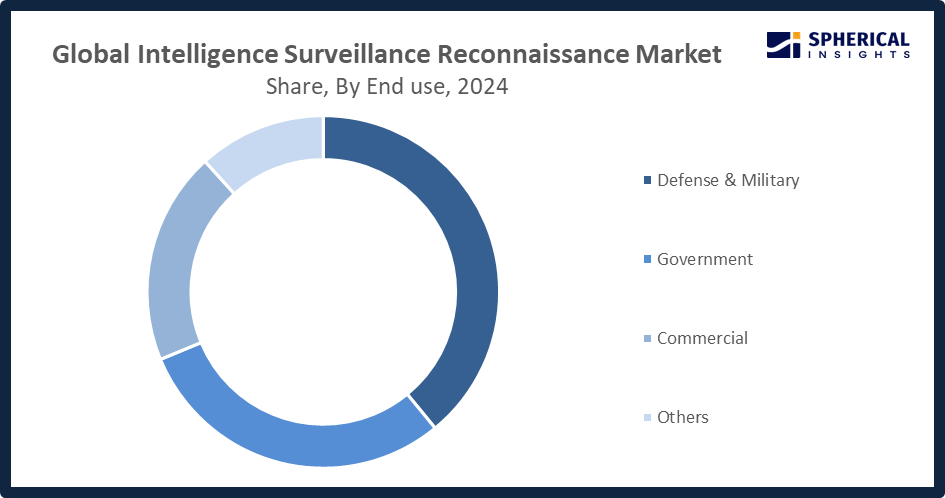
- The defense & military segment accounted for the highest market revenue in 2024, approximately 50%, and is anticipated to grow at a significant CAGR during the forecast period.
Based on the end use, the intelligence surveillance reconnaissance market is divided into defense & military, government, and commercial. Among these, the defense & military segment accounted for the highest market revenue in 2024, approximately 50%, and is anticipated to grow at a significant CAGR during the forecast period. Increasing global geopolitical tensions, increasing investment in upgrading ISR infrastructure, real-time intelligence requirements, and the rise of network-centric warfare is bolstering network equipment manufacturers' market.
Get more details on this report -
Regional Segment Analysis of the intelligence surveillance reconnaissance Market
- North America (U.S., Canada, Mexico)
- Europe (Germany, France, U.K., Italy, Spain, Rest of Europe)
- Asia-Pacific (China, Japan, India, Rest of APAC)
- South America (Brazil and the Rest of South America)
- The Middle East and Africa (UAE, South Africa, Rest of MEA)
North America is anticipated to hold the largest share of the intelligence surveillance reconnaissance market over the predicted timeframe.

Get more details on this report -
North America is anticipated to hold the largest share of the intelligence surveillance reconnaissance market over the predicted timeframe. Massive defense budget, advanced technological infrastructure, and rapid adoption of AI-driven and space-based ISR systems are what propel North America. The region's position is further reinforced by government programs promoting ISR innovation programs, the launch of new reconnaissance satellites and the expansion of ISR capabilities, and border security and counter-terrorism initiatives.
Government initiatives include the U.S. NRO Satellite ISR Expansion, April 2023, to quadruple the number of satellites in orbit, Canada RPAS Acquisition, December 2023, $2.49 billion investment to acquire RPAS capability, and NORAD Modernization Plan, June 2022, with $ 38.6 billion investment over 20 years for ISR-related surveillance, command systems, and aerospace defense.
Asia Pacific is expected to grow at a rapid CAGR in the intelligence surveillance reconnaissance market during the forecast period. China, India, Japan, and South Korea are among the nations making significant investments in expanding defense budgets, acquisition of UAVs and advanced ISR systems, and geopolitical emphasis on surveillance and reconnaissance. The demand for sophisticated ISR is further accelerated by the rising defense spending, modernization of military forces, increasing adoption of unmanned platforms, and growing border and maritime surveillance requirements.
Competitive Analysis:
The report offers the appropriate analysis of the key organizations/companies involved within the intelligence surveillance reconnaissance market, along with a comparative evaluation primarily based on their product of offering, business overviews, geographic presence, enterprise strategies, segment market share, and SWOT analysis. The report also provides an elaborative analysis focusing on the current news and developments of the companies, which includes product development, innovations, joint ventures, partnerships, mergers & acquisitions, strategic alliances, and others. This allows for the evaluation of the overall competition within the market.
List of Key Companies
- Lockheed Martin Corporation
- Northrop Grumman Corporation
- BAE Systems plc
- The Boeing Company
- RTX Corporation
- L3Harris Technologies Inc.
- General Dynamics Corporation
- Elbit Systems Ltd.
- Thales S.A.
- Leonardo S.p.A.
- General Atomics Aeronautical Systems, Inc.
- CACI International Inc.
- Rheinmetall AG
- Israel Aerospace Industries
- Kratos Defense & Security Solutions, Inc.
- Others
Key Target Audience
- Market Players
- Investors
- End-users
- Government Authorities
- Consulting and Research Firm
- Venture capitalists
- Value-Added Resellers (VARs)
Market Segment
This study forecasts revenue at global, regional, and country levels from 2020 to 2035. Spherical Insights has segmented the intelligence surveillance reconnaissance market based on the below-mentioned segments:
Global Intelligence Surveillance Reconnaissance Market, By Component
- Hardware
- Software
- Services
Global Intelligence Surveillance Reconnaissance Market, By Platform
- Land
- Naval
- Airborne
- Space
Global Intelligence Surveillance Reconnaissance Market, By End Use
- Defense & Military
- Government
- Commercial
Global intelligence Surveillance Reconnaissance Market, By Regional Analysis
- North America
- US
- Canada
- Mexico
- Europe
- Germany
- UK
- France
- Italy
- Spain
- Russia
- Rest of Europe
- Asia Pacific
- China
- Japan
- India
- South Korea
- Australia
- Rest of Asia Pacific
- South America
- Brazil
- Argentina
- Rest of South America
- Middle East & Africa
- UAE
- Saudi Arabia
- Qatar
- South Africa
Frequently Asked Questions (FAQ)
-
1. What are the current market trends in ISR?Key trends include AI integration, autonomous ISR platforms, multi-domain ISR networks, and space-based surveillance. There is also growing private-public collaboration for advanced intelligence solutions.
-
2. What role do satellite play in ISR?Satellites provide persistent, all-weather, global surveillance capabilities. They are crucial for strategic intelligence, missile tracking, and environmental monitoring.
-
3. How does government spending affect the ISR market?Rising defense budgets and modernization programs fuel ISR adoption. Governments invest in space surveillance, UAV programs, and AI-enabled ISR systems to enhance security.
-
4. How do UAVs contribute to ISR operations?UAVs offer tactical flexibility, real-time data, and reduced risk to personnel. They are widely used in border patrol, reconnaissance, and intelligence collection missions.
-
5. What technologies drive ISR growth?UAVs, radar systems, space-based sensors, AI and machine learning analytics, and autonomous platforms are primary growth drivers. Integration of multi-domain intelligence enhances operational efficiency.
-
6. What are the key applications of ISR technologies?ISR is used in border monitoring, battlefield intelligence, maritime surveillance, counter-terrorism, and space monitoring. It supports both strategic decision making and tactical operations.
Need help to buy this report?