Global Industrial Waste Management Market Size, Share, and COVID-19 Impact Analysis, By Waste Type (Construction & Demolition Waste, Manufacturing Waste, Chemical Waste, Mining Waste, Oil & Gas Waste, and Others), By Service (Landfill, Recycling, and Incineration), and By Region (North America, Europe, Asia-Pacific, Latin America, Middle East, and Africa), Analysis and Forecast 2025 - 2035
Industry: Energy & Power
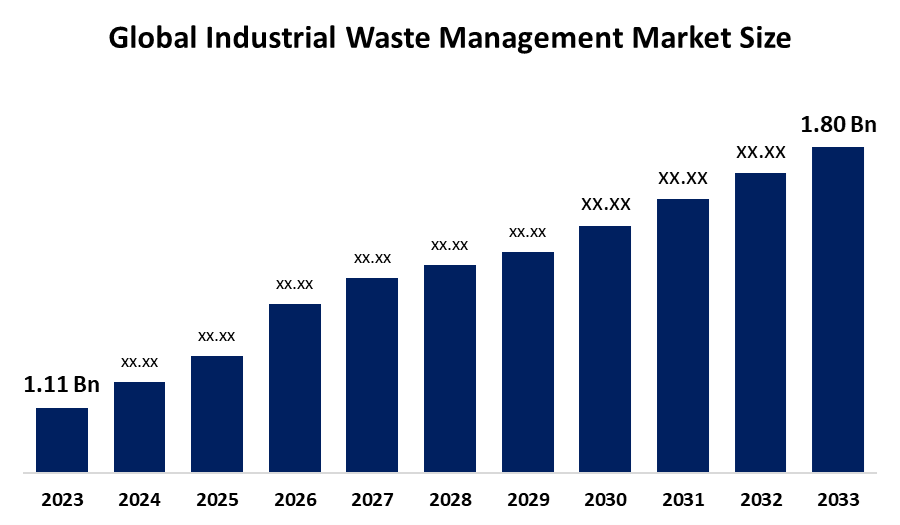
According to Spherical Insights, The Global Industrial Waste Management Market Size is expected to grow from USD 1.11 Billion in 2024 to USD 1.80 Billion by 2035, at a CAGR of 4.49% during the forecast period 2025-2035.
Key Market Trends & Opportunities
The market for industrial waste management has a number of opportunities to grow due to the growing emphasis on developing innovative technologies and advanced collection solutions and development of new technologies for waste collection.
- Increasing global industrial activity is increasing the volume of industrial wastes
- Technological solutions promoting the management of chemical, mining, oil & gas, agricultural, and other industrial waste types.
- Adoption of integrated recycling, landfill, and incineration methods for diverse waste streams
Market Insights Forecasts to 2035
- The Global Industrial Waste Management Market Size Was Estimated at USD 1.11 Billion in 2024
- The Market Size is Expected to Grow at a CAGR of around 4.49% from 2025 to 2035
- The Worldwide Industrial Waste Management Market Size is Expected to Reach USD 1.80 Billion by 2035
Get more details on this report -
Major Players
Veolia, SUEZ, Covanta, Waste Management Inc, Stericycle, Daiseki Co., Ltd., CLEAN HARBORS INC., REMONDIS SE & Co. KG, Biffa, SembCorp, and Republic Services, Inc.
Industrial Waste Management Market
The global industry of industrial waste management is a rapidly growing sector focused on the safe collection, transport, treatment, recycling, and disposal of hazardous and non-hazardous waste produced by manufacturing, mining, and chemical industries. Industrial waste management is an important process of collection, transportation, treatment, and disposal of any waste generated by industrial activities. Stringent environmental regulations, increasing waste output, and an inclination towards circular economy principles are key driving factors in the industrial waste management market.
Innovation and market expansion are anticipated as a result of major players' growing R&D expenditures and the expanding partnerships. For instance, in March 2025, SUEZ and the CNRS formalised a five-year framework agreement aimed at combining their research and development (R&D) efforts to create innovative solutions that promote sustainable resource management and advance decarbonization technologies.
Report Coverage
This research report categorizes the industrial waste management market based on various segments and regions, forecasts revenue growth, and analyzes trends in each submarket. The report analyses the key growth drivers, opportunities, and challenges influencing the industrial waste management market. Recent market developments and competitive strategies such as expansion, type launch, development, partnership, merger, and acquisition have been included to draw the competitive landscape in the market. The report strategically identifies and profiles the key market players and analyses their core competencies in each sub-segment of the industrial waste management market.
Industrial Waste Management Market Report Coverage
| Report Coverage | Details |
|---|---|
| Base Year: | 2024 |
| Market Size in 2024: | USD 1.11 Billion |
| Forecast Period: | 2025-2035 |
| Forecast Period CAGR 2025-2035 : | CAGR of 4.49% |
| 2035 Value Projection: | USD 1.80 Billion |
| Historical Data for: | 2020-2023 |
| No. of Pages: | 220 |
| Tables, Charts & Figures: | 120 |
| Segments covered: | By Waste Type, By Service |
| Companies covered:: | Veolia, SUEZ, Covanta, Waste Management Inc, Stericycle, Daiseki Co., Ltd., CLEAN HARBORS INC., REMONDIS SE & Co. KG, Biffa, SembCorp, Republic Services, Inc., and other key players |
| Pitfalls & Challenges: | COVID-19 Empact, Challenge, Future, Growth, & Analysis |
Get more details on this report -
Driving Factors
Regulatory support and compliance
Governments at a global pace are implementing stringent waste management, mandating the adoption of smart technologies for improving waste segmentation, recycling rates, and overall waste management efficiency.
Accelerated growth in industrial production
It was estimated that the global industrial production is expanding modestly, with a 0.7% increase in Q3 2025, due to emerging markets (3.1% growth) outpacing advanced economies.
Facility upgrades and technology adoption
Integration of technologies like automated sorting systems for providing high precision, using sensors, cameras, and AI algorithms for separating different types of waste like plastics, glass, and metals.
Restraining Factors
Financial constraints, infrastructure deficiencies, and operational challenges
The industrial waste management market is restricted by high installation, operating, and maintenance costs, especially in small and medium-sized enterprises. Further, increased labor cost, specialized equipment required for hazardous waste, and a lack of necessary infrastructure for effective waste management, are challenging the market growth.
Market Segment Insights
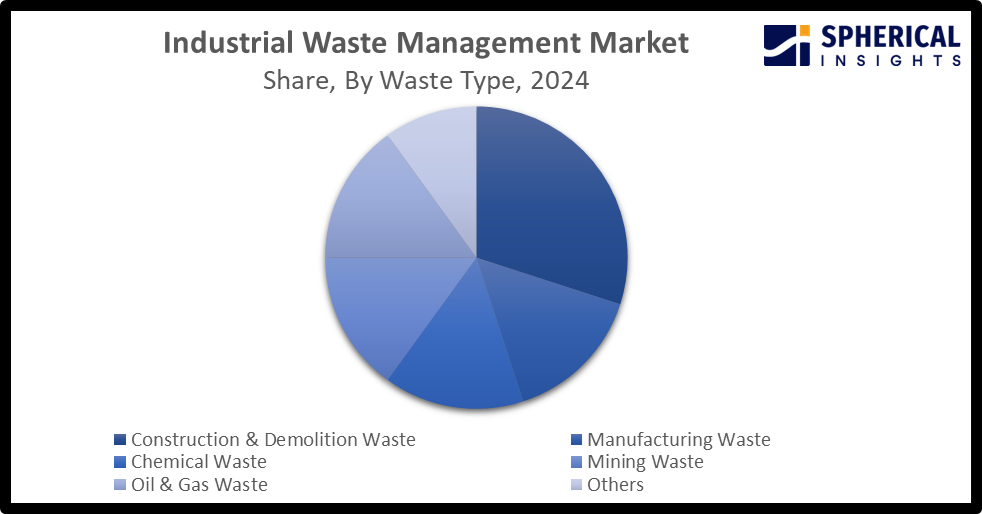
By Waste Type: Construction & Demolition Waste (Largest) Vs Manufacturing Waste (Emerging)
In the industrial waste management market, the construction & demolition waste segment holds the largest share of around 30.1% in 2024, owing to urban infrastructural needs and the emergence of technologies like AI-powered sorting systems and decision support tools. Construction and Demolition (C&D) refers to debris and materials generated from building, renovating, repairing, or dismantling structures like homes, roads, and bridges. It includes heavy components such as concrete, wood, metals, glass, and asphalt. Additionally, waste from the manufacturing industry is anticipated to grow due to the growth of industrialisation in the developing nations, resulting in excess scrap, which may cause air and water pollution. 5% of manufacturing-related waste was discharged into the environment in 2019. The remainder, however, has been addressed by recycling, treatment, and other methods.
Get more details on this report -
By Service: Landfill (Largest) Vs. Recycling (Emerging)
In the industrial waste management market, the landfill segment accounts for the major market share of around 52.5% in 2024, driven by an increasing demand for landfilling as waste management services across the region by the state and local governments for managing waste. Landfill services for industrial waste manage hazardous and non-hazardous materials through engineered, secured landfill facilities designed for protecting human health and the environment. While resource recovery practice refers to the collection and reuse of waste materials. Recycling operations depend profoundly on production and consumption. Recycled waste is waste material reprocessed in a production process that diverts it from the waste stream, except for reuse as fuel.
Regional Segment Analysis of the Industrial Waste Management Market
- North America (U.S., Canada, Mexico)
- Europe (Germany, France, U.K., Italy, Spain, Rest of Europe)
- Asia-Pacific (China, Japan, India, Rest of APAC)
- South America (Brazil and the Rest of South America)
- The Middle East and Africa (UAE, South Africa, Rest of MEA)
Asia Pacific region dominated the industrial waste management market in 2024, with the largest share of around 35.5% during the forecast period. China is the dominant country in the Asia Pacific industrial waste management market owing to its massive manufacturing and industrial base, high industrial waste generation, and government regulations on waste treatment. Further, due to the rapid industrialization responsible for significant waste generation across various industries like sugar, pulp and paper, food processing, distilleries, and more.
Middle East and Africa region is anticipated to grow at the fastest pace of about 8.4% CAGR in the global industrial waste management market during the forecast period. early adoption of leapfrog technologies and national diversification strategies are driving the Asia Pacific industrial waste management market. Demand is also expected to be driven by urbanization, economic growth, and environmental worries over industrial waste.
Competitive Analysis:
The report offers the appropriate analysis of the key organizations/companies involved within the industrial waste management market, along with a comparative evaluation primarily based on their type of offering, business overviews, geographic presence, enterprise strategies, segment market share, and SWOT analysis. The report also provides an elaborative analysis focusing on the current news and developments of the companies, which includes type development, innovations, joint ventures, partnerships, mergers & acquisitions, strategic alliances, and others. This allows for the evaluation of the overall competition within the market.
List of Key Companies
- Veolia
- SUEZ
- Covanta
- Waste Management Inc
- Stericycle
- Daiseki Co., Ltd.
- CLEAN HARBORS INC.
- REMONDIS SE & Co. KG
- Biffa
- SembCorp
- Republic Services, Inc.
- Others
Key Target Audience
- Market Players
- Investors
- End-users
- Government Authorities
- Consulting And Research Firm
- Venture capitalists
- Value-Added Resellers (VARs)
Industry Developments
- In February 2026, CAC Holdings Corporation has decided to acquire a 78.2 percent stake in JEMS Inc., a Japanese software and BPO provider focused on environmental and industrial waste management systems, making it a consolidated subsidiary.
- In February 2026, the Public Establishment for Industrial Estates “Madayn” and Oman Environmental Services Holding Company (Be’ah) signed a cooperation programme aimed at strengthening industrial waste management and treatment.
- In September 2025, Singapore is stepping up its efforts to manage hazardous waste sustainably, aligning with the nation’s environmental goals. As the city-state accelerates its environmental ambitions, the need for safe and sustainable hazardous waste management is more apparent than ever.
- In June 2025, Veolia, the world leader in hazardous waste treatment with 5b$ in this activity, patented technologies and a worldwide presence, announced actions to expand its hazardous waste treatment and disposal business in North America through investment, acquisitions and capacity expansion.
Market Segmentation
This study forecasts revenue at global, regional, and country levels from 2020 to 2035. Spherical Insights has segmented the industrial waste management market based on the below-mentioned segments:
Global Industrial Waste Management Market, By Waste Type
- Construction & Demolition Waste
- Manufacturing Waste
- Chemical Waste
- Mining Waste
- Oil & Gas Waste
- Others
Global Industrial Waste Management Market, By Service
- Landfill
- Recycling
- Incineration
Global Industrial Waste Management Market, By Regional Analysis
- North America
- US
- Canada
- Mexico
- Europe
- Germany
- UK
- France
- Italy
- Spain
- Russia
- Rest of Europe
- Asia Pacific
- China
- Japan
- India
- South Korea
- Australia
- Rest of Asia Pacific
- South America
- Brazil
- Argentina
- Rest of South America
- Middle East & Africa
- UAE
- Saudi Arabia
- Qatar
- South Africa
- Rest of the Middle East & Africa
Frequently Asked Questions (FAQ)
-
1. What is the market size of the industrial waste management market?The global industrial waste management market size is expected to grow from USD 1.11 Billion in 2024 to USD 1.80 Billion by 2035, at a CAGR of 4.49% during the forecast period 2025-2035.
-
2. Which region holds the largest share of the industrial waste management market?Asia Pacific is anticipated to hold the largest share of the industrial waste management market over the predicted timeframe.
-
3. What is the forecasted CAGR of the Global Industrial waste management Market from 2024 to 2035?The market is expected to grow at a CAGR of around 4.49% during the period 2024–2035.
-
4. Who are the top companies that are involved in the Global Industrial waste management Market?Key players include Veolia, SUEZ, Covanta, Waste Management Inc, Stericycle, Daiseki Co., Ltd., CLEAN HARBORS INC., REMONDIS SE & Co. KG, Biffa, SembCorp, and Republic Services, Inc.
-
5. What are the main drivers in the industrial waste management market?Government regulations, accelerated growth in industrial production, and advanced facility upgrades are major market growth drivers of the industrial waste management market.
-
6. What challenges are limiting the adoption of industrial waste management treatment?Factors like Financial constraints, infrastructure deficiencies, and operational challenges remain key restraints in the industrial waste management market.
-
7. What are the key trends in the industrial waste management market?The increasing global industrial activity, technological solutions promoting the management of chemical, mining, oil & gas, agricultural, and other industrial waste types, are major key trends in the industrial waste management market.
Need help to buy this report?