Indonesia Payments Infrastructure Market Size, Share, and COVID-19 Impact Analysis, By Payment Instrument (Card-Based Payments, Real-Time Bank Transfers, and Others), By End-User Vertical (Retail and Grocery, Transportation and Mobility, and Others), and Indonesia Payments Infrastructure Market Insights, Industry Trend, Forecasts to 2035
Industry: Banking & Financial
Indonesia Payments Infrastructure Market Insights Forecasts to 2035
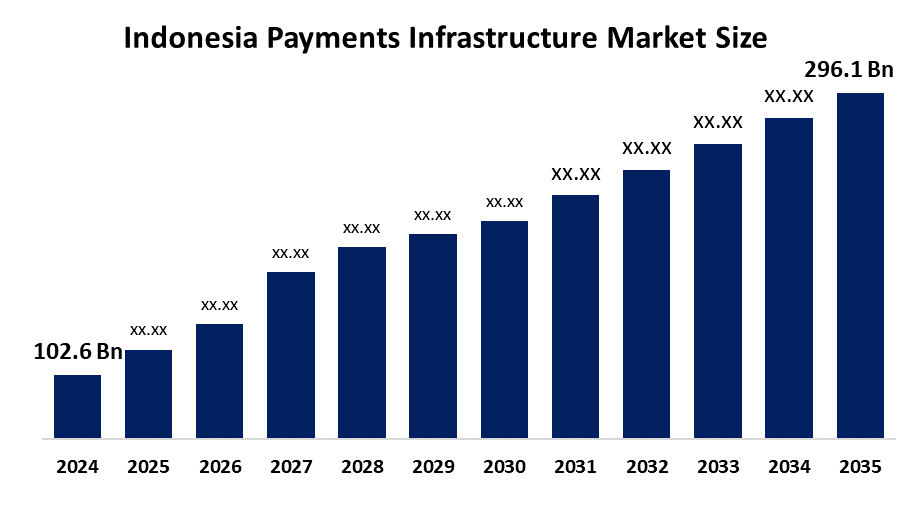
- The Indonesia Payments Infrastructure Market Size Was Estimated at USD 102.6 Billion in 2024
- The Market Size is Expected to Grow at a CAGR of Around 10.11% from 2025 to 2035
- The Indonesia Payments Infrastructure Market Size is Expected to Reach USD 296.1 Billion by 2035
Get more details on this report -
According to a research report published by Spherical Insights & Consulting, the Indonesia payments infrastructure market size is anticipated to reach USD 296.1 billion by 2035, growing at a CAGR of 10.11% from 2025 to 2035. The Indonesia payments infrastructure market is growing due to rising smartphone adoption, growing e-commerce, increasing demand for cashless transactions, supportive government policies, financial inclusion initiatives, and advancements in digital payment technologies.
Market Overview
The Indonesia payments infrastructure market refers to the ecosystem of systems, technologies, institutions, and regulatory frameworks that enable electronic and digital financial transactions across Indonesia. The Indonesia payments infrastructure market supports seamless, secure, and efficient digital transactions across Indonesia, including bank transfers, or payments, card networks, and fintech services regulated by Bank Indonesia. The Indonesia payments infrastructure market is driven by rising smartphone adoption, growing e-commerce, increasing demand for cashless transactions, supportive government policies, financial inclusion initiatives, and advancements in digital payment technologies.
Key opportunities in Indonesia payments infrastructure market include QRIS merchant expansion & optimization, real-time payments solutions, cross-border payment solutions, digital wallet & fintech growth, and AI powered security & infrastructure, and buy now, pay now integration. In August 2025, Indonesia Boosts Market and Payments Infrastructure, MoF Regulations No. revise crypto and gold taxes, while MoT-16/2025 eases import rules, enhancing trading, investor confidence, and liquidity. The reforms also boost digital transactions, fintech, and e-wallet usage, strengthening Indonesia’s payments infrastructure market.
Report Coverage
This research report categorizes the market for the Indonesia payments infrastructure market based on various segments and regions, and forecasts revenue growth and analyses trends in each submarket. The report analyses the key growth drivers, opportunities, and challenges influencing the Indonesia payments infrastructure market. Recent market developments and competitive strategies, such as expansion, product launch, development, partnership, merger, and acquisition, have been included to draw the competitive landscape in the market. The report strategically identifies and profiles the key market players and analyses their core competencies in each sub-segment of the Indonesia payments infrastructure market.
Indonesia Payments Infrastructure Market Report Coverage
| Report Coverage | Details |
|---|---|
| Base Year: | 2024 |
| Market Size in 2024: | USD 102.6 Billion |
| Forecast Period: | 2025-2035 |
| Forecast Period CAGR 2025-2035 : | CAGR of 10.11% |
| 2035 Value Projection: | USD 296.1 Billion |
| Historical Data for: | 2020-2023 |
| No. of Pages: | 210 |
| Tables, Charts & Figures: | 90 |
| Segments covered: | By Payment Instrument,By End-User Vertical |
| Companies covered:: | Xendit,Midtrans,OVO,GoPay,DANA And Others Players |
| Pitfalls & Challenges: | COVID-19 Empact, Challenges, Future, Growth, & Analysis |
Get more details on this report -
Driving Factors
The Indonesia payments infrastructure market is driven by strong government support for the QRIS unified QR code, which accelerates merchant adoption, alongside the rapid expansion of the BI FAST real time payment rail, enhancing bank-fintech integrations. Growing mobile wallet adoption among unbanked populations in outer islands, rising foreign investment in the O2O payments acquiring sector, migration of government social disbursements to digital channels in eastern Indonesia, and the expansion of embedded finance use cases in agritech cooperatives further fuel market growth.
Restraining Factors
The Indonesia payments infrastructure market faces constraints from gaps in inter-island telecom infrastructure, which hinder latency-sensitive transactions, high merchant attrition due to competitive price wars among acquirers, and limited consumer trust in card-not-present transactions outside Java.
Market Segmentation
The Indonesia payments infrastructure market share is classified into payment instrument and end-user vertical.
- The card-based payments segment accounted for the largest revenue market share in 2024 and is expected to grow at a significant CAGR during the forecast period.
The Indonesia payments infrastructure market is segmented by payment instrument into card-based payments, real-time bank transfers, and others. Among these, the card-based payments segment accounted for the largest revenue market share in 2024 and is expected to grow at a significant CAGR during the forecast period. This is due to widespread consumer and merchant trust in credit and debit cards, particularly for high-value and in-store purchases. Government initiatives promoting cashless payments, rising e-commerce activity, and improvements in payment infrastructure further supported card adoption.
- The retail and grocery segment dominated the share in 2024 and is anticipated to grow at a remarkable CAGR during the forecast period.
The Indonesia payments infrastructure market is segmented by end user vertical into retail and grocery, transportation and mobility, and others. Among these, the retail and grocery segment dominated the share in 2024 and is anticipated to grow at a remarkable CAGR during the forecast period. This is due to high consumer reliance on digital and card based payments for everyday purchases, widespread merchant adoption of POS terminals and QRIS, and the growing e commerce penetration in groceries and retail goods. Government initiatives promoting cashless transactions and financial inclusion further boosted adoption.
Competitive Analysis:
The report offers the appropriate analysis of the key organizations/companies involved within the Indonesia payments infrastructure market, along with a comparative evaluation primarily based on their product offering, business overviews, geographic presence, enterprise strategies, segment market share, and SWOT analysis. The report also provides an elaborate analysis focusing on the current news and developments of the companies, which includes product development, innovations, joint ventures, partnerships, mergers & acquisitions, strategic alliances, and others. This allows for the evaluation of the overall competition within the market.
List of Key Companies
- Xendit
- Midtrans
- OVO
- GoPay
- DANA
- PT Jalin
- PT Artajasa
- Ayoconnect
- GHL
- Cashlez
- Others
Key Target Audience
- Market Players
- Investors
- End-users
- Government Authorities
- Consulting and Research Firm
- Venture capitalists
- Value-Added Resellers (VARs)
Recent Developments:
- In January 2026, PT Artajasa Pembayaran Elektronis launched the global payments partnership with Ant International, forming a strategic collaboration to expand Indonesia’s digital payment reach globally, boosting market integration and transaction efficiency.
- In August 2025, GoPay Launches QRIS Tap NFC Payments. GoPay introduced NFC-based QRIS Tap in its app, enabling contactless payments for retail, transport, MSMEs, and parking. Supporting Indonesia’s cashless drive, the rollout strengthens digital payment adoption and accelerates the country’s payments infrastructure growth.
Market Segment
This study forecasts revenue at the Indonesia, regional, and country levels from 2020 to 2035. Spherical Insights has segmented the Indonesia payments infrastructure market based on the below-mentioned segments:
Indonesia Payments Infrastructure Market, By Payment Instrument
- Card-Based Payments
- Real-Time Bank Transfers
- Others
Indonesia Payments Infrastructure Market, By End-User Vertical
- Retail and Grocery
- Transportation and Mobility
- Others
Frequently Asked Questions (FAQ)
-
Q: What is the Indonesia payments infrastructure market size?A: Indonesia payments infrastructure market size is expected to grow from USD 102.6 billion in 2024 to USD 296.1 billion by 2035, growing at a CAGR of 10.11% during the forecast period 2025-2035.
-
Q: What are the key growth drivers of the market?A: The Indonesia payments infrastructure market is driven by rising smartphone adoption, growing e-commerce, increasing demand for cashless transactions, supportive government policies, financial inclusion initiatives, and advancements in digital payment technologies.
-
Q: What factors restrain the Indonesia payments infrastructure market?A: The Indonesia Payments Infrastructure Market faces constraints from gaps in inter-island telecom infrastructure, which hinder latency-sensitive transactions, high merchant attrition due to competitive price wars among acquirers, and limited consumer trust in card-not-present transactions outside Java.
-
Q: How does the payment instrument segment the market?A: The market is segmented into card-based payments, real-time bank transfers, and others.
-
Q: Who are the key opportunities in the Indonesia payments infrastructure market?A: Key opportunities in Indonesia payments infrastructure market include QRIS merchant expansion & optimization, real-time payments solutions, cross-border payment solutions, digital wallet & fintech growth, and AI-powered security & infrastructure, and buy now, pay now integration
Need help to buy this report?