India Vertical Farming Market Size, Share, and COVID-19 Impact Analysis, By Structure (Shipping Container-Based, Building-Based), By Growth Mechanism (Aeroponics, Hydroponics, and Aquaponics), By Crop (Leafy Greens, Herbs, and Others), and India Vertical Farming Market Insights, Industry Trend, Forecasts to 2035
Industry: Agriculture
India Vertical Farming Market Insights Forecasts to 2035
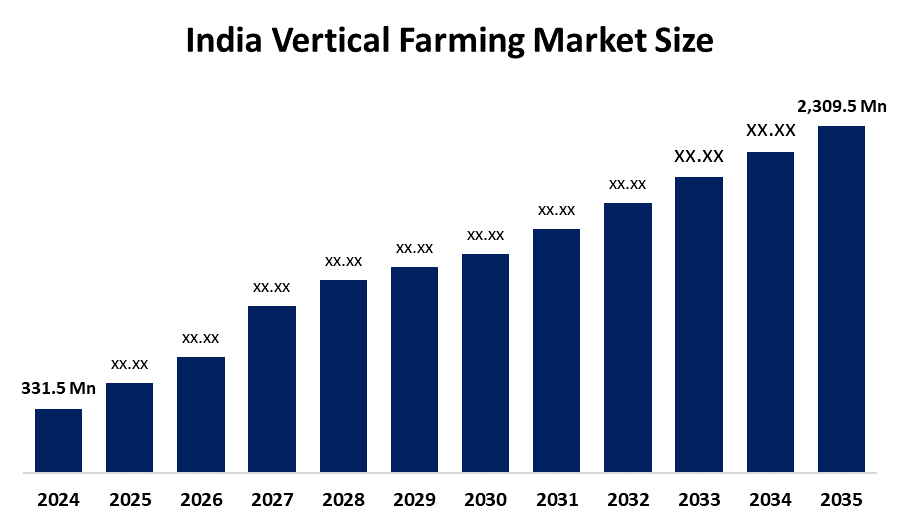
- The India Vertical Farming Market Size Was Estimated at USD 331.5 Million in 2024
- The Market Size is Expected to Grow at a CAGR of Around 19.3% from 2025 to 2035
- The India Vertical Farming Market Size is Expected to Reach USD 2,309.5 Million by 2035
Get more details on this report -
According to a Research Report Published by Spherical Insights & Consulting, The India Vertical Farming Market Size is Anticipated to Reach USD 2,309.5 Million by 2035, Growing at a CAGR of 19.3% from 2025 to 2035. The vertical farming market in India is driven by year-round crop production, technological advancement, and investment opportunities.
Market Overview
India's Vertical Farming Market Size is growing rapidly, substantially influenced by raising urban population and the need for sustainable food production. Vertical farming refers to an agricultural technique of growing crops indoors in vertically stacked layers with soil. This form of farming reduces dependence on traditional farmlands and provides much more yield. Here, growing conditions such as lights, temperature, humidity, and water are technologically controlled to get optimum production.
Customer demand to eat clean, sufficient food has led to vertical farming using various techniques and components, such as hydroponics, for clean and sustainable food. Consumer demand for organic and tasty food consumption, produced through eco-friendly practices also raised the vertical farming market. Due to over-usage of agricultural chemicals, climate change, and water shortage, the government of India offers various initiatives to promote vertical farming, which supports its growth. India's vertical farming market is expected to have a significant impact on how the nation's agriculture develops in the future, and that could result in a more robust food system.
Report Coverage
This research report categorises the market for the India vertical farming based on various segments and regions, and forecasts revenue growth and analyses trends in each submarket. The report analyses the key growth drivers, opportunities, and challenges influencing the Indian vertical farming market. Recent market developments and competitive strategies, such as expansion, product launch, development, partnership, merger, and acquisition, have been included to draw the competitive landscape in the market. The report strategically identifies and profiles the key market players and analyses their core competencies in each sub-segment of the India vertical farming market.
Driving Factors
The India Vertical Farming Market Size is driven by year-round crop production, technological advancement, and investment opportunities. Vertical farming, being controlled by internal factors avoid the impact of external factors such as climate, weeds, pests, and diseases, which adds to its production efficiency and the absence of land preparation processes provides an extra yearly cycle. All this supports producers' profitability while providing quality products to the consumer with sufficient availability.
Advancements in its production techniques through technologies such as the integration of precision agriculture that uses AI for data interpretation for increasing crop yields and resource optimisation, and image analysis to track growth and diseases have improved the performance. Moreover, the use of AI for environmental parameter control has raised the efficiency levels. Thereby, AI usage in critical processes has fuelled the vertical farming market.
To many investors, domestic or international, vertical farming is a viable business model and capable of meeting the need for food security. Thereby, investing in agritech such as vertical farms has surged, contributing to the sector innovation and expansion, which will eventually provide a high return on their investment.
Restraining Factors
The India Vertical Farming Market Size in India is mostly constrained by the high initial setup and limited crop diversification. Starting vertical farming requires a very high capital for the structure build-up, all necessary equipment, and to yield a proper production, even though subsidies are provided by the government schemes. Its indoor environment allows the production of only selected crops because of the characteristics of plants. Plants with longer and more rigid roots or that require natural pollination systems are difficult to grow efficiently.
Market Segmentation
The India Vertical Farming Market share is classified into structure, growth mechanism, and crops.
- The building-based segment accounted for the largest revenue market share in 2024 and is expected to grow at a significant CAGR during the forecast period.
The India Vertical Farming Market Size is segmented by structure into shipping container-based and building-based. Among these, the building-based segment accounted for the largest revenue market share in 2024 and is expected to grow at a significant CAGR during the forecast period. This is due to alignment with urban construction models, which supports largescale cultivation within the city limits. Such a structure is mostly useful in areas with underutilised space and have a high population with a high demand for clean food.
- The hydroponics segment dominated the share in 2024 and is anticipated to grow at a remarkable CAGR during the forecast period.
The India Vertical Farming Market Size is segmented by growth mechanism into aeroponics, hydroponics, and aquaponics. Among these, the hydroponics segment dominated the share in 2024 and is anticipated to grow at a remarkable CAGR during the forecast period. The reason behind this is its optimum water usage & nutrient delivery, and established technology with strong research. It provides extensive production with minimal water usage and reduced production problems.
- The leafy green segment accounted for the largest revenue market share in 2024 and is expected to grow at a significant CAGR during the forecast period.
The India Vertical Farming Market Size is segmented by crop into leafy greens, herbs, and others. Among these, the leafy green segment accounted for the largest revenue market share in 2024 and is expected to grow at a significant CAGR during the forecast period. This is due to a high adaptability rate to different environmental conditions and high demand from consumers and supermarkets. They allow year-round production, provide necessary nutrients, and utilise minimal resources.
Competitive Analysis
The report offers the appropriate analysis of the key organisations/companies involved within the India Vertical Farming Market Size, along with a comparative evaluation primarily based on their product offering, business overviews, geographic presence, enterprise strategies, segment market share, and SWOT analysis. The report also provides an elaborate analysis focusing on the current news and developments of the companies, which includes product development, innovations, joint ventures, partnerships, mergers & acquisitions, strategic alliances, and others. This allows for the evaluation of the overall competition within the market.
List of Key Companies
- UrbanKisaan
- Nutrifresh
- Rise Hydroponics
- Brio Hydroponics
- Aadya Hydroponics
- Future Farms
- Kryzen Biotech
- Vertical Green Farms
Key Target Audience
- Market Players
- Investors
- End-users
- Government Authorities
- Consulting and Research Firm
- Venture capitalists
- Value-Added Resellers (VARs)
Recent Developments
- In May 2025, Brio Hydroponics launched a commercial hydroponics park, known as Unnati Hi-tech, with 100+ acre capacity in India. It cultivates lettuce, bell peppers, and exotic herbs with high technology. It produced around 2, 000 tonnes of vegetables through 6-8 cycles yearly.
Market Segment
This study forecasts revenue at the India, regional, and country levels from 2020 to 2035. Spherical Insights has segmented the India Vertical Farming Market Size based on the below-mentioned segments:
India Vertical Farming Market, By Structure
- Shipping Container Based
- Building Based
India Vertical Farming Market, By Growth Mechanism
- Aeroponics
- Hydroponics
- Aquaponics
India Vertical Farming Market, By Crop
- Leafy Greens
- Herbs
- Others
Frequently Asked Questions (FAQ)
-
Q: What is the India vertical farming market size?A: India vertical farming market size is expected to grow from USD 331.5million in 2024 to USD 2,309.5 million by 2035, growing at a CAGR of 19.3% during the forecast period 2025-2035.
-
Q: What are the key growth drivers of the market?A: The vertical farming market in India is driven by year-round crop production, technological advancement, and investment opportunities.
-
Q: What factors restrain the India vertical farming market?A: The vertical farming market in India is mostly constrained by the high initial setup and limited crop diversification. Starting vertical farming requires a very high capital for the structure build-up, all necessary equipment, and to yield a proper production, even though subsidies are provided by the government schemes and allows only limited crop cultivation.
-
Q: How is the market segmented by structure?A: The market is segmented by structure into shipping container based, building based.
-
Q: Who are the key players in the India vertical farming market?A: Key companies include UrbanKisaan, Nutrifresh, Rise Hydroponics, Brio Hydroponics, Aadya Hydroponics, Future Farms, Kryzen Biotech, and Vertical Green Farms.
-
Q: Who are the target audiences for this market report?A: The report targets market players, investors, end-users, government authorities, consulting and research firms, venture capitalists, and value-added resellers (VARs).
Need help to buy this report?