India Container Market Size, Share, and COVID-19 Impact Analysis, By product (20 Feet, 40 Feet, and 45 Feet), By End Use (Food & Beverage, Consumer Goods, Industrial Goods, Healthcare, and Others), and India Container Market Insights, Industry Trend, Forecasts to 2035
Industry: Chemicals & Materials
India Container Market Size Insights Forecasts to 2035
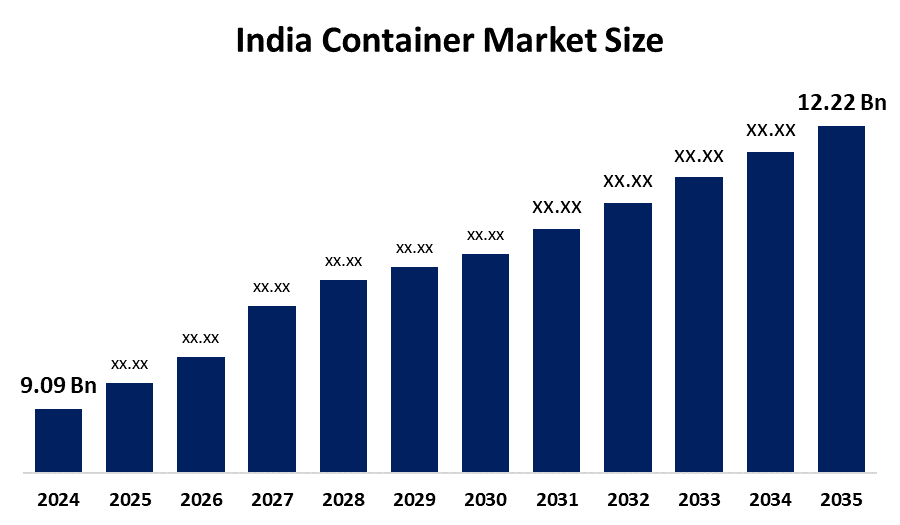
- The India Container Market Size Was Estimated at USD 9.09 Billion in 2024
- The Market Size is Expected to Grow at a CAGR of Around 2.73% from 2025 to 2035
- The India Container Market Size is Expected to Reach USD 12.22 Billion by 2035
Get more details on this report -
According to a Research Report Published by Spherical Insights & Consulting, The India Container Market Size is anticipated to Reach USD 12.22 Billion by 2035, Growing at a CAGR of 2.73% from 2025 to 2035. The India container market is growing due to the growth of international trade, expanding port infrastructure, rising export-import activities, increasing containerization in logistics, and the rapid growth of e-commerce and manufacturing sectors.
Market Overview
The India container market refers to the industry involved in the manufacturing, leasing, transportation, and management of shipping containers used for moving goods through sea, rail, and road logistics. The market is used for the transportation, storage, and handling of goods across domestic and international supply chains. It supports industries such as manufacturing, agriculture, automotive, consumer goods, chemicals, and retail by enabling efficient cargo movement through ports, railways, and road logistics. The India container market is driven by the growth of international trade, expanding port infrastructure, rising export-import activities, increasing containerization in logistics, and the rapid growth of e-commerce and manufacturing sectors.
Key opportunities in the India container market include growing international trade, expanding port and logistics infrastructure, increasing demand for cold-chain transport, and the adoption of smart container technologies, along with government support for domestic container manufacturing. In July 2025, the Government of India announced a Rs.10,000 crore Container Manufacturing Assistance Scheme for five years to strengthen the country’s maritime and logistics sector. The initiative aims to boost domestic container production, enhance supply chain resilience, and support growth in the India container market.
Report Coverage
This research report categorizes the market for the India container market based on various segments and regions, and forecasts revenue growth and analyses trends in each submarket. The report analyses the key growth drivers, opportunities, and challenges influencing the India container market. Recent market developments and competitive strategies, such as expansion, product launch, development, partnership, merger, and acquisition, have been included to draw the competitive landscape in the market. The report strategically identifies and profiles the key market players and analyses their core competencies in each sub-segment of the India container market.
India Container Market Report Coverage
| Report Coverage | Details |
|---|---|
| Base Year: | 2024 |
| Market Size in 2024 : | USD 9.09 Billion |
| Forecast Period: | 2025-2035 |
| Forecast Period CAGR 2025-2035 : | 2.73% |
| 2035 Value Projection: | USD 12.22 Billion |
| Historical Data for: | 2020-2023 |
| No. of Pages: | 168 |
| Tables, Charts & Figures: | 93 |
| Segments covered: | By product, By End Use and COVID-19 Impact Analysis |
| Companies covered:: | Adani Ports & SEZ, Container Corporation of India, Maersk Line India, DP World India, Allcargo Logistics Ltd, MSC Mediterranean Shipping, DCM Hyundai Ltd, Gateway Distriparks Limited, Shipping Corporation of India, Transworld Group, and Others |
| Pitfalls & Challenges: | COVID-19 Empact, Challenges, Future, Growth, & Analysis |
Get more details on this report -
Driving Factors
The India container market is driven by the rapid growth of international trade, the booming e-commerce sector, and strong government initiatives aimed at improving infrastructure, such as the Sagarmala programme. Additionally, rising industrialization, increasing demand for transporting specialized cargo like pharmaceuticals and chemicals, and ongoing efforts to modernize ports, railways, and road networks are significantly contributing to the expansion of containerized logistics in the country. Expansion of port infrastructure, growth in export-oriented manufacturing under initiatives like Make in India, and increasing adoption of multimodal logistics.
Restraining Factors
The India container market faces restraints such as infrastructure bottlenecks, high logistics costs, port congestion, and complex regulatory procedures. Limited hinterland connectivity and fluctuations in global trade also hinder the efficient movement of containers and slow market growth.
Market Segmentation
The India container market share is classified into product and end-use.
- The 40 feet segment accounted for the largest revenue market share in 2024 and is expected to grow at a significant CAGR during the forecast period.
The India container market is segmented by product into 20 feet, 40 feet, and 45 feet. Among these, the 40 feet segment accounted for the largest revenue market share in 2024 and is expected to grow at a significant CAGR during the forecast period. This is due to durability and large capacity, 40-feet containers are widely used for transporting bulk and industrial goods. Their ability to carry higher cargo volumes improves cost efficiency in international trade, while their versatility and compatibility with intermodal transport further increase their adoption.
- The consumer goods segment dominated the share in 2024 and is anticipated to grow at a remarkable CAGR during the forecast period.
The India container market is segmented by end-use food & beverage, consumer goods, industrial goods, healthcare, and Others. Among these, the consumer goods segment dominated the share in 2024 and is anticipated to grow at a remarkable CAGR during the forecast period. Increasing urbanization and rising consumer spending in India are boosting demand for consumer products such as personal care items, household goods, and electronics. The expansion of retail channels, especially e-commerce platforms, along with strong marketing strategies and brand loyalty, further supports the growth of the consumer goods sector.
Competitive Analysis:
The report offers the appropriate analysis of the key organizations/companies involved within the India container market, along with a comparative evaluation primarily based on their product offering, business overviews, geographic presence, enterprise strategies, segment market share, and SWOT analysis. The report also provides an elaborate analysis focusing on the current news and developments of the companies, which includes product development, innovations, joint ventures, partnerships, mergers & acquisitions, strategic alliances, and others. This allows for the evaluation of the overall competition within the market.
List of Key Companies
- Adani Ports & SEZ
- Container Corporation of India
- Maersk Line India
- DP World India
- Allcargo Logistics Ltd
- MSC Mediterranean Shipping
- DCM Hyundai Ltd
- Gateway Distriparks Limited
- Shipping Corporation of India
- Transworld Group
- Others
Key Target Audience
- Market Players
- Investors
- End-users
- Government Authorities
- Consulting and Research Firm
- Venture capitalists
- Value-Added Resellers (VARs)
Recent Developments:
- In February 2026, Adani Ports and Special Economic Zone reported handling 42.5 MMT of cargo, recording 16% YoY growth, driven by higher container and dry cargo volumes. The increase reflects rising trade activity and improved port logistics, supporting container movement efficiency and strengthening growth in India’s port and logistics market.
- In February 2026, Container Corporation of India Ltd. signed an MoU with partners including Shipping Corporation of India and Jawaharlal Nehru Port Authority to establish Bharat Container Shipping Line (BCSL). The venture aims to provide integrated logistics solutions for EXIM and coastal trade, strengthening India’s container shipping and multimodal logistics capabilities.
Market Segment
This study forecasts revenue at the India, regional, and country levels from 2020 to 2035. Spherical Insights has segmented the India container market based on the below-mentioned segments:
India Container Market, By Product
- 20 Feet
- 40 Feet
- 45 Feet
India Container Market, By End-Use
- Foods & Beverage
- Consumer Goods
- Industrial Goods
- Healthcare
- Others
Frequently Asked Questions (FAQ)
-
Q: What is the India container market?A: The India container market refers to the industry involved in the manufacturing, leasing, transportation, and management of shipping containers used for moving goods through sea, rail, and road logistics.
-
Q: What are the government initiatives for the India container market?A: In July 2025, the Government of India announced a ₹10,000 crore Container Manufacturing Assistance Scheme for five years to strengthen the country’s maritime and logistics sector.
-
Q: The India container market offers what opportunities?A: Key opportunities in the India container market include growing international trade, expanding port and logistics infrastructure, increasing demand for cold-chain transport, and the adoption of smart container technologies.
-
Q: What are the driving factors of the India container market?A: The market driven by the growth of international trade, expanding port infrastructure, rising export-import activities, increasing containerization in logistics, and the rapid growth of e-commerce and manufacturing sectors.
-
Q: What are the constraints of the market?A: The India container market faces restraints such as infrastructure bottlenecks, high logistics costs, port congestion, and complex regulatory procedures. Limited hinterland connectivity and fluctuations in global trade also hinder the efficient movement of containers and slow market growth.
Need help to buy this report?