Global Hyperimmune Globulins Market Size, Share, and COVID-19 Impact Analysis, By Type (Hepatitis B Immunoglobulin, Rabies Immunoglobulin, Tetanus Immunoglobulin, and Others), By Route of Administration (Intravenous, Intramuscular, and Others), and By Region (North America, Europe, Asia-Pacific, Latin America, Middle East, and Africa), Analysis and Forecast 2025 - 2035.
Industry: Healthcare
Key Market Trends & Opportunities
The hyperimmune globulins market has a number of opportunities to grow, due to the ongoing development of subcutaneous formulations, expanding applications in autoimmune disorders, and an increasing plasma collection/fractionation infrastructure in the market.
- Expansion of plasma collection infrastructure
- Advancement in purification technology
- Emphasis on specialized, high-demand products such as rabies and hepatitis B immunoglobulins
Global Hyperimmune Globulins Market Insights Forecasts to 2035
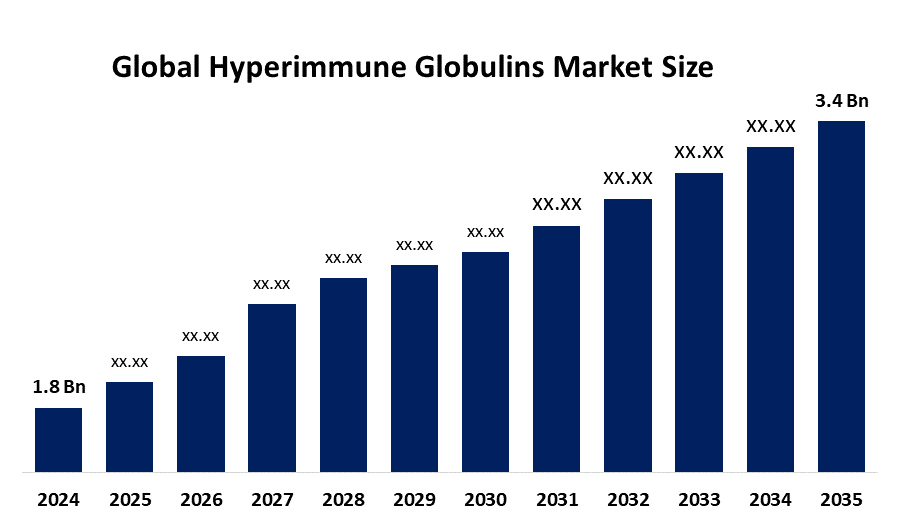
- The Global Hyperimmune Globulins Market Size Was Estimated at USD 1.8 Billion in 2024
- The Market Size is Expected to Grow at a CAGR of around 5.95% from 2025 to 2035
- The Worldwide Hyperimmune Globulins Market Size is Expected to Reach USD 3.4 Billion by 2035
Get more details on this report -
Major Players
CSL Behring, Grifols, Biotest, Kedrion, CBPO, Emergent (Cangene), Kamada, CNBG, Hualan Bio, ADMA Biologics, Shanghai RAAS, and Sichuan Yuanda Shuyang
Market Overview
The global industry focuses on producing and selling high-titer antibodies derived from vaccinated or convalescent human plasma, specifically used for treating or preventing diseases such as rabies, tetanus, and hepatitis B. Hyperimmune globulins are concentrated, purified immunoglobulin (antibody) preparations derived from the plasma of human donors with high antibody titers against specific diseases, providing immediate, short-term passive immunity. There is an increasing global burden of infectious diseases like hepatitis B, rabies, and tetanus, where immediate passive immunity is crucial for prevention and cure.
There is an increasing demand for hyperimmune globulin across industrial, commercial, and technology-driven applications, along with continuous innovation and investment across major end-use sectors. Key companies are also expanding their product offerings and launching novel products.
Report Coverage
This research report categorizes the hyperimmune globulins market based on various segments and regions, forecasts revenue growth, and analyzes trends in each submarket. The report analyses the key growth drivers, opportunities, and challenges influencing the hyperimmune globulins market. Recent market developments and competitive strategies such as expansion, type launch, development, partnership, merger, and acquisition have been included to draw the competitive landscape in the market. The report strategically identifies and profiles the key market players and analyses their core competencies in each sub-segment of the hyperimmune globulins market.
Global Hyperimmune Globulins Market Report Coverage
| Report Coverage | Details |
|---|---|
| Base Year: | 2024 |
| Market Size in 2024: | USD 1.8 Billion |
| Forecast Period: | 2025-2035 |
| Forecast Period CAGR 2025-2035 : | CAGR of 5.95% |
| 2035 Value Projection: | USD 3.4 Billion |
| Historical Data for: | 2020-2023 |
| No. of Pages: | 240 |
| Tables, Charts & Figures: | 95 |
| Segments covered: | By Type,By Route of Administration |
| Companies covered:: | CSL Behring, Grifols, Biotest, Kedrion, CBPO, Emergent (Cangene), Kamada, CNBG, Hualan Bio, ADMA Biologics, Shanghai RAAS, Sichuan Yuanda Shuyang, Others, and Key Players |
| Pitfalls & Challenges: | COVID-19 Empact, Challenge, Future, Growth, & Analysis |
Get more details on this report -
Driving Factors
High prevalence of infectious diseases and reliance on plasma-derived therapies
Hyperimmune globulin therapy is used to treat some infectious diseases of viral or bacterial origin. Antibody preparations derived from immunized human donors are commonly used for the prophylaxis and treatment of rabies, hepatitis A and B viruses, varicella-zoster virus, and pneumonia caused by respiratory syncytial virus. An increased reliance on plasma-derived therapies, which is driven by the increasing diagnostic rate of immunodeficiencies and rare diseases, along with an increasing need for immunoglobulins (IVIG) in neurology and hematology, is contributing to propel the hyperimmune globulins market.
Strategic collaboration for R&D and Government support
Industries are increasingly emphasizing strategic collaboration for formulating novel immunotherapies with hyperimmune globulin (HIG), including the blending of the immediate, broad-spectrum pathogen neutralization of polyclonal antibodies with the precision and long-term effector functions of modern molecular medicines. Government immunization programs (like CDC recommendations, national health services) for prioritizing the use of specific HIGs for preventing severe disease following high-risk exposure are supporting the market growth.
Restraining Factors
Affordability and accessibility of human plasma
Production of hyperimmune globulins is facing significant deficiencies in affordability and accessibility due to reliance on a limited number of suppliers, longer production timelines, and demand for plasma-derived medicinal products.
Market Segment Insights
By Type: Hepatitis B Immunoglobulin (Dominant) versus Rabies Immunoglobulin (Emerging)
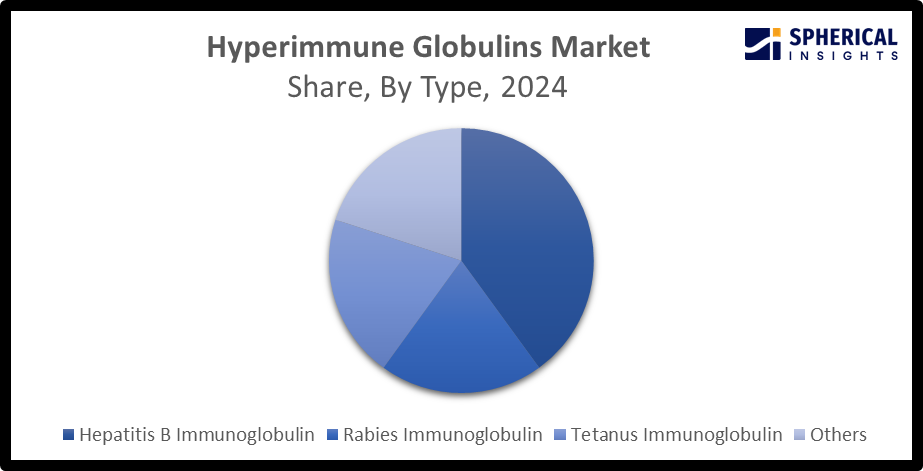
The hepatitis B immunoglobulin segment dominated the market with a substantial share, owing to increased prevalence of hepatitis B infection as well as its role for prevention and post-exposure prophylaxis. Hepatitis B immunoglobulin is used for intramuscular administration to prevent the transmission of hepatitis B virus post-exposure and should be part of a regimen that includes the hepatitis B vaccine. While the rabies immunoglobulin segment is emerging in the market, driven by the increasing healthcare focus on ensuring access and robust supply chain management. Rabies immunoglobulin is used together with rabies vaccine for preventing infection caused by the rabies virus, and is given to persons who have been exposed to an animal known or thought to have rabies.
Get more details on this report -
By Route of Administration: Intravenous (Dominant) versus Intramuscular (Emerging)
The intravenous segment held the dominant share in the hyperimmune globulins market, owing to increasing adoption of IV therapies in advanced healthcare settings and the launch of liquid incorporated immunoglobulin. Hyperimmune IVIG is purified from human donors who were recently vaccinated or are in the convalescent period recovering from an infection, and is currently indicated for postexposure prophylaxis of hepatitis A and B, tetanus, rabies, diphtheria, and other infections. Intramuscular hyperimmune globulins are specifically indicated over intravenous formulations for post-exposure prophylaxis of infectious diseases due to ease of administration and higher concentration.
Regional Segment Analysis of the Hyperimmune Globulins Market
- North America (U.S., Canada, Mexico)
- Europe (Germany, France, U.K., Italy, Spain, Rest of Europe)
- Asia-Pacific (China, Japan, India, Rest of APAC)
- South America (Brazil and the Rest of South America)
- The Middle East and Africa (UAE, South Africa, Rest of MEA)
Get more details on this report -
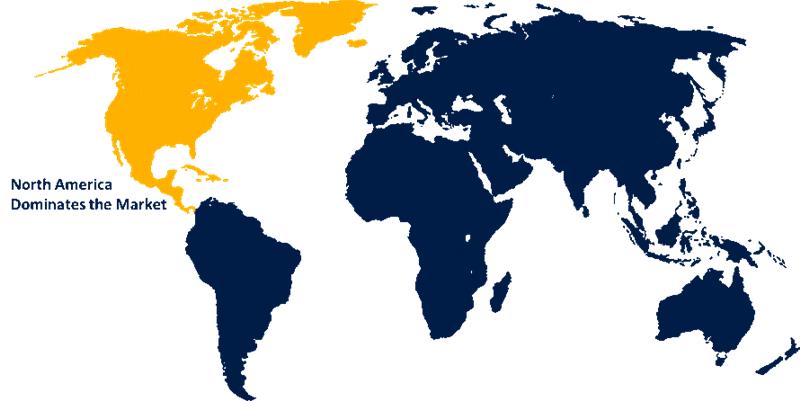
North America is anticipated to hold the largest share of the hyperimmune globulins market over the predicted timeframe.
North America is anticipated to hold the largest share in the hyperimmune globulins market over the predicted timeframe. The market ecosystem in North America is strong, due to the presence of well-established healthcare facilities, an increase in the prevalence of infectious diseases, and disease awareness. Further, a strong industrial presence and well-established regulations are promoting the hyperimmune globulins market. The U.S. is leading the regional market owing to an increasing prevalence of infectious diseases, public awareness about preventive healthcare, and advancements in plasma fractionation technologies
Asia Pacific is expected to grow at a rapid CAGR in the hyperimmune globulins market during the forecast period. The Asia Pacific area has a thriving market for hyperimmune globulins due to increasing investment in healthcare infrastructure and accessibility to advanced medical care. Further, rapid industrialization, expanding manufacturing bases, urbanization, and adoption of cost-efficient technologies are contributing to propel the hyperimmune globulins market. China is the leading country in the Asia Pacific hyperimmune globulins market, driven by an increasing healthcare expenditure, large patient population, and upsurging need for immunoglobulin products.
Competitive Analysis:
The report offers the appropriate analysis of the key organizations/companies involved within the hyperimmune globulins market, along with a comparative evaluation primarily based on their type of offering, business overviews, geographic presence, enterprise strategies, segment market share, and SWOT analysis. The report also provides an elaborative analysis focusing on the current news and developments of the companies, which includes type development, innovations, joint ventures, partnerships, mergers & acquisitions, strategic alliances, and others. This allows for the evaluation of the overall competition within the market.
List of Key Companies
- CSL Behring
- Grifols
- Biotest
- Kedrion
- CBPO
- Emergent (Cangene)
- Kamada
- CNBG
- Hualan Bio
- ADMA Biologics
- Shanghai RAAS
- Sichuan Yuanda Shuyang
- Others
Key Target Audience
- Market Players
- Investors
- End-users
- Government Authorities
- Consulting And Research Firm
- Venture capitalists
- Value-Added Resellers (VARs)
Industry Development
- In January 2025, Kamada Ltd., a global biopharmaceutical company with a portfolio of marketed products indicated for rare and serious conditions and a leader in the specialty plasma-derived field, announced that it was awarded a contract with an international organization for the supply of KAMRAB and VARIZIG in Latin America for 2025-2027.
- In July 2024, Grifols, one of the world’s leading producers of plasma-derived medicines, announced that the United States Food and Drug Administration (FDA) had approved an expanded label for XEMBIFY, the company’s 20% subcutaneous immunoglobulin (SCIg), to include treatment-naïve patients with primary humoral immunodeficiencies (PI).
- In January 2024, CSL Behring, a business unit of global biotechnology leader CSL, announced the availability of a 10g prefilled syringe for Hizentra (Immune Globulin Subcutaneous [Human] 20% Liquid).
- In March 2023, the European Hematology Association discussed shortages of immunoglobulins, which were reported to the European Commission in an ‘EMA multitasker workshop on Shortages’.
- In June 2021, Grifols, a leading global producer of plasma-derived medicines and provider of a variety of postexposure prophylaxis and IgG products for patients, began commercializing HyperHEP B, a new formulation of its hepatitis B immune globulin [human] for hepatitis B postexposure prophylaxis.
Market Segment
This study forecasts revenue at global, regional, and country levels from 2020 to 2035. Spherical Insights has segmented the hyperimmune globulins market based on the below-mentioned segments:
Global Hyperimmune Globulins Market, By Type
- Hepatitis B Immunoglobulin
- Rabies Immunoglobulin
- Tetanus Immunoglobulin
- Others
Global Hyperimmune Globulins Market, By Route of Administration
- Intravenous
- Intramuscular
- Others
Global Hyperimmune Globulins Market, By Regional Analysis
- North America
- US
- Canada
- Mexico
- Europe
- Germany
- UK
- France
- Italy
- Spain
- Russia
- Rest of Europe
- Asia Pacific
- China
- Japan
- India
- South Korea
- Australia
- Rest of Asia Pacific
- South America
- Brazil
- Argentina
- Rest of South America
- Middle East & Africa
- UAE
- Saudi Arabia
- Qatar
- South Africa
- Rest of the Middle East & Africa
Frequently Asked Questions (FAQ)
-
1.What is the market size of the hyperimmune globulins market?The global hyperimmune globulins market size is expected to grow from USD 1.8 Billion in 2024 to USD 3.4 Billion by 2035, at a CAGR of 5.95% during the forecast period 2025-2035.
-
2.Which region holds the largest share of the hyperimmune globulins market?North America is anticipated to hold the largest share of the hyperimmune globulins market over the predicted timeframe.
-
3.What is the forecasted CAGR of the Global Hyperimmune Globulins Market from 2024 to 2035?The market is expected to grow at a CAGR of around 5.95% during the period 2024–2035.
-
4.Who are the top companies that are involved in the Global Hyperimmune Globulins Market?Key players include CSL Behring, Grifols, Biotest, Kedrion, CBPO, Emergent (Cangene), Kamada, CNBG, Hualan Bio, ADMA Biologics, Shanghai RAAS, and Sichuan Yuanda Shuyang.
-
5.What are the main drivers in the hyperimmune globulins market?An increasing prevalence of infectious diseases, high reliance plasma derived therapies, and government immunization programs are major market growth drivers of the hyperimmune globulins market.
-
6.What challenges are limiting the adoption of hyperimmune globulins?Factors like limited affordability and accessibility of human plasma products remain key restraints in the hyperimmune globulins market.
-
7.What are the key trends in the hyperimmune globulins market?The expanding plasma collection infrastructure, advancement in purification technology, and emphasis on specialized, high-demanding products like rabies and hepatitis B immunoglobulins are major key trends in the hyperimmune globulins market.
Need help to buy this report?