Global Hexamethylene Diisocyanate Market Size, Share, and COVID-19 Impact Analysis, By Type (Purity 0.999, Purity 0.995, and Others), By Form (Monomer, Pre-polymer/Oligomer, and Modified/Blended), By Application (Coating, Adhesive, and Others), By End User (Automotive Industry, Construction Industry, and Industrial Manufacturing), and By Region (North America, Europe, Asia-Pacific, Latin America, Middle East, and Africa), Analysis and Forecast 2025 - 2035
Industry: Chemicals & Materials
Global Hexamethylene Diisocyanate Market Size Insights Forecasts to 2035
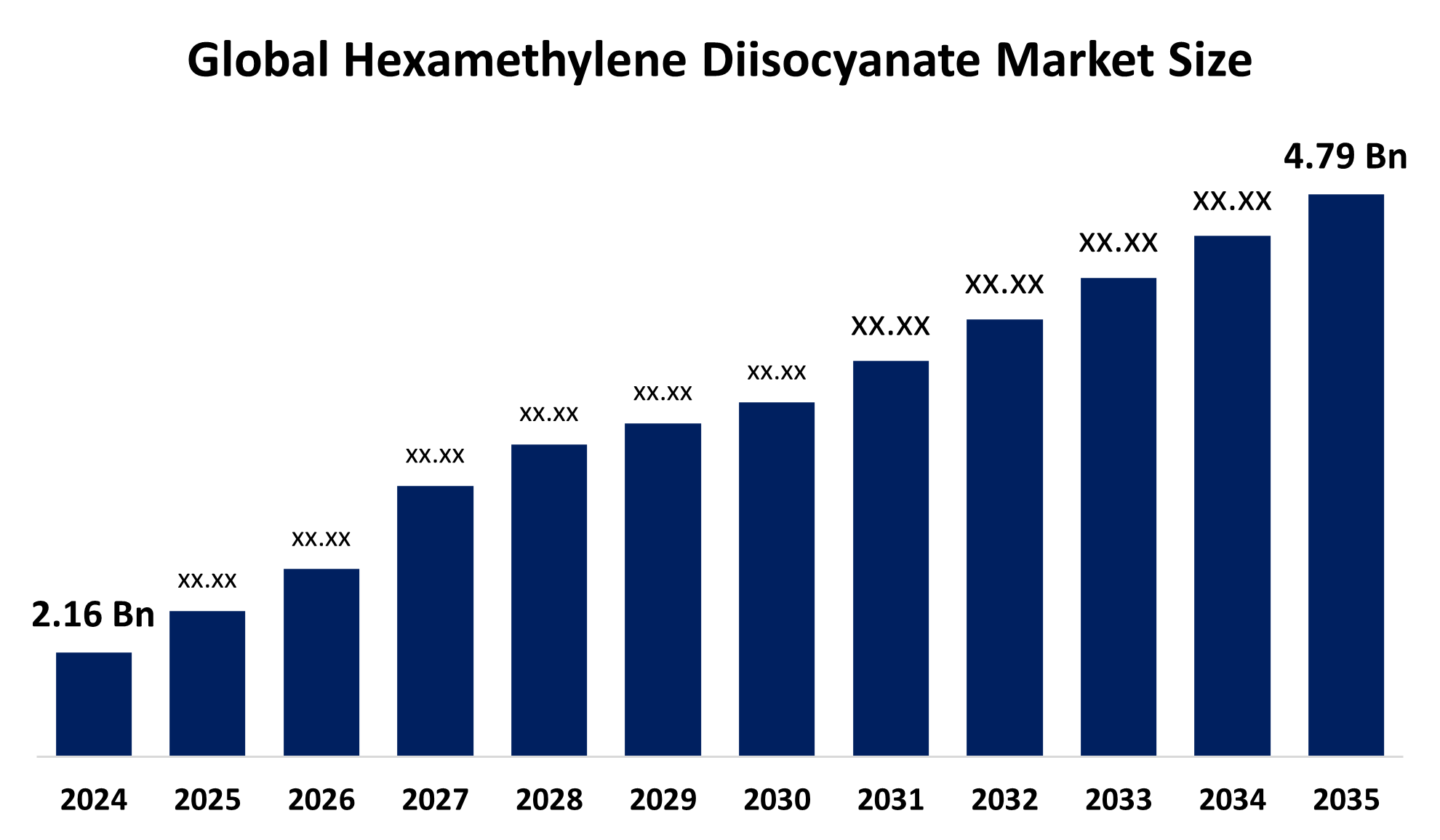
- The Global Hexamethylene Diisocyanate Market Size Was Estimated at USD 2.16 Billion in 2024
- The Market Size is Expected to Grow at a CAGR of around 7.51% from 2025 to 2035
- The Worldwide Hexamethylene Diisocyanate Market Size is Expected to Reach USD 4.79 Billion by 2035
- North America is expected to grow the fastest during the forecast period.
Get more details on this report -
According to a research report published by Spherical Insights and Consulting, The Global Hexamethylene Diisocyanate Market Size was worth around USD 2.16 Billion in 2024 and is Predicted to Grow to around USD 4.79 Billion by 2035 with a Compound Annual Growth Rate (CAGR) of 7.51% from 2025 to 2035. The hexamethylene diisocyanate (HDI) market is growing because the automotive and aerospace industries need high-quality coatings. The market expansion occurs because construction activities increase, technological improvements in polyurethane develop, and VOC regulations mandate the use of sustainable, strong materials.
Market Overview
Hexamethylene diisocyanate (HDI) exists as a colorless to slightly yellow substance that possesses low viscosity and functions as an aliphatic diisocyanate monomer that manufacturers use to create high-performance polyurethanes that maintain their color stability under light exposure. The superior ultraviolet protection, abrasion defense and chemical defense properties of HDI make it a popular choice for high-quality polyurethane coatings and specialized automotive paints and long-lasting elastomers, which the automotive industry uses to obtain more than 60 % of its total market demand. The global market experiences growth because customers from the automotive, aerospace and industrial construction sectors demand premium coatings which provide non-yellowing durability.
The adoption of HDI materials is increasing as companies move towards environmentally friendly coatings that contain low levels of volatile organic compounds. Developing regions such as Asia-Pacific present companies with significant growth possibilities because China's industrial sector keeps growing, and people demand renewable bio-based HDI, and firms develop technologies which minimize application-related volatility and toxicity. India implemented national VOC restrictions for architectural coatings, which will begin enforcement in 2026 after the Ministry of Environment and Urban Affairs completes its draft in May 2025, which requires new projects to use IS 15489 or LEED-compliant materials. Mahacina expanded its Chennai facility into a production plant for low-VOC interior and exterior coatings, which provides green certification assistance to developers.
Report Coverage
This research report categorizes the Global Hexamethylene Diisocyanate Market based on various segments and regions, forecasts revenue growth, and analyzes trends in each submarket. The report analyses the key growth drivers, opportunities, and challenges influencing the hexamethylene diisocyanate market. Recent market developments and competitive strategies, such as expansion, type launch, development, partnership, merger, and acquisition, have been included to draw the competitive landscape in the market. The report strategically identifies and profiles the key market players and analyses their core competencies in each sub-segment of the hexamethylene diisocyanate market.
Global Hexamethylene Diisocyanate Market Report Coverage
| Report Coverage | Details |
|---|---|
| Base Year: | 2024 |
| Market Size in 2024: | USD 2.16 Billion |
| Forecast Period: | 2025-2035 |
| Forecast Period CAGR 2025-2035 : | 7.51% |
| 2035 Value Projection: | USD 4.79 Billion |
| Historical Data for: | 2020-2023 |
| No. of Pages: | 195 |
| Tables, Charts & Figures: | 102 |
| Segments covered: | By Type, By Form |
| Companies covered:: | BASF SE, Covestro AG, Huntsman Corporation, Wanhua Chemical Group, Mitsui Chemicals, Inc., LANXESS, Asahi Kasei Corporation, Evonik Industries AG, Vencorex, LyondellBasell Industries, Tosoh Corporation, Perstorp Holding AB, Dow Inc., China National Petroleum Corporation and Other Key Players |
| Pitfalls & Challenges: | and COVID-19 Impact Analysis |
Get more details on this report -
Driving Factors
The Global Hexamethylene Diisocyanate Market expands because the automotive, aerospace, and construction industries need advanced polyurethane coatings. Automotive coatings account for nearly 40% of global HDI consumption, which manufacturers support through their production of 91.5 million vehicles scheduled for 2024. The construction sector, which operates at a value of USD 10.2 trillion, creates additional demand for HDI-based sealants and adhesives. The Asia-Pacific region leads global consumption with 45% market share because industrialization in China and India is accelerating. The market for HDI products grows because people now choose materials that prevent corrosion and resist UV radiation, offer long-lasting performance and eco-friendly low-VOC characteristics, and are suitable for urban environments and lightweight vehicle production methods.
Restraining Factors
The Global Hexamethylene Diisocyanate Market encounters multiple restraining factors, which include fluctuating raw material prices, strict environmental regulations that control VOC emissions and worker safety, and supply chain interruptions caused by geopolitical conflicts and high production expenses that result from energy-intensive manufacturing methods. The handling of isocyanate materials incurs high costs because of the health risks that require special safety measures.
Market Segmentation
The hexamethylene diisocyanate market share is classified into type, form, application, and end user.
- The purity 0.999 segment dominated the market in 2024, approximately 60% and is projected to grow at a substantial CAGR during the forecast period.
Based on the type, the Global Hexamethylene Diisocyanate Market is divided into purity 0.999, purity 0.995, and others. Among these, the purity 0.999 segment dominated the market in 2024, approximately 60% and is projected to grow at a substantial CAGR during the forecast period. The market growth of the 0.999 purity segment results from its ability to deliver both high precious metal content and durable performance. The solution provides better value to investors and industrial users than lower purity solutions while being easier to use and cheaper than ultra-pure 0.9999 products, which makes it the standard choice for bullion and manufacturing.
- The monomer segment accounted for the largest share in 2024, approximately 45% and is anticipated to grow at a significant CAGR during the forecast period.
Based on the form, the Global Hexamethylene Diisocyanate Market is divided into monomer, pre-polymer/oligomer, and modified/blended. Among these, the monomer segment accounted for the largest share in 2024, approximately 45% and is anticipated to grow at a significant CAGR during the forecast period. The segment grows because it provides the fundamental chemical building block needed to create multiple polymer types, which include plastics, rubbers and resins. The industry maintains its market leadership due to high packaging and automotive and construction sector demand for raw materials, which fuel production capacity growth and ongoing manufacturing facility development.
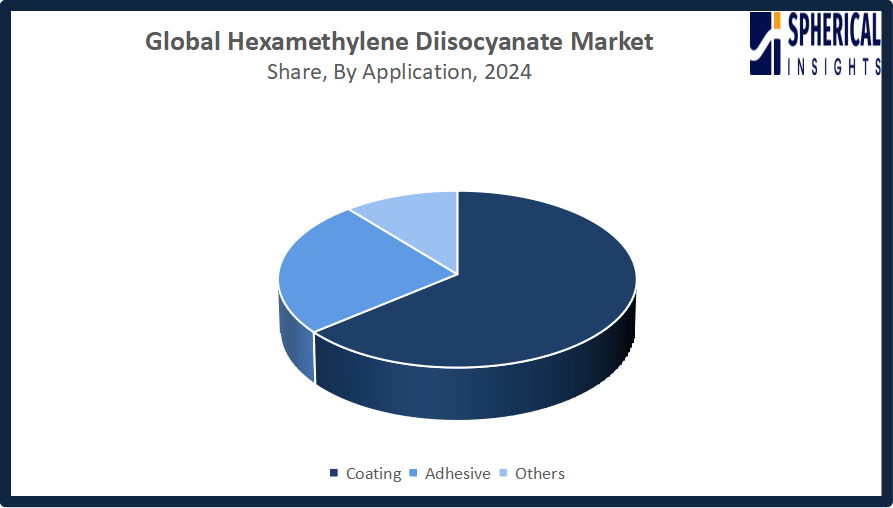
- The coating segment dominated the market in 2024, approximately 64% and is projected to grow at a substantial CAGR during the forecast period.
Based on the application, the Global Hexamethylene Diisocyanate Market is divided into coating, adhesive, and others. Among these, the coating segment dominated the market in 2024, approximately 64% and is projected to grow at a substantial CAGR during the forecast period. The coating segment leads market expansion because it provides essential surface protection against corrosion, wear and environmental damage. The market expands because the automotive, construction, and industrial sectors use extensive decorative finishing, eco-friendly formulations and high-performance products. The industry adopts durable and sustainable coating solutions because of technological improvements.
Get more details on this report -
- The automotive industry segment accounted for the highest market revenue in 2024, approximately 40% and is anticipated to grow at a significant CAGR during the forecast period.
Based on the end user, the Global Hexamethylene Diisocyanate Market is divided into automotive industry, construction industry, and industrial manufacturing. Among these, the automotive industry segment accounted for the highest market revenue in 2024, approximately 40% and is anticipated to grow at a significant CAGR during the forecast period. The automotive industry segment leads market growth because vehicle production increases, and the demand for lightweight materials drives fuel efficiency and more electronic components are integrated into vehicles. Electric vehicle adoption needs special materials that support battery production and weight reduction. The manufacturing supply chains experience increased consumption because safety regulations become stricter, and consumers prefer products with better advanced features and attractive designs.
Regional Segment Analysis of the Hexamethylene Diisocyanate Market
- North America (U.S., Canada, Mexico)
- Europe (Germany, France, U.K., Italy, Spain, Rest of Europe)
- Asia-Pacific (China, Japan, India, Rest of APAC)
- South America (Brazil and the Rest of South America)
- The Middle East and Africa (UAE, South Africa, Rest of MEA)
Asia Pacific is anticipated to hold the largest share of the hexamethylene diisocyanate market over the predicted timeframe.

Get more details on this report -
Asia Pacific is anticipated to hold the largest share of the Hexamethylene Diisocyanate Market over the predicted timeframe. The global hexamethylene diisocyanate market shows Asia-Pacific as its leading region because this region produces almost 49% of total market consumption, with China as its top producer. The coatings industry of China, together with its automotive manufacturing capacity and Wanhua Chemical's main operations, gives the country a strong market position. The region experiences industrial growth because emerging economies build more infrastructure, and their demand increases for advanced polyurethane products. In February 2026, the Indian government established two initiatives, the Make in India program and Petroleum Chemicals and Petrochemicals Investment Regions, to boost chemical industry development in India through domestic production of specialty chemicals, including HDI derivatives.
North America is expected to grow at a rapid CAGR in the hexamethylene diisocyanate market during the forecast period. The North American hexamethylene diisocyanate (HDI) market is experiencing a 25% share of strong growth because the United States leads the market. The aerospace and automotive industries create a strong demand for coatings that require durable UV-resistant finishes. Covestro expands its Texas facility to improve production capabilities in the area. The industry expansion receives support from the growing preference for low-VOC adhesives and sealants, which provide high performance. In January 2026, tightening U.S. environmental regulations accelerated the adoption of low-VOC construction adhesives to improve indoor air quality and support green building standards. Used in flooring, panelling, and insulation, these adhesives emit under 50 g/L VOCs per EPA guidance. Despite 20-30% higher costs, tests show 95% strength retention, outperforming solvent-based alternatives.
The European hexamethylene diisocyanate market sees its growth coming from Germany, which stands as the continent's most economically powerful nation and industrial center. The automotive manufacturing sector in Germany needs high-performance coatings, which creates the most demand for HDI-based products because the country has a strong construction industry and advanced industrial facilities that follow strict environmental standards. The country's sustainable manufacturing practices and innovative development strategies create a positive effect on regional market growth.
Competitive Analysis:
The report offers the appropriate analysis of the key organizations/companies involved within the Global Hexamethylene Diisocyanate Market, along with a comparative evaluation primarily based on their type of offering, business overviews, geographic presence, enterprise strategies, segment market share, and SWOT analysis. The report also provides an elaborative analysis focusing on the current news and developments of the companies, which includes type development, innovations, joint ventures, partnerships, mergers & acquisitions, strategic alliances, and others. This allows for the evaluation of the overall competition within the market.
List of Key Companies
- BASF SE
- Covestro AG
- Huntsman Corporation
- Wanhua Chemical Group
- Mitsui Chemicals, Inc.
- LANXESS
- Asahi Kasei Corporation
- Evonik Industries AG
- Vencorex
- LyondellBasell Industries
- Tosoh Corporation
- Perstorp Holding AB
- Dow Inc.
- China National Petroleum Corporation
- Others
Key Target Audience
- Market Players
- Investors
- End-users
- Government Authorities
- Consulting and Research Firm
- Venture capitalists
- Value-Added Resellers (VARs)
Recent Development
- In December 2025, Asahi Kasei announced plans to discontinue hexamethylene diamine (HMD) production by April 2027 as part of portfolio optimization. HMD, used in PA66, HDI, and resin hardeners, will be phased out following a review of market conditions, competitiveness, and future capital requirements.
- In December 2025, Mitsui Chemicals, Inc. announced that its affiliate Kumho Mitsui Chemicals Inc. will further expand methylene diphenyl diisocyanate (MDI) production capacity in Seoul, South Korea, reinforcing supply capabilities and supporting growing global demand for polyurethane materials.
- In August 2025, Covestro agreed to acquire HDI derivative production companies in Rayong, Thailand, and Freeport, USA, from Vencorex Holding SAS, a subsidiary of PTT Global Chemical Public Company Limited. The move strengthens Covestro’s aliphatic isocyanates capacity, boosting supply security and growth in coatings and adhesives.
- In April 2025, Wanhua Chemical Group Co., Ltd. invited public feedback on expanding its HMDI facility at Yantai Chemical Industrial Park. The project will double HMDI capacity to 40,000 tons annually, add 30,000 tons of HDI output, and construct a hydrogen peroxide refining unit, utilizing existing infrastructure and environmental facilities.
- In December 2024, Tosoh Corporation announced plans to expand HDI derivatives capacity at its Nanyo Complex in Shunan City, Yamaguchi. Marketed under the Coronate brand, these high-performance polyurethanes are widely used as durable, weather-resistant hardeners in automotive and architectural coatings.
Market Segment
This study forecasts revenue at global, regional, and country levels from 2020 to 2035. Spherical Insights has segmented the Global Hexamethylene Diisocyanate Market based on the below-mentioned segments:
Global Hexamethylene Diisocyanate Market, By Type
- Purity 0.999
- Purity 0.995
- Others
Global Hexamethylene Diisocyanate Market, By Form
- Monomer
- Pre-polymer / Oligomer
- Modified / Blended
Global Hexamethylene Diisocyanate Market, By Application
- Coating
- Adhesive
- Others
Global Hexamethylene Diisocyanate Market, By End User
- Automotive Industry
- Construction Industry
- Industrial Manufacturing
Global Hexamethylene Diisocyanate Market, By Regional Analysis
- North America
- US
- Canada
- Mexico
- Europe
- Germany
- UK
- France
- Italy
- Spain
- Russia
- Rest of Europe
- Asia Pacific
- China
- Japan
- India
- South Korea
- Australia
- Rest of Asia Pacific
- South America
- Brazil
- Argentina
- Rest of South America
- Middle East & Africa
- UAE
- Saudi Arabia
- Qatar
- South Africa
- Rest of the Middle East & Africa
Frequently Asked Questions (FAQ)
-
1.How do supply chain disruptions or geopolitical factors affect the availability and pricing of HDI in different regions?Supply chain disruptions and geopolitical tensions restrict HDI availability by delaying raw material deliveries and increasing logistics costs, leading to regional price volatility and supply shortages.
-
2.What recent advancements are being made in the production of bio-based or more sustainable HDI variants?Recent advancements include synthesizing HDI with bio-derived diisocyanates such as dimeryl diisocyanate and using renewable components such as bio-based 1,3-propanediol, creating sustainable polyurethanes with improved thermal stability.
-
3.What is the projected impact of circular economy principles on HDI recycling and end-of-life product management?Circular economy principles are projected to drive chemical recycling technologies that recover HDI precursors from polyurethane waste, enabling closed-loop systems that reduce fossil fuel dependence and lower CO₂ emissions.
-
4.What role do HDI-based adhesives and sealants play in the construction sector's demand for weather-resistant building materials?HDI-based adhesives and sealants provide exceptional durability, weather resistance, and UV stability, ensuring long-lasting bonds in construction applications like window sealing, roofing, and structural glazing exposed to harsh environmental conditions.
-
5.How is demand from automotive and industrial coatings influencing HDI consumption worldwide?Rising demand for durable, UV-resistant automotive clear coats and high-performance industrial coatings drives global HDI consumption, as manufacturers prioritize superior weatherability, scratch resistance, and compliance with stringent environmental regulations.
-
6.What role do environmental regulations and low-VOC trends play in shaping the HDI market?Stringent environmental regulations mandating low-VOC coatings drive HDI market growth, as its high-performance formulations enable compliant, durable finishes. This accelerates adoption of waterborne and high-solid coating technologies across industrial and automotive sectors.
Need help to buy this report?