Global Hepatic Fibrosis Biomarkers Market Size, Share, and COVID-19 Impact Analysis, By Product (Kits And Reagents, Assays, and Services), By Technology (Immunoassay, Molecular Diagnostics, Proteomics/Metabolomics, and Imaging-Based Biomarker Assessment), By End Use (Hospitals, Diagnostic Laboratories, Specialty Clinics, Academic & Research Institutes, and Pharmaceutical & Biotechnology Companies), and By Region (North America, Europe, Asia-Pacific, Latin America, Middle East, and Africa), Analysis and Forecast 2025 - 2035.
Industry: Healthcare
Global Hepatic Fibrosis Biomarkers Market Insights Forecasts to 2035
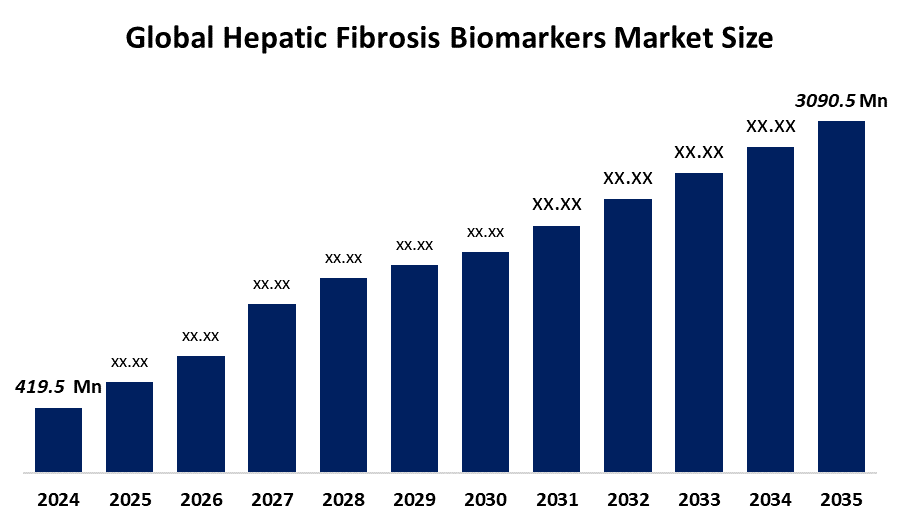
- The Global Hepatic Fibrosis Biomarkers Market Size Was Estimated at USD 419.5 Million in 2024
- The Market Size is Expected to Grow at a CAGR of around 19.91% from 2025 to 2035
- The Worldwide Hepatic Fibrosis Biomarkers Market Size is Expected to Reach USD 3090.5 Million by 2035
- Asia Pacific is expected to grow the fastest during the forecast period.
Get more details on this report -
According to a research report published by Spherical Insights and Consulting, Global Hepatic Fibrosis Biomarkers Market Size was worth around USD 419.5 million in 2024 and is predicted to grow to around USD 3090.5 million by 2035 with a compound annual growth rate (CAGR) of 19.91% from 2025 and 2035. The market for hepatic fibrosis biomarkers has a number of opportunities to grow due to the growing emphasis on standardizing detection assays, establishing universally applicable cut-off values through large multicenter studies, and exploring these biomarkers integration into multi-parameter predictive models. Further, the discovery of proprietary pharmacodynamic blood-based biomarker signature for its lead candidate by the biopharma industries is promoting market demand.
Market Overview
The global hepatic fibrosis biomarkers industry encompasses the development and sale of non-invasive blood tests (e.g., ELF, FIB-4) and imaging techniques to diagnose and stage liver fibrosis. Hepatic fibrosis biomarkers are blood-based, non-invasive indicators (direct or indirect) used to assess the accumulation of scar tissue in the liver, serving as an alternative to liver biopsy. Hyaluronic acid (HA), collagen type IV, and TIMP-1 are some of the key direct markers, while AST, ALT, and platelets are indirect markers. Fibrosis prediction is important for chronic liver disease, in which blood-based biomarkers provide a number of advantages include safety, cost-savings, and wide accessibility over other traditional standards of fibrosis assessment of liver biopsy.
Innovation and market expansion are anticipated as a result of major players' increasing R&D on investigating the utility of combining several biomarkers for enhancing diagnostic accuracy. For instance, there is ongoing research for refining biomarkers and validating their clinical application across diverse populations, improving early diagnosis and management strategies for patients at risk of liver fibrosis.
Report Coverage
This research report categorizes the hepatic fibrosis biomarkers market based on various segments and regions, forecasts revenue growth, and analyzes trends in each submarket. The report analyses the key growth drivers, opportunities, and challenges influencing the hepatic fibrosis biomarkers market. Recent market developments and competitive strategies such as expansion, type launch, development, partnership, merger, and acquisition have been included to draw the competitive landscape in the market. The report strategically identifies and profiles the key market players and analyses their core competencies in each sub-segment of the hepatic fibrosis biomarkers market.
Hepatic Fibrosis Biomarkers Market Report Coverage
| Report Coverage | Details |
|---|---|
| Base Year: | 2024 |
| Market Size in 2024: | USD 419.5 Million |
| Forecast Period: | 2025-2035 |
| Forecast Period CAGR 2025-2035 : | 19.91% |
| 2035 Value Projection: | USD 419.5 Million |
| Historical Data for: | 2020-2023 |
| No. of Pages: | 195 |
| Tables, Charts & Figures: | 110 |
| Segments covered: | By Product, By Technology |
| Companies covered:: | GENFIT, Prometheus Laboratories, Siemens Healthineers AG, BioPredictive, Quest Diagnostics, AstraZeneca, Exalenz Bioscience Ltd (Meridian Bioscience), Labcorp, Pfizer Inc., Bristol-Myers Squibb Company, Others |
| Pitfalls & Challenges: | COVID-19 Empact, Challenge, Future, Growth, & Analysis |
Get more details on this report -
Driving Factors
The market for hepatic fibrosis biomarkers is primarily driven by an increasing prevalence of NASH (nonalcoholic steatohepatitis), obesity, sedentary lifestyles, and metabolic syndrome. Experts estimate that about 24% of U.S. adults have NAFLD, and about 1.5% to 6.5% of U.S. adults have NASH. It was also studied that over 90% individuals with extreme obesity and up to 75% of overweight individuals have NAFLD. Further, globally, advanced hepatic fibrosis affects about 3.3% of the general population, with cirrhosis affecting 1.3%, which is rising, especially in patients with NAFLD, HBV, or excessive alcohol consumption.
Restraining Factors
Global Hepatic Fibrosis Biomarkers Market Size is restricted by factors like increased cost of advanced diagnostic tests, limited reimbursement policies, and lack of standardization across various biomarker panels. Further, the shortage of skilled workforce and limited healthcare infrastructure, especially in the developing economies, is challenging the market growth.
Market Segmentation
The hepatic fibrosis biomarkers market share is classified into product, technology, and end use.
- The kits and reagents segment dominated the market with the largest share of around 47.0% in 2024 and is projected to grow at a substantial CAGR during the forecast period.
Based on the product, the hepatic fibrosis biomarkers market is divided into kits and reagents, assays, and services. Among these, the kits and reagents segment dominated the market with the largest share of around 47.0% in 2024 and is projected to grow at a substantial CAGR during the forecast period. Kits and reagents for these markers, including ELISA for ALT/AST, are important for evaluating liver function and fibrosis progression. Kits like BioPredictive’s Fibro Test and GENFIT’s NIS4 panel set benchmarks for non-invasive liver fibrosis detection, providing reproducibility and compatibility with high-throughput analyzers.
Get more details on this report -
The immunoassay segment accounted for the largest share of about 43.9% in 2024 and is anticipated to grow at a significant CAGR during the forecast period.
Based on the technology, the hepatic fibrosis biomarkers market is divided into immunoassay, molecular diagnostics, proteomics/metabolomics, and imaging-based biomarker assessment. Among these, the immunoassay segment accounted for the largest share of about 43.9% in 2024 and is anticipated to grow at a significant CAGR during the forecast period. Immunoassay technology enables the identification of fibrosis stages and monitoring of treatment response, especially for HBV, HCV, metabolic dysfunction-associated fatty liver disease. Its proven analytical accuracy, scalability for high-throughput screening, and ability to measure multiple biomarkers from small serum volumes is responsible for segmental market growth. are
- The hospitals segment held the largest market share of about 38.0% in 2024 and is anticipated to grow at a substantial CAGR during the forecast period.
Based on the end use, the hepatic fibrosis biomarkers market is divided into hospitals, diagnostic laboratories, specialty clinics, academic & research institutes, and pharmaceutical & biotechnology companies. Among these, the hospitals segment held the largest market share of about 38.0% in 2024 and is anticipated to grow at a substantial CAGR during the forecast period. Non-invasive fibrosis biomarkers are increasingly used as an alternative to invasive liver or lung biopsies. High patient volume, the availability of advanced diagnostic infrastructure, and the integration of biomarker testing into standard hepatology and gastroenterology care pathways are contributing to market growth of the hospitals segment.
Regional Segment Analysis of the Hepatic Fibrosis Biomarkers Market
- North America (U.S., Canada, Mexico)
- Europe (Germany, France, U.K., Italy, Spain, Rest of Europe)
- Asia-Pacific (China, Japan, India, Rest of APAC)
- South America (Brazil and the Rest of South America)
- The Middle East and Africa (UAE, South Africa, Rest of MEA)
North America is anticipated to hold the largest share of the hepatic fibrosis biomarkers market over the predicted timeframe.

Get more details on this report -
North America is anticipated to hold the largest share of about 48.1% in the hepatic fibrosis biomarkers market over the predicted timeframe. The demand for hepatic fibrosis biomarkers has been driven by the region's increased prevalence of chronic liver diseases (NAFLD, NASH, Hepatitis), demand for non-invasive diagnostic tools over liver biopsies, and advanced healthcare infrastructure. Further, the presence of key industry players, including GENFIT, Siemens Healthineers, Quest Diagnostics, Labcorp, and Echosens (Fibroscan), providing serum tests and imaging-based diagnostics for non-alcoholic steatohepatitis (NASH) and liver fibrosis, plays an important role in market growth. The U.S. is dominating the North America market with the largest share, owing to the upsurging demand for non-invasive alternatives to liver biopsy.
Asia Pacific is expected to grow at a rapid CAGR of approximately 21.5% in the hepatic fibrosis biomarkers market during the forecast period. The Asia Pacific area has a thriving market for hepatic fibrosis biomarkers due to the growing prevalence of liver diseases such as hepatitis B/C, and a surge in NAFLD/NASH, which is driven by lifestyle changes, obesity, and diabetes. The ongoing study on liver clinical practice guidelines for the diagnosis and management of metabolic dysfunction-associated fatty liver disease is anticipated to propel market growth. China is leading country in Asia Pacific hepatic fibrosis iomarkers in terms of share, due to its large patient population and strong adoption of diagnostic technologies.
Competitive Analysis:
The report offers the appropriate analysis of the key organizations/companies involved within the Hepatic Fibrosis Biomarkers market, along with a comparative evaluation primarily based on their type of offering, business overviews, geographic presence, enterprise strategies, segment market share, and SWOT analysis. The report also provides an elaborative analysis focusing on the current news and developments of the companies, which includes type development, innovations, joint ventures, partnerships, mergers & acquisitions, strategic alliances, and others. This allows for the evaluation of the overall competition within the market.
List of Key Companies
- GENFIT
- Prometheus Laboratories
- Siemens Healthineers AG
- BioPredictive
- Quest Diagnostics
- AstraZeneca
- Exalenz Bioscience Ltd (Meridian Bioscience)
- Labcorp
- Pfizer Inc.
- Bristol-Myers Squibb Company
- Others
Key Target Audience
- Market Players
- Investors
- End-users
- Government Authorities
- Consulting And Research Firm
- Venture capitalists
- Value-Added Resellers (VARs)
Recent Development
- In March 2025, Precision BioSciences, Inc., a clinical stage gene editing company utilizing its novel proprietary ARCUS platform to develop in vivo gene editing therapies for high unmet need diseases, today announced that the U.S. Food and Drug Administration (FDA) has cleared the Investigational New Drug (IND) application for PBGENE-HBV.
- In November 2024, Arbutus Biopharma Corporation, a clinical-stage biopharmaceutical company leveraging its extensive virology expertise, and Barinthus Biotherapeutics plc, a clinical-stage biopharmaceutical company developing novel immunotherapeutic candidates, announced new preliminary data from the Phase 2a IM-PROVE II clinical trial (AB-729-202) of people with chronic hepatitis B virus (cHBV) at the American Association for the Study of Liver Diseases (AASLD), The Liver Meeting 2024.
- In June 2022, Echosens, a high-technology company offering liver diagnostic solutions, and Novo Nordisk A/S, a leading global healthcare company, today announced a partnership to advance early diagnosis of non-alcoholic steatohepatitis (NASH) and increase awareness of the disease among patients, healthcare providers and other stakeholders.
Market Segment
This study forecasts revenue at global, regional, and country levels from 2020 to 2035. Spherical Insights has segmented the hepatic fibrosis biomarkers market based on the below-mentioned segments:
Global Hepatic Fibrosis Biomarkers Market, By Product
- Kits and Reagents
- Assays
- Services
Global Hepatic Fibrosis Biomarkers Market, By Technology
- Immunoassay
- Molecular Diagnostics
- Proteomics/Metabolomics
- Imaging-Based Biomarker Assessment
Global Hepatic Fibrosis Biomarkers Market, By End Use
- Hospitals
- Diagnostic Laboratories
- Specialty Clinics
- Academic & Research Institutes
- Pharmaceutical & Biotechnology Companies
Global Hepatic Fibrosis Biomarkers Market, By Regional Analysis
- North America
- US
- Canada
- Mexico
- Europe
- Germany
- UK
- France
- Italy
- Spain
- Russia
- Rest of Europe
- Asia Pacific
- China
- Japan
- India
- South Korea
- Australia
- Rest of Asia Pacific
- South America
- Brazil
- Argentina
- Rest of South America
- Middle East & Africa
- UAE
- Saudi Arabia
- Qatar
- South Africa
- Rest of the Middle East & Africa
Frequently Asked Questions (FAQ)
-
1. What is the market size of the hepatic fibrosis biomarkers market?The global hepatic fibrosis biomarkers market size is expected to grow from USD 419.5 Million in 2024 to USD 3090.5 Million by 2035, at a CAGR of 19.91% during the forecast period 2025-2035.
-
2. Which region holds the largest share of the hepatic fibrosis biomarkers market?North America is anticipated to hold the largest share of the hepatic fibrosis biomarkers market over the predicted timeframe.
-
3. What is the forecasted CAGR of the Global Hepatic fibrosis biomarkers Market from 2024 to 2035?The market is expected to grow at a CAGR of around 19.91% during the period 2024–2035.
-
4. Who are the top companies that are involved in the Global Hepatic fibrosis biomarkers Market?Key players include GENFIT, Prometheus Laboratories, Siemens Healthineers AG, BioPredictive, Quest Diagnostics, AstraZeneca, Exalenz Bioscience Ltd (Meridian Bioscience), Labcorp, Pfizer Inc., and Bristol-Myers Squibb Company.
-
5. What are the main drivers in the hepatic fibrosis biomarkers market?An increasing prevalence of NASH (nonalcoholic steatohepatitis), obesity, sedentary lifestyles, and metabolic syndrome are major market growth drivers of the hepatic fibrosis biomarkers market.
-
6. What challenges are limiting the adoption of hepatic fibrosis biomarkers treatment?Factors like increased cost of advanced diagnostic tests, limited reimbursement policies, and lack of standardization remain key restraints in the hepatic fibrosis biomarkers market.
-
7. What are the key trends in the hepatic fibrosis biomarkers market?The surging inclination towards non-invasive diagnostic tools, with increased emphasis on serum-based, direct markers for better accuracy in assessing NASH/MASLD, are major key trends in the hepatic fibrosis biomarkers market.
Need help to buy this report?