Global Gold Nanoparticles Market Size, Share, and COVID-19 Impact Analysis, By Type (Colloidal, Spherical, Rod-Shaped, Core-Shell, and Hollow), By Application (Imaging, Targeted Drug Delivery, Proton Therapy, In-Vitro Assays, and Others), By End User (Healthcare, Electronics, Chemicals, Cosmetics, and Others), and By Region (North America, Europe, Asia-Pacific, Latin America, Middle East, and Africa), Analysis and Forecast 2025 - 2035.
Industry: Chemicals & Materials
Global Gold Nanoparticles Market Insights Forecasts to 2035
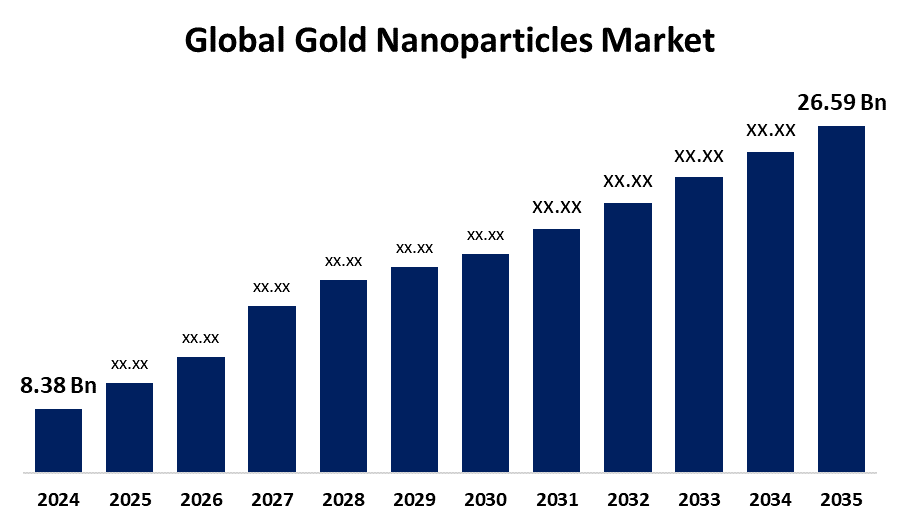
- The Global Gold Nanoparticles Market Size Was Estimated at USD 8.38 Billion in 2024
- The Market Size is Expected to Grow at a CAGR of around 11.07% from 2025 to 2035
- The Worldwide Gold Nanoparticles Market Size is Expected to Reach USD 26.59 Billion by 2035
- Asia Pacific is expected to grow the fastest during the forecast period.
Get more details on this report -
According to a research report published by Spherical Insights and Consulting, the global gold nanoparticles market size was worth around USD 8.38 billion in 2024 and is predicted to grow to around USD 26.59 billion by 2035 with a compound annual growth rate (CAGR) of 11.07% from 2025 to 2035. Global expansion of AI-driven synthesis, green chemistry production, and high performance electronics with significant expansion in medical imaging and biosensors application are all driving opportunities in the gold nanoparticles market.
Market Overview
The global industry segment involved in the production, distribution, and application of gold nanoparticles, tiny particles of gold typically 1 to 100 nm in size known for their unique optical, electronic, and chemical properties is known as the gold nanoparticles market. These include innovations in synthesis methods, surface functionalization for targeted applications, advanced characterization tools, scalable production technologies, and application specific solutions like improved sensors and diagnostics. Governments play a crucial role by funding research, regulating safety and environmental standards, providing incentives for nanotechnology innovation, and implementing policies. For example, in February 2026 Indias DST announced development of a novel gold liquid crystal hybrid material involving gold nanoparticles at the Centre for Nano and Soft Matter Sciences Bengaluru.
In December 2025 the US NNI requested over USD 2.2 billion for nanotechnology research and development a portion of which supports foundational nanoscale science including gold nanoparticle based biomedical and nano optical research.
Report Coverage
This research report categorizes the gold nanoparticles market based on various segments and regions forecasts revenue growth and analyzes trends in each submarket. The report analyses the key growth drivers opportunities and challenges influencing the gold nanoparticles market. Recent market developments and competitive strategies such as expansion product launch development partnership merger and acquisition have been included to draw the competitive landscape in the market. The report strategically identifies and profiles the key market players and analyses their core competencies in each sub segment of the gold nanoparticles market.
Driving Factors
Rapid technological innovation is one of the main drivers of the gold nanoparticles markets growth. Rapid advancements in nanotechnology and material science growing demand in biomedicine along with expansion in electronics cosmetics and catalysis sectors is the main factor driving the market for gold nanoparticles. In this field innovation and investment are driven by the growing need for research and development activities coupled with increasing collaboration between academic institutions startups and large corporations. Government support promoting innovation and ensuring regulatory compliance also supports growth.
In July 2025 the US NSF awarded a project grant to researchers of the University of Southern California and partners to study how N heterocyclic carbene ligands bind to gold nanoparticles and improve their stability for medical diagnostics cancer therapies and catalysis.
Restraining Factors
High development and deployment costs limited synthesis processes regulatory challenges around safety lack of standardized protocols lack of skilled personnel concerns over toxicity bioaccumulation and long term environmental effects are the main factors restricting the gold nanoparticles market.
Market Segmentation
The gold nanoparticles market share is classified into type application and end user.
The spherical segment dominated the market in 2024 approximately 42 percent and is projected to grow at a substantial CAGR during the forecast period. Based on type the gold nanoparticles market is divided into colloidal spherical rod shaped core shell and hollow. Among these the spherical segment dominated the market in 2024 approximately 42 percent and is projected to grow at a substantial CAGR during the forecast period. The growing need for consistent quality provides high volume production exhibits characteristic surface plasmon resonance in the visible light spectrum and offers high biocompatibility and stability which is driving the spherical segment.
The proton therapy segment accounted for the largest share in 2024 approximately 30 percent and is anticipated to grow at a significant CAGR during the forecast period. Based on application the gold nanoparticles market is divided into imaging targeted drug delivery proton therapy in vitro assays and others. Among these the proton therapy segment accounted for the largest share in 2024 approximately 30 percent and is anticipated to grow at a significant CAGR during the forecast period. Increase in high atomic number gold nanoparticles as superior radiosensitizers and increased proton irradiation efficiency to maximize DNA damage in cancer cells is driving the proton therapy segment.
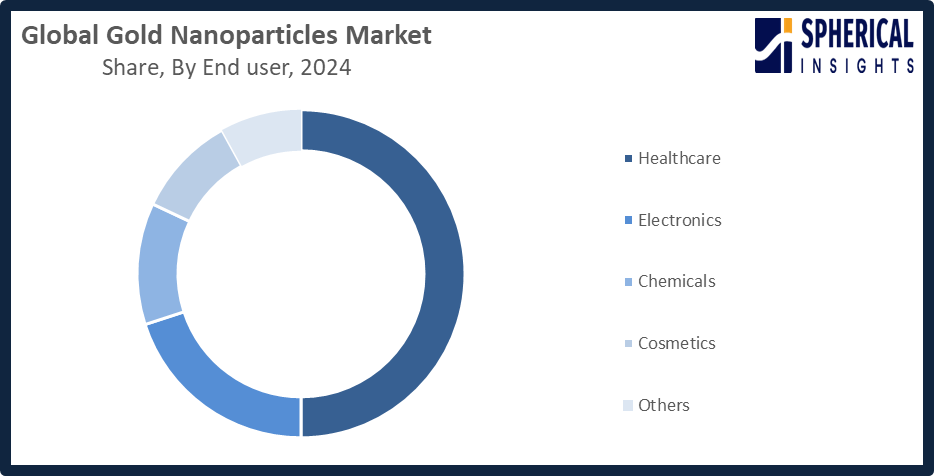
The healthcare segment accounted for the highest market revenue in 2024 approximately 55 percent and is anticipated to grow at a significant CAGR during the forecast period. Based on end user the gold nanoparticles market is divided into healthcare electronics chemicals cosmetics and others. Among these the healthcare segment accounted for the highest market revenue in 2024 approximately 55 percent and is anticipated to grow at a significant CAGR during the forecast period. Increased demand for targeted drug delivery and cancer therapy wide usage in diagnostic kits biocompatibility and increased investment in research and nanotechnology are bolstering the healthcare segment.
Regional Segment Analysis of the Gold Nanoparticles Market
- North America US Canada Mexico
- Europe Germany France UK Italy Spain Rest of Europe
- Asia Pacific China Japan India Rest of Asia Pacific
- South America Brazil Rest of South America
- Middle East and Africa UAE South Africa Rest of Middle East and Africa
Get more details on this report -
North America is anticipated to hold the largest share of the gold nanoparticles market over the predicted timeframe.
Strong government backing for green and scalable synthesis methods surface functionalization for targeted drug delivery advanced characterization tools and integration in nanoelectronics are driving growth in North America. The regions position is further reinforced by government programs promoting high quality production faster commercialization and diversified applications of gold nanoparticles across healthcare electronics and chemical sectors.
Government initiatives include Canadas NRC February 2025 administering a Nanotechnology Initiative in collaboration with the University of Alberta to support nanotechnology research projects and personnel development. In July 2024 Canada supported NMIN through the NCE program to advance nanomedicine diagnostics therapeutics and delivery systems. The US NNI ongoing since 2000 coordinates and funds nanoscale science and engineering research across multiple federal agencies providing billions in annual research and development support.
Asia Pacific is expected to grow at a rapid CAGR in the gold nanoparticles market during the forecast period. China Japan and South Korea are among the nations making significant investments in green and scalable synthesis methods eco friendly production processes and innovations in point of care diagnostics and nanomedicine. The demand for sophisticated gold nanoparticles is further accelerated by the regions major healthcare infrastructure and rising adoption of advanced diagnostics and therapeutics. Governments are also promoting nanotechnology research and commercialization.
Government launches include Chinas October 2025 15th China International Nanotechnology Industry event showcasing nanomaterials nano health MEMS and nano innovations including gold nanoparticles. Japans JST January 2025 exhibited at the nanotech 2025 international nanotechnology trade show in Tokyo showcasing gold nanoparticles in advanced technology fields.
Competitive Analysis
The report offers appropriate analysis of the key organizations and companies involved in the gold nanoparticles market along with comparative evaluation based on their product offerings business overview geographic presence enterprise strategies segment market share and SWOT analysis. The report also provides an elaborative analysis focusing on current news and developments including product development innovations joint ventures partnerships mergers and acquisitions strategic alliances and others. This allows evaluation of overall competition within the market.
List of Key Companies
- BBI Solutions
- Cytodiagnostics Inc
- TANAKA Precious Metal Group Co Ltd
- Fortis Life Sciences
- Merck KGaA
- Meliorum Technologies Inc
- Nanopartz Inc
- American Elements
- NanoHybrids Inc
- CD Bioparticles
- Sigma Aldrich
- Sona Nanotech Inc
- Aurion
- Nanostellar Inc
- Strem Chemicals Inc
- Others
Key Target Audience
- Market Players
- Investors
- End users
- Government Authorities
- Consulting and Research Firms
- Venture Capitalists
- Value Added Resellers
Recent Development
- In August 2025 BBI Solutions Sigma Aldrich and Cytodiagnostics were recognized for their innovation strong portfolios and global reach in the gold nanoparticles market highlighting the growing importance of gold nanoparticles in diagnostics therapeutics and other applications.
- In July 2025 TANAKA Holdings announced an investment in green synthesis technologies for gold nanoparticles aimed at improving sustainability scalability and purity in nanoparticle production.
- In May 2025 Osmania University researchers developed a rapid low cost sepsis test using gold nanoparticles delivering results in just 30 minutes representing a significant advancement in early diagnosis and treatment of sepsis.
Market Segment
This study forecasts revenue at global regional and country levels from 2020 to 2035. Spherical Insights has segmented the gold nanoparticles market based on the following segments
Global Gold Nanoparticles Market, By Type
- Colloidal
- Spherical
- Rod Shaped
- Core Shell
- Hollow
Global Gold Nanoparticles Market, By Application
- Imaging
- Targeted Drug Delivery
- Proton Therapy
- In Vitro Assays
- Others
Global Gold Nanoparticles Market, By End User
- Healthcare
- Electronics
- Chemicals
- Cosmetics
- Others
Global Gold Nanoparticles Market By Regional Analysis
North America
- US
- Canada
- Mexico
Europe
- Germany
- UK
- France
- Italy
- Spain
- Russia
- Rest of Europe
Asia Pacific
- China
- Japan
- India
- South Korea
- Australia
- Rest of Asia Pacific
South America
- Brazil
- Argentina
- Rest of South America
Middle East and Africa
- UAE
- Saudi Arabia
- Qatar
- South Africa
- Rest of Middle East and Africa
Frequently Asked Questions (FAQ)
-
What is green synthesis of gold nanoparticles?Green synthesis uses environmentally friendly methods to produce nanoparticles. It often involves biological agents such as plant extracts or microbes. This approach reduces toxic chemicals and environmental harm.
-
How are gold nanoparticles used in diagnostics?They are used in rapid diagnostic tests due to their strong color properties. Gold nanoparticles help detect biomarkers with high sensitivity. They are commonly found in lateral flow assays and biosensors.
-
How is the gold nanoparticles market evolving?The market is shifting toward large-scale commercialization. There is increasing focus on clinical and industrial applications. Advanced nanohybrid materials are also emerging.
-
What role do gold nanoparticles play in cancer treatment?Gold nanoparticles are used in photothermal therapy to destroy cancer cells. They convert light into heat when exposed to specific wavelengths. This targeted approach minimizes damage to healthy tissues.
-
What is the current trend in the gold nanoparticles market?There is a growing focus on green and sustainable synthesis methods. Companies are developing multifunctional nanoparticles for combined applications. Integration into theranostics is also becoming a key trend.
-
What is the future outlook for the gold nanoparticles market?The future looks promising with growth in nanomedicine and personalized healthcare. Sustainable production methods will play a key role. Continued innovation will expand applications across industries.
Need help to buy this report?