Global Glycerine Market Size, Share, and COVID-19 Impact Analysis, By Grade (USP Grade and Technical Grade), By Application (Personal Care, Food and Beverages, Pharmaceuticals, Polyether Polyols, Chemical Intermediate, and Others), and By Region (North America, Europe, Asia-Pacific, Latin America, Middle East, and Africa), Analysis and Forecast 2025 - 2035.
Industry: Chemicals & Materials
Global Glycerine Market Insights Forecasts to 2035
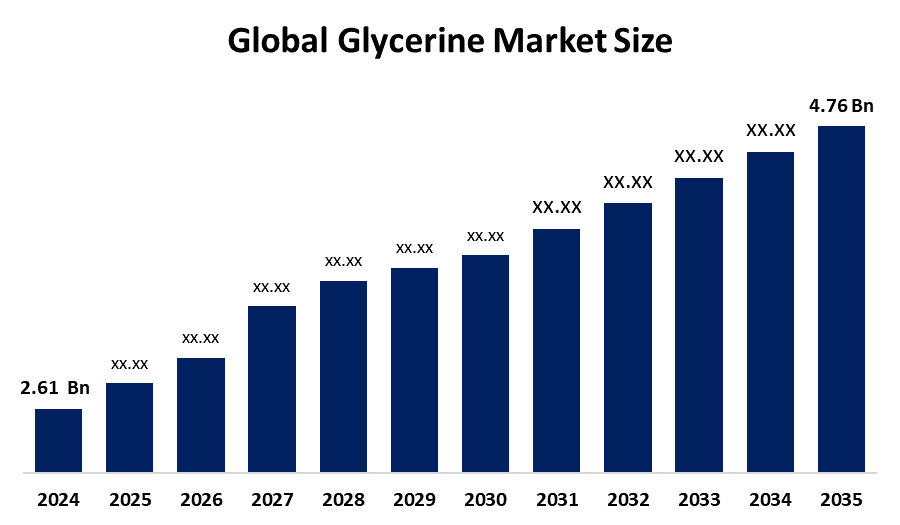
- The Global Glycerine Market Size Was Estimated at USD 2.61 Billion in 2024
- The Market Size is Expected to Grow at a CAGR of around 5.61% from 2025 to 2035
- The Worldwide Glycerine Market Size is Expected to Reach USD 4.76 Billion by 2035
- North America is expected to grow the fastest during the forecast period.
Get more details on this report -
According to a research report published By Spherical Insights and Consulting, The Global Glycerine Market Size was worth around USD 2.61 Billion in 2024 and is predicted to Grow to around USD 4.76 Billion by 2035 with a compound annual Growth rate (CAGR) of 5.61% from 2025 to 2035. The glycerine market has been experiencing growth in recent years due to the rising demand in the personal care, pharma, and food and beverage sectors. This has been a result of the easy availability of glycerine produced from the rising production of biodiesel.
Market Overview
The global glycerine market refers to the production and trading of glycerine, which is an odorless, colorless, and viscous liquid produced through synthetic methods, animal and vegetable fats, and animal and vegetable oils. Glycerine finds numerous applications as an antifreeze solution and a lubricant formulation. However, some key driving forces for the global glycerine industry include increasing usage in personal care and cosmetic goods, growing pharmaceutical manufacturing facilities, and rising production of biodiesel, as one of the key by-products produced through the manufacturing process. Increasing customer preferences for natural ingredients are key trends within the global glycerine market.
The Indonesian government has enforced B40 biodiesel blending mandatory as of January 2025, increasing the required 40% blending content of crude palm oil to 40%, from 35%. With this globally ambitious biodiesel blending policy, the country enhances energy security and biodiesel production but decreases palm oil exports, affecting the production of cooking oil as well as glycerine. There is potential for growth in entrepreneurial ventures involving the production of high-purity and special glycerines, besides their use as a base for green substances. Main rivals for the global glycerine industry include Wilmar International, Cargill, KLK Oleo, IOI Corporation, Emery Oleochemicals, and Oleon.
Report Coverage
This research report categorizes the glycerine market based on various segments and regions, forecasts revenue growth, and analyzes trends in each submarket. The report analyses the key growth drivers, opportunities, and challenges influencing the glycerine market. Recent market developments and competitive strategies, such as expansion, type launch, development, partnership, merger, and acquisition, have been included to draw the competitive landscape in the market. The report strategically identifies and profiles the key market players and analyses their core competencies in each sub-segment of the glycerine market.
Globa Glycerine Market Report Coverage
| Report Coverage | Details |
|---|---|
| Base Year: | 2024 |
| Market Size in 2024: | USD 2.61 Billion |
| Forecast Period: | 2024-2035 |
| Forecast Period CAGR 2024-2035 : | CAGR of 5.61% |
| 2035 Value Projection: | USD 4.76 Billion |
| Historical Data for: | 2020-2023 |
| No. of Pages: | 210 |
| Tables, Charts & Figures: | 115 |
| Segments covered: | By Type, By Application |
| Companies covered:: | Cargill, Incorporated, KLK Oleo, BASF SE, The Dow Chemical Company, Wilmar International Ltd, IOI Corporation, Oleon NV, Emery Oleochemicals, Archer Daniels Midland (ADM), Musim Mas Group, Procter & Gamble (P&G) Chemicals, Kao Corporation, Vantage Specialty Chemicals, Godrej Industries Limited, Others, and key players |
| Pitfalls & Challenges: | COVID-19 Empact, Challenge, Future, Growth, & Analysis |
Get more details on this report -
Driving Factors
The market for glycerine is fueled by the rising adoption of glycerine in the pharma, cosmetic, dermatology, food and beverage, and biodiesel markets. The applications of glycerine as a humectant, sweetener, solvent, and stabilizer contribute to its being an in-demand material. Rising uses in dermatological products, soap, and oral care products, and the growing biodiesel market, which produces crude glycerine as a by-product, also drive the glycerine market. Health consciousness and the preference for a biodegradable product also stimulate the glycerine market. Glycerine purification technology advancements and the rise in industrialization in emerging economies also stimulate the glycerine market.
Restraining Factors
Market-related factors, including market volatility of raw materials, oversupply in specific geographic markets, and high production costs, restrain the glycerine market worldwide. Additionally, restrictions imposed on chemical-grade glycerine, market rivalry posed by synthetic glycerine, and land and water pollution issues of by-product waste in biodiesel production are factors that create difficulties for profitability in this market.
Market Segmentation
The glycerine market share is classified into grade and application.
- The USP grade segment dominated the market in 2024, approximately 58% and is projected to grow at a substantial CAGR during the forecast period.
Based on the grade, the glycerine market is divided into USP grade and technical grade. Among these, the USP grade segment dominated the market in 2024 and is projected to grow at a substantial CAGR during the forecast period. USP Grade glycerine currently leads the market because of its high purity and extensive uses in pharmaceuticals, cosmetics, and foods. It also meets stringent requirements of quality, making it suitable for use in sensitive products. Its non-toxicity, moisture-retentive, as well as its smoothness, along with health, cleanliness, and quality consciousness, will keep demanding high.
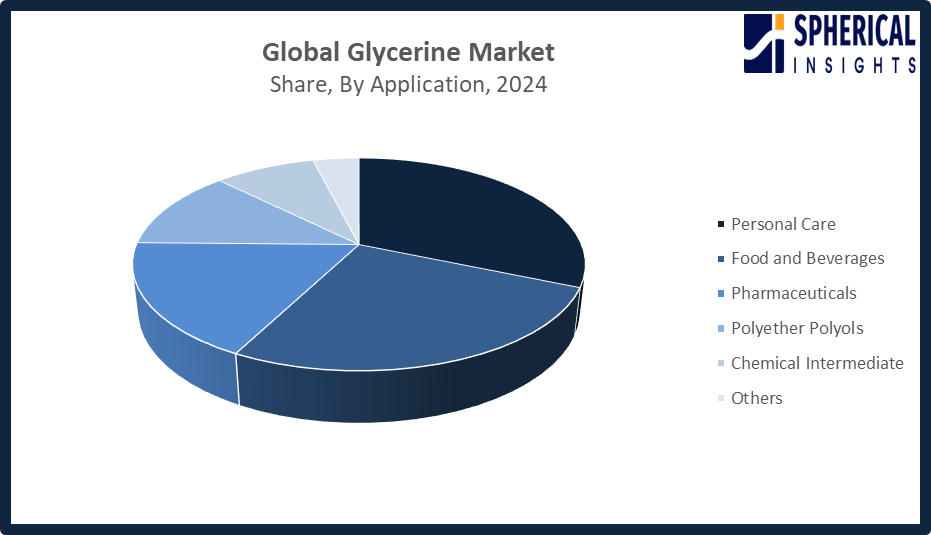
- The personal care segment accounted for the highest market revenue in 2024, approximately 31% and is anticipated to grow at a significant CAGR during the forecast period.
Based on the application, the glycerine market is divided into personal care, food and beverages, pharmaceuticals, polyether polyols, chemical intermediate, and others. Among these, the personal care segment accounted for the highest market revenue in 2024 and is anticipated to grow at a significant CAGR during the forecast period. Personal care dominates the market due to the moisturizing properties of glycerine. Glycerine is a humectant ingredient required in personal care products to retain the softness of the skin. The increasing demand for natural ingredients from the personal care industry raises the market status of glycerine due to its compatibility with other ingredients.
Get more details on this report -
Regional Segment Analysis of the Glycerine Market
- North America (U.S., Canada, Mexico)
- Europe (Germany, France, U.K., Italy, Spain, Rest of Europe)
- Asia-Pacific (China, Japan, India, Rest of APAC)
- South America (Brazil and the Rest of South America)
- The Middle East and Africa (UAE, South Africa, Rest of MEA)
Asia Pacific is anticipated to hold the largest share of the glycerine market over the predicted timeframe.
Asia Pacific is anticipated to hold the largest share of the glycerine market over the predicted timeframe. The Asia Pacific is expected to account for the 45% share of the glycerine market due to the large-scale industrialization process taking place in this region. China, India, and Japan provide some of the major contributions to this market; however, China leads due to its large production capacity as well as the increased use of glycerine in various cosmetic, pharmaceutical, and food products. Environmental concerns, combined with the increased use of bio-based chemicals, remain major factors increasing the demand. Also, due to the growth of renewable fuels/biodiesel markets, this leads to the increased production of crude glycerine as a byproduct.

Get more details on this report -
North America is expected to grow at a rapid CAGR in the glycerine market during the forecast period. The glycerine market in North America is expected to have 27% market share of rising applications in the drug, personal care, and food sectors, countered by the adoption of biodegradable chemicals. The US, being the biggest market, leads the market through Government environmental policies and renewable energy projects, along with the production of biodiesel that results in crude glycerine. The preference for eco-friendly products and improvements in glycerine purification also drive the market. On January 10, 2025, the U.S. Department of Agriculture funded 586 projects aimed at promoting clean energy and the production of biodiesel, thus indirectly promoting glycerine.
The glycerine market in Europe is also expanding owing to increasing applications in consumer products, pharmaceuticals, and food sectors, and strict environmental regulations pushing for the promotion of bio-based chemicals. Germany stands as a leader in this region due to advanced production capabilities, climate change-driven mature consumer demand for cosmetic and drug glycerine, and a focus on the promotion of renewable energy and biodiesel production in that country.
Competitive Analysis:
The report offers the appropriate analysis of the key organizations/companies involved within the glycerine market, along with a comparative evaluation primarily based on their type of offering, business overviews, geographic presence, enterprise strategies, segment market share, and SWOT analysis. The report also provides an elaborative analysis focusing on the current news and developments of the companies, which includes type development, innovations, joint ventures, partnerships, mergers & acquisitions, strategic alliances, and others. This allows for the evaluation of the overall competition within the market.
List of Key Companies
- Cargill, Incorporated
- KLK Oleo
- BASF SE
- The Dow Chemical Company
- Wilmar International Ltd
- IOI Corporation
- Oleon NV
- Emery Oleochemicals
- Archer Daniels Midland (ADM)
- Musim Mas Group
- Procter & Gamble (P&G) Chemicals
- Kao Corporation
- Vantage Specialty Chemicals
- Godrej Industries Limited
- Others
Key Target Audience
- Market Players
- Investors
- End-users
- Government Authorities
- Consulting and Research Firm
- Venture capitalists
- Value-Added Resellers (VARs)
Recent Development
- In July 2025, Godrej Industries announced a RS750 crore expansion in its Chemicals division to support its goal of becoming a USD 1 billion global player by 2030. The plan doubles Fatty Alcohol and Erucic Acid capacities, expands glycerine and specialty chemicals, and boosts renewable energy use to 75%.
- In February 2025, Vantage Specialty Chemicals announced that its VYCERIN API Glycerin, USP is now listed on the FDA Drug Master File (DMF-040171). Made in the U.S. to ICH Q7 standards, it is the first-to-market API-grade glycerin for pharmaceutical applications.
- In December 2023, ADM acquired a controlling stake in Buckminster Química, a Sao Paulo-based refined glycerin producer. The move strengthens ADM’s portfolio and capabilities in sustainably sourced products for food, feed, fuel, industrial, and consumer applications, supporting growing demand for bio-based glycerin and broadening its presence in Brazil.
- In August 2021, Eni and BASF signed a strategic R&D agreement to lower the transportation sector’s CO2 footprint. The partnership focuses on producing advanced biopropanol from glycerin, a biodiesel by-product, using an innovative catalytic hydrotreatment process, with Eni sourcing glycerin from European producers to support sustainable fuel development.
Market Segment
This study forecasts revenue at global, regional, and country levels from 2020 to 2035. Spherical Insights has segmented the glycerine market based on the below-mentioned segments:
Global Glycerine Market, By Grade
- USP Grade
- Technical Grade
Global Glycerine Market, By Application
- Personal Care
- Food and Beverages
- Pharmaceuticals
- Polyether Polyols
- Chemical Intermediate
- Others
Global Glycerine Market, By Regional Analysis
- North America
- US
- Canada
- Mexico
- Europe
- Germany
- UK
- France
- Italy
- Spain
- Russia
- Rest of Europe
- Asia Pacific
- China
- Japan
- India
- South Korea
- Australia
- Rest of Asia Pacific
- South America
- Brazil
- Argentina
- Rest of South America
- Middle East & Africa
- UAE
- Saudi Arabia
- Qatar
- South Africa
- Rest of the Middle East & Africa
Frequently Asked Questions (FAQ)
-
1.What is the CAGR of the glycerine market over the forecast period?The global glycerine market is projected to expand at a CAGR of 5.61% during the forecast period.
-
2.What is the glycerine market?The glycerine market involves the production, distribution, and sale of glycerine, used in pharmaceuticals, cosmetics, food, and industrial applications.
-
3.What is the market size of the glycerine market?The global glycerine market size is expected to grow from USD 2.61 billion in 2024 to USD 4.76 billion by 2035, at a CAGR of 5.61% during the forecast period 2025-2035.
-
4.Which region holds the largest share of the glycerine market?Asia Pacific is anticipated to hold the largest share of the glycerine market over the predicted timeframe.
-
5.Who are the top 10 companies operating in the global glycerine market?Cargill, Incorporated, KLK Oleo, BASF SE, The Dow Chemical Company, Wilmar International Ltd, IOI Corporation, Oleon NV, Emery Oleochemicals, Archer Daniels Midland (ADM), Musim Mas Group, and Others.
-
6.What factors are driving the growth of the glycerine market?The glycerine market is driven by rising demand in pharmaceuticals, personal care, and food industries, increased biodiesel production, adoption of bio-based chemicals, and growing consumer preference for eco-friendly, high-purity products.
-
7.What are the market trends in the glycerine market?Key trends include rising demand for bio-based glycerine, high-purity grades, applications in personal care, pharmaceuticals, and sustainable chemical production.
-
8.What are the main challenges restricting wider adoption of the glycerine market?The main challenges restricting wider adoption of the glycerine market are primarily linked to supply chain volatility tied to the biodiesel industry, fluctuations in raw material costs and availability, and the high expenses associated with purification processes.
Need help to buy this report?