Global Energy Harvesting System Market Size, Share, and COVID-19 Impact Analysis, By Energy Source (Thermal, Vibration & Kinetic Energy, Solar, and Others), By Component (Transducers, Power Management, Storage Devices, and Others), and by Region (North America, Europe, Asia-Pacific, Latin America, Middle East, and Africa), Analysis and Forecast 2025 - 2035
Industry: Energy & Power
Global Energy Harvesting System Market Insights Forecasts to 2035
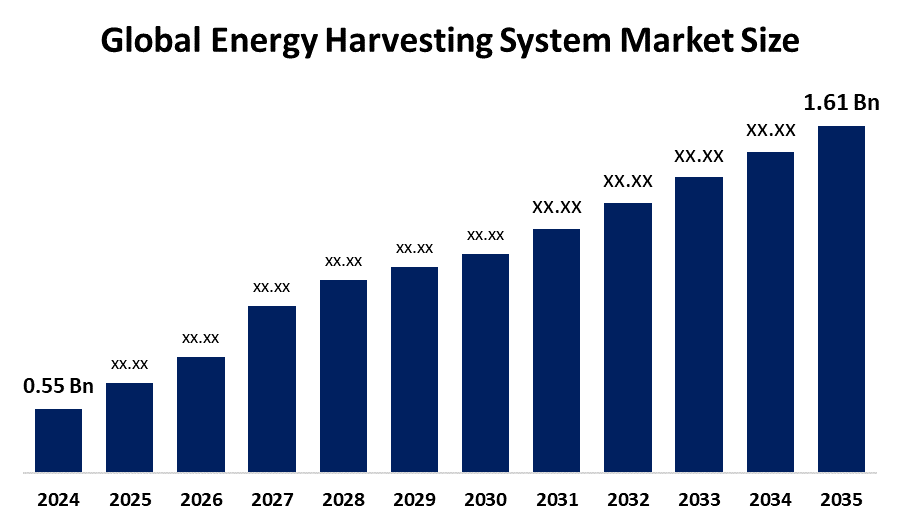
- The Global Energy Harvesting System Market Size Was Estimated At USD 0.55 Billion In 2024
- The Market Size Is Expected To Grow At A CAGR Of Around 10.26 % From 2025 To 2035
- The Worldwide Energy Harvesting System Market Size Is Expected To Reach USD 1.61 Billion By 2035
- Asia Pacific Is Expected To Grow The Fastest During The Forecast Period.
Get more details on this report -
According To A Research Report Published By Spherical Insights And Consulting, The Global Energy Harvesting System Market Size Was Worth Around USD 0.55 Billion In 2024 And Is Predicted To Grow To Around USD 1.61 Billion By 2035 With A Compound Annual Growth Rate (CAGR) Of 10.26% From 2025 to 2035. Future opportunities in the energy harvesting system market include growing IoT device deployment, wearable electronics expansion, renewable energy integration, smart infrastructure development, and increasing demand for self-powered and sustainable energy solutions globally.
Market Overview
Energy harvesting systems (EHS) refer to technologies that capture and convert ambient energy such as solar, thermal, vibration, or kinetic energy into electrical power to operate small devices or sensors. These systems are increasingly used in Internet of Things (IoT) devices, wearable electronics, wireless sensor networks, and smart infrastructure, offering self-powered, sustainable solutions. Market growth is driven by rising demand for energy-efficient devices, the proliferation of connected technologies, and the need for reliable, off-grid power sources. Governments worldwide are supporting adoption through initiatives like the U.S. Department of Energy’s funding for energy harvesting research, the EU’s Horizon Europe program promoting smart infrastructure, and Japan’s subsidies for self-powered sensor technologies, accelerating innovation and deployment.
Report Coverage
This Research Report Categorizes The Energy Harvesting System Market Size based on various segments and regions, forecasts revenue growth, and analyzes trends in each submarket. The report analyses the key growth drivers, opportunities, and challenges influencing the energy harvesting system market. Recent market size developments and competitive strategies, such as expansion, product launch, development, partnership, merger, and acquisition, have been included to draw the competitive landscape in the market. The report strategically identifies and profiles the key market players and analyzes their core competencies in each sub-segment of the energy harvesting system market.
Global Energy Harvesting System Market Report Coverage
| Report Coverage | Details |
|---|---|
| Base Year: | 2024 |
| Market Size in 2024: | 1.61 Billion |
| Forecast Period: | 2020-2023 |
| Forecast Period CAGR 2020-2023 : | 0.55 Billion |
| 2023 Value Projection: | 1.61 Billion |
| Historical Data for: | 2020-2023 |
| No. of Pages: | 180 |
| Tables, Charts & Figures: | 121 |
| Segments covered: | By Component By Energy |
| Companies covered:: | STMicroelectronics, Microchip Technology Inc., Texas Instruments Incorporated, Analog Devices, Inc., Infineon Technologies AG, Renesas Electronics Corporation, EnOcean GmbH, ABB, Honeywell International Inc., Qorvo, Inc., Asahi Kasei Microdevices, Fraunhofer IIS, Kinetron, Ambient Photonics, Powercast, Sony Semiconductor Solutions Corporation, and Other Key Players |
| Pitfalls & Challenges: | COVID-19 Empact, Challenge, Future, Growth, & Analysis |
Get more details on this report -
Driving Factors
The Energy Harvesting System Market Size is driven by increasing adoption of IoT devices, wearable electronics, and wireless sensor networks that require self-sustaining power sources. Growing focus on renewable and sustainable energy solutions, rising demand for energy-efficient and maintenance-free systems, and the need for off-grid and remote monitoring applications further propel growth. Technological advancements in microelectronics, low-power sensors, and energy conversion efficiency are enhancing system performance, while expanding smart infrastructure and industrial automation initiatives globally continue to create significant opportunities for energy harvesting solutions.
Restraining Factors
High initial costs, limited energy conversion efficiency, dependence on specific environmental conditions, and technological complexity restrict widespread adoption of energy harvesting systems across commercial and industrial applications.
Market Segmentation
The Energy Harvesting System market share is classified into energy source and component.
- The solar segment accounted for the largest share in 2024 and is anticipated to grow at a significant CAGR during the forecast period.
Based on the energy source, the energy harvesting system market size is divided into thermal, vibration & kinetic energy, solar, and others. Among these, the solar segment accounted for the largest share in 2024 and is anticipated to grow at a significant CAGR during the forecast period. The Solar segment leads due to abundant sunlight availability, high energy conversion efficiency, low maintenance requirements, and strong adoption in IoT devices, wearable electronics, and smart infrastructure. Government incentives and declining solar technology costs further support rapid market growth.
- The power management segment accounted for the highest market revenue in 2024 and is anticipated to grow at a significant CAGR during the forecast period.
Based on the component, the energy harvesting system market size is divided into transducers, power management, storage devices, and others. Among these, the power management segment accounted for the highest market revenue in 2024 and is anticipated to grow at a significant CAGR during the forecast period. The power management segment dominates due to its essential function in optimizing energy conversion, regulating voltage, and maximizing storage efficiency. Growing deployment of low-power IoT devices and wireless sensors increases demand for advanced power management solutions, supporting strong revenue growth and continued technological advancements across energy harvesting applications.
Regional Segment Analysis of the Energy Harvesting System Market
- North America (U.S., Canada, Mexico)
- Europe (Germany, France, U.K., Italy, Spain, Rest of Europe)
- Asia-Pacific (China, Japan, India, Rest of APAC)
- South America (Brazil and the Rest of South America)
- The Middle East and Africa (UAE, South Africa, Rest of MEA)
North America is anticipated to hold the largest share of the energy harvesting system market over the predicted timeframe.
North America is anticipated to hold the largest share of the energy harvesting system market over the predicted timeframe. North America is expected to dominate the energy harvesting system market due to early adoption of advanced technologies, strong presence of IoT and wearable device manufacturers, and high investments in smart infrastructure. Supportive government funding, research initiatives, and growing demand for energy-efficient, self-powered systems further drive regional market leadership.
Asia Pacific is expected to grow at a rapid CAGR in the energy harvesting system market during the forecast period. Asia Pacific is projected to grow at a rapid CAGR due to expanding industrial automation, rising adoption of IoT devices, and rapid urbanization. Strong manufacturing ecosystems, increasing investments in smart cities, and government initiatives supporting renewable energy and energy-efficient technologies across China, India, and Southeast Asia are accelerating regional market growth.
Competitive Analysis:
The report offers the appropriate analysis of the key organizations/companies involved within the energy harvesting system market, along with a comparative evaluation primarily based on their product offering, business overviews, geographic presence, enterprise strategies, segment market share, and SWOT analysis. The report also provides an elaborative analysis focusing on the current news and developments of the companies, which includes product development, innovations, joint ventures, partnerships, mergers & acquisitions, strategic alliances, and others. This allows for the evaluation of the overall competition within the market.
List of Key Companies
- STMicroelectronics
- Microchip Technology Inc.
- Texas Instruments Incorporated
- Analog Devices, Inc.
- Infineon Technologies AG
- Renesas Electronics Corporation
- EnOcean GmbH
- ABB
- Honeywell International Inc.
- Qorvo, Inc.
- Asahi Kasei Microdevices
- Fraunhofer IIS
- Kinetron
- Ambient Photonics
- Powercast
- Sony Semiconductor Solutions Corporation
Key Target Audience
- Market Players
- Investors
- End-users
- Government Authorities
- Consulting and Research Firm
- Venture capitalists
- Value-Added Resellers (VARs)
Recent Development
- In May 2025, Asahi Kasei Microdevices has introduced power management ICs for energy-harvesting applications that efficiently manage the charging and discharging of rechargeable batteries in IoT sensors, remote controls, and Bluetooth tracking devices.
Market Segment
This study forecasts revenue at global, regional, and country levels from 2020 to 2035. Spherical Insights has segmented the energy harvesting system market based on the below-mentioned segments:
Global Energy Harvesting System Market, By Energy Source
- Thermal
- Vibration & Kinetic Energy
- Solar
- Others
Global Energy Harvesting System Market, By Component
- Transducers
- Power Management
- Storage Devices
- Others
Global Energy Harvesting System Market, By Regional Analysis
- North America
- US
- Canada
- Mexico
- Europe
- Germany
- UK
- France
- Italy
- Spain
- Russia
- Rest of Europe
- Asia Pacific
- China
- Japan
- India
- South Korea
- Australia
- Rest of Asia Pacific
- South America
- Brazil
- Argentina
- Rest of South America
- Middle East & Africa
- UAE
- Saudi Arabia
- Qatar
- South Africa
- Rest of the Middle East & Africa
Frequently Asked Questions (FAQ)
-
1. What is the CAGR of the energy harvesting system market over the forecast period?The global energy harvesting system market is projected to expand at a CAGR of 10.26% during the forecast period.
-
2. What is the market size of the energy harvesting system market?The global energy harvesting system market size is expected to grow from USD 0.55 billion in 2024 to USD 1.61 billion by 2035, at a CAGR of 10.26 % during the forecast period 2025-2035.
-
3. Which region holds the largest share of the energy harvesting system market?North America is anticipated to hold the largest share of the energy harvesting system market over the predicted timeframe.
-
4. Who are the top 10 companies operating in the global energy harvesting system market?STMicroelectronics, Microchip Technology Inc., Texas Instruments Incorporated, Analog Devices, Inc., Infineon Technologies AG, Renesas Electronics Corporation, EnOcean GmbH, ABB, Honeywell International Inc., Qorvo, Inc., Asahi Kasei Microdevices, Fraunhofer IIS, Kinetron, Ambient Photonics, Powercast, and Sony Semiconductor Solutions Corporation.
-
5. What factors are driving the growth of the energy harvesting system market?Rising IoT adoption, demand for battery-free devices, energy efficiency needs, wireless sensors, smart buildings, industrial automation, and sustainable power solutions drive market growth.
-
6. What are the market trends in the energy harvesting system market?Key trends include wireless sensors, IoT integration, ultra-low-power designs, multi-source harvesting, smart infrastructure deployment, and sustainable energy solutions adoption.
-
7. What are the main challenges restricting the wider adoption of the energy harvesting system market?Low power output, high initial costs, energy variability, integration complexity, storage limitations, and limited efficiency in low-energy environments restrict adoption.
Need help to buy this report?