Germany Cell Line Development Market Size, Share, By Product & Service (Reagents & Media, Equipment, Accessories & Consumables, and Services), By Source (Mammalian Cell Lines and Non-Mammalian Cell Lines), By Type (Recombinant Cell Lines, Hybridomas, Continuous Cell Lines, and Primary Cell Lines), By Application (Bioproduction, Drug Discovery, Toxicity Testing, Tissue Engineering & Regenerative Medicine, and Others), Germany Cell Line Development Market Insights, Industry Trends, Forecasts to 2035
Industry: Healthcare
Germany Cell Line Development Market Insights Forecasts to 2035
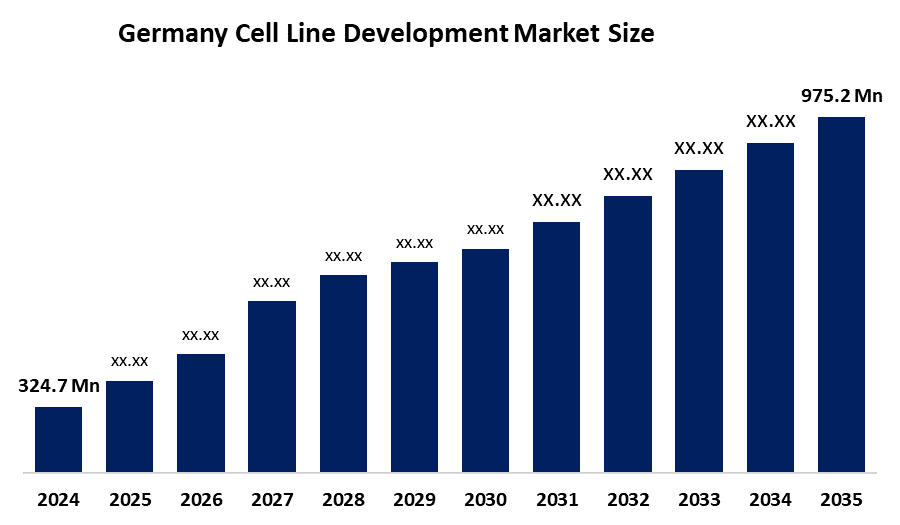
- Germany Cell Line Development Market Size 2024: USD 324.7 Million
- Germany Cell Line Development Market Size 2035: USD 975.2 Million
- Germany Cell Line Development Market CAGR 2024: 10.51%
- Germany Cell Line Development Market Segments: Product & Services, Source, Type, and Application
Get more details on this report -
Cell line development is described as an aspect of creating, optimizing, as well as stabilizing cells. It is used as a basis for manufacturing biopharmaceutical products, research, development, toxicity evaluation, as well as using tissues in biotherapeutic products. The product requirement is driven by increasing biologics development programs, together with enhanced usage of advanced biotherapeutic modalities.
Technological innovation involves automated cell culture systems, AI-aided cell line development, high-throughput screening systems, and gene editing. With respect to government policies, the German federal ministry for education and research has undertaken the drafting of the national strategy for gene- and cell-based therapies, with €48 million budgeted for the implementation of research initiatives from 2023-2026. Biosimilars, personalized therapeutics, digital bioprocessing, and research academia-industry collaboration are some of the emerging opportunities within Germany’s life science industry.
Market Dynamics of the Germany Cell Line Development Market:
The Germany cell line development market is mainly driven by the increase in pharmaceutical and biotechnology R&D activities, the rise of biologics and biosimilars production, and the demand of reliable cell systems in drug discovery and bioproduction. On the one hand, strict quality requirements and complicated development workflows make companies depend on specialized cell line development providers. On the other hand, continuous progresses in cell engineering, automation, and bioprocess optimization are additional factors that support a market expansion.
The Germany cell line development market faces challenges due to high operational and compliance costs, long development, and validation timelines that cell, based technologies must adhere to. The scarcity of skilled professionals in advanced cell culture and genetic engineering, the issue of scalability, and the reproducibility of the processes can cause delays in the development cycles and increase the total costs of the projects.
In the future, the Germany cell line development market will still be supported by the constantly growing cell and gene therapy pipeline, the increase in outsourcing to contract development organizations, and the demand for customized and high, yield cell lines. The use of automated platforms, AI, driven cell line screening, and state, of, the, art bioprocess technologies are predicted to be the factors that will increase efficiency, shorten timelines, and open up new growth opportunities in research and manufacturing applications.
Germany Cell Line Development Market Report Coverage
| Report Coverage | Details |
|---|---|
| Base Year: | 2024 |
| Market Size in 2024: | USD 324.7 Million |
| Forecast Period: | 2024-2035 |
| Forecast Period CAGR 2024-2035 : | 10.51% |
| 2035 Value Projection: | USD 975.2 Million |
| Historical Data for: | 2020-2023 |
| No. of Pages: | 240 |
| Tables, Charts & Figures: | 105 |
| Segments covered: | By Type, By Application |
| Companies covered:: | Sartorius AG, Merck KGaA, Lonza Group Ltd, Thermo Fisher Scientific Inc, Danaher Corporation, Others, and Key Players |
| Pitfalls & Challenges: | COVID-19 Empact, Challenge, Future, Growth, & Analysis |
Get more details on this report -
Market Segmentation
The Germany cell line development market share is classified into product & services, source, type, and application.
By Product & Service:
The Germany cell line development market is divided by product & service into reagents & media, equipment, accessories & consumables, and services. Among these, reagents & media dominated in 2024 and is anticipated to grow at a remarkable CAGR during the forecast period. High consumption volumes, repeat purchasing cycles, the critical role in cell culture optimization, and continuous demand from biopharmaceutical manufacturing and research laboratories have combined to support the segments dominance.
By Source:
The Germany cell line development market is divided by source into mammalian cell lines and non-mammalian cell lines. Among these, mammalian cell lines dominated in 2024 and is anticipated to grow at a remarkable CAGR during the forecast period. Widespread use of the method has been one of the key drivers of higher consumption. It has also been helped by monoclonal antibody production, biologics manufacturing, regulatory acceptance, and being compatible with human protein expression, which have all contributed to the increased utilization.
By Type:
The Germany cell line development market is divided by type into recombinant cell lines, hybridomas, continuous cell lines, and primary cell lines. Among these, recombinant cell lines led the market in 2024 and is anticipated to grow at a remarkable CAGR during the forecast period. The segment's dominance has been further supported by the continuous development of biologics, the scale, up beyond advantages, genetic stability, and the preference for large, scale production.
By Application:
The Germany cell line development market is divided by application into bioproduction, drug discovery, toxicity testing, tissue engineering & regenerative medicine, and others. Among these, bioproduction dominated the market in 2024 and is anticipated to grow at a remarkable CAGR during the forecast period. Biologics manufacturing is on the uptrend along with the demand for biosimilars, as well as the increased expansion of the biopharmaceutical pipelines which, in combination, are the reasons that continue to keep the production volumes high.
Competitive Analysis:
The report offers the appropriate analysis of the key organisations/companies involved within the Germany cell line development market, along with a comparative evaluation primarily based on their product offering, business overviews, geographic presence, enterprise strategies, segment market share, and SWOT analysis. The report also provides an elaborative analysis focusing on the current news and developments of the companies, which includes product development, innovations, joint ventures, partnerships, mergers & acquisitions, strategic alliances, and others. This allows for the evaluation of the overall competition within the market.
Top Key Companies in Germany Cell Line Development Market:
- Sartorius AG
- Merck KGaA
- Lonza Group Ltd
- Thermo Fisher Scientific Inc
- Danaher Corporation
- Others
Key Target Audience
- Market Players
- Investors
- End-users
- Government Authorities
- Consulting and Research Firm
- Venture capitalists
- Value-Added Resellers (VARs)
Market Segment
This study forecasts revenue at the Japan, regional, and country levels from 2020 to 2035. Decisions Advisors has segmented the Germany cell line development market based on the below-mentioned segments:
Germany Cell Line Development Market, By Product & Service
- Reagents & Media
- Equipment
- Accessories & Consumables
- Services
Germany Cell Line Development Market, By Source
- Mammalian Cell Lines
- Non-mammalian Cell Lines
Germany Cell Line Development Market, By Type
- Recombinant Cell Lines
- Hybridomas
- Continuous Cell Lines
- Primary Cell Lines
Germany Cell Line Development Market, By Application
- Bioproduction
- Drug Discovery
- Toxicity Testing
- Tissue Engineering & Regenerative Medicine
- Others
Frequently Asked Questions (FAQ)
-
Q: What is the Germany cell line development market size?A: Germany cell line development market is expected to grow from USD 324.7 million in 2024 to USD 975.2 million by 2035, growing at a CAGR of 10.51% during the forecast period 2025-2035.
-
Q: What are the key growth drivers of the Germany cell line development market?A: Market growth is driven by rising pharmaceutical and biotechnology R&D activities, increasing biologics and biosimilars production, demand for reliable cell systems in drug discovery and bioproduction, and growing adoption of automation, AI-enabled cell line development, and advanced bioprocess technologies.
-
Q: What factors restrain the Germany cell line development market?A: Market restraints include high operational and regulatory compliance costs, long development and validation timelines, scarcity of skilled professionals in advanced cell culture and genetic engineering, scalability challenges, and reproducibility issues that increase project costs and delay development cycles.
-
Q: Which segment dominated the market by product & service in 2024?A: Reagents & media dominated the market in 2024 due to high consumption volumes, repeat purchasing cycles, and continuous demand from biopharmaceutical manufacturing and research laboratories.
-
Q: Which source segment held the largest share in 2024?A: Mammalian cell lines dominated the market in 2024, supported by widespread use in monoclonal antibody production, biologics manufacturing, regulatory acceptance, and compatibility with human protein expression.
-
Q: Who are the key players in the Germany cell line development market?A: Key companies operating in the market include Sartorius AG, Merck KGaA, Lonza Group Ltd, Thermo Fisher Scientific Inc., Danaher Corporation, and others.
-
Q: What are the key target audiences for this market report?A: The report targets market players, investors, end-users, government authorities, consulting and research firms, venture capitalists, and value-added resellers (VARs).
Need help to buy this report?