Global Genetic Analyzers Market Size, Share, and COVID-19 Impact Analysis, By Product Type (Consumables & Reagents and Instruments), By Application (Genotyping, Mutation Detection, Fragment Analysis, Sanger Sequencing, and Sequence Analysis), and By Region (North America, Europe, Asia-Pacific, Latin America, Middle East, and Africa), Analysis and Forecast 2025 - 2035
Industry: Healthcare
Global Genetic Analyzers Market Size Insights Forecasts to 2035
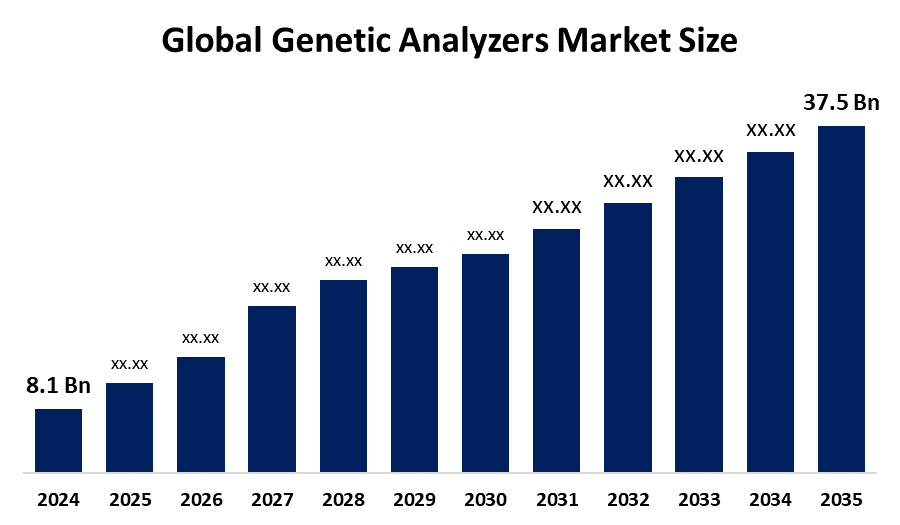
- The Global Genetic Analyzers Market Size Was Estimated at USD 8.1 Billion in 2024
- The Market Size is Expected to Grow at a CAGR of around 14.95% from 2025 to 2035
- The Worldwide Genetic Analyzers Market Size is Expected to Reach USD 37.5 Billion by 2035
- Asia Pacific is expected to Grow the fastest during the forecast period.
Get more details on this report -
According to a Research Report Published by Spherical Insights and Consulting, The Global Genetic Analyzers Market Size was worth around USD 8.1 Billion in 2024 and is predicted to Grow to around USD 37.5 Billion by 2035 with a compound annual growth rate (CAGR) of 14.95% from 2025 and 2035. The market for genetic analyzers has a number of opportunities to grow due to its increased usage in life sciences, along with the integration of advanced technologies like the SeqStudio Flex Series of genetic analyzer.
Market Overview
The global industry for genetic analyzer focused on automated instruments and consumables (reagents) used to sequence DNA and analyzer genetic variations for clinical diagnostics, research, and forensics. Genetic analyzers are automated systems capable of sequencing DNA or analyzing fragments for a variety of applications. For example, genetic fingerprinting can be conducted with a portable DNA analyzer. The base system of analysis revolves around general genetics, and base studies include identification of genes and inherited disorders.
Innovation and market expansion are anticipated as a result of investment in early stage technology, providing regulatory support, and infrastructure development. For instance, in December 2025, Organigram Global Inc., Canada’s #1 cannabis company by market share1, announced the expansion of its innovation investment in Phylos Bioscience Inc.
Report Coverage
This research report categorizes the genetic analyzers market based on various segments and regions, forecasts revenue growth, and analyzes trends in each submarket. The report analyses the key growth drivers, opportunities, and challenges influencing the genetic analyzers market. Recent market developments and competitive strategies such as expansion, type launch, development, partnership, merger, and acquisition have been included to draw the competitive landscape in the market. The report strategically identifies and profiles the key market players and analyses their core competencies in each sub-segment of the genetic analyzers market.
Global Genetic Analyzers Market Report Coverage
| Report Coverage | Details |
|---|---|
| Base Year: | 2024 |
| Market Size in 2024 : | USD 8.1 Billion |
| Forecast Period: | 2025-2035 |
| Forecast Period CAGR 2025-2035 : | 14.95% |
| 2035 Value Projection: | USD 37.5 Billion |
| Historical Data for: | 2020-2023 |
| No. of Pages: | 264 |
| Tables, Charts & Figures: | 103 |
| Segments covered: | By Product Type, By Application and COVID-19 Impact Analysis |
| Companies covered:: | Thermo Fisher Scientific, Illumina, Inc., Roche Diagnostics, Agilent Technologies, Bio-Rad Laboratories, QIAGEN, PerkinElmer, Inc., Abbott Laboratories, and Others |
| Pitfalls & Challenges: | COVID-19 Empact, Challenges, Future, Growth, & Analysis |
Get more details on this report -
Driving Factors
The genetic analyzers market is driven by genetic tests that may be used for confirming a diagnosis in a symptomatic individual or for disease prognosis or treatment response. The ongoing genome research, driven by the rising prevalence of viral and inherited disorders, along with government funding for genome projects and expanding genomics applications are anticipated to propel market demand. In addition, technological advancements, for instance, in February 2026, when Clinical Hospital Sveti Duh introduced advanced next generation sequencing (NGS) technology for genome sequencing, for faster and more precise genetic analysis is enhancing market demand.
Restraining Factors
The genetic analyzers market is restricted by factors like increased costs of advanced genetic analyzers and infrastructure, limiting the accessibility, especially among smaller healthcare providers and research institutions. Further, data privacy concerns regarding the genetic information and the lack of standardized protocols are restricting the market expansion.
Market Segmentation
The genetic analyzers market share is classified into product type and application.
- The consumables & reagents segment dominated the market with about 44.5% share in 2024 and is projected to grow at a substantial CAGR during the forecast period.
Based on the product type, the genetic analyzers market is divided into consumables & reagents and instruments. Among these, the consumables & reagents segment dominated the market with about 44.5% share in 2024 and is projected to grow at a substantial CAGR during the forecast period. The segment includes polymer (POP-4,6,7), capillary arrays, buffers, and DNA size standards. The continuous demand for high-quality reagents and consumables for reliable and reproducible genetic analysis, advancements in reagent formulations for enhanced sensitivity & specificity, contribute to propelling segmental market growth.
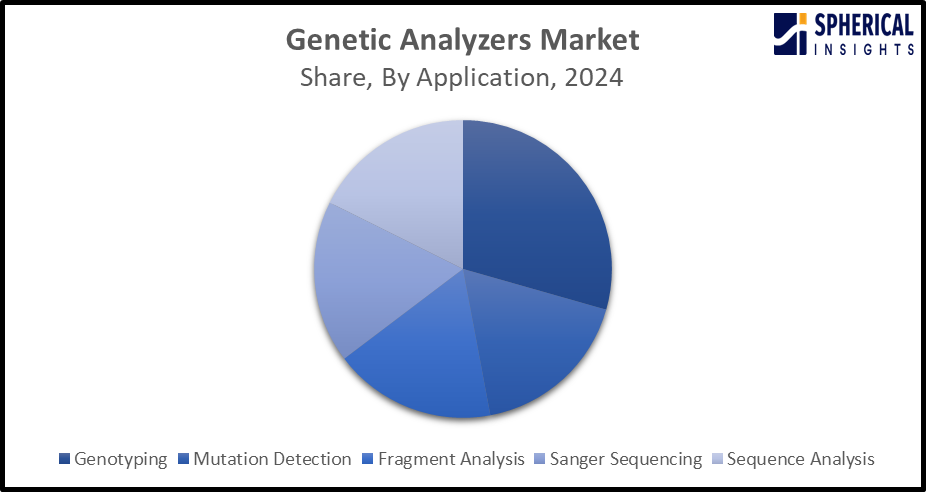
- The genotyping segment accounted for the largest market share of over 25.1% in 2024 and is anticipated to grow at a significant CAGR during the forecast period.
Based on the application, the genetic analyzers market is divided into genotyping, mutation detection, fragment analysis, Sanger sequencing, and sequence analysis. Among these, the genotyping segment accounted for the largest market share of over 25.1% in 2024 and is anticipated to grow at a significant CAGR during the forecast period. It includes tools or instruments such as EVA (Exome Variation Analyzer) or BV-BRC's Variation Service, used to identify, filter, and interpret genetic mutations. There is increased use of genotyping for personalized medicine, disease research, biomarker discovery, and for detailed insights into genetic variations for identifying disease susceptibility, therapeutic targets, and genetic traits.
Get more details on this report -
Regional Segment Analysis of the Genetic Analyzers Market
- North America (U.S., Canada, Mexico)
- Europe (Germany, France, U.K., Italy, Spain, Rest of Europe)
- Asia-Pacific (China, Japan, India, Rest of APAC)
- South America (Brazil and the Rest of South America)
- The Middle East and Africa (UAE, South Africa, Rest of MEA)
North America is anticipated to hold the largest share of the genetic analyzers market over the predicted timeframe.

Get more details on this report -
North America is anticipated to hold the largest share of about 43.0% in the genetic analyzers market over the predicted timeframe. The market ecosystem in North America is strong, with both cutting-edge startups like Ultima Genomics, 10x genomics, Daisy Genomics, and major industries promoting technologies like precision oncology, spatial biology, reproductive & rare disease testing, agricultural genomics & eDNA, and AI-driven bioinformatics & drug discovery. The demand for genetic analyzers has been driven by the region's increasing adoption of advanced technologies, shift towards sustainable & efficient solutions, digital technologies, and an expanding number of large-scale commercial projects. The U.S. is the dominant country in the North America genetic analyzers market, accounting for the largest share within the region, owing to significant investments in molecular biology and personalized medicine.
Asia Pacific is expected to grow at a rapid CAGR of around 10.5% in the genetic analyzers market during the forecast period. The Asia Pacific area has a thriving market for genetic analyzers due to collaborative efforts among research institutes. For instance, in July 2022, Lenovo and CSIR-IGIB, India’s leading genome sequencing research institute, partnered to accelerate cancer research through genetic analysis, leveraging Lenovo high-performance Genomics Optimization and Scalability Tool (GOAST) architecture. The region's increasing investments in genomics research, healthcare infrastructure, and biotechnological advancement have also fueled the expansion of the genetic analyzers market. China is the leading country in the APAC market of genetic analyzers, owing to strong genomics research funding and large clinical volumes.
Competitive Analysis:
The report offers the appropriate analysis of the key organizations/companies involved within the genetic analyzers market, along with a comparative evaluation primarily based on their type of offering, business overviews, geographic presence, enterprise strategies, segment market share, and SWOT analysis. The report also provides an elaborative analysis focusing on the current news and developments of the companies, which includes type development, innovations, joint ventures, partnerships, mergers & acquisitions, strategic alliances, and others. This allows for the evaluation of the overall competition within the market.
List of Key Companies
- Thermo Fisher Scientific
- Illumina, Inc.
- Roche Diagnostics
- Agilent Technologies
- Bio-Rad Laboratories
- QIAGEN
- PerkinElmer, Inc.
- Abbott Laboratories
- Others
Key Target Audience
- Market Players
- Investors
- End-users
- Government Authorities
- Consulting and Research Firm
- Venture capitalists
- Value-Added Resellers (VARs)
Recent Development
- In January 2026, Dr Lal PathLabs Limited announced the launch of SOVAAKA, its new-age Diagnostic Experience Centre in Gurugram, which represents a significant advancement in preventive healthcare, combining precision diagnostics with cutting-edge technology to deliver personalized wellness solutions.
- In September 2025, Korean precision medicine company Dx&Vx said it introduced advanced genomic an analysis technology from China’s Yikon Genomics to expand services aimed at overcoming infertility.
- In April 2025, Thermo Fisher Scientific launched a new IVDR-compliant capillary electrophoresis instrument. The new genetic analyzer supports both clinical and research applications for Sanger sequencing and fragment analysis in targeted genomic testing.
Market Segment
This study forecasts revenue at global, regional, and country levels from 2020 to 2035. Spherical Insights has segmented the genetic analyzers market based on the below-mentioned segments:
Global Genetic Analyzers Market, By Product Type
- Consumables & Reagents
- Instruments
Global Genetic Analyzers Market, By Application
- Genotyping
- Mutation Detection
- Fragment Analysis
- Sanger Sequencing
- Sequence Analysis
Global Genetic Analyzers Market, By Regional Analysis
- North America
- US
- Canada
- Mexico
- Europe
- Germany
- UK
- France
- Italy
- Spain
- Russia
- Rest of Europe
- Asia Pacific
- China
- Japan
- India
- South Korea
- Australia
- Rest of Asia Pacific
- South America
- Brazil
- Argentina
- Rest of South America
- Middle East & Africa
- UAE
- Saudi Arabia
- Qatar
- South Africa
- Rest of the Middle East & Africa
Frequently Asked Questions (FAQ)
-
1. What is the market size of the genetic analyzers market?The global genetic analyzers market size is expected to grow from USD 8.1 Billion in 2024 to USD 37.5 Billion by 2035, at a CAGR of 14.95% during the forecast period 2025-2035.
-
2. Which region holds the largest share of the genetic analyzers market?North America is anticipated to hold the largest share of the genetic analyzers market over the predicted timeframe.
-
3. What is the forecasted CAGR of the Global Genetic analyzers Market from 2024 to 2035?The market is expected to grow at a CAGR of around 14.95% during the period 2024–2035.
-
4. Who are the top companies that are involved in the Global Genetic analyzers Market?Key players include Thermo Fisher Scientific, Illumina, Inc., Roche Diagnostics, Agilent Technologies, Bio-Rad Laboratories, QIAGEN, PerkinElmer, Inc., Abbott Laboratories.
-
5. What are the main drivers in the genetic analyzers market?Ongoing genome research, driven by the rising prevalence of viral and inherited disorders, government funding for genome projects, expanding genomics applications, and technological advancements, are major market growth drivers of the genetic analyzers market.
-
6. What challenges are limiting the adoption of genetic analyzers treatment?The increased costs of advanced genetic analyzers and infrastructure, limiting the accessibility, especially among smaller healthcare providers and research institutions remain key restraints in the genetic analyzers market.
-
7. What are the key trends in the genetic analyzers market?Integration of advanced technologies like the SeqStudio Flex Series of genetic analyzer, investment in early-stage technology, providing regulatory support, and infrastructure development, are key trends in the genetic analyzers market.
Need help to buy this report?