Global Generalized Anxiety Disorder Treatment Market Size, Share, and COVID-19 Impact Analysis, By Drug Class (Antidepressant, Buspirone, and Benzodiazepines), By Therapies (Interpersonal Therapy, Behavioural Therapy, Cognitive Behaviour Therapy, and Mindfulness Based Cognitive Therapy), By Distribution Channel (Hospital Pharmacy, Retail Pharmacy, and Online Pharmacy), and By Region (North America, Europe, Asia-Pacific, Latin America, Middle East, and Africa), Analysis and Forecast 2025 - 2035
Industry: Healthcare
Global Generalized Anxiety Disorder Treatment Market Insights Forecasts to 2035
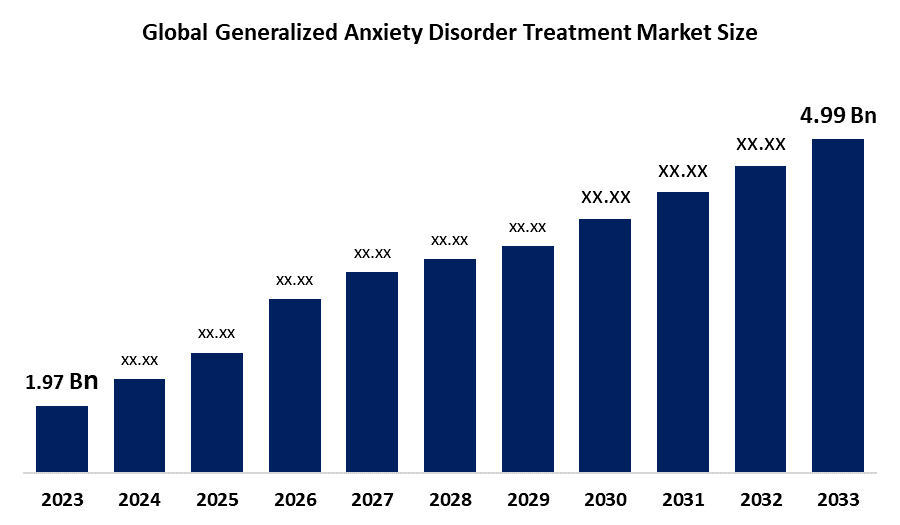
- The Global Generalized Anxiety Disorder Treatment Market Size Was Estimated at USD 1.97 Billion in 2024
- The Market Size is Expected to Grow at a CAGR of around 8.82% from 2025 to 2035
- The Worldwide Generalized Anxiety Disorder Treatment Market Size is Expected to Reach USD 4.99 Billion by 2035
- Asia Pacific is expected to grow the fastest during the forecast period.
Get more details on this report -
According to a research report published by Spherical Insights and Consulting, The Global Generalized Anxiety Disorder Treatment Market Size Was Worth Around USD 1.97 Billion In 2024 And Is Predicted To Grow To Around USD 4.99 Billion By 2035 With A Compound Annual Growth Rate (CAGR) Of 8.82% From 2025 To 2035. The generalized anxiety disorder (GAD) treatment market is growing due to the rising prevalence of high stress, increasing mental health awareness, reduced stigma, and expanded access to care. Innovation in novel drugs, digital therapeutics, and increased R&D fuel this growth.
Market Overview
Generalized anxiety disorder (GAD) treatment is a chronic mental health condition that causes people to experience continuous excessive anxiety, which disrupts their ability to work normally, and it affects 3.1% of the United States population. The GAD treatment market includes both SSRIs and benzodiazepines, which serve as pharmacological treatments and cognitive behavioral therapy and digital therapeutics, which function as non-pharmacological treatment methods. The market expansion drivers include increasing global anxiety disorder prevalence, which the WHO estimates affects more than 284 million people, showing a 25% growth during the last ten years. The combination of post-pandemic stress and economic uncertainties, together with increased mental health awareness, has created a situation where more people receive diagnoses and seek medical treatment.
Digital therapeutics and telemedicine platforms present major business opportunities because mobile applications and digital cognitive behavioral therapy solutions have reached widespread use in developing countries, which possess high mobile device usage but face shortages of mental health specialists. The development of innovative psychedelic therapies together with neurosteroid modulators leads to market growth for treatment-resistant generalized anxiety disorder patients. The Clinical Guideline for generalized anxiety disorder, which ACE published in March 2025, provides evidence-based non-pharmacological and pharmacological treatment methods for achieving remission and preventing relapse. The guideline provides assessment methods and treatment selection procedures, and inadequate response management techniques, while it also presents specific guidance for perinatal women, children and adolescents.
Report Coverage
This research report categorizes the generalized anxiety disorder treatment market based on various segments and regions, forecasts revenue growth, and analyzes trends in each submarket. The report analyses the key growth drivers, opportunities, and challenges influencing the generalized anxiety disorder treatment market. Recent market developments and competitive strategies, such as expansion, type launch, development, partnership, merger, and acquisition, have been included to draw the competitive landscape in the market. The report strategically identifies and profiles the key market players and analyses their core competencies in each sub-segment of the generalized anxiety disorder treatment market.
Global Generalized Anxiety Disorder Treatment Market Report Coverage
| Report Coverage | Details |
|---|---|
| Base Year: | 2024 |
| Market Size in 2024: | USD 1.97 Billion |
| Forecast Period: | 2025-2035 |
| Forecast Period CAGR 2025-2035 : | CAGR Of 8.82% |
| 2035 Value Projection: | USD 4.99 Billion |
| Historical Data for: | 2020-2023 |
| No. of Pages: | 240 |
| Tables, Charts & Figures: | 90 |
| Segments covered: | By Drug Class, By Therapies |
| Companies covered:: | Pfizer Inc. Johnson & Johnson GlaxoSmithKline (GSK) AstraZeneca Bristol-Myers Squibb MindMed Inc. Eli Lilly and Company Sanofi S.A. Otsuka Pharmaceutical Co., Ltd. Merck & Co., Inc. H. Lundbeck A/S Roche Holding AG Teva Pharmaceutical Industries Ltd. Sun Pharmaceutical Industries Ltd. Others Key Players |
| Pitfalls & Challenges: | COVID-19 Empact, Challenge, Future, Growth, & Analysis |
Get more details on this report -
Driving Factors
The Global Generalized Anxiety Disorder (GAD) Treatment Market Size develops through three main factors, which include rising mental health issues, better diagnosis methods and more available treatment options. According to WHO estimates, anxiety disorders affect over 300 million people worldwide, with GAD making up a considerable portion. Increasing treatment access results from awareness campaigns and telehealth adoption, while antidepressants serve as the primary treatment option. North America and Europe experienced increased mental health spending in 2024 because government funding programs supported this growth. The digital therapeutics market and AI-based mental health platforms experience rapid growth because workplace stress and post-pandemic psychological disorders create ongoing treatment needs that exist throughout the world.
Restraining Factors
The global market for treating generalized anxiety disorder encounters multiple important obstacles. The main obstacle exists because 66.3% of US adults with symptoms receive no treatment, which increases to 69% among recent immigrants. Stigma and access issues persist, as 38% prefer to manage alone and 32% cite affordability concerns. The diagnosis process creates difficulties that result in misdiagnosis, and patients stop using standard medications because of their adverse effects and delayed effects.
Market Segmentation
The generalized anxiety disorder treatment market share is classified into drug class, therapies, and distribution channel.
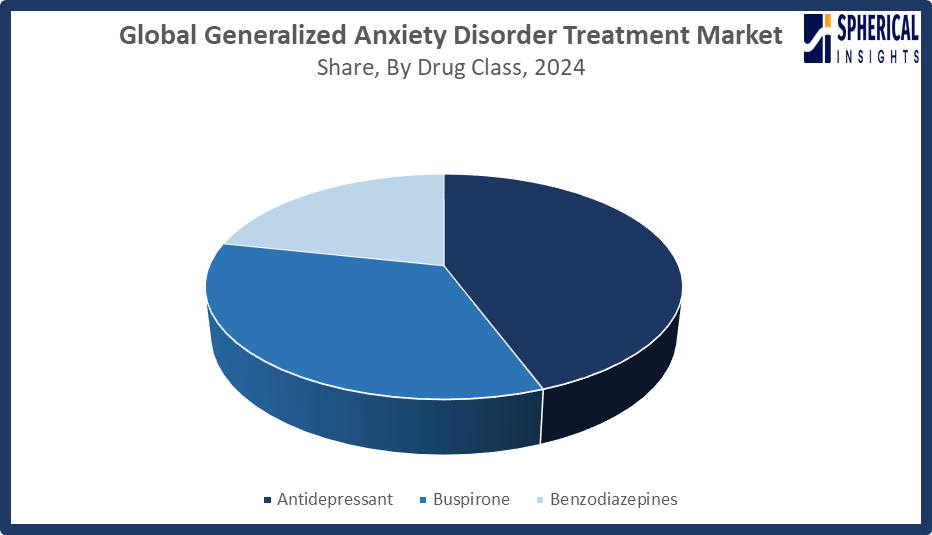
- The antidepressant segment dominated the market in 2024, approximately 44% and is projected to grow at a substantial CAGR during the forecast period.
Based on the drug class, the generalized anxiety disorder treatment market is divided into antidepressant, buspirone, and benzodiazepines. Among these, the antidepressant segment dominated the market in 2024 and is projected to grow at a substantial CAGR during the forecast period. The antidepressant segment dominated market growth because SSRIs and SNRIs function as the primary treatment option for generalized anxiety disorder. The clinical data demonstrate that 60 to 70% of patients who receive treatment show positive results, while antidepressants constitute about 65% of global GAD treatment prescriptions because physicians prefer the drugs that show long-term effectiveness and safe usage.
Get more details on this report -
- The cognitive behaviour therapy segment accounted for the largest share in 2024, approximately 35% and is anticipated to grow at a significant CAGR during the forecast period.
Based on the therapies, the generalized anxiety disorder treatment market is divided into interpersonal therapy, behavioural therapy, cognitive behaviour therapy, and mindfulness based cognitive therapy. Among these, the cognitive behaviour therapy segment accounted for the largest share in 2024 and is anticipated to grow at a significant CAGR during the forecast period. The segment market grows because it establishes strong proof through clinical studies, and it receives endorsements from treatment guidelines. Research demonstrates that CBT enables patients with generalized anxiety disorder to experience 50-60% symptom relief, while its effectiveness creates a 30% reduction in relapse occurrences compared to using medicine as the only treatment, which results in greater implementation of the treatment at hospitals and clinics and through online therapy programs worldwide.
- The hospital pharmacy segment accounted for the highest market revenue in 2024, approximately 50% and is anticipated to grow at a significant CAGR during the forecast period.
Based on the distribution channel, the generalized anxiety disorder treatment market is divided into hospital pharmacy, retail pharmacy, and online pharmacy. Among these, the hospital pharmacy segment accounted for the highest market revenue in 2024 and is anticipated to grow at a significant CAGR during the forecast period. The hospital pharmacy segment experienced market expansion because hospital visits increased among patients with anxiety disorders who needed treatment, and there was an increase in prescription medication distribution. Research shows that approximately 40-50% of patients with moderate to severe anxiety begin their care in hospital environments, while post-pandemic admissions for mental health treatment at hospitals worldwide rose more than 15%, which resulted in hospitals distributing more anxiolytics and antidepressants to their patients.
Regional Segment Analysis of the Generalized Anxiety Disorder Treatment Market
- North America (U.S., Canada, Mexico)
- Europe (Germany, France, U.K., Italy, Spain, Rest of Europe)
- Asia-Pacific (China, Japan, India, Rest of APAC)
- South America (Brazil and the Rest of South America)
- The Middle East and Africa (UAE, South Africa, Rest of MEA)
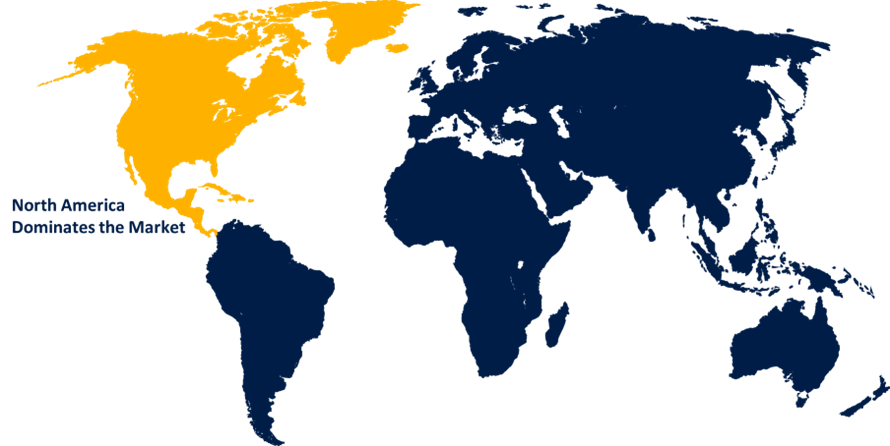
North America is anticipated to hold the largest share of the generalized anxiety disorder treatment market over the predicted timeframe.
Get more details on this report -
North America is anticipated to hold the largest share of the generalized anxiety disorder treatment market over the predicted timeframe. The treatment market for generalized anxiety disorder (GAD) is expected to have 38% market share in North America because the United States and Canada maintain high healthcare expenditures, people show strong mental health awareness, and the two countries have developed advanced treatment networks. The United States accounts for most of the worldwide anxiety treatment market because it has higher diagnosis rates and extensive insurance coverage that enables patients to access medication and cognitive behavioral therapy. The pandemic caused a major increase in tele-mental health services, which resulted in more than 50% growth of anxiety-related virtual visits that occurred in 2024 because people needed better access to mental health services. In September 2025, Rhode Island’s delegation secured a $7.94 million federal grant for Bradley Hospital, a Brown University affiliate, to establish a pediatric psychiatric research laboratory.
Asia Pacific is expected to grow at a rapid CAGR in the generalized anxiety disorder treatment market during the forecast period. The Asia Pacific region is expected to have 28% share in the GAD treatment market because of increased public understanding, better health services and rising cases of the disorder throughout China, India, Japan and South Korea. Anxiety disorders affect roughly 4-6% of populations, while treatment gaps exceed 60% in some countries. The healthcare industry supports growth through two factors, which include expanding tele-mental health and digital therapies and annual spending that exceeds 8%. The WHO reported 1.1 billion people with mental disorders in November 2025, while India showed an 11% prevalence rate, and The Lancet estimated 5.2% of the global disease burden.
The treatment market for generalized anxiety disorder in Europe experiences growth because Germany, the United Kingdom, and France all implement robust mental health policies, while their citizens receive complete healthcare coverage, and their governments increase funding for psychological services. Approximately 20% of adult’s experience anxiety symptoms, which drives up the need for medication and therapy-based treatment methods. Telehealth adoption and awareness campaigns continue improving access. The UK government allocated €4.1 million in September 2025 to fund therapeutic XR technologies, which include virtual reality and augmented reality systems for mental healthcare development.
Competitive Analysis:
The report offers the appropriate analysis of the key organizations/companies involved within the generalized anxiety disorder treatment market, along with a comparative evaluation primarily based on their type of offering, business overviews, geographic presence, enterprise strategies, segment market share, and SWOT analysis. The report also provides an elaborative analysis focusing on the current news and developments of the companies, which includes type development, innovations, joint ventures, partnerships, mergers & acquisitions, strategic alliances, and others. This allows for the evaluation of the overall competition within the market.
List of Key Companies
- Pfizer Inc.
- Johnson & Johnson
- GlaxoSmithKline (GSK)
- AstraZeneca
- Bristol-Myers Squibb
- MindMed Inc.
- Eli Lilly and Company
- Sanofi S.A.
- Otsuka Pharmaceutical Co., Ltd.
- Merck & Co., Inc.
- H. Lundbeck A/S
- Roche Holding AG
- Teva Pharmaceutical Industries Ltd.
- Sun Pharmaceutical Industries Ltd.
- Others
Key Target Audience
- Market Players
- Investors
- End-users
- Government Authorities
- Consulting and Research Firm
- Venture capitalists
- Value-Added Resellers (VARs)
Recent Development
- In January 2026, Deinium Therapeutics Inc. advanced DT120 ODT toward FDA submissions for generalized anxiety disorder and major depressive disorder. Backed by four Phase 3 trials and FDA Breakthrough Therapy Designation for GAD, the company is preparing commercial readiness ahead of potential U.S. launch.
- In October 2025, Mind Medicine Inc. reported strong Phase 2b results for MM120 in generalized anxiety disorder, earning FDA Breakthrough Therapy designation and initiating three Phase 3 trials. Investor confidence surged, driving shares up 15% weekly, 81% year-to-date, with 107% one-year returns.
- In January 2025, Johnson & Johnson acquired Intra-Cellular Therapies Inc., adding CAPLYTA (lumateperone), FDA-approved for bipolar depression and schizophrenia. An sNDA seeks approval for major depressive disorder, with $5 billion peak sales potential and pipeline expansion into generalized anxiety disorder and Alzheimer’s-related psychosis.
- In January 2025, Mind Medicine Inc. announced first patient dosing in its Phase 3 Panorama trial evaluating MM120 ODT, an optimized LSD formulation, for generalized anxiety disorder. The U.S. and Europe study will enroll about 250 participants, assessing efficacy and safety versus placebo.
Market Segment
This study forecasts revenue at global, regional, and country levels from 2020 to 2035. Spherical Insights has segmented the generalized anxiety disorder treatment market based on the below-mentioned segments:
Global Generalized Anxiety Disorder Treatment Market, By Drug Class
- Antidepressant
- Buspirone
- Benzodiazepines
Global Generalized Anxiety Disorder Treatment Market, By Therapies
- Interpersonal Therapy
- Behavioural Therapy
- Cognitive Behaviour Therapy
- Mindfulness Based Cognitive Therapy
Global Generalized Anxiety Disorder Treatment Market, By Distribution Channel
- Hospital Pharmacy
- Retail Pharmacy
- Online Pharmacy
Global Generalized Anxiety Disorder Treatment Market, By Regional Analysis
- North America
- US
- Canada
- Mexico
- Europe
- Germany
- UK
- France
- Italy
- Spain
- Russia
- Rest of Europe
- Asia Pacific
- China
- Japan
- India
- South Korea
- Australia
- Rest of Asia Pacific
- South America
- Brazil
- Argentina
- Rest of South America
- Middle East & Africa
- UAE
- Saudi Arabia
- Qatar
- South Africa
- Rest of the Middle East & Africa
Frequently Asked Questions (FAQ)
-
How has the adoption of tele-mental health services influenced GAD treatment access and outcomes?The adoption of tele-mental health has expanded GAD treatment access, with virtual visits increasing over 50% since 2020, improving therapy reach, reducing wait times, and boosting treatment adherence and outcomes globally.
-
What impact do FDA breakthrough therapy designations have on novel drug development timelines?FDA Breakthrough Therapy designations accelerate novel drug development by shortening approval timelines by up to 40%, expediting clinical phases and priority reviews for promising therapies addressing serious conditions
-
How is Cognitive Behavioral Therapy maintaining dominance while digital formats gain adoption?Cognitive Behavioral Therapy maintains dominance due to strong clinical evidence and guideline support, with 60-70% symptom improvement, even as digital CBT adoption rises, expanding accessibility and complementing traditional delivery
-
What technological advancements in drug delivery systems are gaining traction in the market?Technological advancements like long-acting injectables, transdermal patches, and digital pill systems are gaining traction, improving adherence and consistency, with long-acting formulations reducing dosing frequency by up to 50% and enhancing patient outcomes.
-
How are digital therapeutics and AI-powered mental health platforms transforming treatment delivery?Digital therapeutics and AI mental health platforms improve treatment delivery by expanding access, personalizing care, and enhancing engagement; usage grew over 70% since 2021, boosting adherence and measurable anxiety symptom reduction
-
What role did the COVID-19 pandemic play in accelerating diagnosis rates and treatment adoption?The COVID-19 pandemic significantly increased anxiety disorder diagnosis and treatment adoption, with mental health consultations rising over 60% globally, driven by telehealth expansion and heightened awareness of psychological impacts
-
How is rising mental health awareness and reduced stigma expanding the addressable patient population?Rising awareness and reduced stigma increased treatment uptake by nearly 25% globally, while reported anxiety diagnoses rose 20-30% post-pandemic. According to the World Health Organization, 1 in 8 people live with mental disorders, expanding the addressable patient pool
Need help to buy this report?