Global Furnace Filters Market Size, Share, By Filter Type (Fiberglass Filters, Pleated Filters, Electrostatic Filters, and HEPA Filters), By Distribution Channel (Online and Offline), By End Use (Residential, Commercial, and Industrial), and By Region (North America, Europe, Asia-Pacific, Latin America, Middle East, and Africa), Analysis and Forecast 2025 - 2035.
Industry: Construction & Manufacturing
Global Furnace Filters Market Insights Forecasts to 2035
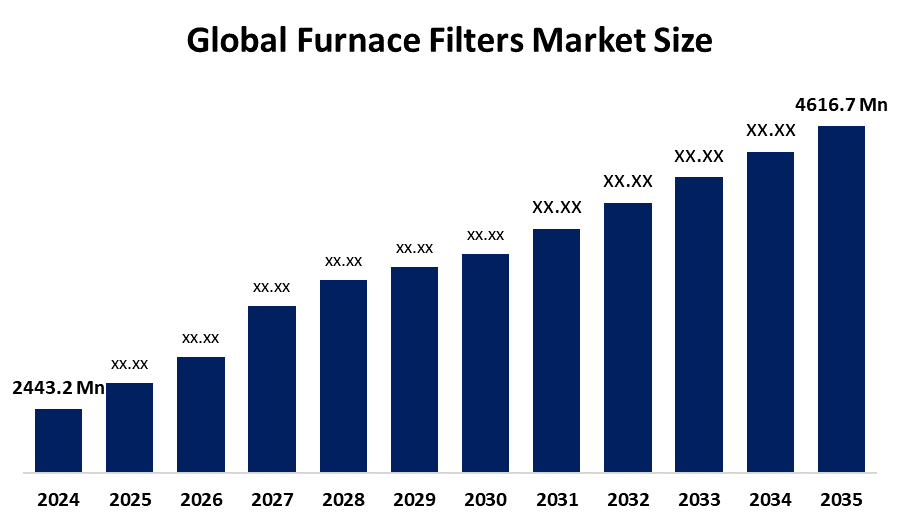
- The Global Furnace Filters Market Size Was Estimated at USD 2443.2 Million in 2024
- The Market Size is Expected to Grow at a CAGR of around 5.96 % from 2025 to 2035
- The Worldwide Furnace Filters Market Size is Expected to Reach USD 4616.7 Million by 2035
- Asia Pacific is expected to grow the fastest during the forecast period.
Get more details on this report -
According to a Research Report Published by Spherical Insights, The Global Furnace Filters Market Size was Worth Around USD 2443.2 Million in 2024 and is Predicted to Grow to Around USD 4616.7 Million by 2035 with a Compound Annual Growth rate (CAGR) of 5.96% from 2025 to 2035. The global furnace filters market development is driven by rising air pollution, increasing awareness of indoor air quality, growing adoption of energy-efficient HVAC systems, and expanding residential and commercial construction worldwide.
Market Overview
The Global Furnace Filters Market Size includes the production and distribution of HVAC system filters, which function to eliminate dust, pollen, and pollutants while improving indoor air quality and safeguarding home and industrial heating systems. The global furnace filters market experiences growth because air pollution levels increase and people become more health conscious and they require clean indoor environments and the worldwide adoption of energy-efficient HVAC systems. Government initiatives supporting the furnace filters market include regulations on indoor air quality and energy efficiency standards for HVAC systems and programs that promote clean air in residential spaces and commercial areas and industrial environments. In November 2023, the U.S. Environmental Protection Agency launched a USD2 billion Community Change Grants program under the Inflation Reduction Act to support projects that reduce air pollution and improve environmental conditions. The funding supports initiatives such as indoor air quality improvement and pollution monitoring, which indirectly drives demand for advanced HVAC filtration and furnace filter technologies.
The Furnace Filters Market Size is experiencing significant technological advancements, driven by the adoption of high-efficiency HEPA filters, electrostatic filtration systems, and smart sensors that monitor indoor air quality. Additionally, innovations in filtration materials are enhancing performance while reducing energy consumption.
In May 2024, the European Union adopted the revised Energy Performance of Buildings Directive (EPBD), which establishes zero-emission buildings as the standard for all new constructions by 2030. It also strengthens requirements for renovations and energy performance improvements in existing buildings. These regulations are expected to accelerate the retrofit market, including upgrades to HVAC systems and advanced indoor air quality solutions, thereby increasing demand for efficient furnace filters.
The Furnace Filters Market Size presents strong business opportunities driven by several key trends, including rising demand in developing nations, growing public awareness of indoor air quality, increasing integration with smart home systems, and the development of sustainable, long-lasting filtration solutions.
Report Coverage
This research report categorizes the Global Furnace Filters Market Size based on various segments and regions, forecasts revenue growth, and analyzes trends in each submarket. The report analyses the key growth drivers, opportunities, and challenges influencing the global furnace filters market. Recent market developments and competitive strategies, such as expansion, product launch, development, partnership, merger, and acquisition, have been included to draw the competitive landscape in the market. The report strategically identifies and profiles the key market players and analyzes their core competencies in each sub-segment of the furnace filters market.
Global Furnace Filters Market Report Coverage
| Report Coverage | Details |
|---|---|
| Base Year: | 2024 |
| Market Size in 2024: | USD 2443.2 Million |
| Forecast Period: | 2024-2035 |
| Forecast Period CAGR 2024-2035 : | 5.96% |
| 2035 Value Projection: | USD 4616.7 Million |
| Historical Data for: | 2020-2023 |
| No. of Pages: | 245 |
| Tables, Charts & Figures: | 106 |
| Segments covered: | By Filter Type ,By Region |
| Companies covered:: | 3M Company, Honeywell International Inc., Parker Hannifin Corporation, Camfil AB, Parker Hannifin, Donaldson Company Inc, MANN+HUMMEL Group, Lennox International Inc, Carrier Corporation, American Air Filter Company Inc, Freudenberg Filtration Technologies GmbH & Co KG, Koch Filter Corporation, Filtration Group Corporation, Nordic Pure LLC, Glasfloss Industries, and Other Key Players |
| Pitfalls & Challenges: | COVID-19 Empact, Challenge, Future, Growth, & Analysis. |
Get more details on this report -
Driving Factors
The Global Furnace Filters Market Size is driven by increasing awareness of indoor air quality and health concerns, which originate from urban and industrial environments. The rising air pollution, together with allergens, leads consumers and businesses to choose high-efficiency filtration systems. The market expansion is driven by rising demand for energy-efficient HVAC systems, which receive support from government regulations and incentives in India, Japan, and the U.S. The development of advanced technologies, such as HEPA filters, electrostatic filters, and smart filters with monitoring functions, delivers better filtration results while reducing energy consumption. The combination of urban growth, smart building initiatives, and increasing disposable income in developing countries presents business opportunities that enable residential, commercial, and industrial sectors to expand their smart building initiatives.
Restraining Factors
The Global Furnace Filters Market Size is developing because advanced filters require high upfront costs, which do not work with existing HVAC systems. The need for equipment replacement and maintenance activities pushes operational costs to higher levels. The market shows slow growth because certain regions do not understand indoor air quality benefits while facing challenges with raw material prices and supply chain problems.
Market Segmentation
The Global Furnace Filters Market share is classified into filter type, distribution channel, and end use.
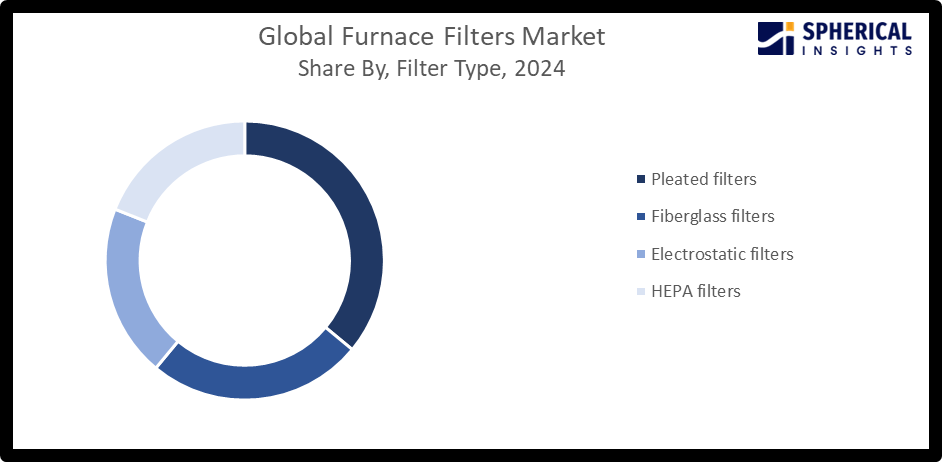
- The pleated filters segment accounted for the largest share in 2024, approximately 36%, and is anticipated to grow at a significant CAGR during the forecast period.
Based on the filter type, the Global Furnace Filters Market Size is divided into fiberglass filters, pleated filters, electrostatic filters, and HEPA filters. Among these, the pleated filters segment accounted for the largest share in 2024, approximately 36%, and is anticipated to grow at a significant CAGR during the forecast period. This is because pleated filters offer higher dust-holding capacity, improved filtration efficiency, longer service life, and compatibility with most residential and commercial HVAC systems, making them preferred for maintaining indoor air quality while reducing maintenance frequency and operational costs.
Get more details on this report -
- The offline segment accounted for the highest market revenue in 2024, approximately 65%, and is anticipated to grow at a significant CAGR during the forecast period.
Based on the distribution channel, the Global Furnace Filters Market Size is divided into online and offline. Among these, the offline segment accounted for the highest market revenue in 2024, approximately 65%, and is anticipated to grow at a significant CAGR during the forecast period. This is because offline channels provide easy accessibility, immediate product availability, and personalized assistance, which are preferred by residential and commercial customers for selecting compatible filters, ensuring trust, convenience, and reliable after-sales support.
- The residential segment dominated the market in 2024, approximately 70%, and is projected to grow at a substantial CAGR during the forecast period.
Based on the end use, the Global Furnace Filters Market Size is divided into residential, commercial, and industrial. Among these, the residential segment dominated the market in 2024, approximately 70%, and is projected to grow at a substantial CAGR during the forecast period. The market dominance is driven by the growing use of HVAC systems in residential spaces, heightened awareness of indoor air quality, and increasing consumer preference for energy-efficient and effective filtration solutions, which together boost demand for residential furnace filters globally.
Regional Segment Analysis of the Global Furnace Filters Market
- North America (U.S., Canada, Mexico)
- Europe (Germany, France, U.K., Italy, Spain, Rest of Europe)
- Asia-Pacific (China, Japan, India, Rest of APAC)
- South America (Brazil and the Rest of South America)
- The Middle East and Africa (UAE, South Africa, Rest of MEA)
North America is anticipated to hold the largest share of the global furnace filters market over the predicted timeframe.
North America is anticipated to hold the largest share of the Global Furnace Filters Market Size over the predicted timeframe, approximately 54% market share, due to the widespread adoption of advanced HVAC systems, strong awareness of indoor air quality, and well-established residential and commercial infrastructure. The presence of strict air quality standards, higher replacement rates of furnace filters, and growing demand for energy-efficient filtration systems further support regional market growth.

Get more details on this report -
The Asia Pacific region is expected to grow at the fastest rate during the forecast period, approximately 28% market share, due to rapid urbanization, expanding construction activities, and increasing HVAC system installations across residential and commercial sectors. Rising concerns about air pollution, improving living standards, and government initiatives promoting energy-efficient buildings are also contributing to the growing demand for furnace filtration systems
Competitive Analysis:
The report provides a comprehensive analysis of the key companies operating in the Global Furnace Filters Market Size, along with a comparative evaluation based on their product offerings, business overview, geographic presence, strategic initiatives, segment-wise market share, and SWOT analysis.
It also includes an in-depth assessment of recent developments, such as product launches, innovations, joint ventures, partnerships, mergers & acquisitions, and strategic alliances. This enables a clear understanding of the competitive landscape and overall market dynamics.
List of Key Companies:
-
3M Company
-
Honeywell International Inc.
-
Parker Hannifin Corporation
-
Camfil AB
-
Donaldson Company, Inc.
-
MANN+HUMMEL Group
-
Lennox International Inc.
-
Carrier Corporation
-
American Air Filter Company, Inc.
-
Freudenberg Filtration Technologies GmbH & Co. KG
-
Koch Filter Corporation
-
Filtration Group Corporation
-
Nordic Pure LLC
-
Glasfloss Industries
-
Others
Key Target Audience
- Market Players
- Investors
- End-users
- Government Authorities
- Consulting and Research Firm
- Venture capitalists
- Value-Added Resellers (VARs)
Recent Developments:
-
In September 2024, Metalmark introduced the Sierra Air Filter, a high-efficiency MERV 13 HVAC filter designed for enhanced wildfire smoke mitigation. The product captures fine smoke particles more effectively than conventional filters and improves indoor air quality in both commercial and residential HVAC systems, making it highly relevant to the global furnace filters market.
-
In June 2025, AAF International launched its BioCel VXL RC and VariCel VXL RC high-efficiency V-bank air filters. Featuring an eight-panel V-bank design with up to 50% more media area than standard rigid cartridge filters, these products offer improved airflow capacity, lower resistance, and near-HEPA filtration efficiency in commercial HVAC systems.
-
In April 2025, 3M introduced Filtrete Refillable Air Filters, incorporating advanced Microparticle Performance Rating (MPR) technology to capture a higher proportion of airborne particles in the 0.3–1 micron range. These filters enhance indoor air quality while maintaining airflow efficiency, supporting the growing demand for high-performance furnace filters globally.
Market Segment
This study forecasts revenue at global, regional, and country levels from 2020 to 2035. Spherical Insights has segmented the Global Furnace Filters Market Size based on the below-mentioned segments:
Global Furnace Filters Market, By Filter Type
- Fiberglass Filters
- Pleated Filters
- Electrostatic Filters
- HEPA Filters
Global Furnace Filters Market, By Distribution Channel
- Online
- Offline
Global Furnace Filters Market, By End Use
- Residential
- Commercial
- Industrial
Global Furnace Filters Market, By Regional Analysis
- North America
- US
- Canada
- Mexico
- Europe
- Germany
- UK
- France
- Italy
- Spain
- Russia
- Rest of Europe
- Asia Pacific
- China
- Japan
- India
- South Korea
- Australia
- Rest of Asia Pacific
- South America
- Brazil
- Argentina
- Rest of South America
- Middle East & Africa
- UAE
- Saudi Arabia
- Qatar
- South Africa
- Rest of the Middle East & Africa
Frequently Asked Questions (FAQ)
-
1. What key performance metrics should buyers consider when choosing furnace filters?A: Buyers should look at MERV rating, particle capture efficiency (especially for small particles like PM2.5), airflow resistance, filter lifespan, and compatibility with specific HVAC systems.
-
2. How do furnace filters differ from air purifiers?A: Furnace filters are built into HVAC systems to trap particles as air circulates through ducts, whereas stand‑alone air purifiers clean air in a specific room without relying on HVAC airflow.
-
3. What are the environmental benefits of using high‑efficiency furnace filters?A: High‑efficiency filters reduce airborne particulate matter indoors, which can improve respiratory health, lower HVAC system energy use, and decrease emissions indirectly by improving system efficiency.
-
4. Which innovations are shaping the future of furnace filter technologies?A: Smart filters with app connectivity, sensors that track filter life and air quality, antimicrobial media, and materials optimized for very fine particles are leading current innovation.
-
5. Are furnace filters reusable?A: Some high‑end electrostatic and washable filters can be cleaned and reused, but most high‑efficiency disposable filters are designed for one‑time replacement to maintain optimal performance.
-
6. What roles do regulatory standards play in the furnace filters market?A: Regulations on indoor air quality, HVAC energy efficiency, and building codes influence product design and adoption. Higher minimum filtration standards can drive demand for advanced filters.
-
7. How often should residential furnace filters be replaced?A: Replacement frequency varies by filter type, HVAC usage, and indoor conditions, but a common recommendation is every 3–6 months for standard filters and more frequent changes for high‑traffic homes, pets, or allergy sufferers.
Need help to buy this report?