Global Formaldehyde Removal Air Purifier Market Size, Share, and COVID-19 Impact Analysis, By Type (Filter-type Air Purifier, Electrostatic Air Purifier, Photocatalyst Air Purifier, and Water-washable Air Purifier), By Filtration Technology (Activated Carbon Filtration, HEPA Filtration, Photocatalytic Oxidation, and Hybrid Filtration Systems), By Application (Household, Commercial, Healthcare Facilities, Educational Institutions, and Others), and By Region (North America, Europe, Asia-Pacific, Latin America, Middle East, and Africa), Analysis and Forecast 2025 - 2035
Industry: Machinery & Equipment
Global Formaldehyde Removal Air Purifier Market Insights Forecasts to 2035
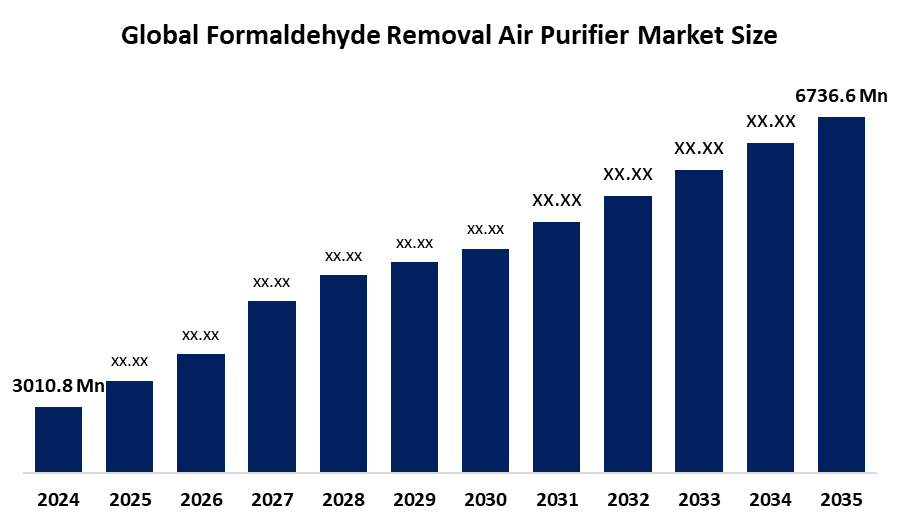
- The Global Formaldehyde Removal Air Purifier Market Size Was Estimated at USD 3010.8 Million in 2024
- The Market Size is Expected to Grow at a CAGR of around 7.6% from 2025 to 2035
- The Worldwide Formaldehyde Removal Air Purifier Market Size is Expected to Reach USD 6736.6 Million by 2035
- North America is expected to grow the fastest during the forecast period.
Get more details on this report -
According to a research report published by Spherical Insights and Consulting, The Global Formaldehyde Removal Air Purifier Market Size was worth around USD 3010.8 Million in 2024 and is predicted to Grow to around USD 6736.6 Million by 2035 with a compound annual growth rate (CAGR) of 7.6% from 2025 to 2035. The international market of air purifiers that remove formaldehyde is increasing due to rising awareness about formaldehyde, which causes various health issues as it is a carcinogenic chemical, along with rising air pollution indoors, as well as stricter regulations from governments.
Market Overview
The global formaldehyde removal air purifier market includes products that help to reduce formaldehyde, a toxic VOC, and thereby contribute to improving air quality and minimizing health problems related to formaldehyde exposure. These air purifiers have significant applications in residences, offices, hospitals, schools, and industries, mainly those that involve furniture, flooring, and construction materials. However, the major factors that contribute to market expansion are the growing awareness regarding air quality, urbanization and industrialization, and government regulations.
The market also has potential opportunities that can help it expand and grow further. These markets mainly include developing countries, as growing income and health-conscious consumers have been significantly influencing the adoption process. Advances in HEPA filters and other innovations related to air purification also have significant potential in this market. The prominent participants in the global market are Blueair AB, Philips, Honeywell International Inc., Xiaomi Corporation, Sharp Corporation, LG Electronics, Coway Co., Ltd., and Panasonic Corporation, to develop new products, making them energy-efficient, and improving their filtration qualities in an effort to increase their presence in the market. The U.S. Indoor Air Quality and Healthy Schools Act was presented in September 2025, intending to implement a new program concerning the reduction of indoor air pollutants. This will be a step forward in improving the level of air quality and the use of purifiers, such as formaldehyde removal, in educational institutions.
Report Coverage
This research report categorizes the formaldehyde removal air purifier market based on various segments and regions, forecasts revenue growth, and analyzes trends in each submarket. The report analyses the key growth drivers, opportunities, and challenges influencing the formaldehyde removal air purifier market. Recent market developments and competitive strategies, such as expansion, type launch, development, partnership, merger, and acquisition, have been included to draw the competitive landscape in the market. The report strategically identifies and profiles the key market players and analyses their core competencies in each sub-segment of the formaldehyde removal air purifier market.
Formaldehyde Removal Air Purifier Market Report Coverage
| Report Coverage | Details |
|---|---|
| Base Year: | 2024 |
| Market Size in 2024: | USD 3010.8 Million |
| Forecast Period: | 2024-2035 |
| Forecast Period CAGR 2024-2035 : | CAGR of 7.6% |
| 2035 Value Projection: | USD 6736.6 Million |
| Historical Data for: | 2020-2023 |
| No. of Pages: | 210 |
| Tables, Charts & Figures: | 90 |
| Segments covered: | By Type |
| Companies covered:: | Honeywell International Inc., Blueair AB, Xiaomi Corporation, Dyson, Panasonic Corporation, Sharp Corporation, Philips, Haier, Daikin, IQAir, ECOVAC, LG Electronics, SoleusAir, Coway Co., Ltd., and Other key players |
| Pitfalls & Challenges: | COVID-19 Empact, Challenge, Future, Growth, & Analysis |
Get more details on this report -
Driving Factors
The formaldehyde removal air purifier market, globally, is driven mainly by the increasing awareness of indoor air quality and health-conscious consumers. The increased focus on rapid urbanization, industrialization, and the use of furniture, construction materials, and the consumption of various products that release formaldehyde increases the risk of formaldehyde exposure. The growing strict regulations set by the government on indoor air quality in residential, commercial, and industrial areas are also influencing the market. Technological advancements in the area of purification technology, such as HEPA filters, activated carbon and photocatalytic oxidation technology, increase the efficiency of removing formaldehyde. Moreover, the rise in cases associated with respiratory diseases and allergies caused by formaldehyde is stimulating the demand for air purifiers among people worldwide.
Restraining Factors
The global formaldehyde removal air purifier market has some limitations include high equipment costs, high maintenance costs, limited adoption, especially within developing regions. These factors include a lack of awareness among consumers about formaldehyde hazards, the lack of standard regulations in some countries, and the presence of various low-quality, ineffective purifiers that hamper further growth of the market despite indoor air quality concerns.
Market Segmentation
The formaldehyde removal air purifier market share is classified into type, filtration technology, and application.
- The filter-type air purifier segment dominated the market in 2024, approximately 58% and is projected to grow at a substantial CAGR during the forecast period.
Based on the type, the formaldehyde removal air purifier market is divided into filter-type air purifier, electrostatic air purifier, photocatalyst air purifier, and water-washable air purifier. Among these, the filter-type air purifier segment dominated the market in 2024 and is projected to grow at a substantial CAGR during the forecast period. Consumers and air quality experts prefer filter-type systems due to their efficacy in absorbing formaldehyde, defined standards, and economies of cost. Filter-type systems have high filtration efficiency and can be used in conjunction with advanced air quality systems. Rising health consciousness and the need for reliability in purification are the factors that make filter-type systems imperative to air quality requirements.
- The HEPA filtration segment accounted for the largest share in 2024, approximately 42% and is anticipated to grow at a significant CAGR during the forecast period.
Based on the filtration technology, the formaldehyde removal air purifier market is divided into activated carbon filtration, HEPA filtration, photocatalytic oxidation, and hybrid filtration systems. Among these, the HEPA filtration segment accounted for the largest share in 2024 and is anticipated to grow at a significant CAGR during the forecast period. The HEPA filtration technology has been responsible for the larger market growth due to the superior efficiency in the removal and reduction of airborne particles and higher acceptance and established standards. It is compatible with multi-stage purification technology and is economical with increased demands because of higher health and indoor air quality demands and requirements.
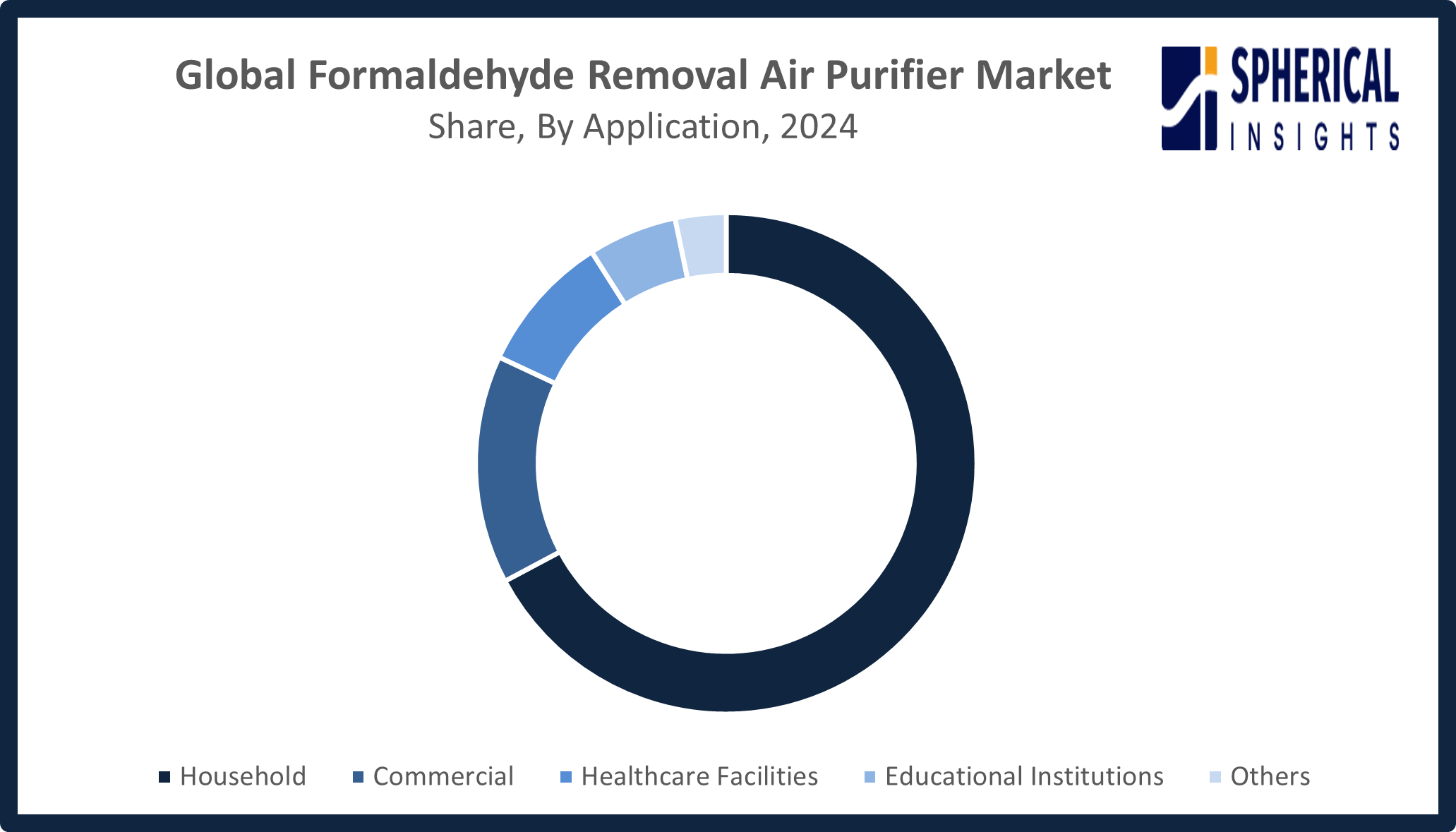
- The household segment accounted for the highest market revenue in 2024, approximately 67% and is anticipated to grow at a significant CAGR during the forecast period.
Based on the application, the formaldehyde removal air purifier market is divided into household, commercial, healthcare facilities, educational institutions, and others. Among these, the household segment accounted for the highest market revenue in 2024 and is anticipated to grow at a significant CAGR during the forecast period. Applications within the household sector assume a significant role within the context of health-concerned consumers, who demand the best indoor air quality as well as proper management of the residential environment. Homeowners display their preference for the technology due to the health benefit it provides, the depth of consumer acceptance, as well as its applicability to multiple rooms within the house.
Get more details on this report -
Regional Segment Analysis of the Formaldehyde Removal Air Purifier Market
- North America (U.S., Canada, Mexico)
- Europe (Germany, France, U.K., Italy, Spain, Rest of Europe)
- Asia-Pacific (China, Japan, India, Rest of APAC)
- South America (Brazil and the Rest of South America)
- The Middle East and Africa (UAE, South Africa, Rest of MEA)
Asia Pacific is anticipated to hold the largest share of the formaldehyde removal air purifier market over the predicted timeframe.

Get more details on this report -
Asia Pacific is anticipated to hold the largest share of the formaldehyde removal air purifier market over the predicted timeframe. The Asia Pacific is expected to possess the 45% market share for formaldehyde removal air purifiers owing to the high pace of urbanization, increased indoor air pollution, and growing awareness regarding healthcare. It is driven mainly by China, with increased emissions from new buildings and furniture, and India, driven by the growing middle class and decreasing air quality. It is further fueled by Japan, with the highest air quality regulations and South Korea, with high technology implementation. Government norms, increased residential construction, and a focus on indoor health further propel the market. In October 2024, the Indian Bureau of Indian Standards began stringent checks on air purifiers to implement BIS standards for effective, non-exaggerated performance, including superior removal of formaldehyde.
North America is expected to grow at a rapid CAGR in the formaldehyde removal air purifier market during the forecast period. The North American market is anticipated to have a 27% market share of the market for formaldehyde removal air purifiers. This can be attributed to rising awareness about indoor air quality and respiratory health. Moreover, stringent building norms in these countries will propel the growth of the market. The U.S. will lead the growth in North America due to technological advancements in air purification. Owing to increasing renovation activities and demands for quality solutions, the market is accelerating its growth. In March 2024, the U.S. EPA published a draft TSCA risk evaluation specifying potential health risks posed by contact with formaldehyde, thereby increasing demands for effective IAQ purification solutions.
The market for formaldehyde removal air purifiers is experiencing steady growth in the European region due to stringent government regulations on the quality of indoor air. This is being led by both the German and French governments due to their focus on eco-friendly residential and commercial buildings. However, the use of these air purifiers is slowly gaining momentum in the UK. Energy-efficient and eco-friendly technologies are additional factors that are promoting the steady growth of the market. The EU has set stricter regulations on the release of formaldehyde starting in 2026 through the REACH agreement.
Competitive Analysis:
The report offers the appropriate analysis of the key organizations/companies involved within the formaldehyde removal air purifier market, along with a comparative evaluation primarily based on their type of offering, business overviews, geographic presence, enterprise strategies, segment market share, and SWOT analysis. The report also provides an elaborative analysis focusing on the current news and developments of the companies, which includes type development, innovations, joint ventures, partnerships, mergers & acquisitions, strategic alliances, and others. This allows for the evaluation of the overall competition within the market.
List of Key Companies
- Honeywell International Inc.
- Blueair AB
- Xiaomi Corporation
- Dyson
- Panasonic Corporation
- Sharp Corporation
- Philips
- Haier
- Daikin
- IQAir
- ECOVAC
- LG Electronics
- SoleusAir
- Coway Co., Ltd.
- Others
Key Target Audience
- Market Players
- Investors
- End-users
- Government Authorities
- Consulting and Research Firm
- Venture capitalists
- Value-Added Resellers (VARs)
Recent Development
• In October 2025, Xiaomi launched the Mijia Air Purifier 6 Dual-Core in China, priced at 2,599 yuan (USD 365), with pre-sales available on Xiaomi Youpin. Designed for new or recently renovated homes, the purifier features dual filters, dual fan blades, and a six-sensor monitoring system, effectively targeting formaldehyde and VOC emissions from furniture and building materials.
• In August 2025, Xiaomi introduced the Mijia Smart Air Purifier 6 in China. The device offers formaldehyde removal and multi-stage HEPA filtration, along with upgraded sensors that monitor PM2.5, PM1, dust, humidity, and temperature. It includes an OLED display and supports Google Home and Alexa, combining smart connectivity with affordable pricing.
• In October 2024, Sharp India launched its PureFit air purifier series, including the FX-S120, FP-S42M-L, and FP-S40M-T/W models. The series incorporates Plasmacluster ion technology, Coanda Airflow for uniform air distribution, and HEPA plus activated carbon filters, enabling efficient removal of airborne pollutants, allergens, and odors to improve indoor air quality in Indian homes.
• In August 2024, Daikin launched two plug-and-play air purifiers, the MCK70Z and MC80Z, offering real-time indoor air quality monitoring. Connected to the Onecta app, users can control, schedule, and monitor purification via smartphones or tablets. Integrated sensors, along with Google Maps integration, provide detailed insights into both indoor and outdoor air quality.
• In May 2024, Swiss air quality company IQAir highlighted significant growth opportunities in China with the launch of the GC XE air purifier, designed for long-term formaldehyde removal. CEO Frank Hammes reaffirmed the company’s commitment to the market, citing increased air quality awareness since IQAir’s hospital installations in China began in 1998.
• In December 2023, Dyson launched the Big plus Quiet Formaldehyde air purifier in the UK, capable of covering areas of up to 100 m while operating at a low noise level of 56 dB. Featuring a sleek design and high-performance filtration, the model outperforms earlier products such as the Purifier Humidify plus Cool, offering advanced purification at a premium price of USD 879.99.
Market Segment
This study forecasts revenue at global, regional, and country levels from 2020 to 2035. Spherical Insights has segmented the formaldehyde removal air purifier market based on the below-mentioned segments:
Global Formaldehyde Removal Air Purifier Market, By Type
- Filter-type Air Purifier
- Electrostatic Air Purifier
- Photocatalyst Air Purifier
- Water-washable Air Purifier
Global Formaldehyde Removal Air Purifier Market, By Filtration Technology
- Activated Carbon Filtration
- HEPA Filtration
- Photocatalytic Oxidation
- Hybrid Filtration Systems
Global Formaldehyde Removal Air Purifier Market, By Application
- Household
- Commercial
- Healthcare Facilities
- Educational Institutions
- Others
Global Formaldehyde Removal Air Purifier Market, By Regional Analysis
- North America
- US
- Canada
- Mexico
- Europe
- Germany
- UK
- France
- Italy
- Spain
- Russia
- Rest of Europe
- Asia Pacific
- China
- Japan
- India
- South Korea
- Australia
- Rest of Asia Pacific
- South America
- Brazil
- Argentina
- Rest of South America
- Middle East & Africa
- UAE
- Saudi Arabia
- Qatar
- South Africa
Frequently Asked Questions (FAQ)
-
1. What is the CAGR of the formaldehyde removal air purifier market over the forecast period?The global formaldehyde removal air purifier market is projected to expand at a CAGR of 7.6% during the forecast period.
-
2. What is the market size of the formaldehyde removal air purifier market?The global formaldehyde removal air purifier market size is expected to grow from USD 3010.8 million in 2024 to USD 6736.6 million by 2035, at a CAGR of 7.6% during the forecast period 2025-2035.
-
3. Which region holds the largest share of the formaldehyde removal air purifier market?Asia Pacific is anticipated to hold the largest share of the formaldehyde removal air purifier market over the predicted timeframe
-
4. What is the formaldehyde removal air purifier market?The formaldehyde removal air purifier market involves products designed to eliminate formaldehyde and improve indoor air quality in homes and buildings.
-
5. Who are the top 10 companies operating in the global Formaldehyde Removal Air Purifier market?Honeywell International Inc., Blueair AB, Xiaomi Corporation, Dyson, Panasonic Corporation, Sharp Corporation, Philips, Haier, Daikin, IQAir, and Others
-
6. What factors are driving the growth of the formaldehyde removal air purifier market?The market growth is driven by rising indoor air pollution, increasing health awareness, stringent regulations, urbanization, demand for residential and commercial air quality solutions, and adoption of advanced purification technologies.
-
7. What are the market trends in the formaldehyde removal air purifier market?Trends include advanced filtration technology adoption, smart connected purifiers, hybrid systems, rising demand for VOC removal, and eco‑friendly indoor air quality solutions.
-
8. What are the main challenges restricting wider adoption of the formaldehyde removal air purifier market?The main challenges restricting the wider adoption of the formaldehyde removal air purifier market include high costs, limited and confusing consumer awareness, and technological limitations of current systems.
Need help to buy this report?