Europe Recombinant Cell Culture Insulin Market Size, Share, and COVID-19 Impact Analysis, By Type (Stand-Alone Powder, Combined Kits and Cocktails, Liquid Insulin), By End User (Therapeutic Protein Originators, Therapeutic Proteins Biosimilars, Vaccine Manufacturers, Regenerative Medicine, Academic Research Institutes, and Cell Culture Media Manufacturers), and Europe Recombinant Cell Culture Insulin Market Insights Forecasts to 2035
Industry: Healthcare
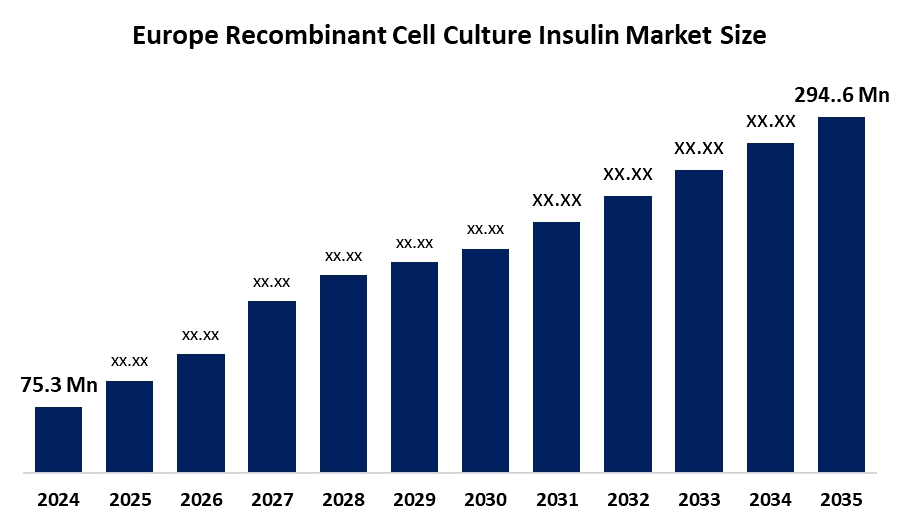
- The Europe Recombinant Cell Culture Insulin Market Size Was Estimated At USD 75.3 Million In 2024
- The Market Size Is Expected To Grow At A CAGR Of Around 13.2% From 2025 To 2035
- The Europe Recombinant Cell Culture Insulin Market Size Is Expected To Reach USD 294.6 Million By 2035
Get more details on this report -
According To A Research Report Published By Spherical Insights & Consulting, The Europe Recombinant Cell Culture Insulin Market Size Is Anticipated To Reach USD 294.6 Million By 2035, Growing At A CAGR Of 13.2% From 2025 To 2035. The market size is driven by biopharmaceuticals manufacturing is gradually shifting towards more recombinant technologies, there is a growing need for media that are chemically defined and free of serum, and the usage of insulin as a significant additive in cell culture is becoming more widespread.
Market Overview
The recombinant insulin is a highly pure, animal-free protein manufactured by microbial fermentation in yeast, produced to imitate human insulin in terms of both structure and function. It acts in the same way as insulin in the human body, and thus it promotes signalling of cell growth, survival, and protein synthesis, thereby enhancing the proliferation of cells and improving the final yield. Recombinant Insulin is being used for the production of monoclonal antibodies, viral vaccines, gene therapies, and other biologics.
The European Medicines Agency (EMA) is focusing on the need for tracing and purity of raw materials, which in turn is rapidly the use of insulin that is recombinant and non-animal-derived insulin both in research and production.
Local enterprises and research establishments stress the necessity of non-animal, chemically defined formulations as a means of meeting the strictest regulatory standards and sustainability targets. The ongoing use of high-quality insulin in the making of cell culture media formulations has been greatly influenced by the increasing investments in R&D for the production of biosimilars and advanced biologics. The governments are progressively giving more importance to the biosimilar development route as a way of cutting down on healthcare expenses; this, consequently, increases the market demand for recombinant insulin in the cell culture supplement of their production.
Report Coverage
This Research Report Categorizes The Market Size For the Europe recombinant cell culture insulin market based on various segments and regions, and forecasts revenue growth and analyses trends in each submarket. The report analyses the key growth drivers, opportunities, and challenges influencing the Europe recombinant cell culture insulin market. Recent market developments and competitive strategies, such as expansion, product launch, development, partnership, merger, and acquisition have been included to draw the competitive landscape in the market. The report strategically identifies and profiles the key market players and analyses their core competencies in each sub-segment of the Europe recombinant cell culture insulin market.
Europe Recombinant Cell Culture Insulin Market Report Coverage
| Report Coverage | Details |
|---|---|
| Base Year: | 2024 |
| Market Size in 2024: | USD 294.6 Million |
| Forecast Period: | 2020-2023 |
| Forecast Period CAGR 2020-2023 : | USD 75.3 Million |
| 2023 Value Projection: | USD 294.6 Million |
| Historical Data for: | 2020-2023 |
| No. of Pages: | 250 |
| Tables, Charts & Figures: | 121 |
| Segments covered: | By Type By End User |
| Companies covered:: | Lonza Group Ltd, Merck KGaA, Novo Nordisk, InSphero, Excell Gene, Cell Genix, Invivo Gen, Celonic, Bioton, Cell Culture Technologies, and Others, Key Players |
| Pitfalls & Challenges: | COVID-19 Empact, Challenge, Future, Growth, & Analysis |
Get more details on this report -
Driving Factors
The Recombinant Cell Culture Insulin Market Size in Europe is driven by advancements in biotechnology have positively affected the sourcing and use of recombinant insulin to be used as a supplement for cell cultures. The shift to serum-free and animal origin-free media reflects the mounting concerns regarding the ethical and sustainable biomanufacturing. The United Kingdom recombinant cell culture insulin market is experiencing strong growth by using recombinant insulin in cell-based research and bioprocessing, which is backed by the cell and gene therapy manufacturing base in the country, which is getting larger.
Restraining Factors
The Recombinant Cell Culture Insulin Market Size in Europe is restrained by biotechnology advancements haven’t only improved the sourcing and utilization of recombinant insulin as a cell culture supplement but also reflected the increase of ethical and sustainable biomanufacturing concerns through the changeover to serum-free and animal origin-free media. The recombinant cell culture insulin market in the UK is growing rapidly, as the use of recombinant insulin in cell-based research and bioprocessing is supported by the already established and growing cell and gene therapy manufacturing base in the country.
Market Segmentation
The Europe recombinant cell culture insulin market share is categorised into type and end user.
- The stand-alone powder segment accounted for the largest revenue market share in 2024 and is expected to grow at a significant CAGR during the forecast period.
The Europe Recombinant Cell Culture Insulin Market Size is segmented by type into stand-alone powder, combined kits and cocktails, liquid insulin. Among these, the stand-alone powder segment accounted for the largest revenue market share in 2024 and is expected to grow at a significant CAGR during the forecast period. The segmental growth is driven by the product with a longer shelf life, easy storage and transportation, and versatility for injectable, oral, or other applications in large-scale biomanufacturing processes was highly appreciated.
- The therapeutic protein originators segment dominated the market in 2024 and is projected to grow at a substantial CAGR during the forecast period.
Based on end user, the Europe recombinant cell culture insulin market size is segmented into therapeutic protein originators, therapeutic proteins biosimilars, vaccine manufacturers, regenerative medicine, academic research institutes, and cell culture media manufacturers. Among these, the therapeutic protein originators segment dominated the market in 2024 and is projected to grow at a substantial CAGR during the forecast period. The growth of the segment is driven by the presence of their famous brands and the widespread application of their recombinant insulin products in key markets. Their ability to market extensively, invest in new research and development, and adhere to strict manufacturing standards are all part of the reasons for their continued dominance in the market.
Competitive Analysis:
The report offers the appropriate analysis of the key organizations/companies involved within the Europe recombinant cell culture insulin market, along with a comparative evaluation primarily based on their product offering, business overviews, geographic presence, enterprise strategies, segment market share, and SWOT analysis. The report also provides an elaborate analysis focusing on the current news and developments of the companies, which includes product development, innovations, joint ventures, partnerships, mergers & acquisitions, strategic alliances, and others. This allows for the evaluation of the overall competition within the market.
List of Key Companies
- Lonza Group Ltd
- Merck KGaA
- Novo Nordisk
- InSphero
- Excell Gene
- Cell Genix
- Invivo Gen
- Celonic
- Bioton
- Cell Culture Technologies
- Others
Key Target Audience
- Market Players
- Investors
- End-users
- Government Authorities
- Consulting and Research Firm
- Venture capitalists
- Value-Added Resellers (VARs)
Recent Development
In August 2024, French drugmaker Sanofi, opens new tab will invest 1.3 billion euros ($1.40 billion) in a new insulin production facility at its existing site in Frankfurt, where it makes insulin brand Lantus, the company said on Thursday.
In January 2024, Medtronic plc, a global leader in healthcare technology, announced CE Mark approval for the MiniMed 780G system with Simplera Sync, a disposable, all-in-one continuous glucose monitor (CGM) requiring no fingerstick.
Market Segment
This study forecasts revenue at the Europe, regional, and country levels from 2020 to 2035. Spherical Insights has segmented the Europe Recombinant Cell Culture Insulin Market based on the below-mentioned segments:
Europe Recombinant Cell Culture Insulin Market, By Type
- Stand-Alone Powder
- Combined Kits and Cocktails
- Liquid Insulin
Europe Recombinant Cell Culture Insulin Market, By End User
- Therapeutic Protein Originators
- Therapeutic Proteins Biosimilars
- Vaccine Manufacturers
- Regenerative Medicine
- Academic Research Institutes
- Cell Culture Media Manufacturers
Frequently Asked Questions (FAQ)
-
What is the Europe recombinant cell culture insulin market size?Europe Recombinant Cell Culture Insulin market size is expected to grow from USD 75.3 Million in 2024 to USD 294.6 Million by 2035, growing at a CAGR of 13.2% during the forecast period 2025-2035.
-
What is recombinant cell culture insulin, and its primary use?The recombinant insulin is a highly pure, animal-free protein manufactured by microbial fermentation in yeast, produced to imitate human insulin in terms of both structure and function. It acts in the same way as insulin in the human body, and thus it promotes signalling of cell growth, survival, and protein synthesis, thereby enhancing the proliferation of cells and improving the final yield.
-
What are the key growth drivers of the market?Market growth is driven by advancements in biotechnology have positively affected the sourcing and use of recombinant insulin to be used as a supplement for cell cultures. The shift to serum-free and animal origin-free media reflects the mounting concerns regarding the ethical and sustainable biomanufacturing.
-
What factors restrain the Europe recombinant cell culture insulin market?The market is restrained by biotechnology advancements that haven’t only improved the sourcing and utilization of recombinant insulin as a cell culture supplement but also reflected the increase of ethical and sustainable biomanufacturing concerns through the changeover to serum-free and animal origin-free media. The recombinant cell culture insulin market in the UK is growing rapidly.
-
How is the market segmented by type?The market is segmented into stand-alone powder, combined kits and cocktails, liquid insulin.
-
Who are the key players in the Europe recombinant cell culture insulin market?Key companies include Lonza Group Ltd, Merck KGaA, Novo Nordisk, InSphero, Excell Gene, Cell Genix, Invivo Gen, Celonic, Bioton, and Cell Culture Technologies.
Need help to buy this report?