Europe Biosimilars Market Size, Share, And COVID-19 Impact Analysis, By Drug Class (Monoclonal Antibodies, Insulin, Recombinant Hormones, and Others), By Indication (Oncology, Autoimmune Disorders, Diabetes, Blood Disorders, Others), By End Users (Hospitals, Clinics, Homecare Settings, Retail Pharmacies, and Others), and Europe Biosimilars Market Insights, Industry Trend, Forecasts to 2035.
Industry: Healthcare
Europe Biosimilars Market Size Insights Forecasts to 2035
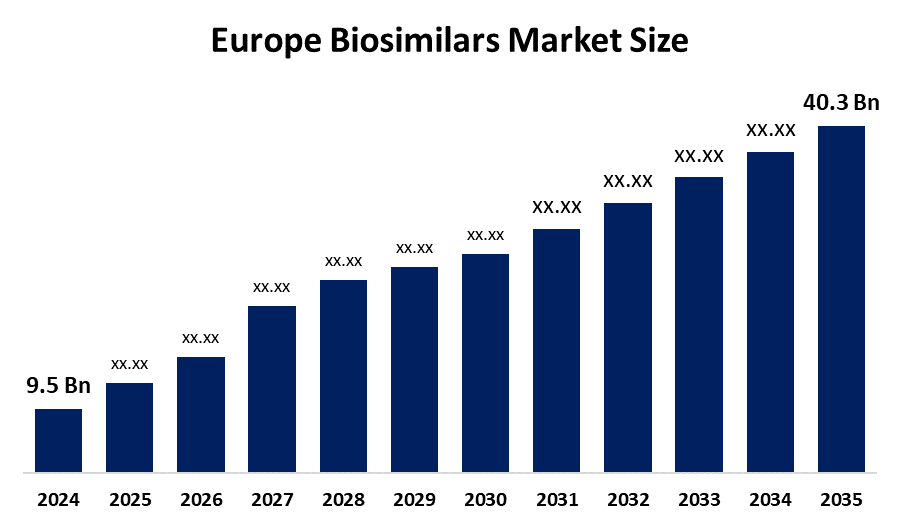
- The Europe Biosimilars Market Size was estimated at USD 9.5 Billion in 2024
- The Market size is expected to grow at a CAGR of Around 13.96% from 2025 to 2035
- The European Biosimilars Market size is expected to reach USD 40.3 Billion by 2035
Get more details on this report -
According to a research report published by Spherical Insights and Consulting, The Europe Biosimilars Market Was Valued At Approximately USD 9.5 Billion In 2024 And Is Projected To Grow To Around USD 40.3 Billion By 2035 With A Compound Annual Growth Rate (CAGR) Of 13.96% From 2025 To 2035. The Europe biosimilars market is experiencing growth owing to a rise in chronic conditions like cancer, rising global demand for targeted therapies, and faster regulatory approvals for biosimilars as a cost-effective treatment. are also driving the growth in the Europe biosimilars market.
Market Overview
The Europe Biosimilars Market Size is the development, manufacturing and sale of large molecule therapeutic substances derived from living biological organisms (biologics) and their highly similar lower cost equivalent (biosimilars). They are produced using advanced biotechnological methods. These biopharmaceuticals have become essential to clinical care, particularly for infectious diseases, chronic conditions and disorders where traditional drugs may be less effective.
The European Medicines Agency (EMA) is pioneering streamlined regulatory pathways that favour advanced analytical data over redundant clinical trials. Simultaneously, manufacturers are deploying AI-driven continuous bioprocessing and smart delivery devices, such as citrate-free autoinjectors with digital monitoring. Europe is successfully combining high-tech manufacturing with fiscal responsibility to expand patient access.
Biosimilars are indispensable to the European medical landscape, serving as a vital fiscal tool that reconciles drug expenditures by providing significant savings for insurers. This financial flexibility not only paves the way for cutting-edge medical breakthroughs but also widens patient access to essential biological treatments. While these therapies have been a cornerstone of robust healthcare systems since their 2006 debut, recent pipeline data confirms that the persistent market challenges identified in earlier assessments remain a significant concern.
The demand for biosimilars is rising due to various factors, some of which are that they can target specific disease-related molecules, reducing damage to healthy tissues. Biosimilars are cost-effective alternatives to Biologics, enabling the reduction of healthcare costs.
Report Coverage
This research report categorises the Europe biosimilars market based on various segments and regions, forecasts revenue growth, and analyses trends in each submarket. The report analyses the key growth drivers, opportunities, and challenges influencing the biosimilars market. Recent market developments and competitive strategies, such as expansion, type launch, development, partnership, merger, and acquisition, have been included to draw the competitive landscape in the market. The report strategically identifies and profiles the key market players and analyses their core competencies in each sub-segment of the Europe biosimilars market.
Europe Biosimilars Market Report Coverage
| Report Coverage | Details |
|---|---|
| Base Year: | 2024 |
| Market Size in 2024: | USD 9.5 Billion |
| Forecast Period: | 2025-2035 |
| Forecast Period CAGR 2025-2035 : | 13.96% |
| 2035 Value Projection: | USD 40.3 Billion |
| Historical Data for: | 2020-2023 |
| No. of Pages: | 195 |
| Tables, Charts & Figures: | 110 |
| Segments covered: | By Drug Class, By Indication, By End Users |
| Companies covered:: | Sandoz, Pfizer, Amgen, Celltrion, Samsung Bioepis, Biocon Biologics, Teva Pharmaceutical Industries, STADA Arzneimittel, Fresenius Kabi, Organon, Viatris (Formerly Mylan), Accord Healthcare, Biogen, Boehringer Ingelheim, Eli Lilly and Company, Sanofi, Zentiva |
| Pitfalls & Challenges: | COVID-19 Empact, Challenge, Future, Growth, & Analysis |
Get more details on this report -
Driving Factors
The Europe Biosimilars Market Sizeis driven by various key factors. The key factor is cost savings. Biosimilars offer significant cost savings compared to their reference products, making them a favourable option for patients and healthcare providers. Rise in chronic diseases like rheumatoid arthritis, cancers, also contribute for the growth of biosimilars. Regulators around the world are reducing the time and cost of development of biosimilars.
Restraining Factors
Despite of being a cost-effective treatment, factors such as the complex and high manufacturing process, intense competition, pricing pressure, and physicians’ acceptance have restrained the growth of biosimilars.
Market Segmentation
The Europe biosimilars market is classified by drug class, indication, and end user.
- The monoclonal antibody segment accounted for the largest market share in 2024 and is expected to grow at a significant CAGR during the forecast period.
The Europe Biosimilars Market Size is segmented by drug class into monoclonal antibodies, insulin, and recombinant hormones. Among these, the monoclonal antibody segment accounted for the largest market share in 2024 and is expected to grow at a significant CAGR during the forecast period. Due to factors which include the expiration of patents of prominent monoclonal antibody biologics, innovations in monoclonal antibody manufacturing processes, they have diverse applications in diagnosis, treatment and in some cases in prevention of diseases, and the rise of chronic diseases like cancer, arthritis, and autoimmune disorders.
- The oncology segment dominated the share in 2024 and is anticipated to grow at a remarkable CAGR during the forecast period.
Based on indication, the Europe biosimilars market is segmented into oncology, autoimmune disorders, diabetes, blood disorders, and others. Among these, the oncology segment dominated the share in 2024 and is anticipated to grow at a remarkable CAGR during the forecast period. This is because of the high prevalence of cancers, high clinical volume, and high cost of biologics.
- The hospital segment accounted for the largest market share in 2024 and is expected to grow at a significant CAGR during the forecast period.
Based on end user, the Europe biosimilars market is segmented into hospitals, clinics, and others. Among these, the hospital segment accounted for the largest market share in 2024 and is expected to grow at a significant CAGR during the forecast period. This is because chronic conditions such as cancers and autoimmune disorders require specialised clinical environments and professional oversight. Also, Europe’s centralised procurement model has a significant role in this segment dominance, where hospital networks utilise competitive tender systems to purchase biosimilars in high volumes. By leveraging these bulk-buying strategies, healthcare systems achieve significant cost reductions.
Competitive Analysis
The report offers the appropriate analysis of the key organisations/companies involved within the Biosimilars market, along with a comparative evaluation primarily based on their type of offering, business overviews, geographic presence, enterprise strategies, segment market share, and SWOT analysis. The report also provides an elaborate analysis focusing on the current news and developments of the companies, which includes type development, innovations, joint ventures, partnerships, mergers & acquisitions, strategic alliances, and others. This allows for the evaluation of the overall competition within the market.
List of Key Companies
- Sandoz
- Pfizer
- Amgen
- Celltrion
- Samsung Bioepis
- Biocon Biologics
- Teva Pharmaceutical Industries
- STADA Arzneimittel
- Fresenius Kabi
- Organon
- Viatris (Formerly Mylan)
- Accord Healthcare
- Biogen
- Boehringer Ingelheim
- Eli Lilly and Company
- Sanofi
- Zentiva
Key Target Audience
- Market Players
- Investors
- End-users
- Government Authorities
- Consulting and Research Firm
- Venture capitalists
- Value-Added Resellers (VARs)
Market Segment
This study forecasts revenue at the Europe, regional, and country levels from 2020 to 2035. Spherical Insights has segmented the Europe biosimilars market based on the below-mentioned segments
Europe Biosimilars Market, By Drug Class
- Monoclonal Antibodies
- Insulin
- Recombinant Hormones
- Others
Europe Biosimilars Market, By Indication
- Oncology
- Autoimmune Disorders
- Diabetes
- Blood Disorders
- Others
Europe Biosimilars Market, By End Users
- Hospitals
- Clinics
- Homecare Settings
- Retail Pharmacies
- Others
Frequently Asked Questions (FAQ)
-
Q. What are Biosimilars?A. Biosimilars are medicines specifically designed to have similar properties to a drug that’s already been created; they are not exact copies of the medicines they’re designed to imitate.
-
Q. What are the key driving factors of the market?A. The key driving factors of Biosimilars are the increasing prevalence of chronic diseases like cancer, and highly cost-effective compared to biologics, evolving regulatory frameworks of European Medicines Agency
-
Q. Who are the key players in the Biosimilars market?A. Sandoz, Pfizer, Amgen, Celltrion, Samsung Bioepis, Biocon Biologics, Teva Pharmaceutical Industries, STADA, Arzneimittel, Fresenius Kabi, Organon, Viatris (Formerly Mylan), Accord Healthcare, Biogen, Boehringer Ingelheim, Eli Lilly and Company, Sanofi, and Zentiva.
-
Q. How is the Europe biosimilar market segmented by Indication? Mention the dominant and fastest-growing segment?A. The Europe biosimilar market is segmented by indication into oncology, autoimmune disorders, diabetes, blood disorders, and others. The oncology segment dominated the share in 2024 and is anticipated to grow at a remarkable CAGR during the forecast period. The diabetes segment is the fastest-growing segment and is anticipated to grow at a significant CAGR during the forecast period.
Need help to buy this report?