Europe Acetone Market Size, Share, and COVID-19 Impact Analysis, By Application (Solvent, Bisphenol A, Methyl Methacrylate, and Others), By End User (Paints & Coatings, Plastic, Automotive, Adhesives, Pharmaceuticals, Cosmetics, Electrical & Electronics, and Others), and Europe Acetone Market Insights, Industry Trends, Forecast to 2035.
Industry: Chemicals & Materials
Europe Acetone Market Size Insights Forecasts to 2035
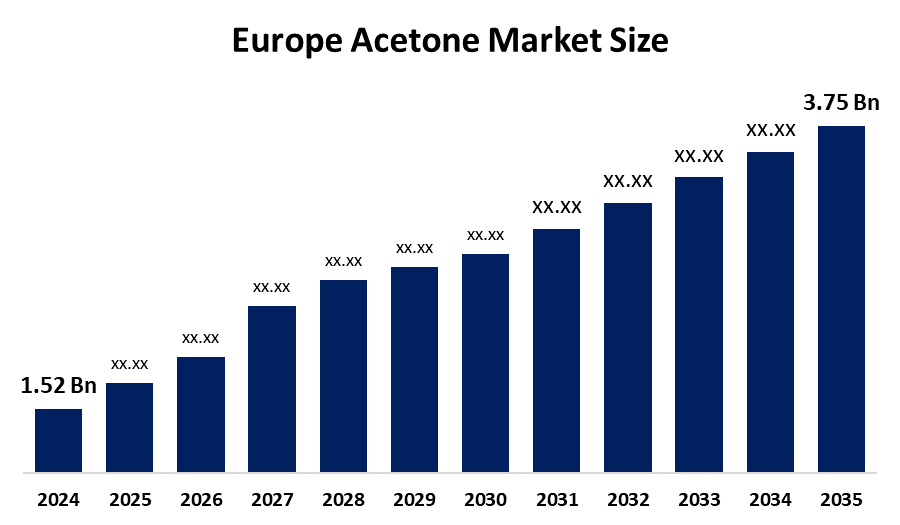
- The Europe Acetone Market Size Was Estimated at USD 1.52 Billion in 2024
- The Market Size is Expected to Grow at a CAGR of Around 8.56% from 2025 to 2035
- The Europe Acetone Market Size is Expected to Reach USD 3.75 Billion by 2035
Get more details on this report -
According to a research report published by Spherical Insights & Consulting, The Europe Acetone Market Size Is Anticipated To Reach USD 3.75 Billion By 2035, Growing At A CAGR Of 8.56% From 2025 To 2035. The market is driven by the increasing usage of solvents and high demand in the pharmaceutical, cosmetic, adhesive, and automotive industries are expected to drive growth
Market Overview
The Europe Acetone Market Size represents a developed market which exhibits intricate operational patterns. The market continues to function as an important international center but undergoes fundamental changes because of excess supply from Asia, with declining demand in conventional downstream sectors. Acetone functions as an essential solvent which various industries including chemical and pharmaceutical use for their operations. The market for bio-based acetone which companies produce from renewable waste glycerol resources is growing at a 7.92% CAGR because of EU environmental regulations, which require stricter compliance.
In 2022, LG Chem announced on the 21st that it started to export its first bio-balanced phenol and acetone. The product has achieved International Sustainability & Carbon Certification PLUS (ISCC PLUS) which serves as a worldwide certification for sustainable, eco-friendly materials that use renewable bio-feedstock derived from biomass and waste cooking oil.
Companies use platforms that enable their teams to work efficiently through automated processes and functions, which can grow their operations. The combination of expanded partnerships with pilot projects and innovation programs will lead to faster technology validation and adoption. The European Union created a unified digital platform for chemical information which the European Chemicals Agency (ECHA) manages to centralize chemical data from all industrial sectors.
Report Coverage
This research report categorises the European acetone market based on various segments and regions, and forecasts revenue growth and analyses trends in each submarket. The report analyses the key growth drivers, opportunities, and challenges influencing the Europe acetone market. Recent market developments and competitive strategies, such as expansion, product launch, development, partnership, merger, and acquisition have been included to draw the competitive landscape in the market. The report strategically identifies and profiles the key market players and analyses their core competencies in each sub-segment of the Europe acetone market.
Europe Acetone Market Report Coverage
| Report Coverage | Details |
|---|---|
| Base Year: | 2024 |
| Market Size in 2024: | USD 1.52 Billion |
| Forecast Period: | 2025-2035 |
| Forecast Period CAGR 2025-2035 : | 8.56% |
| 2035 Value Projection: | USD 3.75 Billion |
| Historical Data for: | 2020-2023 |
| No. of Pages: | 220 |
| Tables, Charts & Figures: | 109 |
| Segments covered: | By Application, By End User |
| Companies covered:: | Cepsa, INEOS, Shell PLC, Solvay SA, Arkema SA, Domo Chemicals, Versalis S.p.A., BASF SE, Others |
| Pitfalls & Challenges: | COVID-19 Empact, Challenge, Future, Growth, & Analysis |
Get more details on this report -
Driving Factors
The acetone market in Europe is driven by governments and enterprises, plus service providers are focusing on modernization efforts to achieve better transparency, operational efficiency and enhanced service delivery. The increasing use of cloud-based systems, with real-time monitoring solutions, is transforming existing business operations. The market development is driven by two factors, which include improved risk management and compliance requirements, with enhanced data protection measures. The Europe acetone market expansion is primarily driven by digitalization efforts, which both public and private organizations are currently implementing.
Restraining Factors
The acetone market in Europe is restrained by the main obstacle of data security and privacy concerns. Businesses keep their distance from digital platforms because they want to protect themselves from potential security breaches, regulatory penalties and damage to their public image. Organizations now respond with increased security measures after they experience high-profile cybersecurity breaches, which bring them greater public examination.
Market Segmentation
The Europe acetone market share is categorised into application and end user.
- The bisphenol A segment accounted for the largest share in 2024 and is expected to grow at a significant CAGR during the forecast period.
The Europe Acetone Market Size is segmented by application into solvent, bisphenol A, methyl methacrylate, and others. Among these, the bisphenol A segment accounted for the largest share in 2024 and is expected to grow at a significant CAGR during the forecast period. The bisphenol A segment held the largest share 42.1% of the Europe acetone market in 2024. The BPA segment holds the top market position because it serves as the essential component for manufacturing both polycarbonate plastics and epoxy resins. The production of components for wind energy, especially for coastal installations, consumed a notable volume of the chemical, showing a considerable increase in usage for the application compared to period.
- The paints & coatings segment dominated the market in 2024 and is projected to grow at a substantial CAGR during the forecast period.
Based on end user, the Europe acetone market is segmented into paints & coatings, plastic, automotive, adhesives, pharmaceuticals, costemics, electrical & electronics, and others. Among these, the paints & coatings segment dominated the market in 2024 and is projected to grow at a substantial CAGR during the forecast period. The paints and coatings segment led the Europe acetone market and held a share of 35.6 in 2024. Aceton serves three industrial purposes because its evaporation speed delivers fast results while its chemical properties effectively dissolve resins, nitrocellulose, and acrylics. The demand for acetone in this sector is influenced by construction and infrastructure activities, as well as the overall demand for paints and coatings in Europe.
Competitive Analysis:
The report offers the appropriate analysis of the key organizations/companies involved within the Europe acetone market, along with a comparative evaluation primarily based on their product offering, business overviews, geographic presence, enterprise strategies, segment market share, and SWOT analysis. The report also provides an elaborate analysis focusing on the current news and developments of the companies, which includes product development, innovations, joint ventures, partnerships, mergers & acquisitions, strategic alliances, and others. This allows for the evaluation of the overall competition within the market.
List of Key Companies
- Cepsa
- INEOS
- Shell PLC
- Solvay SA
- Arkema SA
- Domo Chemicals
- Versalis S.p.A.
- BASF SE
- Others
Key Target Audience
- Market Players
- Investors
- End-users
- Government Authorities
- Consulting and Research Firm
- Venture capitalists
- Value-Added Resellers (VARs)
Recent Development
In June 2025, INEOS Phenol, the world's largest producer of phenol and acetone, announced its intention to permanently stop production at its site in Gladbeck, Germany. Sky-high European energy costs alongside Europe’s punitive CO2 tax policy have combined to leave Europe uncompetitive against imported Chinese production and a global oversupply.
Market Segment
This study forecasts revenue at the Europe, regional, and country levels from 2020 to 2035. Spherical Insights has segmented the Europe Acetone Market based on the below-mentioned segments
Europe Acetone Market, By Application
- Solvent
- Bisphenol A
- Methyl Methacrylate
- Others
Europe Acetone Market, By End User
- Paints & Coatings
- Plastic
- Automotive
- Adhesives
- Pharmaceuticals
- Costemics
- Electrical & Electronics
- Others
Frequently Asked Questions (FAQ)
-
Q: What is the Europe acetone market size?A: Europe acetone market size is expected to grow from USD 1.52 billion in 2024 to USD 3.75 billion by 2035, growing at a CAGR of 8.56% during the forecast period 2025-2035.
-
Q: What is acetone, and its primary use?A: Acetone is a widely used industrial solvent and chemical intermediate. It is primarily used in pharmaceuticals, cosmetics, paints & coatings, and the production of BPA and MMA.
-
Q: What are the key growth drivers of the market?A: Market growth is driven by digitalization, modernization, and the adoption of cloud-based systems. Additionally, rising demand from the construction, automotive, and pharmaceutical sectors supports growth.
-
Q: What factors restrain the Europe acetone market?A: The market is restrained by data security and privacy concerns related to digital transformation.
-
Q: Which application segment holds the largest share?A: The bisphenol A segment holds the largest share (~42.1% in 2024). It is widely used in plastics, resins, and wind energy component manufacturing.
-
Q: What recent developments are impacting the market?A: In 2025, INEOS announced the closure of its Germany plant due to high energy costs and CO₂ regulations. This reflects Europe’s competitiveness challenges against global oversupply.
Need help to buy this report?