Global Ethanol E-Fuel Market Size, Share, By Renewable Source (On-Site Solar and Wind), By Technology (Fischer-Tropsch, eRWGS, and Others), By Application (Automotive, Marine, Aviation, Industrial, and Others), By Region (North America, Europe, Asia-Pacific, Latin America, Middle East, and Africa), Analysis and Forecast 2026 - 2035
Industry: Energy & Power
Global Ethanol E-Fuel Market Insights Forecasts to 2035
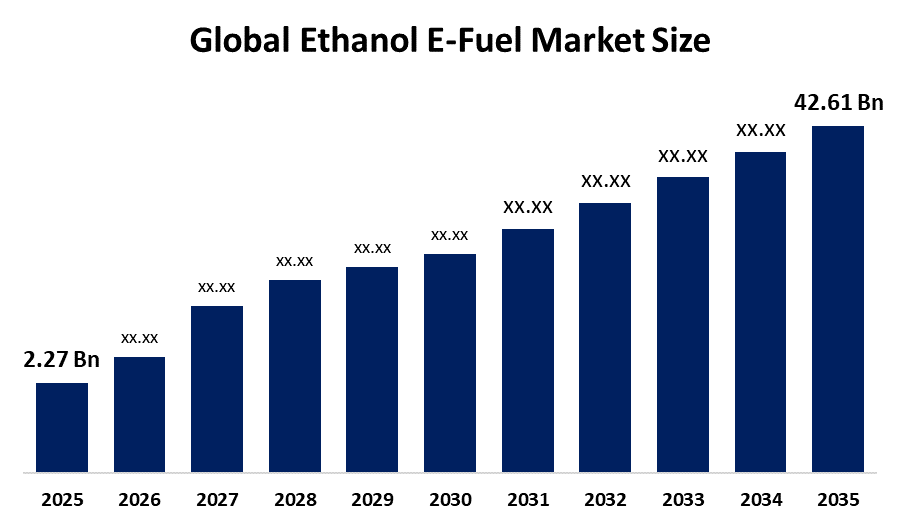
- The Global Ethanol E-Fuel Market Size Was Estimated at USD 2.27 Billion in 2025
- The Market Size is Expected to Grow at a CAGR of around 34.08% from 2026 to 2035
- The Worldwide Ethanol E-Fuel Market Size is Expected to Reach USD 42.61 Billion by 2035
- Asia Pacific is expected to grow the fastest during the forecast period.
Get more details on this report -
According to a research report published by Spherical Insights and Consulting, the global ethanol E-fuel market size was worth around USD 2.27 billion in 2025 and is predicted to grow to around USD 42.61 billion by 2035 with a compound annual growth rate (CAGR) of 34.08% from 2026 to 2035. The ethanol E-Fuel market experiences growth because of increasing energy security needs and rising climate change issues. The combination of renewable subsidies and tax incentives, together with advanced production technologies, leads to high adoption rates in the automotive, aviation and marine sectors, which enables full commercial operations and worldwide market growth.
Market Overview
The global ethanol E-fuel market refers to the production, commercialization, and utilization of ethanol-based fuels that can replace or blend with conventional fossil fuels in transportation and industrial sectors. Ethanol E-Fuel is a renewable, low-carbon fuel produced from biomass, agricultural residues, or through synthetic processes such as Fischer-Tropsch and electrochemical water-gas conversion. It is widely applied in automotive, marine, aviation, and industrial sectors to reduce greenhouse gas emissions, improve air quality, and support energy transition goals. The market scope covers feedstock sourcing, production technologies, blending infrastructure, and end-user adoption. Government initiatives driving growth include Japan’s Beyond 5G Promotion Consortium, supporting ethanol production pilot projects using renewable energy, South Korea’s Biofuel Promotion Roadmap 2030, funding sustainable fuel research, and China’s provincial-level subsidies for low-carbon fuel adoption in industrial fleets. These policies encourage investment, scale production, and support commercial deployment. Future opportunities lie in scaling renewable feedstock, integrating ethanol e-fuels into transport networks, and leveraging advanced Fischer-Tropsch and eRWGS technologies to reduce costs and emissions.
Report Coverage
This research report categorizes the ethanol E-fuel market based on various segments and regions, forecasts revenue growth, and analyzes trends in each submarket. The report analyses the key growth drivers, opportunities, and challenges influencing the ethanol E-fuel market. Recent market developments and competitive strategies, such as expansion, product launch, development, partnership, merger, and acquisition, have been included to draw the competitive landscape in the market. The report strategically identifies and profiles the key market players and analyses their core competencies in each sub-segment of the ethanol E-fuel market.
Global Ethanol E-Fuel Market Report Coverage
| Report Coverage | Details |
|---|---|
| Base Year: | 2024 |
| Market Size in 2024: | USD 2.27 Billion |
| Forecast Period: | 2026-2035 |
| Forecast Period CAGR 2026-2035 : | 34.08% |
| 2035 Value Projection: | USD 42.61 Billion |
| Historical Data for: | 2020-2024 |
| No. of Pages: | 268 |
| Tables, Charts & Figures: | 112 |
| Segments covered: | By Renewable Source, By Technolog , By Application, By Region |
| Companies covered:: | HIF Global, LanzaJet Inc, Arcadia eFuels, Electrochaea GmbH, ExxonMobil Corporation, Norsk e Fuel AS, Sunfire GmbH, Synhelion SA, Zero Petroleum, Archer Daniels Midland Company ADM, POET LLC, BP Bioenergia, and Others |
| Pitfalls & Challenges: | Covid 19 Impact Challanges, Future, Growth and Analysis |
Get more details on this report -
Driving Factors
Rising global focus on energy security and climate change mitigation is driving the ethanol E-fuel market. Governments and industries are supporting the development of low-carbon fuels through renewable energy subsidies, tax incentives, and pilot e-fuel projects. Advances in synthetic ethanol production technologies, including power-to-liquid and electrochemical conversion, enhance efficiency and scalability. Expanding adoption across automotive, aviation, and marine sectors, coupled with growing investments in sustainable transport infrastructure, strengthens market growth. Increasing corporate commitments to net-zero targets and rising consumer preference for eco-friendly fuels are further accelerating innovation, commercialization, and large-scale deployment of ethanol e-fuels worldwide, driving long-term market expansion.
Restraining Factors
High production and operational costs, feedstock supply constraints, limited ethanol blending and distribution infrastructure, competition from conventional fossil fuels, lack of standardized global regulations, and uncertainty in government policy implementation are the main factors restricting the growth and rapid adoption of the Ethanol E-Fuel market globally.
Market Segmentation
The ethanol E-fuel market share is classified into renewable source, technology, and application.
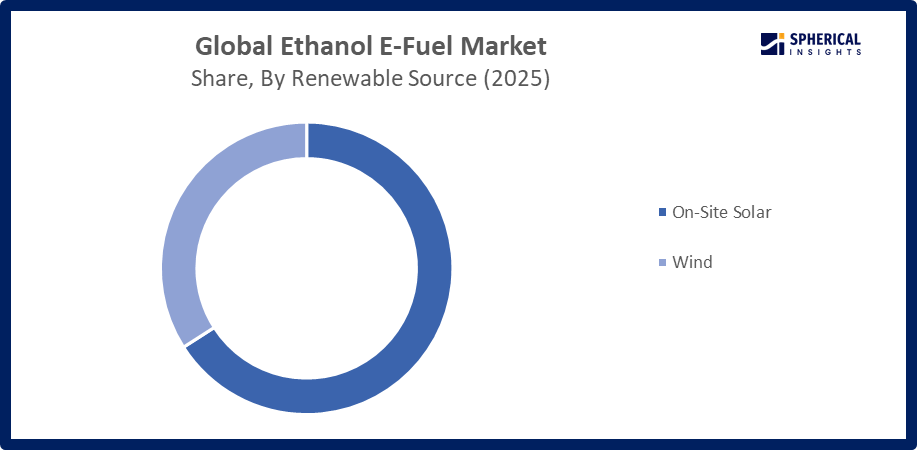
- The on-site solar segment dominated the market in 2025, approximately 65.94%, and is projected to grow at a substantial CAGR during the forecast period.
Based on renewable source, the ethanol E-fuel market is divided into on-site solar and wind. Among these, the on-site solar segment dominated the market in 2025, approximately 65.94%, and is projected to grow at a substantial CAGR during the forecast period. The growth is driven by increasing adoption of low-cost, carbon-neutral electricity integrated into ethanol synthesis plants, strong government incentives for renewable energy, decreasing solar panel costs, and rising industrial demand for sustainable and environmentally friendly fuel alternatives in multiple sectors.
Get more details on this report -
- The Fischer-Tropsch segment accounted for the largest share in 2025, approximately 39.75%, and is anticipated to grow at a significant CAGR during the forecast period.
Based on technology, the ethanol E-fuel market is divided into Fischer-Tropsch, eRWGS, and others. Among these, the Fischer-Tropsch segment accounted for the largest share in 2025, approximately 39.75%, and is anticipated to grow at a significant CAGR during the forecast period. This growth is due to its industrial scalability, high conversion efficiency, compatibility with existing infrastructure, ability to produce high-quality liquid fuels, increasing adoption by renewable fuel producers, and rising regulatory support for sustainable and carbon-neutral fuel production technologies.
- The automotive segment held the largest share in 2025, approximately 41.28%, and is projected to grow at a substantial CAGR during the forecast period.
Based on application, the ethanol E-fuel market is divided into automotive, marine, aviation, industrial, and others. Among these, the automotive segment held the largest share in 2025, approximately 41.28%, and is projected to grow at a substantial CAGR during the forecast period. The growth is driven by rising consumer demand for cleaner fuels, stringent vehicle emission regulations, compatibility of ethanol e-fuels with existing engines, increased fleet adoption, government incentives for green mobility, and the automotive industry's push toward sustainability and decarbonization.
Regional Segment Analysis of the Ethanol E-Fuel Market
- North America (U.S., Canada, Mexico)
- Europe (Germany, France, U.K., Italy, Spain, Rest of Europe)
- Asia-Pacific (China, Japan, India, Rest of APAC)
- South America (Brazil and the Rest of South America)
- The Middle East and Africa (UAE, South Africa, Rest of MEA)
North America is anticipated to hold the largest share of the ethanol E-fuel market over the predicted timeframe.

Get more details on this report -
North America is anticipated to hold the largest share of the ethanol E-fuel market over the forecast period. Strong government backing for renewable fuels, a mature ethanol production ecosystem, and the presence of leading energy and biofuel companies propel North America. The region’s position is reinforced by policy frameworks and regulatory initiatives that directly support ethanol blending, production, and commercialization. Key programs include the U.S. Renewable Fuel Standard (RFS), which mandates ethanol blending and sustains domestic supply, the EPA’s March 2026 temporary E15 waiver, allowing broader summer sales of 15% ethanol gasoline nationwide, and Canada’s Clean Fuels Standard (CFS), which mandates increasing renewable content in transportation fuels. These measures collectively enhance market availability, stimulate industrial and automotive adoption, and strengthen the growth trajectory of ethanol e-fuels across the region.
Asia Pacific is expected to grow at a rapid CAGR in the ethanol E-fuel market during the forecast period. India, Japan, and South Korea are among the nations making significant policy and infrastructure investments to expand ethanol adoption and support renewable fuel targets. The demand for ethanol e-fuels is further accelerated by the region’s growing automotive, industrial, and transport sectors. Key government initiatives include India’s E20 Petrol Mandate in April 2026, which enforces 20% ethanol blending in petrol and directly drives domestic ethanol demand, and the National Policy on Biofuels from 2018, amended in 2022, which sets blending targets, provides incentives, and establishes long-term ethanol supply frameworks. These programs collectively strengthen production, commercialisation, and adoption of ethanol e-fuels across the Asia Pacific, positioning the region as the fastest-growing market globally.
Competitive Analysis:
The report offers the appropriate analysis of the key organizations/companies involved within the ethanol E-fuel market, along with a comparative evaluation primarily based on their product offerings, business overviews, geographic presence, enterprise strategies, segment market share, and SWOT analysis. The report also provides an elaborative analysis focusing on the current news and developments of the companies, which includes product development, innovations, joint ventures, partnerships, mergers & acquisitions, strategic alliances, and others. This allows for the evaluation of the overall competition within the market.
List of Key Companies
- HIF Global
- LanzaJet Inc
- Arcadia eFuels
- Electrochaea GmbH
- ExxonMobil Corporation
- Norsk e Fuel AS
- Sunfire GmbH
- Synhelion SA
- Zero Petroleum
- Archer Daniels Midland Company ADM
- POET LLC
- BP Bioenergia
- Others
Key Target Audience
- Market Players
- Investors
- End-users
- Government Authorities
- Consulting and Research Firm
- Venture capitalists
- Value-Added Resellers (VARs)
Market Segment
This study forecasts revenue at global, regional, and country levels from 2020 to 2035. Spherical Insights has segmented the ethanol E-fuel market based on the below-mentioned segments:
Global Ethanol E-Fuel Market, By Renewable Source
- On-Site Solar
- Wind
Global Ethanol E-Fuel Market, By Technology
- Fischer-Tropsch
- eRWGS
- Others
Global Ethanol E-Fuel Market, By Application
- Automotive
- Marine
- Aviation
- Industrial
- Others
Global Ethanol E-Fuel Market, By Regional Analysis
- North America
- US
- Canada
- Mexico
- Europe
- Germany
- UK
- France
- Italy
- Spain
- Russia
- Rest of Europe
- Asia Pacific
- China
- Japan
- India
- South Korea
- Australia
- Rest of Asia Pacific
- South America
- Brazil
- Argentina
- Rest of South America
- Middle East & Africa
- UAE
- Saudi Arabia
- Qatar
- South Africa
- Rest of the Middle East & Africa
Frequently Asked Questions (FAQ)
-
1. How does climate variability affect ethanol E-Fuel production?Climate variability impacts the yield of biomass feedstocks such as sugarcane and corn, influencing ethanol supply stability, production costs, and overall market dynamics, prompting companies to diversify sourcing and adopt resilient agricultural practices.
-
2. Can ethanol E-Fuel be integrated with existing refinery infrastructure?Yes, ethanol E-Fuel can often blend with gasoline and diesel in conventional refineries, though modifications to storage tanks, pipelines, and blending units may be required to maintain efficiency and prevent corrosion or phase separation.
-
3. What role do private–public partnerships play in this market?Collaborations between governments, energy companies, and research institutions accelerate pilot projects, fund technology innovations, and facilitate large-scale deployment of ethanol E-Fuels, enhancing market growth and adoption across multiple sectors.
-
4. How does ethanol E-Fuel contribute to circular economy initiatives?By converting agricultural residues, industrial waste, and renewable electricity into fuel, ethanol E-Fuel reduces waste, lowers carbon emissions, and closes the material loop, supporting sustainable production and circular economy principles.
-
5. What are the key environmental advantages of ethanol E-Fuel over traditional fuels?Ethanol E-Fuel reduces greenhouse gas emissions, particulate matter, and sulfur content, improves air quality, and supports carbon neutrality targets, making it a preferred alternative in transportation, aviation, and industrial applications.
-
6. Which emerging technologies are enhancing ethanol E-Fuel production efficiency?Advanced catalysts, electrochemical water-gas conversion, solar- and wind-powered synthesis, and AI-based process optimization are driving higher yields, lower energy consumption, and improved scalability in ethanol E-Fuel production.
-
7. How does market volatility in feedstock prices influence ethanol E-Fuel adoption?Fluctuating prices of corn, sugarcane, and other biomass feedstocks affect production costs and pricing strategies, motivating companies to invest in alternative renewable feedstocks or synthetic processes for stable ethanol supply.
Need help to buy this report?