Global Enzymatic Debridement Market Size, Share, and COVID-19 Impact Analysis, By Type (Chronic Wounds, Diabetic Foot Ulcers, Pressure Ulcers, Venous Leg Ulcers, Acute Wounds, Burn, and Other Acute Wounds), By Product (Collagenase Product, Papain Product, and Others), By End-use (Hospitals, Clinics, and Others), and By Region (North America, Europe, Asia-Pacific, Latin America, Middle East, and Africa), Analysis and Forecast 2025 - 2035
Industry: Healthcare
Global Enzymatic Debridement Market Size Insights Forecasts to 2035
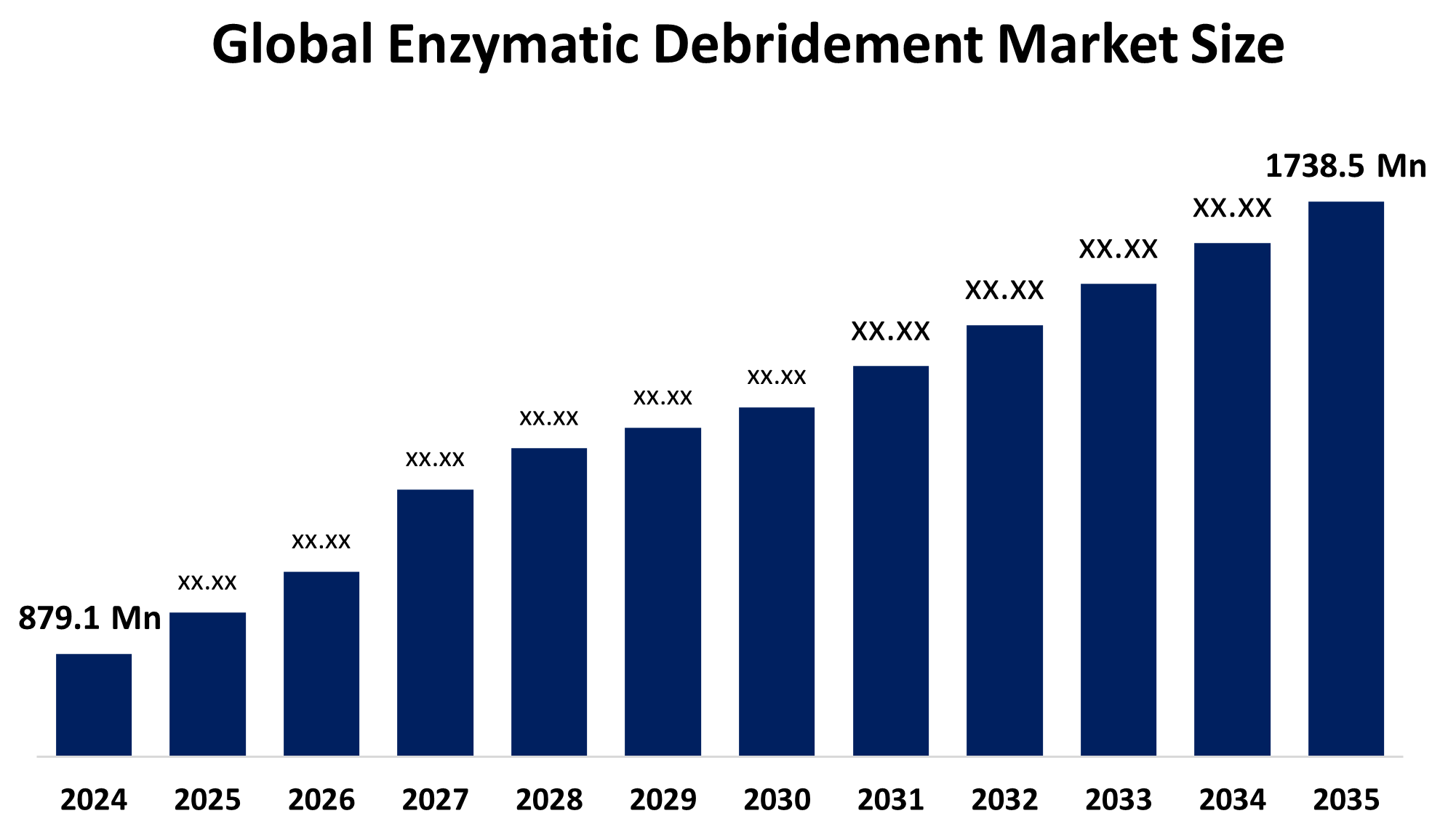
- The Global Enzymatic Debridement Market Size Was Estimated at USD 879.1 Million in 2024
- The Market Size is Expected to Grow at a CAGR of around 6.4% from 2025 to 2035
- The Worldwide Enzymatic Debridement Market Size is Expected to Reach USD 1738.5 Million by 2035
- Asia Pacific is Expected to Grow the fastest during the forecast period.
Get more details on this report -
According to a research report published by Spherical Insights and Consulting, The Global Enzymatic Debridement Market Size was worth around USD 879.1 Million in 2024 and is Predicted to Grow to around USD 1738.5 Million by 2035 with a Compound Annual Growth Rate (CAGR) of 6.4% from 2025 to 2035. The enzymatic debridement market globally is expanding owing to the rising incidence of chronic wounds, the elderly population pool, technological advancements in wound care products in terms of minimally invasive techniques, and greater awareness among healthcare professionals about an easy healing solution for wounds.
Market Overview
The Global Enzymatic Debridement Market Size is centred around products that utilise proteolytic enzymes in a manner that allows for a highly specific removal of dead tissue from a wound to facilitate a quick healing procedure with a minimum impact on healthy tissue. The market is greatly bolstered by the increasing number of instances of chronic conditions such as wound infections, burns, diabetic foot infections, pressure sores, and complex injuries, which are currently being treated with these products in place of more invasive surgical debridement.
In July 2025, BARDA issued a solicitation for FDA-approved proprietary products for the use of debridement in enhancing U.S. preparedness for a mass burn casualty event. This program aims to provide a scalable solution devoid of surgical invasiveness, with quick application and minimal pain. The prototype tests are expected in Q4 2025, aiming for a 2026 full-scale introduction in light of the FDA’s Phase 3 financing of MediWound. There are certain opportunities in the market which could be tapped in the future, such as increasing awareness of these products in emerging markets, product development with low costs in mind, use of novel enzyme formulations for better results, and so on. The key players in this market are Smith & Nephew, Mölnlycke Health Care, Kerecis, Derma Sciences, and Healthpoint Ltd., who are trying to increase market presence through innovation in products, partnership-building, or expansion into wider markets to cater to the increasing demands for enzymatic debridement worldwide.
Report Coverage
This research report categorizes the Global Enzymatic Debridement Market Size based on various segments and regions, forecasts revenue growth, and analyzes trends in each submarket. The report analyses the key growth drivers, opportunities, and challenges influencing the enzymatic debridement market. Recent market developments and competitive strategies, such as expansion, type launch, development, partnership, merger, and acquisition, have been included to draw the competitive landscape in the market. The report strategically identifies and profiles the key market players and analyses their core competencies in each sub-segment of the enzymatic debridement market.
Driving Factors
The main drivers of the Global Enzymatic Debridement Market Size are the increasing incidence of chronic wounds like diabetic foot ulcers, pressure sores, and venous leg ulcers, thereby propelling growth due to increased demand for a good treatment solution for wounds. Increasing awareness about minimal invasive and targeted debridement practices among healthcare professionals and patients is another factor propelling growth in this market. Improvements in formulation and effectiveness of enzymatic debriding agents will also act as a thrust factor for growth in this market. With increased healthcare spending and attention toward enhancing the quality of life among chronic wound patients, growth in this market is expected.
Restraining Factors
Factors that could constrain the Global Enzymatic Debridement Market Size include high treatment expense, low healthcare provider knowledge, adoption resistance in developing countries, the chance of an allergic reaction, and general preference for traditional treatments such as surgical and autolytic debridement. Strict government regulation could also pose an issue.
Market Segmentation
The enzymatic debridement market share is classified into type, product, and end-use.
- The chronic wounds segment dominated the market in 2024, approximately 72% and is projected to grow at a substantial CAGR during the forecast period.
Based on the type, the Global Enzymatic Debridement Market Size is divided into chronic wounds, diabetic foot ulcers, pressure ulcers, venous leg ulcers, acute wounds, burn, and other acute wounds. Among these, the chronic wounds segment dominated the market in 2024 and is projected to grow at a substantial CAGR during the forecast period. The chronic wounds segment is driving the market as there is an increase in the incidence of diabetes, obesity, and an aging population, which significantly increases the risk of developing diabetic foot ulcers, pressure sores, and venous leg ulcers. In addition to this, rising awareness of advanced care of wounds, along with the efficiency of enzymatic debridement for rapid healing without infections, is also boosting this market segment.
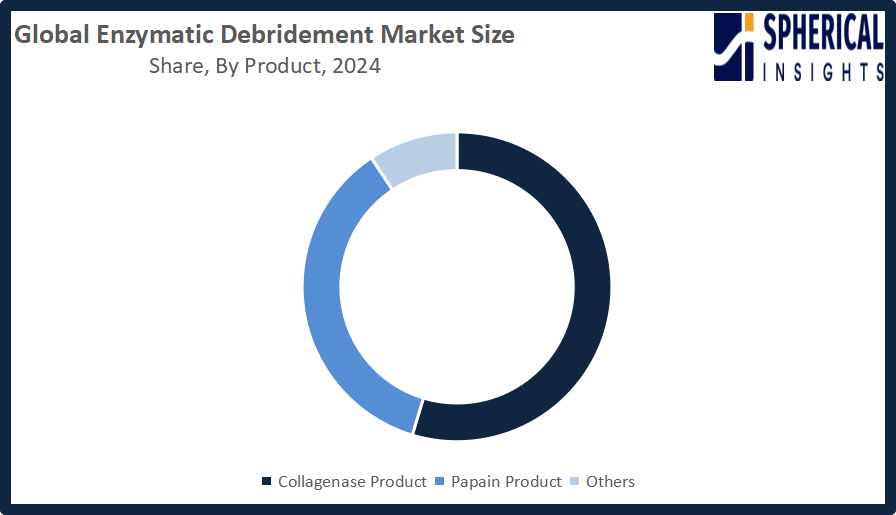
- The collagenase product segment accounted for the largest share in 2024, approximately 55% and is anticipated to grow at a significant CAGR during the forecast period.
Based on the product, the Global Enzymatic Debridement Market Size is divided into collagenase product, papain product, and others. Among these, the collagenase product segment accounted for the largest share in 2024 and is anticipated to grow at a significant CAGR during the forecast period. The market for the collagenase product segment grew because it had high biocompatibility and potency in degrading the necrotic part of the collagen tissue. The versatility in its formulation, such as topical gels and powders, the quick healing rate of the skin, the low possibility of infection, and its usage in treating various chronic and acute wounds led to its high market acceptance.
Get more details on this report -
- The hospitals segment accounted for the highest market revenue in 2024, approximately 53% and is anticipated to grow at a significant CAGR during the forecast period.
Based on the end use, the Global Enzymatic Debridement Market Size is divided into hospitals, clinics, and others. Among these, the hospitals segment accounted for the highest market revenue in 2024 and is anticipated to grow at a significant CAGR during the forecast period. The hospitals segment also has a market growth rate, owing to the growing number of patients with chronic wounds. They have advanced wound care facilities, the required trained medical staff and access to enzymatic debridement agents. An increase in hospitalizations for diabetics, pressure sores, and surgical wounds also increases adoption, and hence, hospitals are the main distribution channels for the market.
Regional Segment Analysis of the Enzymatic Debridement Market
- North America (U.S., Canada, Mexico)
- Europe (Germany, France, U.K., Italy, Spain, Rest of Europe)
- Asia-Pacific (China, Japan, India, Rest of APAC)
- South America (Brazil and the Rest of South America)
- The Middle East and Africa (UAE, South Africa, Rest of MEA)
North America is anticipated to hold the largest share of the enzymatic debridement market over the predicted timeframe.
North America is anticipated to hold the largest share of the Global Enzymatic Debridement Market Size over the predicted timeframe. The North America region is projected to have the 46% share within the enzymatic debridement industry due to the advanced healthcare infrastructure, high spending, and increasing acceptance of new and advanced treatments for wounds. The region also observes a large number of cases of chronic wounds, including diabetic foot ulcers, pressure sores, and post-surgical injuries, thereby fueling demand. The US, the primary contributor to the North America region, enjoys government support through regulations, a large number of hospitals, and government programs. In July 2025, Congress passed the Skin Substitute Access and Payment Reform Act (S.2561), which became active from January 2026, regulating payment caps and coverage safeguards, thereby indirectly contributing to enzymatic debridement for 10.5 million Medicare patients.
Asia Pacific is expected to grow at a rapid CAGR in the Global Enzymatic Debridement Market Size during the forecast period. Asia Pacific is estimated to have a 24% market share of enzymatic debridement owing to an increasing number of chronic wounds, a rising aged population, a high incidence of diabetes and obesity, and a rising overall healthcare infrastructure. China and India remain significant growth drivers in the Asia Pacific; this growth is attributed to a rising number of hospitals and awareness among service providers. In 2024, a significant amount of approx. US $150 million has been allocated in China’s NMPA for supporting biotechnology companies, thereby making the Asia Pacific a high-growth market for MILD enzymatic debridement therapy.
The Global Enzymatic Debridement Market Size is a rapidly developing market with a rise in the occurrence of chronic wounds and rising awareness among patients and physicians for minimally invasive and most effective treatment modalities like enzymatic debridement. The market is led by the German market and then followed by other major markets like the UK and France because of the advanced hospital facilities and high spending in Europe’s healthcare system.
Competitive Analysis:
The report offers the appropriate analysis of the key organizations/companies involved within the enzymatic debridement market, along with a comparative evaluation primarily based on their type of offering, business overviews, geographic presence, enterprise strategies, segment market share, and SWOT analysis. The report also provides an elaborative analysis focusing on the current news and developments of the companies, which includes type development, innovations, joint ventures, partnerships, mergers & acquisitions, strategic alliances, and others. This allows for the evaluation of the overall competition within the market.
List of Key Companies
- Smith & Nephew
- Mölnlycke Health Care
- Derma Sciences
- Lohmann & Rauscher
- Advancis Medical
- ConvaTec Inc.
- Healthpoint Ltd.
- Arobella Medical, LLC
- Coloplast
- Medline Industries
- Sanara MedTech Inc.
- Integra Lifesciences
- B. Braun Melsungen AG
- DeRoyal Industries
- Others
Key Target Audience
- Market Players
- Investors
- End-users
- Government Authorities
- Consulting and Research Firm
- Venture capitalists
- Value-Added Resellers (VARs)
Recent Development
- In September 2025, Smith+Nephew launched the CENTRIO Platelet-Rich-Plasma (PRP) System, a biodynamic hematogel derived from a patient’s own platelets and plasma. The product promotes natural healing by maintaining a moist wound environment, supporting faster recovery in various wound care applications.
- In July 2025, Sanara MedTech launched a first-of-its-kind wound care provider pilot program through its subsidiary, Tissue Health Plus. The value-based initiative targets payers, risk-bearing entities, and primary care companies, aiming to improve clinical outcomes, reduce healthcare costs, and advance innovative wound care solutions.
- In March 2024, Integra Life Sciences announced the U.S. commercial launch of Micro Matrix Flex, a dual-syringe system. It enables precise mixing and delivery of Micro Matrix paste, providing easy access to hard-to-reach areas and ensuring an even wound surface in challenging wound care applications.
Market Segment
This study forecasts revenue at global, regional, and country levels from 2020 to 2035. Spherical Insights has segmented the Global Enzymatic Debridement Market Size based on the below-mentioned segments:
Global Enzymatic Debridement Market, By Type
- Chronic Wounds
- Diabetic Foot Ulcers
- Pressure Ulcers
- Venous Leg Ulcers
- Acute Wounds
- Burn
- Other Acute Wounds
Global Enzymatic Debridement Market, By Product
- Collagenase Product
- Papain Product
- Others
Global Enzymatic Debridement Market, By End-use
- Hospitals
- Clinics
- Others
Global Enzymatic Debridement Market, By Regional Analysis
- North America
- US
- Canada
- Mexico
- Europe
- Germany
- UK
- France
- Italy
- Spain
- Russia
- Rest of Europe
- Asia Pacific
- China
- Japan
- India
- South Korea
- Australia
- Rest of Asia Pacific
- South America
- Brazil
- Argentina
- Rest of South America
- Middle East & Africa
- UAE
- Saudi Arabia
- Qatar
- South Africa
- Rest of the Middle East & Africa
Frequently Asked Questions (FAQ)
-
1.What is the CAGR of the enzymatic debridement market over the forecast period?The global enzymatic debridement market is projected to expand at a CAGR of 6.4% during the forecast period.
-
2.What is the market size of the enzymatic debridement market?The global enzymatic debridement market size is expected to grow from USD 879.1 million in 2024 to USD 1738.5 million by 2035, at a CAGR of 6.4% during the forecast period 2025-2035.
-
3.Which region holds the largest share of the enzymatic debridement market?North America is anticipated to hold the largest share of the enzymatic debridement market over the predicted timeframe.
-
4.Who are the top 10 companies operating in the global enzymatic debridement market?Smith & Nephew, Mölnlycke Health Care, Derma Sciences, Lohmann & Rauscher, Advancis Medical, ConvaTec Inc., Healthpoint Ltd., Arobella Medical, LLC, Coloplast, Medline Industries, and Others.
-
5.What factors are driving the growth of the enzymatic debridement market?The enzymatic debridement market is driven by rising chronic wound prevalence, aging population, increasing diabetes and obesity rates, demand for minimally invasive treatments, advanced wound care awareness, and growing healthcare infrastructure globally.
-
6.What are the market trends in the enzymatic debridement market?Rising use of minimally invasive products, enzyme innovations, expanded reimbursement, growing chronic wound prevalence, increasing provider awareness, and adoption in emerging markets.
-
7.What are the main challenges restricting wider adoption of the enzymatic debridement market?The main challenges restricting the wider adoption of the enzymatic debridement market include high product costs and limited insurance reimbursement, competition from alternative methods like surgery, stringent regulatory hurdles, and a lack of awareness or training among healthcare professionals.
Need help to buy this report?