Global Encapsulated Vitamin C Market Size, Share, and By Encapsulation Technology (Microencapsulation, Nanoencapsulation, and Liposome Encapsulation), By Application (Food & Beverages, Pharmaceuticals, Cosmetics & Personal Care, and Animal Nutrition), and By Region (North America, Europe, Asia-Pacific, Latin America, Middle East, and Africa), Analysis and Forecast 2025 - 2035
Industry: Healthcare
Global Encapsulated Vitamin C Market Insights Forecasts to 2035
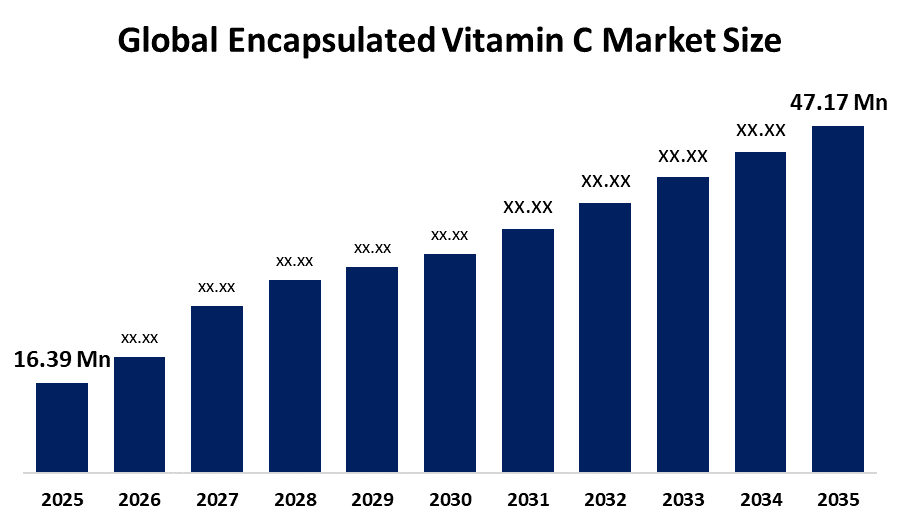
- The Global Encapsulated Vitamin C Market Size Was Estimated at USD 16.39 Million in 2025
- The Market Size is Expected to Grow at a CAGR of around 11.15% from 2025 to 2035
- The Worldwide Encapsulated Vitamin C Market Size is Expected to Reach USD 47.17 Million by 2035
- Asia Pacific is expected to grow the fastest during the forecast period.
Get more details on this report -
According to a research report published by Spherical Insights and Consulting, The Global Encapsulated Vitamin C Market Size Was Worth Around USD 16.39 Million In 2025 And Is Predicted To Grow To Around USD 47.17 Million By 2035 With A Compound Annual Growth Rate (CAGR) Of 11.15% From 2025 To 2035. The opportunities for increased stability, better bioavailability, longer shelf life, targeted delivery systems, growing demand for nutraceuticals, functional food applications, and customer desire for efficient, controlled-release formulations are all present in the encapsulated vitamin C market.
Market Overview
The production, distribution, and use of L-ascorbic acid (vitamin C) shielded within micro- or nano-scale delivery systems, such as ethyl cellulose microspheres, lipid nanoparticles, liposomes, silica shells, or polymer matrices, are all included in the global market for encapsulated vitamin C. In addition to providing regulated release, enhanced bioavailability, greater formulation compatibility, and less discomfort in topical treatments, these encapsulating technologies protect the extremely unstable vitamin C from oxidative destruction, pH sensitivity, light, and heat.
In January 2026, Botanic Healthcare launched new clinical findings highlighting the superior bioavailability of Lipomac™, its liposomal vitamin C developed using patented DFS Technology™. The announcement strengthens its position as a science-driven nutraceutical ingredient manufacturer focused on advanced formulation and efficacy. The need for stable and efficient vitamin C formulations has increased due in large part to growing consumer awareness of the value of antioxidant intake and preventative healthcare. The usage of encapsulated nutrients has also increased due to the growing demand for functional meals, nutritional supplements, and fortified drinks.
Report Coverage
This research report categorizes the encapsulated vitamin C market based on various segments and regions, forecasts revenue growth, and analyzes trends in each submarket. The report analyses the key growth drivers, opportunities, and challenges influencing the encapsulated vitamin C market. Recent market developments and competitive strategies, such as expansion, product launch, development, partnership, merger, and acquisition, have been included to draw the competitive landscape in the market. The report strategically identifies and profiles the key market players and analyses their core competencies in each sub-segment of the encapsulated vitamin C market.
Global Encapsulated Vitamin C Market Report Coverage
| Report Coverage | Details |
|---|---|
| Base Year: | 2025 |
| Market Size in 2025: | USD 16.39 Million |
| Forecast Period: | 2026 – 2035 |
| Forecast Period CAGR 2026 – 2035 : | 11.15% |
| 026 – 2035 Value Projection: | USD 47.17 Million |
| Historical Data for: | 2020-2024 |
| No. of Pages: | 240 |
| Tables, Charts & Figures: | 112 |
| Segments covered: | By Encapsulation Technology, By Application and By Region |
| Pitfalls & Challenges: | COVID-19 Impact, Challenges, Future, Growth, & Analysis |
Get more details on this report -
Driving Factors
The industry's long-term growth trajectory is sustained by increased investments in R&D and growing distribution networks in international markets, which enable wider market penetration and adoption of encapsulated vitamin C products. Demand is increasing since encapsulation resolves L-ascorbic acid's fundamental instability issue, allowing vitamin C to be used in formulations that were previously unable to sustain potency over time. By shielding vitamin C from deterioration brought on by light, heat, and oxygen, encapsulation technologies increase its stability and bioavailability and boost product efficacy. Since encapsulated vitamin C is widely used for its medicinal and skin-improving qualities, growth in the pharmaceutical and cosmetic industries further boosts market expansion.
Restraining Factors
The market for encapsulated vitamin C is constrained by high production costs, intricate manufacturing procedures, low consumer awareness in developing nations, strict regulations, and difficulties preserving stable bioavailability across a variety of product applications.
Market Segmentation
The encapsulated vitamin C market share is classified into encapsulation technology and application.
- The microencapsulation segment dominated the market in 2025, approximately 65%, and is projected to grow at a substantial CAGR during the forecast period.
Based on the encapsulation technology, the encapsulated vitamin C market is divided into microencapsulation, nanoencapsulation, and liposome encapsulation. Among these, the microencapsulation segment dominated the market in 2025, approximately 65%, and is projected to grow at a substantial CAGR during the forecast period. The broad use of microencapsulation in the food, beverage, pharmaceutical, and cosmetic sectors is the reason for this market. Vitamin C's stability is improved via microencapsulation, which preserves its bioavailability while shielding it from deterioration brought on by heat, light, and oxygen. It is perfect for producing fortified meals, supplements, and functional drinks in large quantities since it is affordable, scalable, and compatible with a variety of formulations.
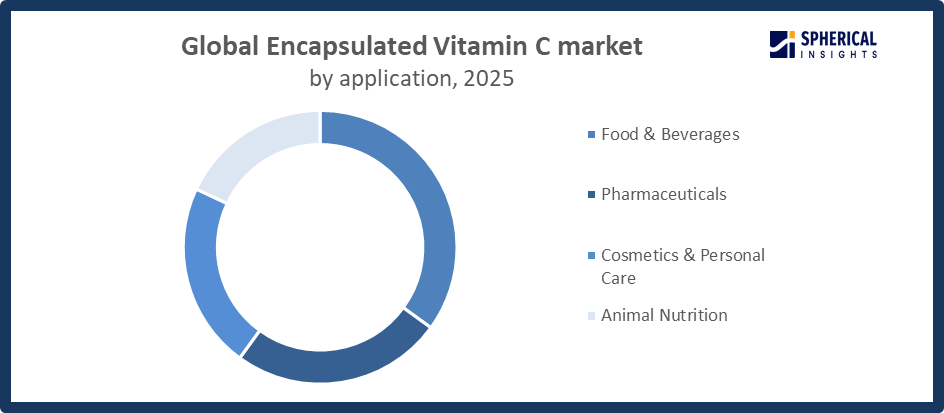
The pharmaceuticals segment accounted for the highest market revenue in 2025, approximately 35%, and is anticipated to grow at a significant CAGR during the forecast period.
Based on the application, the encapsulated vitamin C market is divided into food & beverages, pharmaceuticals, cosmetics & personal care, and animal nutrition. Among these, the pharmaceuticals segment accounted for the highest market revenue in 2025, approximately 35%, and is anticipated to grow at a significant CAGR during the forecast period. Growing demand for therapeutic formulations, high-purity medical products, and immune-support supplements is driving the pharmaceuticals market. Encapsulated vitamin C is perfect for tablets, capsules, and syrups used in medical applications because it has improved stability, bioavailability, and controlled-release qualities.
Get more details on this report -
Regional Segment Analysis of the Encapsulated Vitamin C Market
- North America (U.S., Canada, Mexico)
- Europe (Germany, France, U.K., Italy, Spain, Rest of Europe)
- Asia-Pacific (China, Japan, India, Rest of APAC)
- South America (Brazil and the Rest of South America)
- The Middle East and Africa (UAE, South Africa, Rest of MEA)
Competitive Analysis:
The report offers the appropriate analysis of the key organizations/companies involved within the encapsulated vitamin C market, along with a comparative evaluation primarily based on their product offerings, business overviews, geographic presence, enterprise strategies, segment market share, and SWOT analysis. The report also provides an elaborative analysis focusing on the current news and developments of the companies, which includes product development, innovations, joint ventures, partnerships, mergers & acquisitions, strategic alliances, and others. This allows for the evaluation of the overall competition within the market.
Key Target Audience
- Market Players
- Investors
- End-users
- Government Authorities
- Consulting and Research Firm
- Venture capitalists
- Value-Added Resellers (VARs)
North America is anticipated to hold the largest share of the encapsulated vitamin C market over the predicted timeframe.

Get more details on this report -
North America is anticipated to hold the largest share of the encapsulated vitamin C market over the predicted timeframe. Nutraceuticals, dietary supplements, and functional foods enhanced with vitamin C are in great demand due to the region's high consumer awareness of health, wellness, and preventative healthcare. Encapsulated formulation development and commercialization are supported by well-established pharmaceutical and food industries as well as sophisticated healthcare infrastructure. With its 12-hour time-release microencapsulated vitamin C for long-lasting skin effects, Tatcha introduced its Brightening Collection in 2025. In the established U.S. market, premium positioning is still driven by patent activity and R&D concentration on stable, non-irritating formulations. With companies like Cymbiotika increasing their retail presence and One Innovation Labs/Lonza creating next-generation liposomal delivery for better absorption, liposomal technologies are progressing.
Asia Pacific is expected to grow at a rapid CAGR in the encapsulated vitamin C market during the forecast period. The demand for dietary supplements, functional foods, and fortified beverages providing stable, bioavailable vitamin C has increased due to rapid urbanization, rising disposable incomes, and a growing middle-class population that is concerned about their health. Wider product access is guaranteed by India's strong e-commerce industry, and local manufacturing activities contribute to increased availability and cost. China-based Joyful Nutritional introduced LiposoMoreTM liposomal vitamin C powder for B2B supplements worldwide in March 2026, focusing stomach comfort and excellent encapsulation efficiency. A study conducted in April 2025 by Japan's Tokyo Metropolitan Institute enhanced vitamin C's function in epigenetic skin rejuvenation.
Market Segment
This study forecasts revenue at global, regional, and country levels from 2020 to 2035. Spherical Insights has segmented the encapsulated vitamin C market based on the below-mentioned segments:
Global Encapsulated Vitamin C Market, By Encapsulation Technology
- Microencapsulation
- Nanoencapsulation
- Liposome Encapsulation
Global Encapsulated Vitamin C Market, By Application
- Food & Beverages
- Pharmaceuticals
- Cosmetics & Personal Care
- Animal Nutrition
Global Encapsulated Vitamin C Market, By Regional Analysis
- North America
- US
- Canada
- Mexico
- Europe
- Germany
- UK
- France
- Italy
- Spain
- Russia
- Rest of Europe
- Asia Pacific
- China
- Japan
- India
- South Korea
- Australia
- Rest of Asia Pacific
- South America
- Brazil
- Argentina
- Rest of South America
- Middle East & Africa
- UAE
- Saudi Arabia
- Qatar
- South Africa
- Rest of the Middle East & Africa
Frequently Asked Questions (FAQ)
-
1. What is the CAGR of the encapsulated vitamin C market over the forecast period?The global encapsulated vitamin C market is projected to expand at a CAGR of 11.15% during the forecast period.
-
2. Which region holds the largest share of the encapsulated vitamin C market?North America is anticipated to hold the largest share of the encapsulated vitamin C market over the predicted timeframe.
-
3. Who are the top 10 companies operating in the global encapsulated vitamin C market?Ashland, BASF SE, Clariant, Croda International, Dow / Dow Inc., Evonik Industries, Seppic, Symrise, and Others.
-
4. What factors are driving the growth of the encapsulated vitamin C market?Rising health awareness, demand for functional foods, improved stability and bioavailability, technological innovations in encapsulation, growing nutraceutical, pharmaceutical, and cosmetic applications, and increasing focus on immunity and wellness.
-
5. What are the market trends in the encapsulated vitamin C market?Adoption of micro- and nanoencapsulation, demand for controlled-release formulations, fortified beverages and supplements, clean-label products, personalized nutrition, and integration of encapsulated Vitamin C in cosmetics and animal nutrition.
-
6. What are the main challenges restricting wider adoption of the encapsulated vitamin C market?High production costs, complex manufacturing processes, regulatory compliance, limited consumer awareness in emerging regions, stability issues in diverse products, and competition from conventional Vitamin C formulations.
Need help to buy this report?