Global Electrical Sectionalizer Market Size, Share, and COVID-19 Impact Analysis, By Product (Resettable Electronic Sectionalizers, Programmable (Intelligent) Sectionalizers, and Others), By Voltage (Medium-Voltage (1 kV-36 kV) and High-Voltage (>36 kV)), By End Use (Power & Utilities, Mining & Heavy Manufacturing, Railways & Transportation, Telecommunications, and Others), and By Region (North America, Europe, Asia-Pacific, Latin America, Middle East, and Africa), Analysis and Forecast 2025 - 2035
Industry: Energy & Power
Global Electrical Sectionalizer Market Insights Forecasts to 2035
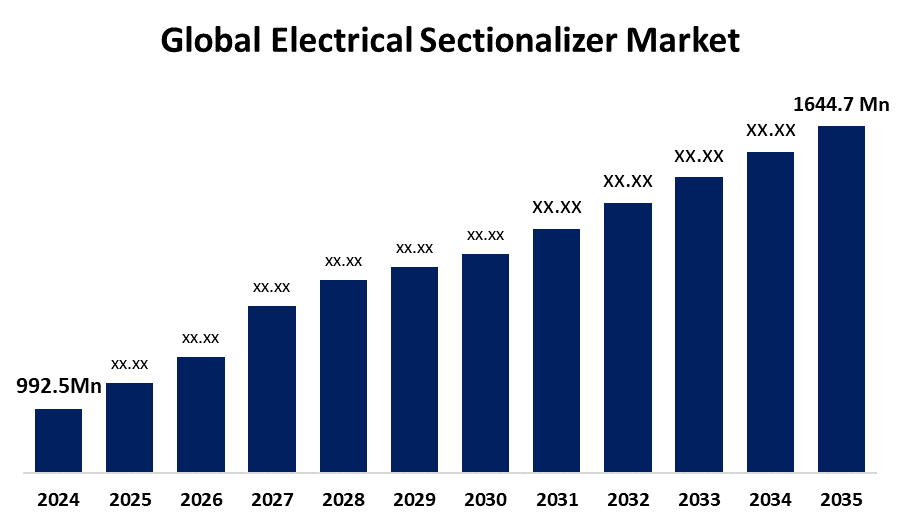
- The Global Electrical Sectionalizer Market Size Was Estimated at USD 992.5 Million in 2024
- The Market Size is Expected to Grow at a CAGR of around 4.7% from 2025 to 2035
- The Worldwide Electrical Sectionalizer Market Size is Expected to Reach USD 1644.7 Million by 2035
- North America is expected to grow the fastest during the forecast period.
Get more details on this report -
According to a research report published by Spherical Insights and Consulting, The Global Electrical Sectionalizer Market Size Was Worth Around USD 992.5 Million In 2024 And Is Predicted To Grow To Around USD 1644.7 Million By 2035 With A Compound Annual Growth Rate (CAGR) Of 4.7% From 2025 To 2035. The electrical sectionalizer market is growing due to rising investments in grid modernization and smart infrastructure, increasing demand for reliable power distribution to reduce outages, and the integration of renewable energy sources that require advanced, automated fault management solutions.
Market Overview
The Global Electrical Sectionalizer Market Size refers to intelligent protective devices installed in medium-voltage distribution networks that automatically isolate faulty power line sections after a fault event, operating in coordination with reclosers and circuit breakers. These devices are mainly utilized by electric utilities and distribution companies to enhance power supply reliability, shorten outage durations, and strengthen grid resilience across urban, rural, and industrial networks. In December 2025, the U.S. Department of Energy announced grid reliability investments deploying advanced protection equipment, including sectionalizers, reclosers, and relays, to isolate faults, minimize outage impacts, and accelerate service restoration, particularly addressing tree-driven power disruptions and reinforcing overall U.S. grid resilience.
Major market drivers include grid modernization initiatives, with the U.S. installing 142 sectionalizers in 2023 and China adding another 142 units to improve power reliability. Renewable energy integration also fuels demand, as India deployed smart sectionalizers across 52 renewable projects. Significant opportunities exist in emerging economies, exemplified by India’s Saubhagya scheme, which installed 250,000 sectionalizers, electrifying 50 million households by 2025 and enhancing grid reliability by 22%. The adoption of smart grids and IoT-enabled devices for real-time monitoring further accelerates market growth. These innovations enhance operational efficiency, reduce downtime, and boost grid reliability, establishing electrical sectionalizers as vital components for modern power networks globally. In January 2026, Sharika Enterprises partnered with Dakshin Gujarat Vij Company (DGVCL) under India’s RDSS to supply 11 kV sectionalizers for feeder automation in Gujarat. The initiative facilitates automated fault detection, isolation, and restoration, enhancing grid reliability, reducing outage durations, and advancing the state’s modernized power distribution network.
Report Coverage
This research report categorizes the electrical sectionalizer market based on various segments and regions, forecasts revenue growth, and analyzes trends in each submarket. The report analyses the key growth drivers, opportunities, and challenges influencing the electrical sectionalizer market. Recent market developments and competitive strategies, such as expansion, type launch, development, partnership, merger, and acquisition, have been included to draw the competitive landscape in the market. The report strategically identifies and profiles the key market players and analyses their core competencies in each sub-segment of the electrical sectionalizer market.
Global Electrical Sectionalizer Market Report Coverage
| Report Coverage | Details |
|---|---|
| Base Year: | 2024 |
| Market Size in 2024: | USD 992.5 Million |
| Forecast Period: | 2025-2035 |
| Forecast Period CAGR 2025-2035 : | CAGR Of 4.7% |
| 2035 Value Projection: | USD 1644.7 Million |
| Historical Data for: | 2020-2023 |
| No. of Pages: | 240 |
| Tables, Charts & Figures: | 90 |
| Segments covered: | By Voltage, By Product |
| Companies covered:: | Eaton Corporation plc ABB Ltd. Hubbell Incorporated G&W Electric Company Schneider Electric SE Siemens AG Crompton Greaves S&C Electric Company NOJA Power Bevins Co. Tavrida Electric Hughes Power System Vesco, LLC Elektrolites (Power) Pvt. Ltd Bharat Heavy Electricals Limited Others Key Players |
| Pitfalls & Challenges: | COVID-19 Empact, Challenge, Future, Growth, & Analysis |
Get more details on this report -
Driving Factors
The growth of the global electrical sectionalizer market is increasing due to rising investments in grid modernization, renewable energy integration, and the demand for reliable power distribution. Modernizing aging infrastructure drives utilities to deploy sectionalizers for rapid fault isolation and shorter outages. Increasing adoption of wind and solar energy requires advanced protection devices to maintain grid stability. Large-scale investments in transmission and distribution, such as India’s planned USD 107 billion power transmission investment by 2032, further boost demand. Additionally, the expansion of smart grids and automation technologies enables real-time monitoring and faster fault detection, enhancing reliability and operational efficiency, thereby accelerating sectionalizer adoption worldwide.
Restraining Factors
The primary restraint is the high initial investment cost, particularly for smaller utilities, which acts as a significant barrier to adoption. Retrofitting ageing infrastructure with smart sectionalizers demands careful planning and skilled labor, complicating implementation and increasing project timelines. Additionally, fluctuating raw material costs (copper, aluminium) impact production and pricing. These economic constraints limit market growth, especially among budget-constrained utilities in developing regions.
Market Segmentation
The electrical sectionalizer market share is classified into product, voltage, and end use.
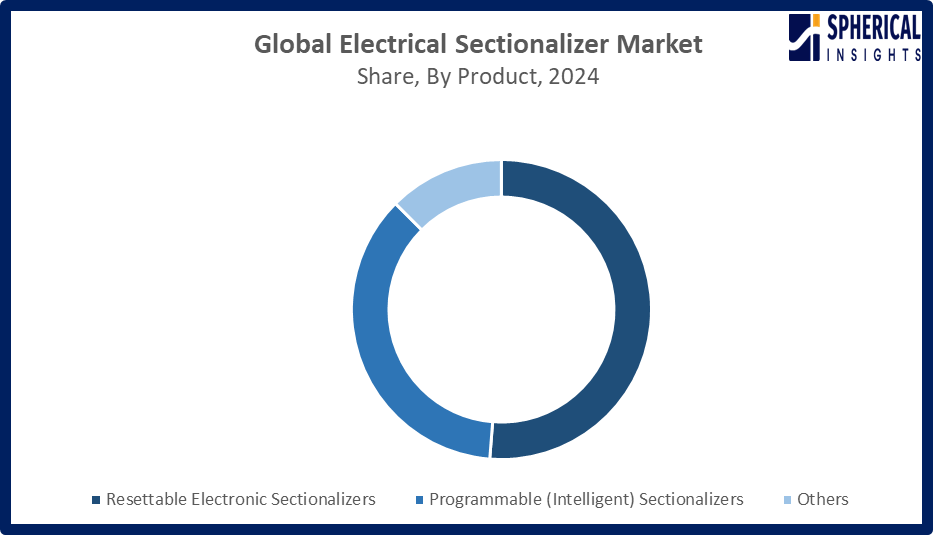
- The resettable electronic sectionalizers segment dominated the market in 2024, approximately 51% and is projected to grow at a substantial CAGR during the forecast period.
Based on the product, the electrical sectionalizer market is divided into resettable electronic sectionalizers, programmable (intelligent) sectionalizers, and others. Among these, the resettable electronic sectionalizers segment dominated the market in 2024 and is projected to grow at a substantial CAGR during the forecast period. The segment dominated the market, driven by its superior compatibility with low- to medium-voltage applications and automated fault isolation capabilities, which enhance system reliability and decrease outage times. Their cost efficiency in managing repetitive faults and widespread adoption in medium-voltage distribution networks, supported by integration with microprocessor-based protection systems, further solidifies their market position.
Get more details on this report -
- The medium-voltage (1 kV-36 kV) segment accounted for the largest share in 2024, approximately 59% and is anticipated to grow at a significant CAGR during the forecast period.
Based on the voltage, the electrical sectionalizer market is divided into medium-voltage (1 kV-36 kV) and high-voltage (>36 kV). Among these, the medium-voltage (1 kV-36 kV) segment accounted for the largest share in 2024 and is anticipated to grow at a significant CAGR during the forecast period. The medium-voltage (1 kV-36 kV) segment led market growth due to its widespread use in distribution and sub-transmission networks, offering a balance of performance and cost. Utilities in the U.S. installed 142 units in 2023, while India deployed medium-voltage sectionalizers in 52 renewable projects, enhancing fault isolation, grid reliability, and supporting smart grid modernization.
- The power & utilities segment accounted for the highest market revenue in 2024, approximately 53% and is anticipated to grow at a significant CAGR during the forecast period.
Based on the end use, the electrical sectionalizer market is divided into power & utilities, mining & heavy manufacturing, railways & transportation, telecommunications, and others. Among these, the power & utilities segment accounted for the highest market revenue in 2024 and is anticipated to grow at a significant CAGR during the forecast period. Power and utility segment deploy sectionalizers to automate fault isolation and enhance operational efficiency across feeders and substations, maintaining continuous electricity for residential, commercial, and industrial users. With growing grid automation and renewable integration, sectionalizers improve fault detection, selective coordination, and real-time control, reducing operational losses, enhancing power quality, and supporting modernization and stability of distribution and sub-transmission networks.
Regional Segment Analysis of the Electrical Sectionalizer Market
- North America (U.S., Canada, Mexico)
- Europe (Germany, France, U.K., Italy, Spain, Rest of Europe)
- Asia-Pacific (China, Japan, India, Rest of APAC)
- South America (Brazil and the Rest of South America)
- The Middle East and Africa (UAE, South Africa, Rest of MEA)
Asia Pacific is anticipated to hold the largest share of the electrical sectionalizer market over the predicted timeframe.

Get more details on this report -
Asia Pacific is anticipated to hold the largest share of the electrical sectionalizer market over the predicted timeframe. The regions, led by India and China, are anticipated to hold the 46% share of the electrical sectionalizer market due to rapid electrification, renewable energy integration, and government-backed initiatives. India’s Saubhagya scheme installed 250,000 sectionalizers, electrifying 50 million households and improving grid reliability by 22%, while China added 142 units in 2023 to strengthen medium-voltage networks. Rising smart grid adoption, RDSS projects, and demand for automated fault isolation are driving sectionalizer deployment, enhancing grid resilience, reducing outages, and modernizing power distribution across the region. In January 2026, Kerala State Electricity Board (KSEB) plans to transform over 750 Model Section Offices into Smart Section Offices. An 11-member working group will draft the concept to modernize distribution sections with digital capabilities, supporting smart meters, GIS asset mapping, RDSS projects, and online service delivery across Kerala.
North America is expected to grow at a rapid CAGR in the electrical sectionalizer market during the forecast period. North America is rapidly growing in the electrical sectionalizer market, with a 28% share and dominated by the United States, due to extensive grid modernization, smart automation, and resilience initiatives. In 2023, the U.S. installed 142 sectionalizers to enhance fault isolation and reduce outage durations. Programs like the DOE’s GRIP and SPARK initiatives focus on self-healing networks and advanced distribution technologies, addressing rising electricity demand from electrification and AI data centers, driving strong sectionalizer adoption across urban, rural, and industrial grids. In March 2024, the IEEE released IEEE C37.63-2024, updating standards for overhead, pad-mounted, and submersible automatic line sectionalizers up to 38 kV. The new guidelines provide a unified regulatory framework for manufacturers and utilities, replacing the 2013 version and enhancing safety, reliability, and consistency across the U.S. electric grid.
Europe, led by Germany and France, is experiencing growth in the electrical sectionalizer market due to rising investments in smart grid modernization, renewable energy integration, and distribution network reliability. Utilities are deploying sectionalizers to improve fault isolation, reduce outage durations, and support automated network management. Germany’s grid modernization programs and France’s renewable energy expansion projects are driving demand, strengthening grid resilience, and enabling efficient power delivery across urban and industrial networks.
Competitive Analysis:
The report offers the appropriate analysis of the key organizations/companies involved within the electrical sectionalizer market, along with a comparative evaluation primarily based on their type of offering, business overviews, geographic presence, enterprise strategies, segment market share, and SWOT analysis. The report also provides an elaborative analysis focusing on the current news and developments of the companies, which includes type development, innovations, joint ventures, partnerships, mergers & acquisitions, strategic alliances, and others. This allows for the evaluation of the overall competition within the market.
List of Key Companies
- Eaton Corporation plc
- ABB Ltd.
- Hubbell Incorporated
- G&W Electric Company
- Schneider Electric SE
- Siemens AG
- Crompton Greaves
- S&C Electric Company
- NOJA Power
- Bevins Co.
- Tavrida Electric
- Hughes Power System
- Vesco, LLC
- Elektrolites (Power) Pvt. Ltd
- Bharat Heavy Electricals Limited
- Others
Key Target Audience
- Market Players
- Investors
- End-users
- Government Authorities
- Consulting and Research Firm
- Venture capitalists
- Value-Added Resellers (VARs)
Recent Development
• In March 2026, ABB launched the DS301C M Inc. 10kA, the world’s slimmest voltage-independent RCBO, at Light + Building 2026. Delivering 10 kA breaking capacity in a single 17.6 mm module, it provides reliable protection against earth faults, short circuits, and overcurrent, saving 50% space for retrofits, upgrades, and industrial applications.
• In March 2026, Schneider Electric announced it will showcase healthcare power, automation, and digital innovation solutions at HIMSS26 (March 10-12), demonstrating how AI, intelligent automation, and advanced cybersecurity enhance hospital resilience, reduce operational risks, and support digital healthcare transformation.
• In January 2026, Hubbell Incorporated launched Aclara360, a modular software solution that leverages grid-edge device data for utilities. The platform enables advanced analytics, remote monitoring, and diagnostics, improving fault localization, topology accuracy, voltage balance, and asset performance without major capital investment, enhancing efficiency and decision-making across distribution networks.
• In August 2025, NOJA Power added Sectionalizer functionality to its EcoLink medium-voltage switchgear, enabling automated fault isolation, upstream fault counting, and optional backup protection. The upgrade enhances network reliability, fault management, and service continuity, particularly for rural and remote overhead distribution networks, modernizing aging sectionalizer assets.
• In October 2025, ABB unveiled its MNS low-voltage switchgear with the SACE Emax 3 air circuit breaker at Data Center World Asia. The space-saving solution enhances reliability and power security for AI-ready data centers, supporting rising global demand and mitigating outage risks amid rapid data center capacity growth from 80 GW to 220 GW by 2030.
Market Segment
This study forecasts revenue at global, regional, and country levels from 2020 to 2035. Spherical Insights has segmented the electrical sectionalizer market based on the below-mentioned segments:
Global Electrical Sectionalizer Market, By Product
- Resettable Electronic Sectionalizers
- Programmable (Intelligent) Sectionalizers
- Others
Global Electrical Sectionalizer Market, By Voltage
- Medium-Voltage (1 kV-36 kV)
- High-Voltage (>36 kV)
Global Electrical Sectionalizer Market, By End Use
- Power & Utilities
- Mining & Heavy Manufacturing
- Railways & Transportation
- Telecommunications
- Others
Global Electrical Sectionalizer Market, By Regional Analysis
- North America
- US
- Canada
- Mexico
- Europe
- Germany
- UK
- France
- Italy
- Spain
- Russia
- Rest of Europe
- Asia Pacific
- China
- Japan
- India
- South Korea
- Australia
- Rest of Asia Pacific
- South America
- Brazil
- Argentina
- Rest of South America
- Middle East & Africa
- UAE
- Saudi Arabia
- Qatar
- South Africa
- Rest of the Middle East & Africa
Frequently Asked Questions (FAQ)
-
What are the key economic benefits of deploying electrical sectionalizers in modern power grids?Deploying electrical sectionalizers enhances grid reliability, reduces outage durations by up to 22% (India’s Saubhagya scheme), lowers operational costs, and improves service continuity, benefiting utilities and consumers across urban and rural networks.
-
How are innovations in digital and resettable sectionalizers transforming fault management and grid reliability?Innovations in digital and resettable sectionalizers enable automated fault isolation and restoration, reducing outage durations by up to 25% in pilot projects, enhancing grid reliability, efficiency, and integration of renewable energy sources
-
Which trends are shaping the adoption of electrical sectionalizers in smart grids and automated networks?Trends driving electrical sectionalizer adoption include smart grid integration, IoT-enabled monitoring, and renewable energy deployment, with India installing 250,000 units under the Saubhagya scheme, improving grid reliability by 22%.
-
How are smart grid and automation technology accelerating the growth of the electrical sectionalizer market?Smart grid and automation technologies boost electrical sectionalizer demand by enabling real-time fault detection and isolation; India’s RDSS projects deployed 52 million smart meters, enhancing sectionalizer integration and grid reliability by 22%.
-
What role do sectionalizers play in enhancing power distribution efficiency and outage reduction?Sectionalizers enhance power distribution by isolating faulted sections, reducing outage durations by up to 22% (India’s Saubhagya scheme), improving service continuity, operational efficiency, and reliability across residential, commercial, and industrial networks
-
How are government initiatives and regulatory frameworks influencing sectionalizer adoption globally?Government initiatives and regulations drive global sectionalizer adoption through grid modernization programs; the U.S. DOE’s SPARK and GRIP initiatives and India’s RDSS scheme support deployment, improving fault isolation and reliability across millions of households
-
How do resettable and electronic sectionalizers differ in market adoption and efficiency?Resettable sectionalizers lead adoption in renewable-rich grids due to automated restoration, while electronic sectionalizers offer precise fault detection; India deployed 52 units in renewable projects, enhancing grid reliability by 22%.
-
How are utilities leveraging sectionalizers to improve fault detection and isolation?Utilities use sectionalizers to automatically isolate faulted sections, reducing outage durations by up to 22% (India’s Saubhagya scheme) and enhancing real-time fault detection, grid resilience, and operational efficiency across distribution networks
Need help to buy this report?