Global Edge AI in Automotive Market Size, Share, and COVID-19 Impact Analysis, By Vehicle Type (Passenger Cars, Premium/Luxury Vehicles, Light Commercial Vehicles, Heavy Commercial Vehicles, Buses & Coaches, Off-road/Agricultural/Construction Vehicles, and Two-wheelers & Light EVs), By Application (Advanced Driver Assistance Systems (ADAS), Autonomous Driving, Driver Monitoring Systems, Predictive Maintenance, and Infotainment Systems), By Region (North America, Europe, Asia-Pacific, Latin America, Middle East, and Africa), Analysis and Forecast 2025 - 2035.
Industry: Automotive & Transportation
Global Edge AI in Automotive Market Insights Forecasts to 2035
- The Global Edge AI in Automotive Market Size Was Estimated at USD 2.86 Billion in 2024
- The Market Size is Expected to Grow at a CAGR of around 21.5% from 2025 to 2035
- The Worldwide Edge AI in Automotive Market Size is Expected to Reach USD 24.36 Billion by 2035
- Asia Pacific is expected to grow the fastest during the forecast period.
Get more details on this report -
According to a research report published by Spherical Insights and Consulting, the global edge AI in automotive market size was worth around USD 2.86 billion in 2024 and is predicted to grow to around USD 24.36 billion by 2035 with a compound annual growth rate (CAGR) of 21.5% from 2025 to 2035. Real-time data processing, greater autonomous driving capabilities, improved car safety systems, less reliance on the cloud, predictive maintenance, and quicker decision-making for connected and intelligent vehicles are just a few of the opportunities that edge AI in automotive market.
Market Overview
Edge AI in the automotive sector uses AI algorithms processed on embedded vehicle hardware to perform critical functions, which include self-driving technology, advanced driver assistance systems (ADAS), and personalized in-vehicle experiences. The system enables immediate data processing through its on-board processors and sensors and edge compute modules, which deliver faster results, better security, and dependable performance. Edge AI processes data at the source, which reduces latency, improves system performance, and improves vehicle safety and reaction times.
In June 2025, embedUR Systems launched an Ultra-Wideband (UWB) Sensing Edge AI solution built on NXP Semiconductors’ Trimension NCJ29D6 platform, enabling gesture-based automotive controls like hands-free trunk opening and supporting secure ranging and radar sensing in vehicles. The increasing need for HN's software-defined vehicles (SDVs) has accelerated the market's growth has been accelerated by a number of government initiatives targeted at improving vehicle safety. The expansion of edge AI in the automotive market is anticipated to be accelerated by manufacturers' growing focus on integrating SOCs in luxury vehicles to carry out a variety of tasks, including advanced driver assistance systems (ADAS), autonomous driving, high-end entertainment, and some others.
Edge AI in Automotive Market Trends
- The increasing use of onboard AI-powered advanced driving assistance systems (ADAS).
- Real-time vehicle data processing is becoming more and more necessary to cut down on latency and reliance on the cloud.
- The expansion of edge computing devices and in-car AI chips for quicker analytics.
- incorporating AI-driven driver monitoring technologies to increase security and reduce collisions.
- The expansion of edge intelligence-based vehicle-to-everything (V2X) connectivity and connected cars.
Report Coverage
This research report categorizes the edge AI in automotive market based on various segments and regions, forecasts revenue growth, and analyzes trends in each submarket. The report analyzes the key growth drivers, opportunities, and challenges influencing the edge AI in automotive market. Recent market developments and competitive strategies, such as expansion, product launch, development, partnership, merger, and acquisition, have been included to draw the competitive landscape in the market. The report strategically identifies and profiles the key market players and analyzes their core competencies in each sub-segment of the edge AI in automotive market.
Edge AI in Automotive Market Report Coverage
| Report Coverage | Details |
|---|---|
| Base Year: | 2024 |
| Market Size in 2024: | USD 2.86 Billion |
| Forecast Period: | 2025-2035 |
| Forecast Period CAGR 2025-2035 : | 21.5% |
| 2035 Value Projection: | USD 24.36 Billion |
| Historical Data for: | 2020-2023 |
| No. of Pages: | 240 |
| Tables, Charts & Figures: | 110 |
| Segments covered: | By Vehicle, By Region |
| Companies covered:: | Ambarella, AMD, Aptiv PLC, Continental AG, DENSO Corporation, Horizon Robotics, Huawei, Infineon Technologies, Intel (Mobileye), NVIDIA, NXP Semiconductors, Qualcomm, Renesas Electronics, Samsung Semiconductor, STMicroelectronics, Others |
| Pitfalls & Challenges: | COVID-19 Empact, Challenge, Future, Growth, & Analysis |
Get more details on this report -
Driving factors
The increasing need for real-time data processing and quicker decision-making in contemporary cars is driving edge AI in the automotive market. The market has expanded as a result of the increasing usage of edge AI processors in contemporary automobiles for monitoring a variety of applications, such as object detection, emergency braking in autonomous driving, predictive maintenance, cybersecurity, and monitoring driver weariness, among others. The rise of edge AI in the automotive sector is also anticipated to be fuelled by semiconductor companies' quick investments in establishing new manufacturing facilities to boost the production of car sensors.
Restraining Factor
High implementation costs, complicated hardware integration, restricted edge processing capabilities, cybersecurity threats, and difficulties handling massive amounts of real-time vehicle data within resource-constrained automotive edge devices are some of the limitations facing the automotive edge AI market.
Market Segmentation
The global edge AI in automotive market is divided into vehicle type and application.
Global Edge AI in Automotive Market, By Vehicle Type:
- The passenger cars segment dominated the market in 2024, approximately 60%, and is projected to grow at a substantial CAGR during the forecast period.
Based on the vehicle type, the edge AI in automotive market is divided into passenger cars, premium/luxury vehicles, light commercial vehicles, heavy commercial vehicles, buses & coaches, off-road/agricultural/construction vehicles, and two-wheelers & light EVs. Among these, the passenger cars segment dominated the market in 2024, approximately 60%, and is projected to grow at a substantial CAGR during the forecast period. Advanced driver assistance systems (ADAS), entertainment systems, predictive maintenance, and connected car solutions are just a few of the AI-powered technologies that have become widely used in passenger cars. The integration of Edge AI has accelerated due to the large global production and sales volumes of passenger cars, as well as the growing consumer demand for safe and intelligent vehicles.
The heavy commercial vehicles segment in the edge AI in automotive market is expected to grow at the fastest CAGR over the forecast period. The heavy commercial vehicles are driven by the rising use of Edge AI for fleet automation, logistics optimization, and autonomous operations.
Global Edge AI in Automotive Market, By Application:
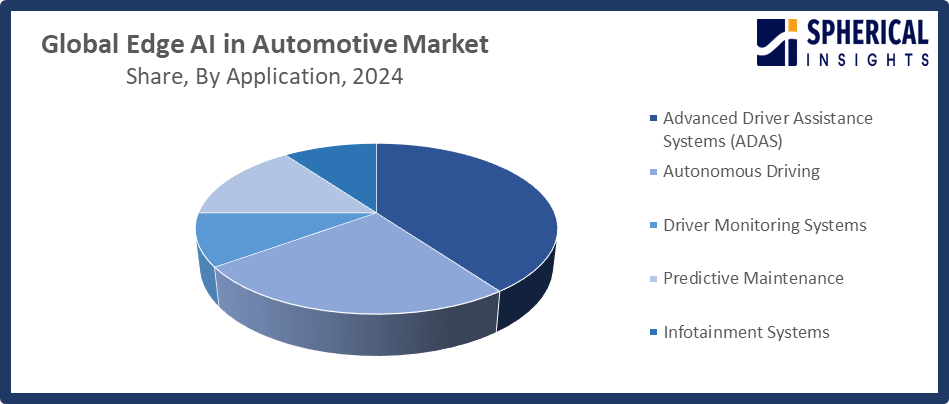
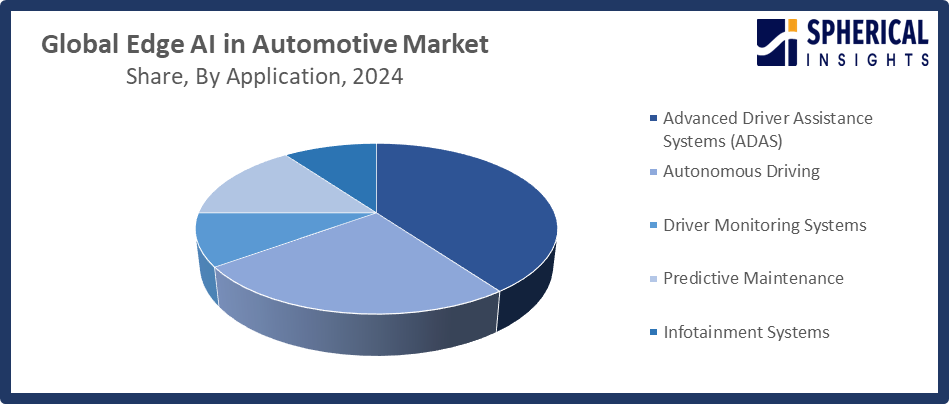
- The advanced driver assistance systems segment accounted for the highest market revenue in 2024, approximately 45%, and is anticipated to grow at a significant CAGR during the forecast period.
Based on the application, the edge AI in automotive market is divided into advanced driver assistance systems (ADAS), autonomous driving, driver monitoring systems, predictive maintenance, and infotainment systems. Among these, the advanced driver assistance systems segment accounted for the highest market revenue in 2024, approximately 45%, and is anticipated to grow at a significant CAGR during the forecast period. In order to handle input from cameras, radar, and sensors within the car, ADAS systems mostly rely on Edge AI, which lowers latency and speeds up decision-making. Furthermore, automakers have been urged to aggressively integrate ADAS technologies due to stringent government safety laws and consumer demand for sophisticated safety systems, further bolstering the segment.
Get more details on this report -
The healthcare institutions segment in the edge AI in automotive market is expected to grow at the fastest CAGR over the forecast period. Growing investments in self-driving technologies, AI-powered perception systems, and the expanding global development of intelligent and connected vehicles are driving the autonomous driving market.
Regional Segment Analysis of the Global Edge AI in Automotive Market
- North America (U.S., Canada, Mexico)
- Europe (Germany, France, U.K., Italy, Spain, Rest of Europe)
- Asia-Pacific (China, Japan, India, Rest of APAC)
- South America (Brazil and the Rest of South America)
- The Middle East and Africa (UAE, South Africa, Rest of MEA)
Asia Pacific is expected to hold the largest share of the global edge AI in automotive market over the forecast period.

Get more details on this report -
Asia Pacific is expected to hold the largest share of the global edge AI in automotive market over the forecast period. The existence of significant automotive manufacturing centers in nations like China, Japan, South Korea, and India is the main factor driving the Asia Pacific. These nations are quickly embracing cutting-edge automotive technologies, such as advanced driver assistance systems (ADAS), connected car platforms, and artificial intelligence. While Japan's METI/NADO-backed AI chip initiatives assist roadside and vehicle systems, India's IndiaAI Mission finances computing infrastructure, and China's "AI+" strategy and five-year plan prioritize embodied intelligence for smart vehicles. Widespread Level 2+ ADAS integration and BYD's autonomous driving technology in vehicles like the Denza N9 SUV (which debuted in March 2025) are examples of recent advancements.
North America is expected to grow at the fastest CAGR in the edge AI in automotive market during the forecast period. The substantial presence of top automakers, cutting-edge technological firms, and semiconductor developers is primarily responsible for the region's expansion. Nations like the US and Canada are making significant investments in next-generation car platforms, autonomous driving technologies, and artificial intelligence. Notable announcements include Qualcomm's September 2025 Harman partnership for AI-enabled cockpits and ADAS solutions specifically designed for U.S. autonomous vehicles, GM's October 2025 announcement that eyes-off autonomous driving will debut on the Cadillac Escalade IQ in 2028, and conversational AI powered by Google Gemini launching in 2026.
Competitive Analysis:
The report offers the appropriate analysis of the key organizations/companies involved within the global edge AI in automotive market, along with a comparative evaluation primarily based on their type of offering, business overviews, geographic presence, enterprise strategies, segment market share, and SWOT analysis. The report also provides an elaborate analysis focusing on the current news and developments of the companies, which includes product development, innovations, joint ventures, partnerships, mergers & acquisitions, strategic alliances, and others. This allows for the evaluation of the overall competition within the market.
Worldwide Top Key Players In The Edge AI in Automotive Market Include
- Ambarella
- AMD
- Aptiv PLC
- Continental AG
- DENSO Corporation
- Horizon Robotics
- Huawei
- Infineon Technologies
- Intel (Mobileye)
- NVIDIA
- NXP Semiconductors
- Qualcomm
- Renesas Electronics
- Samsung Semiconductor
- STMicroelectronics
- Others
Key Target Audience
- Market Players
- Investors
- End-users
- Government Authorities
- Consulting And Research Firm
- Venture capitalists
- Value-Added Resellers (VARs)
Recent Development
- In October 2025, AutoSonix launched an AI-based solution delivering real-time vehicle diagnostics and trade-in intelligence, helping warranty providers improve vehicle evaluation accuracy, streamline claims management, and enhance decision-making across automotive service operations.
- In September 2025, Sonatus launched Sonatus AI Director, an AI-enabled platform enabling OEMs to deploy and manage artificial intelligence applications directly at vehicle manufacturing centers, supporting smarter production processes and advanced automotive software integration.
- In May 2025, Retronix Technologies Inc. collaborated with Renesas Electronics Corporation and launched two Edge AI platforms, Sparrow Hawk SBC and Raptor SoM, designed to enhance processing performance and capabilities of modern intelligent vehicles.
- In April 2025, ECARX Holdings Inc. partnered with HERE Technologies and launched an AI-based vehicle navigation system designed to strengthen intelligent mobility solutions and improve navigation capabilities for global automotive manufacturers.
Market Segment
This study forecasts revenue at the global, regional, and country levels from 2020 to 2035. Spherical Insights has segmented the edge AI in automotive market based on the following segments:
Global Edge AI in Automotive Market, By Vehicle Type
- Passenger Cars
- Premium / Luxury Vehicles
- Light Commercial Vehicles
- Heavy Commercial Vehicles
- Buses & Coaches
- Off-road / Agricultural / Construction Vehicles
- Two-wheelers & Light EVs
Global Edge AI in Automotive Market, By Application
- Advanced Driver Assistance Systems (ADAS)
- Autonomous Driving
- Driver Monitoring Systems
- Predictive Maintenance
- Infotainment Systems
Global Edge AI in Automotive Market, By Regional Analysis
- North America
- US
- Canada
- Mexico
- Europe
- Germany
- UK
- France
- Italy
- Spain
- Russia
- Rest of Europe
- Asia Pacific
- China
- Japan
- India
- South Korea
- Australia
- Rest of Asia Pacific
- South America
- Brazil
- Argentina
- Rest of South America
- Middle East & Africa
- UAE
- Saudi Arabia
- Qatar
- South Africa
- Rest of the Middle East & Africa
Frequently Asked Questions (FAQ)
-
1. What is the CAGR of the edge AI in automotive market over the forecast period?The global edge AI in automotive market is projected to expand at a CAGR of 21.5% during the forecast period.
-
2. Which region holds the largest share of the edge AI in automotive market?North America is anticipated to hold the largest share of the edge AI in automotive market over the predicted timeframe.
-
3. Who are the top companies operating in the global edge AI in automotive market?Ambarella, AMD (Xilinx), Aptiv PLC, Continental AG, DENSO Corporation, Horizon Robotics, Infineon Technologies, Intel (Mobileye), NVIDIA, NXP Semiconductors, Qualcomm, Renesas Electronics, Samsung Semiconductor, STMicroelectronics, and Others.
-
4. What factors are driving the growth of edge AI in automotive market?Growth of the edge AI in automotive market is driven by rising adoption of autonomous vehicles, increasing demand for real-time data processing, expansion of ADAS, connected vehicle technologies, and advancements in AI-enabled automotive semiconductors.
-
5. What are market trends in the edge AI in automotive market?Key trends in the edge AI in automotive market include integration of AI chips in vehicles, growth of smart cabins, expansion of ADAS technologies, development of autonomous driving platforms, and increased collaboration between automakers and semiconductor companies.
-
6. What are the main challenges restricting wider adoption of the edge AI in automotive market?Major challenges in the edge AI in automotive market include high development costs, complex hardware integration, limited edge processing power, cybersecurity risks, data management difficulties, and regulatory concerns affecting deployment of AI-enabled automotive technologies.
Need help to buy this report?