Global Dimethylacetamide Market Size, Share, and COVID-19 Impact Analysis, By Form (Liquid, Solid, and Aqueous Solution), By Purity Level (High Purity, Technical Grade, and Industrial Grade), By Application (Solvent, Intermediate, Reagent, and Additive), By End Use (Pharmaceuticals, Agriculture, Chemical Manufacturing, Electronics, and Others), and By Region (North America, Europe, Asia-Pacific, Latin America, Middle East, and Africa), Analysis and Forecast 2025 - 2035
Industry: Chemicals & Materials
Global Dimethylacetamide Market Size Insights Forecasts to 2035
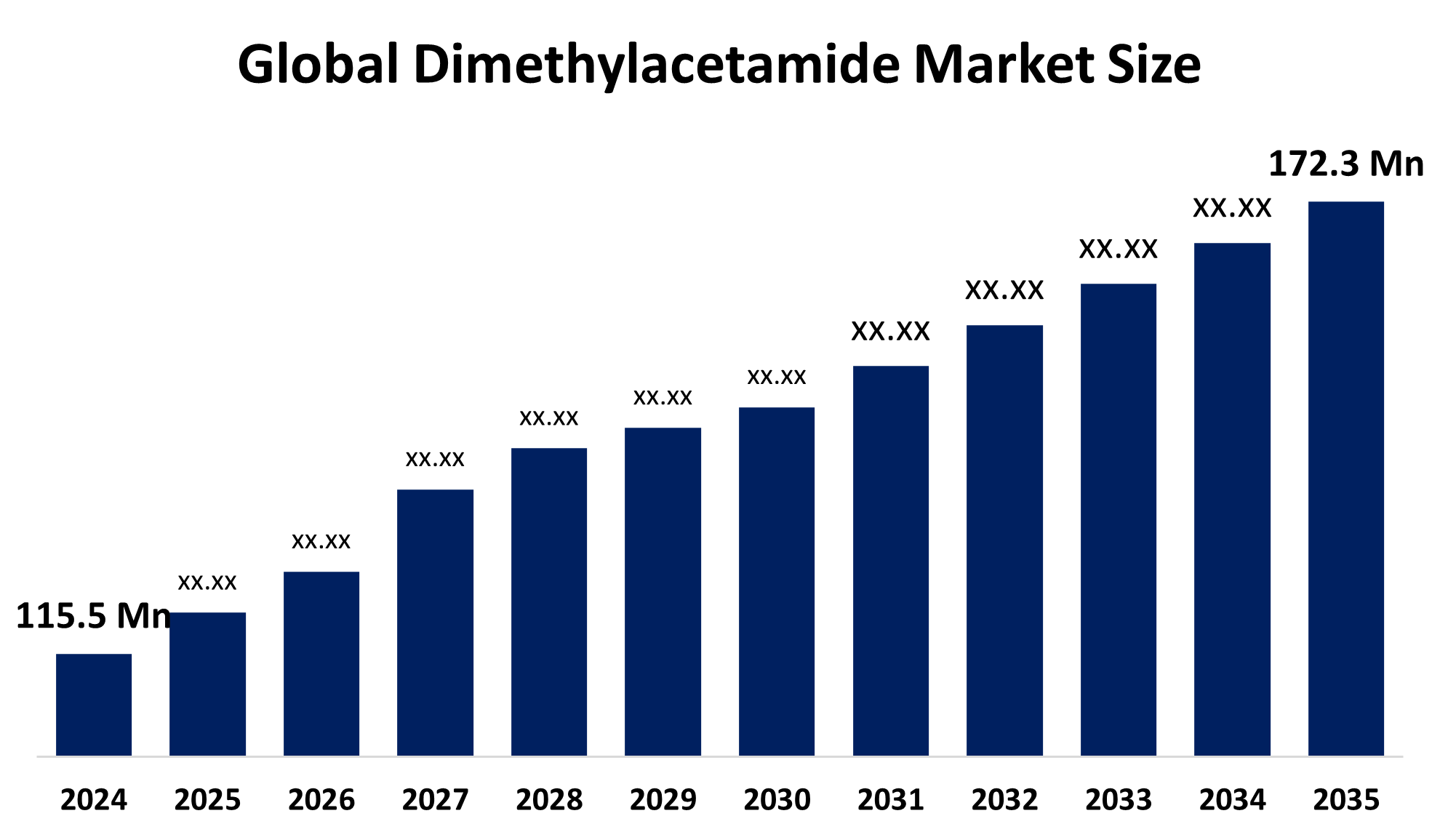
- The Global Dimethylacetamide Market Size Was Estimated at USD 115.5 Million in 2024
- The Market Size is Expected to Grow at a CAGR of around 3.7% from 2025 to 2035
- The Worldwide Dimethylacetamide Market Size is Expected to Reach USD 172.3 Million by 2035
- North America is expected to grow the fastest during the forecast period.
Get more details on this report -
According to a research report published by Spherical Insights and Consulting, The Global Dimethylacetamide Market Size was worth around USD 115.5 Million in 2024 and is Predicted to Grow to around USD 172.3 Million by 2035 with a Compound Annual Growth Rate (CAGR) of 3.7% from 2025 to 2035. The Dimethylacetamide Market is growing because pharmaceutical companies need DMAc for their active pharmaceutical ingredient production, and the electronics industry needs DMAc for semiconductor battery manufacturing and high-performance fiber creation through acrylic and spandex processes. The industrial growth in the Asia-Pacific region creates more demand for this particular market expansion.
Market Overview
Dimethylacetamide (DMAc) Market refers to a polar aprotic solvent that manufacturers use because it demonstrates both excellent solvent abilities and thermal endurance. The substance serves multiple commercial purposes, which include creating synthetic fibers such as acrylic and spandex and producing pharmaceuticals, agrochemicals and specialty resins. Market growth is primarily driven by rising demand for high-performance fibres in textiles and automotive interiors. According to industry data, global spandex production has grown by over 8% annually, which results in increased DMAc usage. The pharmaceutical market in Asia-Pacific maintains constant demand because its manufacturing operations have extended since the sector reached a market size of USD 1.5 trillion in 2023.
The electric vehicle sector, which sold 14 million units worldwide in 2023, has created new opportunities for growth in electronic chemicals and lithium-ion battery binders. Solvent toxicity regulations have led to increased funding for recovery and recycling technologies, thereby creating a sustainable DMAc market study. The European Union issued Commission Regulation (EU) 2025/1090 on June 3 2025, to amend REACH Annex XVII by prohibiting N, N-dimethylacetamide (DMAC) and 1-ethylpyrrolidin-2-one (NEP) usage. Both solvents fall under Category 1B reproductive toxicants, which establishes higher compliance standards for usage. CATO supplies certified DMAC and NEP reference standards, which help customers meet their regulatory obligations.
Report Coverage
This research report categorizes the dimethylacetamide market based on various segments and regions, forecasts revenue growth, and analyzes trends in each submarket. The report analyses the key growth drivers, opportunities, and challenges influencing the dimethylacetamide market. Recent market developments and competitive strategies, such as expansion, type launch, development, partnership, merger, and acquisition, have been included to draw the competitive landscape in the market. The report strategically identifies and profiles the key market players and analyses their core competencies in each sub-segment of the Dimethylacetamide Market.
Global Dimethylacetamide Market Report Coverage
| Report Coverage | Details |
|---|---|
| Base Year: | 2024 |
| Market Size in 2024: | USD 115.5 Million |
| Forecast Period: | 2025-2035 |
| Forecast Period CAGR 2025-2035 : | 3.7% |
| 2035 Value Projection: | USD 172.3 Million |
| Historical Data for: | 2020-2023 |
| No. of Pages: | 195 |
| Tables, Charts & Figures: | 102 |
| Segments covered: | By Form, By Purity Level |
| Companies covered:: | Eastman Chemical Company, BASF SE, Mitsubishi Gas Chemical Company, Inc., Zhejiang Jiangshan Chemical Co., Ltd., Akkim Kimya Sanayi A., Merck KGaA, DuPont de Nemours, Inc., Evonik Industries AG, Holy Stone Enterprise Co., Ltd, Glentham Life Sciences Limited, Tokyo Chemical Industry Pvt.,, Samsung Fine Chemicals Co., Ltd, Nanjing Chemical Industry Group Co., Ltd., Shandong Jinling Chemical Co., Ltd. and Other Key Players |
| Pitfalls & Challenges: | and COVID-19 Impact Analysis |
Get more details on this report -
Driving Factors
The Global Dimethylacetamide (DMAc) Market exists because the synthetic fiber and polymer industries demand polyacrylonitrile (PAN) fiber production which serves the carbon fiber composite market. The growing demand for composite materials in the aerospace, automotive, and wind energy sectors has raised carbon fibre needs, which in turn drives DMAc requirements. The production of cellulose acetate and urethane needed for film coatings and adhesives also depends on DMAc. The rising demand for electronics production in the Asia-Pacific region, together with the strict pharmaceutical solvent quality requirements, creates more demand for this product. The rising production of polyester staple fiber in China, which produces more than 60% of worldwide fiber output, enables continuous growth in DMAc consumption.
Restraining Factors
The Global Dimethylacetamide (DMAc) Market faces restrictions because environmental and health regulations impose strict controls on the chemical, which health authorities consider a reproductive toxin. The market experiences slower growth because companies face high costs for solvent recovery and face uncertainty in raw material pricing.
Market Segmentation
The dimethylacetamide market share is classified into form, purity level, application, and end use.
- The liquid segment dominated the market in 2024, approximately 80% and is projected to grow at a substantial CAGR during the forecast period.
Based on the form, the Dimethylacetamide Market is divided into liquid, solid, and aqueous solution. Among these, the liquid segment dominated the market in 2024 and is projected to grow at a substantial CAGR during the forecast period. The liquid segment dominated the DMAC market because it handles better and delivers accurate dosing and dissolves in both water and organic solvents. The liquid form of polyacrylonitrile and polyurethane allows efficient polymer dissolution during the fibre production process. The pumpable nature of the product allows it to be easily used in both pharmaceutical and chemical manufacturing processes, which has led to its widespread use in industrial settings.
- The high purity segment accounted for the largest share in 2024, approximately 55% and is anticipated to grow at a significant CAGR during the forecast period.
Based on the purity level, the Dimethylacetamide Market is divided into high purity, technical grade, and industrial grade. Among these, the high purity segment accounted for the largest share in 2024 and is anticipated to grow at a significant CAGR during the forecast period. The high purity segment accounted for the largest share because pharmaceutical manufacturing and semiconductor processing require strict quality standards. High purity DMAC (typically ≥99.5%) enables drug synthesis to proceed without any impurities that would endanger safety or effectiveness. The electronics industry requires more contaminant-free solvents because it expands rapidly, especially in the production of lithium battery separators.
- The solvent segment dominated the market in 2024, approximately 65% and is projected to grow at a substantial CAGR during the forecast period.
Based on the application, the Dimethylacetamide Market is divided into solvent, intermediate, reagent, and additive. Among these, the solvent segment dominated the market in 2024 and is projected to grow at a substantial CAGR during the forecast period. The solvent segment dominated the market because DMAC can dissolve high-performance polymers such as acrylic fibre, polyimides, and aramid. Its thermal stability and low volatility make it essential for textile wet spinning and industrial coating production processes. The global fiber production reached 124 million tons in 2023, which created a 7% increase in demand for this solvent.
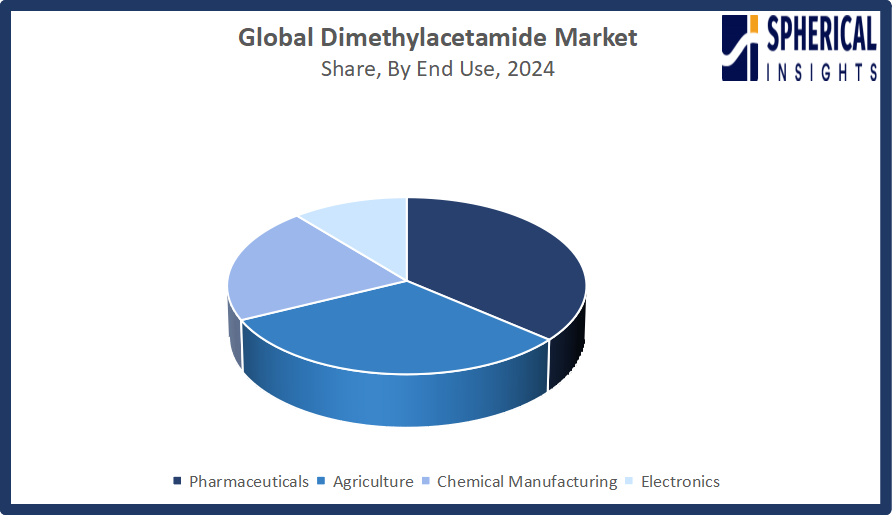
- The pharmaceuticals segment accounted for the highest market revenue in 2024, approximately 36% and is anticipated to grow at a significant CAGR during the forecast period.
Based on the end use, the Dimethylacetamide Market is divided into pharmaceuticals, agriculture, chemical manufacturing, electronics, and others. Among these, the pharmaceuticals segment accounted for the highest market revenue in 2024 and is anticipated to grow at a significant CAGR during the forecast period. The pharmaceuticals market grows because DMAC serves as an essential solvent for active pharmaceutical ingredient (API) synthesis and drug formulation. The segment accounts for 40-45% of global DMAC demand because chronic diseases lead to 17.9 million annual deaths, and pharmaceutical production is projected to grow 25% within five years. Since 2020, antibiotic production has increased by 30%.
Get more details on this report -
Regional Segment Analysis of the Dimethylacetamide Market
- North America (U.S., Canada, Mexico)
- Europe (Germany, France, U.K., Italy, Spain, Rest of Europe)
- Asia-Pacific (China, Japan, India, Rest of APAC)
- South America (Brazil and the Rest of South America)
- The Middle East and Africa (UAE, South Africa, Rest of MEA)
Asia Pacific is anticipated to hold the largest share of the dimethylacetamide market over the predicted timeframe.

Get more details on this report -
Asia Pacific is anticipated to hold the largest share of the Dimethylacetamide Market over the predicted timeframe. The dimethylacetamide market is expected to have its 45% market share from the Asia Pacific due to its growing textile, chemical, and pharmaceutical industries across China, India, South Korea and Japan. The production of acrylic fibre in China provides more than 60% of global output, which creates a strong demand for dimethylacetamide because it serves as a vital solvent in fiber production. The electronics industry and coatings industry in Southeast Asia and India will see increased product demand from their growing operations. The industrial development and healthcare spending growth, together with strong textile and pharmaceutical export markets, will enable the Asia Pacific to maintain its market leadership position.
North America is expected to grow at a rapid CAGR in the Dimethylacetamide Market during the forecast period. The dimethylacetamide market in North America is experiencing a 21% share growth because the aerospace, automotive and pharmaceutical industries in the United States and Canada are increasing their need for this chemical compound. The United States market for advanced composites and high-performance fibre production continues to grow because of increasing pharmaceutical outsourcing and specialty chemical production, which drives up solvent requirements. The growth of the regional market, because of industrial research and development activities together with investments in environmentally friendly manufacturing methods, creates additional demand for dimethylacetamide.
The chemical, pharmaceutical and advanced materials industries in Germany, France and the UK create a strong foundation for the European Dimethylacetamide Market to expand. The application of strict quality standards and environmental regulations forces companies to use high-purity solvents for their specialized needs. The automotive industry requires high-performance textiles, which will result in increased dimethylacetamide usage for their production. The industrial research and development activities, together with the mandatory solvent usage for compliance requirements, will drive ongoing market expansion in this region.
Competitive Analysis:
The report offers the appropriate analysis of the key organizations/companies involved within the Dimethylacetamide Market, along with a comparative evaluation primarily based on their type of offering, business overviews, geographic presence, enterprise strategies, segment market share, and SWOT analysis. The report also provides an elaborative analysis focusing on the current news and developments of the companies, which includes type development, innovations, joint ventures, partnerships, mergers & acquisitions, strategic alliances, and others. This allows for the evaluation of the overall competition within the market.
List of Key Companies
- Eastman Chemical Company
- BASF SE
- Mitsubishi Gas Chemical Company, Inc.
- Zhejiang Jiangshan Chemical Co., Ltd.
- Akkim Kimya Sanayi A.
- Merck KGaA
- DuPont de Nemours, Inc.
- Evonik Industries AG
- Holy Stone Enterprise Co., Ltd
- Glentham Life Sciences Limited
- Tokyo Chemical Industry Pvt.,
- Samsung Fine Chemicals Co., Ltd
- Nanjing Chemical Industry Group Co., Ltd.
- Shandong Jinling Chemical Co., Ltd.
- Others
Key Target Audience
- Market Players
- Investors
- End-users
- Government Authorities
- Consulting and Research Firm
- Venture capitalists
- Value-Added Resellers (VARs)
Recent Development
- In May 2025, BASF signed an agreement to acquire DOMO Chemicals’ 49% stake in the Alsachimie joint venture. The move would grant BASF full ownership, strengthening its PA 6.6 precursor production footprint in Chalampe, France, pending regulatory consultations and approvals.
- In April 2025, Eastman Chemical Company began producing enhanced sustainability dimethylaminopropylamine (DMAPA ES) at its St. Gabriel, Louisiana site. Using renewable raw materials, the product can cut global warming potential by up to 50% for CAPB surfactant manufacturers, supporting sustainable consumer product formulations.
- In August 2024, Arclin announced plans to expand methylamines and dimethylformamide capacity at its Belle, West Virginia, facility. Production will rise 35% for methylamines and 100% for DMF, with potential formamide installation to meet growing U.S. demand.
Market Segment
This study forecasts revenue at global, regional, and country levels from 2020 to 2035. Spherical Insights has segmented the Dimethylacetamide Market based on the below-mentioned segments:
Global Dimethylacetamide Market, By Form
- Liquid
- Solid
- Aqueous Solution
Global Dimethylacetamide Market, By Purity Level
- High Purity
- Technical Grade
- Industrial Grade
Global Dimethylacetamide Market, By Application
- Solvent
- Intermediate
- Reagent
- Additive
Global Dimethylacetamide Market, By End Use
- Pharmaceuticals
- Agriculture
- Chemical Manufacturing
- Electronics
Global Dimethylacetamide Market, By Regional Analysis
- North America
- US
- Canada
- Mexico
- Europe
- Germany
- UK
- France
- Italy
- Spain
- Russia
- Rest of Europe
- Asia Pacific
- China
- Japan
- India
- South Korea
- Australia
- Rest of Asia Pacific
- South America
- Brazil
- Argentina
- Rest of South America
- Middle East & Africa
- UAE
- Saudi Arabia
- Qatar
- South Africa
- Rest of the Middle East & Africa
Frequently Asked Questions (FAQ)
-
1.What role does DMAC play as a critical solvent in pharmaceutical API synthesis and high-performance polymer production?DMAc serves as a critical polar aprotic solvent, enabling efficient active pharmaceutical ingredient (API) synthesis and high-performance polymer production; about 40% of global DMAc demand comes from pharmaceuticals, where its high purity boosts reaction yields, and it dissolves high-molecular-weight polymers for advanced materials.
-
2.How is the rapid expansion of lithium-ion battery production in Asia-Pacific driving DMAC demand for separator membranes?Rapid Asia-Pacific lithium-ion battery growth, accounting for 65% of global separator production (3.9 billion m² in 2023), boosts demand for DMAc used in high-purity separator membranes, as battery capacity and EV manufacturing expand sharply in China, Japan, and South Korea.
-
3.What are the latest technological innovations in bio-based or low-toxicity DMAC alternatives to comply with stringent environmental regulations?Recent innovations in bio-based and low-toxicity alternatives to DMAC include the adoption of biodegradable solvents like dimethyl carbonate (DMC) and γ-valerolactone (GVL), and deep eutectic solvents (DES), some blends (e.g., 30% DMAc with plant-derived solvents) cut toxicity >20% while aligning with stricter environmental regulations.
-
4.How is the trend toward sustainable and green chemistry influencing DMAC product development and substitution?The shift toward sustainable and green chemistry is pushing the DMAc market toward cleaner production, solvent recovery, and lower-toxicity alternatives, with over 20% of manufacturers exploring greener methods and bio-based feedstocks to reduce environmental impact and regulatory burdens.
-
5.What impact is the global shift toward electric vehicles having on DMAC consumption in battery component manufacturing?The global shift toward electric vehicles is boosting DMAc use in lithium-ion battery separator production, as EV sales hit 14 million in 2024 and separator demand (Asia-Pacific 45% share) rises with battery capacity growth, expanding high-purity solvent needs in separator membranes.
-
6.How do DMAC emissions and worker exposure limits under REACH affect operational costs for European manufacturers?Under EU REACH Annex XVII, dimethylacetamide (DMAC) is restricted due to reproductive toxicity, requiring manufacturers to control worker exposure below 13 mg/m³ inhalation and 1.8 mg/kg bw/day dermal limits and implement strict risk controls. Compliance, including updated safety reports, ventilation systems, and PPE, can raise operational costs significantly for European producers.
Need help to buy this report?