Global Digital Twin in Life Science Market Size, Share, and COVID-19 Impact Analysis, By Type of Digital Twin (Process Digital Twins, Product / Device Digital Twins, System / Asset Digital Twins, Patient / Physiological Digital Twins, Clinical Trial Digital Twins), By Application (Drug Discovery & Preclinical Modeling, Bioprocessing & Manufacturing Optimization, Clinical Trial Simulation & Virtual Study Design, Personalized Medicine & Therapeutic Modeling, Medical Device R&D & Performance Validation, Quality Management & Regulatory Support), and By Region (North America, Europe, Asia-Pacific, Latin America, Middle East, and Africa), Analysis and Forecast 2025 - 2035
Industry: Healthcare
Global Digital Twin in Life Science Market Size Insights Forecasts to 2035
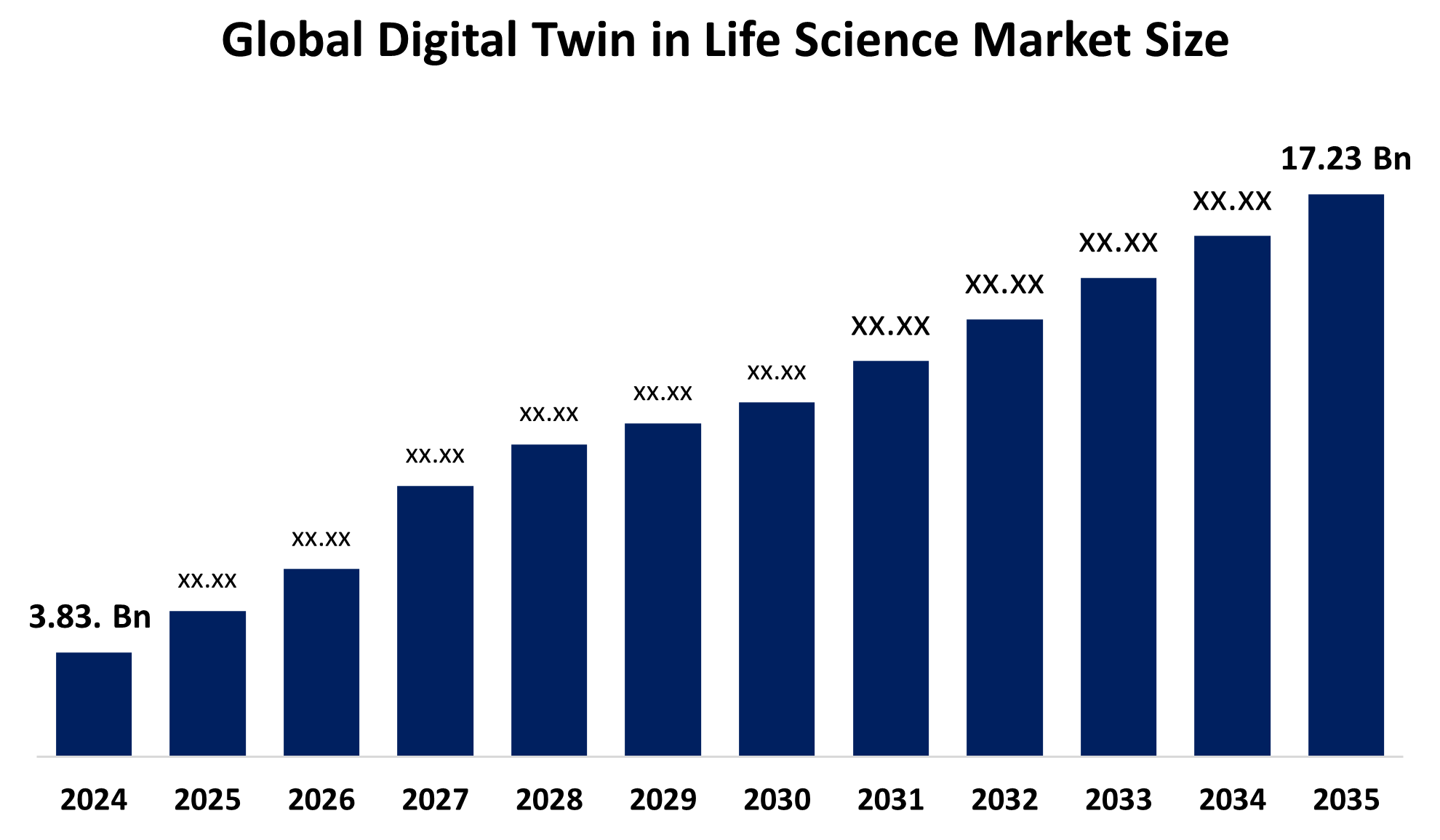
- The Global Digital Twin in Life Science Market Size Was Estimated at USD 3.83 Billion in 2024
- The Market Size is Expected to Grow at a CAGR of around 14.65 % from 2025 to 2035
- The Worldwide Digital Twin in Life Science Market Size is Expected to Reach USD 17.23 Billion by 2035
- Asia Pacific is expected to grow the fastest during the forecast period.
Get more details on this report -
According to a research report published by Spherical Insights and Consulting, The Global Digital Twin in Life Science Market Size was valued at around USD 3.83 Billion in 2024 and is Predicted to Grow to around USD 17.23 Billion by 2035 with a Compound Annual Growth Rate (CAGR) of 14.65 % from 2025 to 2035. Predictive modeling, personalized medicine, expedited drug development, improved clinical trial simulations, operational optimization, and real-time patient monitoring are all made possible by digital twin technology in the life sciences sector, which boosts productivity, lowers costs, and facilitates data-driven decision-making.
Market Overview
In the life sciences industry, a "digital twin" is a high-fidelity virtual representation of biological systems, processes, pharmaceutical goods, or medical devices that is produced by combining real-time data, sophisticated analytics, and computational modeling. R&D, clinical trials, and biopharma manufacturing are all made quicker and simpler with the added benefit of lower risks and expenses when this technology is applied. The U.S. Department of Energy unveiled its Genesis Mission at the start of 2026, working with NVIDIA to inject AI infrastructures of R&D, especially through digital twins that mimic biological systems. For instance, in October 2023, Siemens Digital Industries Software and CEA-List launched a strategic collaboration to advance digital twin technology, focusing on AI integration, virtual and hybrid simulation platforms, and enhancing embedded software for next-generation digital twins. The growth of the digital twin in the life sciences market is primarily attributed to the rise in demand for personalized medicine, drug development efficiencies, and predictive modeling.
Report Coverage
This research report categorizes the Global Digital Twin in Life Science Market Size based on various segments and regions, forecasts revenue growth, and analyzes trends in each submarket. The report analyses the key growth drivers, opportunities, and challenges influencing the digital twin in life science market. Recent market developments and competitive strategies, such as expansion, product launch, development, partnership, merger, and acquisition, have been included to draw the competitive landscape in the market. The report strategically identifies and profiles the key market players and analyzes their core competencies in each sub-segment of the digital twin in life science market.
Global Digital Twin in Life Science Market Report Coverage
| Report Coverage | Details |
|---|---|
| Base Year: | 2024 |
| Market Size in 2024: | USD 3.83 Billion |
| Forecast Period: | 2025-2035 |
| Forecast Period CAGR 2025-2035 : | 14.65% |
| 2035 Value Projection: | USD 17.23 Billion |
| Historical Data for: | 2020-2023 |
| No. of Pages: | 225 |
| Tables, Charts & Figures: | 102 |
| Segments covered: | By Type of Digital Twin, By Application |
| Companies covered:: | ANSYS, Inc., Atos, Autodesk Inc., Bentley Systems, Certara, Dassault Systèmes, ExactCure, GE Healthcare, GSK Plc, IBM Corporation, Mesh Bio, Microsoft Corporation, NVIDIA Corporation, Oracle Corporation, and Other Key Players |
| Pitfalls & Challenges: | and COVID-19 Impact Analysis |
Get more details on this report -
Driving Factors
The market for digital twins in life science is expanding globally as businesses use virtual replicas to improve clinical trials, medication discovery, and personalized care. The growing need for innovation, efficiency, and precision in the pharmaceutical and healthcare industries is what is propelling the use of Global Digital Twin in Life Science Market Size. The market for digital twins in life sciences is propelled by the growing need for predictive modeling, efficient drug discovery, and personalized medicine. Predictive modeling and expedited medication development also shorten the duration and expense of clinical trials, improving the efficiency of R&D procedures.
Restraining Factors
The adoption of digital twins in the life sciences industry is restricted by a number of factors, including high implementation costs, difficult data integration, a lack of standardization, regulatory obstacles, and a shortage of qualified personnel.
Market Segmentation
The digital twin in life science market share is classified into type of digital twin and application.
- The digital twins segment accounted for the largest share in 2024 and is anticipated to grow at a significant CAGR during the forecast period.
Based on the type of digital twin, the Global Digital Twin in Life Science Market Size is divided into process digital twins, product/device digital twins, system/asset digital twins, patient/physiological digital twins, clinical trial digital twins. Among these, the digital twins segment accounted for the largest share in 2024 and is anticipated to grow at a significant CAGR during the forecast period. The basic biopharmaceutical production processes, which are concerned with product quality and efficiency as well as regulatory compliance, are closely linked to the process digital twin segment.
- The clinical trial simulation & virtual study design segment accounted for the highest market revenue in 2024 and is anticipated to grow at a significant CAGR during the forecast period.
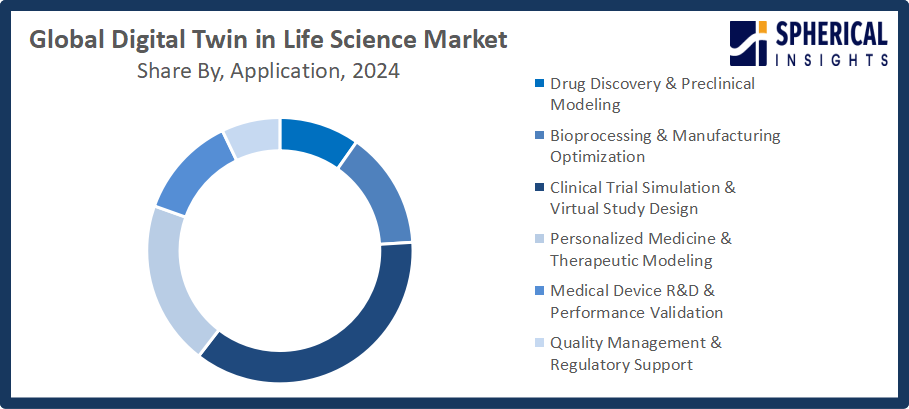
Based on the application, the Global Digital Twin in Life Science Market Size is divided into drug discovery & preclinical modeling, bioprocessing & manufacturing optimization, clinical trial simulation & virtual study design, personalized medicine & therapeutic modeling, medical device r&d & performance validation, quality management & regulatory support. Among these, the clinical trial simulation & virtual study design segment accounted for the highest market revenue in 2024 and is anticipated to grow at a significant CAGR during the forecast period. The need for quicker, safer, and less expensive drug development, the clinical trial simulation and customized medicine industry will grow significantly. This lowers the frequency of trial failures, expedites the approval procedure, and lowers R&D expenses.
Get more details on this report -
Regional Segment Analysis of the Digital Twin in Life Science Market
- North America (U.S., Canada, Mexico)
- Europe (Germany, France, U.K., Italy, Spain, Rest of Europe)
- Asia-Pacific (China, Japan, India, Rest of APAC)
- South America (Brazil and the Rest of South America)
- The Middle East and Africa (UAE, South Africa, Rest of MEA)
North America is anticipated to hold the largest share of the digital twin in life science market over the predicted timeframe.

Get more details on this report -
North America is anticipated to hold the largest share of the Global Digital Twin in Life Science Market Size over the predicted timeframe. North America is credited with its sophisticated healthcare system, extensive use of cutting-edge technologies, and significant R&D expenditures. Significant financing is being provided by the government, venture capital firms, and the business sector to accelerate innovation and implementation, particularly in the areas of bioprocess optimization, virtual clinical trials, and customized medicine. In order to increase the use of digital twins in clinical trials and manufacturing, the U.S. Department of Energy and NVIDIA launched the Genesis Mission in November 2025. One recent development is the $6 million financing for digital twin research in medicines announced in late 2025 by the NSF, NIH, and FDA.
Asia Pacific is expected to grow at a rapid CAGR in the Global Digital Twin in Life Science Market Size during the forecast period. Asia Pacific is driven by rising acceptance of cutting-edge technology, growing investments in healthcare infrastructure, and the rising need for effective drug research and personalized treatment. The need for digital twins is high because of the recent surge in biologics manufacturing, increased clinical trial activity, and the expansion of regional pharma and medtech. China's National Medical Goods Administration released the Implementation Plan for Digitalized Pharmaceutical Industry in June 2025. It calls for over 100 high-performance digital twin-enabled goods and 30 smart digital standards in order to improve manufacturing by 2030.
Competitive Analysis:
The report offers the appropriate analysis of the key organizations/companies involved within the Global Digital Twin in Life Science Market Size, along with a comparative evaluation primarily based on their product offering, business overviews, geographic presence, enterprise strategies, segment market share, and SWOT analysis. The report also provides an elaborative analysis focusing on the current news and developments of the companies, which includes product development, innovations, joint ventures, partnerships, mergers & acquisitions, strategic alliances, and others. This allows for the evaluation of the overall competition within the market.
List of Key Companies
- ANSYS, Inc.
- Atos
- Autodesk Inc.
- Bentley Systems
- Certara
- Dassault Systèmes
- ExactCure
- GE Healthcare
- GSK Plc
- IBM Corporation
- Mesh Bio
- Microsoft Corporation
- NVIDIA Corporation
- Oracle Corporation
- Others
Key Target Audience
- Market Players
- Investors
- End-users
- Government Authorities
- Consulting and Research Firm
- Venture capitalists
- Value-Added Resellers (VARs)
Recent Development
- In October 2025, SOPHiA GENETICS launched SOPHiA DDM™ Digital Twins, an AI-driven platform enabling oncologists to simulate patient-specific treatment effects and optimize personalized cancer therapy using clinical, imaging, and genomic data.
- In August 2023, Altis Labs launched an international initiative to accelerate digital twin adoption in clinical trials, using AI-based computational imaging to reduce trial failures and expedite cancer treatment development.
Market Segment
This study forecasts revenue at global, regional, and country levels from 2020 to 2035. Spherical Insights has segmented the Global Digital Twin in Life Science Market Size based on the below-mentioned segments:
Global Digital Twin in Life Science Market, By Type of Digital Twin
- Process Digital Twins
- Product / Device Digital Twins
- System / Asset Digital Twins
- Patient / Physiological Digital Twins
- Clinical Trial Digital Twins
Global Digital Twin in Life Science Market, By Application
- Drug Discovery & Preclinical Modeling
- Bioprocessing & Manufacturing Optimization
- Clinical Trial Simulation & Virtual Study Design
- Personalized Medicine & Therapeutic Modeling
- Medical Device R&D & Performance Validation
- Quality Management & Regulatory Support
Global Digital Twin in Life Science Market, By Regional Analysis
- North America
- US
- Canada
- Mexico
- Europe
- Germany
- UK
- France
- Italy
- Spain
- Russia
- Rest of Europe
- Asia Pacific
- China
- Japan
- India
- South Korea
- Australia
- Rest of Asia Pacific
- South America
- Brazil
- Argentina
- Rest of South America
- Middle East & Africa
- UAE
- Saudi Arabia
- Qatar
- South Africa
- Rest of the Middle East & Africa
Frequently Asked Questions (FAQ)
-
1.What is the CAGR of the digital twin in life science market over the forecast period?The global digital twin in life science market is projected to expand at a CAGR of 14.65% during the forecast period.
-
2.What is the market size of the digital twin in life science market?The global digital twin in life science market size is expected to grow from USD 3.83 billion in 2024 to USD 17.23 billion by 2035, at a CAGR of 14.65 % during the forecast period 2025-2035.
-
3.Which region holds the largest share of the digital twin in life science market?Asia Pacific is anticipated to hold the largest share of the digital twin in life science market over the predicted timeframe.
-
4.Who are the top companies operating in the global digital twin in life science market?ANSYS, Inc., Atos, Autodesk Inc., Bentley Systems, Certara, Dassault Systèmes, ExactCure, GE Healthcare, GSK Plc, IBM Corporation, Mesh Bio, Microsoft Corporation, NVIDIA Corporation, Oracle Corporation, and Others.
-
5.What factors are driving the growth of the digital twin in life science market?The growth of the digital twin in life science market is driven by personalized medicine demand, accelerated drug development, predictive modeling, real-time data analytics, process optimization, and increasing adoption of advanced healthcare technologies.
-
6.What are the market trends in the digital twin in life science market?AI and IoT integration, hybrid and virtual simulations, digital transformation in pharmaceutical and healthcare operations, predictive analytics adoption, cloud-based platforms, and the creation of next-generation, patient-focused Digital Twin solutions are some of the major themes.
-
7.What are the main challenges restricting the wider adoption of the digital twin in life science market?Wider adoption is limited by high implementation costs, complex data integration, regulatory constraints, lack of standardization, data security concerns, and scarcity of skilled professionals proficient in Digital Twin technologies.
Need help to buy this report?