Global Digital Oscilloscope Market Size, Share, and COVID-19 Impact Analysis, By Product Type (Handheld Digital Oscilloscope, Benchtop Digital Oscilloscope, and PC-Based Digital Oscilloscope), By Bandwidth Range (Up to 500 MHz, 500 MHz to 1 GHz, and Above 1 GHz), By Application (Consumer Electronics, Automotive, Aerospace & Defense, Healthcare, IT & Telecommunications, and Others), and By Region (North America, Europe, Asia-Pacific, Latin America, Middle East, and Africa), Analysis and Forecast 2025 - 2035
Industry: Semiconductors & Electronics
Global Digital Oscilloscope Market Insights Forecasts to 2035
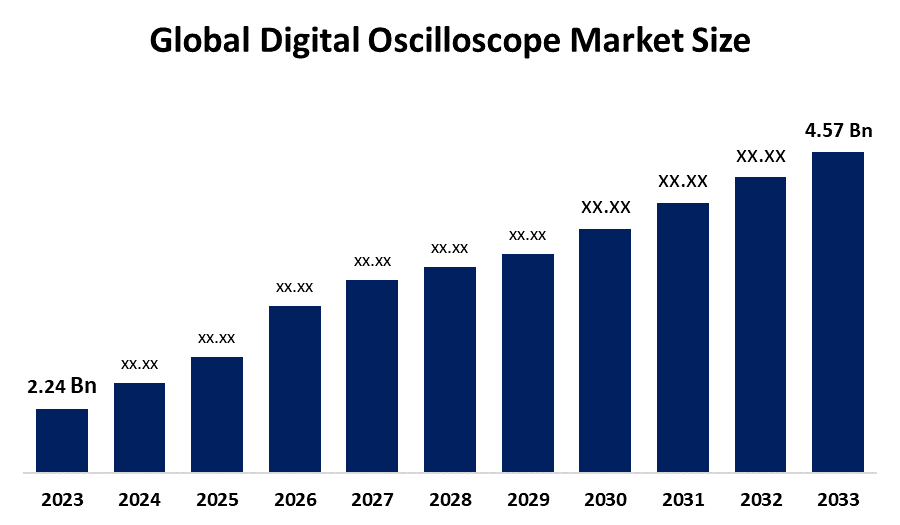
- The Global Digital Oscilloscope Market Size Was Estimated at USD 2.24 Billion in 2024
- The Market Size is Expected to Grow at a CAGR of around 6.7% from 2025 to 2035
- The Worldwide Digital Oscilloscope Market Size is Expected to Reach USD 4.57 Billion by 2035
- Asia Pacific is expected to grow the fastest during the forecast period.
Get more details on this report -
According to a research report published by Spherical Insights and Consulting, the Global Digital Oscilloscope Market Size was worth around USD 2.24 billion in 2024 and is predicted to grow to around USD 4.57 billion by 2035, with a compound annual growth rate (CAGR) of 6.7% from 2025 to 2035. The digital oscilloscope market is growing due to rising demand for precision testing in electric vehicles (EVs), 5G deployment, and IoT devices. Increased R&D in automotive and aerospace, advancements in AI-driven analysis, and the need for high-bandwidth, portable, and automated measurement solutions are driving expansion.
Market Overview
The Global Digital Oscilloscope Market is defined by electronic test instruments that graphically display electrical signal waveforms, such as voltage over time, serving as essential tools for design, troubleshooting, and signal analysis across industries. These devices are primarily used to visualize and analyze signal properties like amplitude, frequency, and waveform shape, facilitating diagnosis in sectors ranging from automotive electronics to telecommunications.
In October 2025, the Airports Authority of India (AAI) issued a tender for a high-performance Digital Storage Oscilloscope (Q3 category) with multi-channel inputs, bandwidth upgradability, and advanced display features. The procurement emphasizes NABL/ILAC-accredited test reports, compliance with government norms, and verified product datasheets, targeting suppliers experienced in central/state government contracts.
Market drivers include the rapid expansion of 5G infrastructure, with global 5G connections reaching 2.4 billion in 2025, demanding high-bandwidth oscilloscopes for rigorous signal testing. Additionally, the rise of intelligent EVs and 800V platforms fuels a 34% annual growth in demand for automotive-grade oscilloscopes. Significant opportunities lie in developing integrated measurement ecosystems that bundle oscilloscopes with spectrum analysis and automated test scripts for specialized verticals, alongside the rising adoption of compact and affordable PC-based digital oscilloscopes.
In February 2026, Europe advanced the European Chips Act with 700 M+ investments in pilot lines and test facilities, including NanoIC and FAMES. Calls for Chips Act 2.0 aim to expand support for metrology and validation, driving demand for digital oscilloscopes in R&D and compliance testing across automotive, telecom, and industrial automation sectors.
Report Coverage
This research report categorizes the digital oscilloscope market based on various segments and regions, forecasts revenue growth, and analyzes trends in each submarket. The report analyses the key growth drivers, opportunities, and challenges influencing the digital oscilloscope market. Recent market developments and competitive strategies, such as expansion, type launch, development, partnership, merger, and acquisition, have been included to draw the competitive landscape in the market. The report strategically identifies and profiles the key market players and analyses their core competencies in each sub-segment of the digital oscilloscope market.
Global Digital Oscilloscope Market Report Coverage
| Report Coverage | Details |
|---|---|
| Base Year: | 2024 |
| Market Size in 2024: | USD 2.24 Billion |
| Forecast Period: | 2025-2035 |
| Forecast Period CAGR 2025-2035 : | CAGR Of 6.7% |
| 2035 Value Projection: | USD 4.57 Billion |
| Historical Data for: | 2020-2023 |
| No. of Pages: | 210 |
| Tables, Charts & Figures: | 90 |
| Segments covered: | By Product Type, By Application |
| Companies covered:: | Tektronix, Inc., Rigol Technologies, Inc., Keysight Technologies, Inc., Pico Technology, Rohde & Schwarz GmbH & Co. KG, Yokogawa Electric Corporation, Teledyne LeCroy, Inc., GW Instek, Fluke Corporation, National Instruments Corporation, B&K Precision Corporation, and other key players |
| Pitfalls & Challenges: | COVID-19 Empact, Challenge, Future, Growth, & Analysis |
Get more details on this report -
Driving Factors
The Global Digital Oscilloscope Market is primarily driven by the increasing demand for precision testing and measurement across electronics, automotive, aerospace, and telecommunications industries. The rapid adoption of electric vehicles, 5G infrastructure, and high-speed digital devices has intensified the need for accurate waveform analysis and real-time data monitoring. Advancements in high-bandwidth, portable, and mixed-signal oscilloscopes enable improved performance and flexibility. Growing investment in R&D, industrial automation, and semiconductor manufacturing further stimulates market expansion. Additionally, the shift toward AI-enabled and network-integrated testing solutions provides opportunities for innovation, enhancing efficiency, accuracy, and scalability in electronic design and validation processes.In September 2023, Keysight Technologies, Inc. expanded its Infiniium portfolio with the MXR B-Series oscilloscopes. Featuring hardware-accelerated, automated analysis tools and superior signal integrity, the new series enables faster anomaly detection, reduces debugging time, and helps engineers accelerate product development and time-to-market.
Restraining Factors
Key restraining factors for the Global Digital Oscilloscope Market include the high cost of advanced, high-bandwidth oscilloscopes, which limits adoption among small and medium enterprises. Additionally, complex operation and maintenance requirements, coupled with rapidly evolving electronics standards, can slow deployment, while increasing competition from affordable portable and software-based alternatives constrains growth.
Market Segmentation
The digital oscilloscope market share is classified into product type, bandwidth range, and application.
- The benchtop digital oscilloscope segment dominated the market in 2024, approximately 65% and is projected to grow at a substantial CAGR during the forecast period.
Based on the product type, the digital oscilloscope market is divided into handheld digital oscilloscopes, benchtop digital oscilloscopes, and PC-based digital oscilloscopes. Among these, the benchtop digital oscilloscope segment dominated the market in 2024 and is projected to grow at a substantial CAGR during the forecast period. This segment’s dominance is attributed to its high bandwidth capabilities exceeding 50 GHz, which are essential for advanced 5G and semiconductor testing. Its superior processing power and deep memory enable precise signal analysis for R&D applications in aerospace and defense. Additionally, benchtop models offer extensive connectivity and multi-channel functionality, making them indispensable for professional laboratories and industrial validation environments.
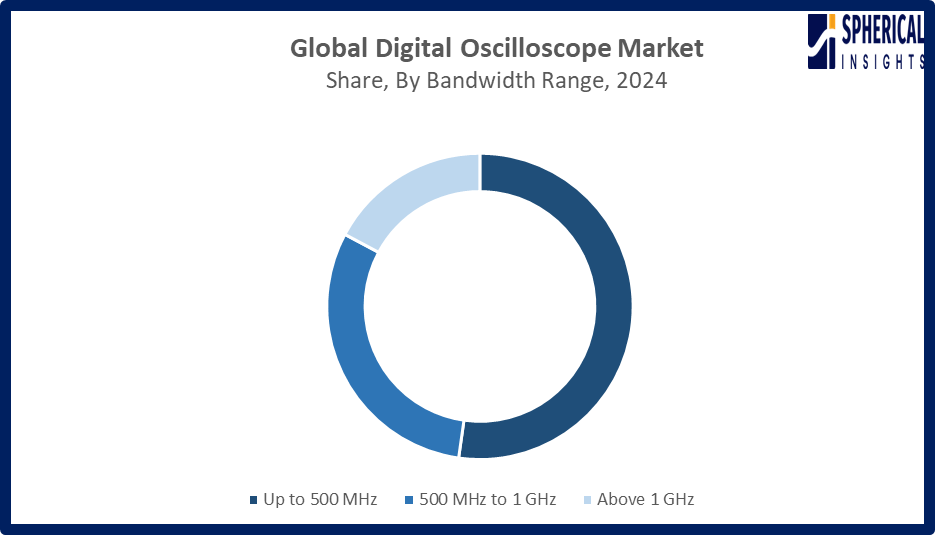
- The up to 500 MHz segment accounted for the largest share in 2024, approximately 52% and is anticipated to grow at a significant CAGR during the forecast period.
Based on the bandwidth range, the digital oscilloscope market is divided into up to 500 MHz, 500 MHz to 1 GHz, and above 1 GHz. Among these, the up to 500 MHz segment accounted for the largest share in 2024 and is anticipated to grow at a significant CAGR during the forecast period. The growth of the up to 500 MHz segment is due to its optimal balance of performance and affordability for general-purpose testing. It is widely adopted in consumer electronics manufacturing, educational laboratories, and automotive repair for debugging mixed-signal circuits. This bandwidth range sufficiently covers most industrial applications, including power supply analysis and sensor validation, without the premium cost associated with higher-frequency models.
Get more details on this report -
- The consumer electronics segment accounted for the highest market revenue in 2024, approximately 40% and is anticipated to grow at a significant CAGR during the forecast period.
Based on the application, the digital oscilloscope market is divided into consumer electronics, automotive, aerospace & defense, healthcare, IT & telecommunications, and others. Among these, the consumer electronics segment accounted for the highest market revenue in 2024 and is anticipated to grow at a significant CAGR during the forecast period. The consumer electronics segment market growth is due to rising global demand for smartphones, wearables, and smart home devices, which require advanced testing for miniaturized, high-speed circuits. Increasing production volumes, rapid product innovation cycles, and integration of IoT and AI features further drive the need for precise signal analysis using digital oscilloscopes.
Regional Segment Analysis of the Digital Oscilloscope Market
- North America (U.S., Canada, Mexico)
- Europe (Germany, France, U.K., Italy, Spain, Rest of Europe)
- Asia-Pacific (China, Japan, India, Rest of APAC)
- South America (Brazil and the Rest of South America)
- The Middle East and Africa (UAE, South Africa, Rest of MEA)
North America is anticipated to hold the largest share of the digital oscilloscope market over the predicted timeframe.

Get more details on this report -
North America is anticipated to hold a 40% share of the digital oscilloscope market over the predicted timeframe. The region’s growth is supported by advanced technological infrastructure, substantial R&D investments, and early adoption of cutting-edge testing solutions. The United States leads due to strong spending in aerospace, defense, semiconductors, and 5G, all requiring high-performance instruments. Canada and Mexico further contribute through telecom growth, industrial automation, electronics manufacturing, and automotive production. In November 2024, the U.S. Department of Commerce reaffirmed export controls on high-end oscilloscopes and transient recorders with sampling rates over 1 GS/s. These regulations restrict global access to advanced testing technology, shaping market dynamics by limiting which companies and countries can develop or acquire cutting-edge digital measurement capabilities.
Asia Pacific is expected to grow at a rapid CAGR in the digital oscilloscope market during the forecast period. The region is rapidly expanding, with an approximate 30% market share, driven by growing electronics manufacturing, increasing semiconductor investments, and rapid 5G rollout. China leads with strong localization policies and semiconductor expansion, while Japan and South Korea contribute through advanced electronics innovation. India is emerging quickly due to supportive government initiatives and rising demand in telecom and automotive electronics. In December 2025, China enforced a 50% domestic equipment mandate for new semiconductor fabs, requiring procurement to include at least half locally sourced tools. This policy accelerates the adoption of indigenous oscilloscopes and high-resolution analyzers across semiconductor, telecom, and power electronics sectors, driving progress toward fully domestic test and measurement equipment.
Europe is experiencing consistent growth fueled by developments in automotive electronics, industrial automation, and semiconductor research. Germany remains a key contributor with its strong manufacturing and automotive base, while France and the United Kingdom support growth through aerospace, defense, and telecommunications advancements. Increased regional investments in semiconductor innovation and testing infrastructure continue to strengthen demand for high-precision oscilloscopes.
Competitive Analysis:
The report offers the appropriate analysis of the key organizations/companies involved within the digital oscilloscope market, along with a comparative evaluation primarily based on their type of offering, business overviews, geographic presence, enterprise strategies, segment market share, and SWOT analysis. The report also provides an elaborative analysis focusing on the current news and developments of the companies, which includes type development, innovations, joint ventures, partnerships, mergers & acquisitions, strategic alliances, and others. This allows for the evaluation of the overall competition within the market.
List of Key Companies
- Tektronix, Inc.
- Rigol Technologies, Inc.
- Keysight Technologies, Inc.
- Pico Technology
- Rohde & Schwarz GmbH & Co. KG
- Yokogawa Electric Corporation
- Teledyne LeCroy, Inc.
- GW Instek
- Fluke Corporation
- National Instruments Corporation
- B&K Precision Corporation
- Siglent Technologies
- Hantek Electronic Co., Ltd.
- Agilent Technologies, Inc.
- Others
Key Target Audience
- Market Players
- Investors
- End-users
- Government Authorities
- Consulting and Research Firm
- Venture capitalists
- Value-Added Resellers (VARs)
Recent Development
- In February 2026, Keysight Technologies, Inc. launched Infiniium XR8 real-time oscilloscopes, featuring advanced ASIC, ADC, and DSP architecture. Designed for high-speed digital testing, the solution improves signal integrity and timing accuracy, enabling engineers to reduce validation cycles from days to hours in complex electronic systems.
- In October 2025, Rohde & Schwarz expanded its MXO portfolio with the compact MXO 3 series oscilloscopes. Featuring up to 4.5 million acquisitions per second and advanced ASIC technology, the series delivers high-speed signal capture, enhanced triggering, and faster FFT analysis, offering precise performance in a compact, cost-effective design.
- In November 2025, Good Will Instrument Co., Ltd. introduced GDS-3102A and GDS-3104A oscilloscopes with 1 GHz bandwidth, 5 GSa/s sampling, and 200 Mpts memory. Designed for high-speed circuits and power electronics, the models offer enhanced bandwidth flexibility and strong price-performance for engineering and educational applications.
- In July 2025, RIGOL Technologies launched its eighth-generation DS80000 Series real-time digital oscilloscopes, offering up to 13 GHz bandwidth and 40 GSa/s sampling. Featuring ultra-deep memory and Smart Probe 2.0, the series enhances high-speed signal capture, enabling precise validation and fault analysis in advanced electronic designs.
- In March 2025, RIGOL Technologies introduced the MHO2000 series digital oscilloscopes, featuring 350 MHz bandwidth, 12-bit ADC, and integrated analysis tools. Designed for medical, power, and automotive applications, the solution offers a cost-effective, multifunctional platform, reducing complexity while delivering high-performance testing and signal analysis capabilities.
- In September 2023, Teledyne LeCroy launched the WaveMaster 8000HD oscilloscope platform, offering 20–65 GHz bandwidth and 12-bit resolution. With enhanced SDA Expert software, the system strengthens validation and debugging capabilities for next-generation high-speed serial data technologies and advanced electronic design testing
Market Segment
This study forecasts revenue at global, regional, and country levels from 2020 to 2035. Spherical Insights has segmented the digital oscilloscope market based on the below-mentioned segments:
Global Digital Oscilloscope Market, By Product Type
- Handheld Digital Oscilloscope
- Benchtop Digital Oscilloscope
- PC-Based Digital Oscilloscope
Global Digital Oscilloscope Market, By Bandwidth Range
- Up to 500 MHz
- 500 MHz to 1 GHz
- Above 1 GHz
Global Digital Oscilloscope Market, By Application
- Consumer Electronics
- Automotive
- Aerospace & Defense
- Healthcare
- IT & Telecommunications
- Others
Global Digital Oscilloscope Market, By Regional Analysis
- North America
- US
- Canada
- Mexico
- Europe
- Germany
- UK
- France
- Italy
- Spain
- Russia
- Rest of Europe
- Asia Pacific
- China
- Japan
- India
- South Korea
- Australia
- Rest of Asia Pacific
- South America
- Brazil
- Argentina
- Rest of South America
- Middle East & Africa
- UAE
- Saudi Arabia
- Qatar
- South Africa
- Rest of the Middle East & Africa
Frequently Asked Questions (FAQ)
-
How are innovations in high-bandwidth and AI-integrated oscilloscopes influencing market trends?Innovations in high-bandwidth (>30 GHz) and AI-integrated oscilloscopes are accelerating market trends, with high-bandwidth models contributing 31% of new sales and AI reducing diagnostic time by up to 52%, enhancing efficiency and adoption in 5G and semiconductor testing
-
What economic factors are driving investments in digital oscilloscope manufacturing and R&D globally?Rising semiconductor R&D spending and $28 billion foundry capex in 2024, coupled with 6% annual electronics industry growth, are key economic drivers boosting investments in digital oscilloscope manufacturing and advanced testing infrastructure globally
-
How is the expansion of the semiconductor and electronics industries affecting market demand?Expansion of the semiconductor and electronics industries significantly boosts demand for digital oscilloscopes, as semiconductor sales are projected to exceed $1 trillion by 2026, while over 50% of testing demand comes from advanced chip validation, increasing the need for high-precision measurement tools.
-
What impact do government policies and export regulations have on global market dynamics?Government policies and export regulations significantly shape market dynamics by restricting access to advanced technologies; for instance, U.S. controls reduced Chinese access to key components by 75% and increased compliance costs, while over 1,800 firms faced sanctions, disrupting global supply chains and limiting high-end oscilloscope adoption
-
How are emerging trends in IoT and embedded systems influencing oscilloscope adoption?Emerging IoT and embedded system trends are driving oscilloscope adoption, with over 27 billion connected IoT devices in 2024, increasing demand for mixed-signal analysis, real-time debugging, and compact testing solutions in development environments
-
What are the key technological advancements improving oscilloscope performance and usability?Key technological advancements include ultra-high bandwidth up to 110 GHz and sampling rates beyond 256 GSa/s, while AI integration reduces analysis time by 40% and touchscreen adoption exceeds 70%, enhancing performance and usability.
-
How does increasing demand for high-speed data transmission affect market expansion?Rising high-speed data transmission demand, with global data traffic growing 25% annually and 5G connections surpassing 2.4 billion in 2025, drives the need for high-bandwidth oscilloscopes, expanding market adoption across telecom and data centers
-
What challenges are limiting market growth despite rising demand for advanced testing equipment?High costs and complexity limit growth, with over 41% of SMEs unable to adopt high-end oscilloscopes and 33% facing operational challenges, while component costs rose 32%, restricting affordability and widespread deployment.
Need help to buy this report?