Global Delta Robots Market Size, Share, and COVID-19 Impact Analysis, By Type (Cartesian Delta Robots and Parallel Delta Robots), By Control System (Manual Control and Automated Control), By Application (Food & Beverage, Pharmaceutical, Electronics, Industrial Automation, and Others), and By Region (North America, Europe, Asia-Pacific, Latin America, Middle East, and Africa), Analysis and Forecast 2025 - 2035
Industry: Electronics, ICT & Media
Global Delta Robots Market Insights Forecasts to 2035
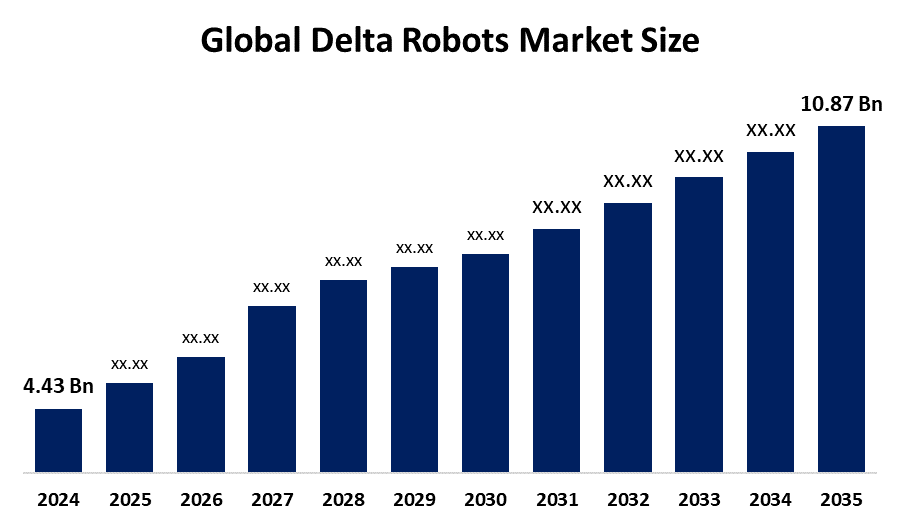
- The Global Delta Robots Market Size Was Estimated at USD 4.43 Billion in 2024
- The Market Size is Expected to Grow at a CAGR of around 8.5% from 2025 to 2035
- The Worldwide Delta Robots Market Size is Expected to Reach USD 10.87 Billion by 2035
- North America is expected to grow the fastest during the forecast period.
Get more details on this report -
According to a Research Report Published by Spherical Insights and Consulting, The Global Delta Robots Market Size was Worth Around USD 4.43 Billion in 2024 and is Predicted to Grow to Around USD 10.87 Billion by 2035 with a Compound Annual Growth Rate (CAGR) of 8.5% from 2025 to 2035. Global integration of AI, machine vision, and advanced motion control, 3D vision, miniaturization for micro-assembly, and increased adoption in food, pharma, and e-commerce logistics are all driving opportunities in the delta robots market.
Market Overview
The Global Delta Robots Market Size is the global industry segment dedicated to designing, producing, and deploying high-speed, parallel arm robots for tasks like pick and place, packaging, sorting, assembly, and precision handling in industries like electronics, pharmaceuticals, food processing, and automotive. These comprise end-effectors, sensors, software for motion control and AI-enabled automation, huge robot hardware, and integration services to create intelligent, automated manufacturing lines. Opportunities driving market expansion include increased adoption of Industry 4.0 and smart factory technologies, the need to reduce labor costs, growing demands for production efficiency, and improved standards for product quality.
Through financing, laws, and programs that assist industrial automation and robotics adoption, governments around the world indirectly help this market by strengthening the domestic robotics ecosystem, promoting research and development, and accelerating the deployment of advanced industrial robots, such as delta robots. For instance, In July 2025, the U.S. Information Technology and Innovation Foundation reported 285 robots per 10,000 manufacturing workers, highlighting robotics as a key driver of productivity, GDP growth, and industrial competitiveness.
In March 2025, India approved the IndiaAI Mission with an outlay of INR 10300 crore, aimed at building advanced computing infrastructure, AI innovation, and research ecosystems. This initiative strengthens Industry 4.0 capabilities such as machine vision and intelligent automation, which are essential for deploying advanced robotic systems, including delta robots in smart factories. The quick speed of technological advancement is one of the main drivers of the delta robots market's expansion.
Report Coverage
This research report categorizes the Global Delta Robots Market Size based on various segments and regions, forecasts revenue growth, and analyzes trends in each submarket. The report analyses the key growth drivers, opportunities, and challenges influencing the delta robots market. Recent market developments and competitive strategies, such as expansion, product launch, development, partnership, merger, and acquisition, have been included to draw the competitive landscape in the market. The report strategically identifies and profiles the key market players and analyses their core competencies in each sub-segment of the delta robots market.
Global Delta Robots Market Report Coverage
| Report Coverage | Details |
|---|---|
| Base Year: | 2024 |
| Market Size in 2024: | USD 4.43 Billion |
| Forecast Period: | 2024-2035 |
| Forecast Period CAGR 2024-2035 : | 8.5% |
| 2035 Value Projection: | USD 10.87 Billion |
| Historical Data for: | 2020-2023 |
| No. of Pages: | 245 |
| Tables, Charts & Figures: | 100 |
| Segments covered: | By Type , By Control System |
| Companies covered:: | ABB Ltd., FANUC Corporation, Yaskawa Electric Corporation, KUKA AG, Omron Corporation, Kawasaki Heavy Industries Ltd., Mitsubishi Electric Corporation, Staubli International AG, Epson Robots, DENSO Corporation, Festo SE & Co. KG, IGUS GmbH, Delta Electronics Inc., Cama Group, Codian Robotics, and Other Key Players |
| Pitfalls & Challenges: | COVID-19 Empact, Challenge, Future, Growth, & Analysis. |
Get more details on this report -
Driving Factors
Rapid technological innovation is a key driver of growth in the delta robots market. The increasing demand for high-speed and precise automation in manufacturing and packaging industries is significantly boosting market expansion. Additionally, the rising adoption of smart factories and Industry 4.0 technologies is accelerating innovation and investment in this space.
The need to reduce labor costs, improve production efficiency, and enhance product quality standards is further fueling demand. Strong government initiatives supporting research, development, and local manufacturing of robotics are also playing a crucial role in driving global adoption.
In June 2025, Japan’s METI launched the RING Project to promote robot adoption across regional industries and address labor shortages. In February 2025, Delta Electronics introduced the D-Bot Series Collaborative Robots for the Indian market at ELECRAMA 2025, under the theme of smart manufacturing. These 6-axis cobots are designed to enable more efficient and intelligent production processes.
Restraining Factors
High development and deployment costs, complex integration with existing production lines, the need for skilled workforce, cybersecurity concerns, limited awareness of advanced robotics solutions, and heavy dependence on continuous power and software updates are the main factors restricting the delta robots market.
Market Segmentation
The Delta Robots Market share is classified into type, control system, and application.
- The parallel delta robots segment dominated the market in 2024, approximately 65%, and is projected to grow at a substantial CAGR during the forecast period.
Based on the type, the Global Delta Robots Market Size is divided cartesian delta robots and parallel delta robots. Among these, the parallel delta robots segment dominated the market in 2024, approximately 65%, and is projected to grow at a substantial CAGR during the forecast period. The unparalleled speed, high precision, superior performance in high-throughput applications like packaging and assembly, and offers lightweight design and independent arm functionality is driving the parallel delta robots industry.
- The automated control segment accounted for the largest share in 2024, approximately 45%, and is anticipated to grow at a significant CAGR during the forecast period.
Based on the control system, the Global Delta Robots Market Size is divided into manual control and automated control. Among these, the automated control segment accounted for the largest share in 2024, approximately 45%, and is anticipated to grow at a significant CAGR during the forecast period. Crucial for driving high-speed, precise pick and place applications essential in modern packaging, electronics, and food industries, integrated with AI and vision technologies, and offers unparalleled speed and repeatability is driving the automated control industry.
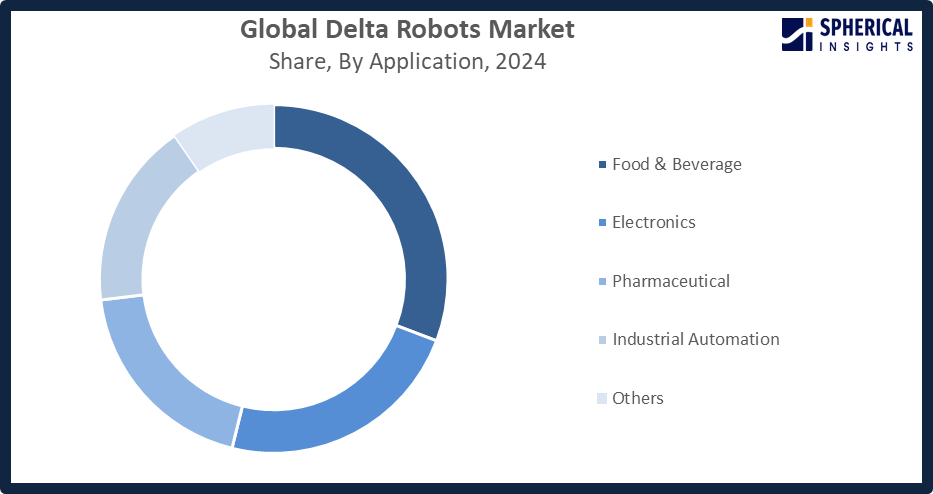
- The food & beverage segment accounted for the highest market revenue in 2024, approximately 37%, and is anticipated to grow at a significant CAGR during the forecast period.
Based on the application, the Global Delta Robots Market Size is divided into food & beverage, pharmaceutical, electronics, industrial automation, and others. Among these, the food & beverage segment accounted for the highest market revenue in 2024, approximately 37%, and is anticipated to grow at a significant CAGR during the forecast period. Increased demand for high speed, hygienic, and precise pick and plate automation in primary packaging, industries strict adherence to sanitation standards, growing labour shortage, rising consumer demand for ready to eat and processed foods is bolstering food & beverage market.
Get more details on this report -
Regional Segment Analysis of the Delta Robots Market
- North America (U.S., Canada, Mexico)
- Europe (Germany, France, U.K., Italy, Spain, Rest of Europe)
- Asia-Pacific (China, Japan, India, Rest of APAC)
- South America (Brazil and the Rest of South America)
- The Middle East and Africa (UAE, South Africa, Rest of MEA)
North America is expected to register a rapid CAGR in the Global Delta Robots Market Size during the forecast period. The United States and Canada are making significant investments in automation technologies, driven by the growing need for high-speed and precision robotic solutions across expanding manufacturing hubs.
The region’s strong presence in industries such as electronics, food & beverage, and pharmaceuticals is further boosting demand for advanced delta robots. Additionally, government initiatives promoting the adoption of robotics and smart manufacturing are accelerating market growth.
Asia Pacific is anticipated to hold the largest share of the delta robots market over the predicted timeframe.
Asia Pacific is anticipated to hold the largest share of the Global Delta Robots Market Size over the predicted timeframe. China, Japan, India, and South Korea are among the nations which rely heavily on automation for electronics, automotive, and food processing industries. Significant demand for automation solutions that are quick, accurate, and affordable, with government programs encourage the use of robotics. Asia-Pacific's dominance in the delta robotics market is further reinforced by the presence of delta robot manufacturers in the area, competitive labor costs, and robust infrastructure for the manufacturing of electronics and automobiles.

Get more details on this report -
Government initiatives are playing a crucial role in advancing robotics adoption across North America. In August 2024, the U.S.-based ARM Institute selected new robotics and AI technology projects to strengthen manufacturing automation and innovation. In the same month, Canada’s NGen advanced manufacturing initiative funded 15 projects focused on integrating AI and robotics into factory automation.
Additionally, in June 2024, Agriculture and Agri-Food Canada supported the adoption of robotics in agriculture to enhance productivity and address labor shortages.
Competitive Analysis:
The report offers the appropriate analysis of the key organizations/companies involved within the Global Delta Robots Market Size, along with a comparative evaluation primarily based on their product of offering, business overviews, geographic presence, enterprise strategies, segment market share, and SWOT analysis. The report also provides an elaborative analysis focusing on the current news and developments of the companies, which includes product development, innovations, joint ventures, partnerships, mergers & acquisitions, strategic alliances, and others. This allows for the evaluation of the overall competition within the market.
List of Key Companies
- ABB Ltd.
- FANUC Corporation
- Yaskawa Electric Corporation
- KUKA AG
- Omron Corporation
- Kawasaki Heavy Industries Ltd.
- Mitsubishi Electric Corporation
- Staubli International AG
- Epson Robots
- DENSO Corporation
- Festo SE & Co. KG
- IGUS GmbH
- Delta Electronics Inc.
- Cama Group
- Codian Robotics
- Others
Key Target Audience
- Market Players
- Investors
- End-users
- Government Authorities
- Consulting and Research Firm
- Venture capitalists
- Value-Added Resellers (VARs)
Market Segment
This study forecasts revenue at global, regional, and country levels from 2020 to 2035. Spherical Insights has segmented the Global Delta Robots Market Size based on the below-mentioned segments:
Global Delta Robots Market, By Type
- Cartesian Delta Robots
- Parallel Delta Robots
Global Delta Robots Market, By Control System
- Manual Control
- Automated Control
Global Delta Robots Market, By Application
- Food & Beverage
- Electronics
- Pharmaceutical
- Industrial Automation
- Others
Global Delta Robots Market, By Regional Analysis
- North America
- US
- Canada
- Mexico
- Europe
- Germany
- UK
- France
- Italy
- Spain
- Russia
- Rest of Europe
- Asia Pacific
- China
- Japan
- India
- South Korea
- Australia
- Rest of Asia Pacific
- South America
- Brazil
- Argentina
- Rest of South America
- Middle East & Africa
- UAE
- Saudi Arabia
- Qatar
- South Africa
- Rest of the Middle East & Africa
Frequently Asked Questions (FAQ)
-
1. What is the average payload of a delta robot?Delta robots typically handle payloads ranging from 0.5 kg to 30 kg, depending on the model. High-speed delta robots are designed for lighter objects requiring precision, whereas some industrial delta models can manage medium-weight products in packaging or assembly lines.
-
2. Are delta robots collaborative?Traditional delta robots are industrial and require safety enclosures, but modern collaborative delta robots (cobots) are designed to operate safely alongside humans.
-
3. What software is used to control delta robots?Delta robots operate using specialized robot motion control software, often integrated with AI and vision systems for trajectory optimization, object recognition, and predictive maintenance.
-
4. How long do delta robots last?With regular maintenance, delta robots can operate efficiently for 10–15 years. Proper calibration, lubrication, and software updates ensure durability and consistent performance.
-
5. Are delta robots compatible with conveyor systems?Yes, they integrate seamlessly with conveyor-based pick-and-place, sorting, and packaging lines, improving speed and accuracy while reducing manual labor.
-
6. What is the future of delta robots?The future is driven by Industry 4.0, smart factories, AI integration, e-commerce packaging, and rising labor costs. Delta robots are expected to expand in pharmaceuticals, food processing, electronics, and logistics automation.
Need help to buy this report?