Global Content Services Platforms Market Size, Share, By Component (Solutions, and Services), By Deployment (Cloud, and On-premises), By End Use (BFSI, Government & Public Sector, IT & Telecommunication, Healthcare, Retail & Consumer Goods, and Media & Entertainment), and By Region (North America, Europe, Asia-Pacific, Latin America, Middle East, and Africa), Analysis and Forecast 2026 - 2035.
Industry: Electronics, ICT & Media
Global Content Services Platforms Market Insights and Forecasts to 2035
- The Global Content Services Platforms Market Size Was Estimated at USD 76.35 Billion in 2025
- The Market Size is Expected to Grow at a CAGR of around 16.01% from 2026 to 2035
- The Worldwide Content Services Platforms Market Size is Expected to Reach USD 337.01 Billion by 2035
- Asia Pacific is expected to grow the fastest during the forecast period.
Get more details on this report -
According to a research report published by Spherical Insights, the global content services platforms market size was worth around USD 76.35 billion in 2025 and is predicted to grow to around USD 337.01 billion by 2035 with a compound annual growth rate (CAGR) of 16.01% from 2026 to 2035. The global content services platforms market is driven by rising unstructured data, increasing digital transformation initiatives, growing demand for cloud-based solutions, the need for regulatory compliance, and the adoption of AI-driven tools to enhance content management efficiency.
Market Overview
The global content services platforms market refers to software solutions that manage, store, and deliver digital content across enterprises, enabling efficient collaboration, compliance, and workflow automation. The market experiences growth because businesses require digital solutions to manage their increasing unstructured data, and their need to implement digital transformation, and improve content management across different fields. In August 2025, Yotta Data Services launched Urja and Sudarshan, cloud-native platforms for rendering, content management, and streaming in the media and entertainment sector, supporting end-to-end content workflows, though they are more specialized than core global content services platforms. The market adoption of digital technologies receives support from government initiatives, which include smart city programs, e-governance, data security regulations, and document management regulations. The development of artificial intelligence, machine learning, cloud computing, and intelligent automation technologies enables organizations to enhance their content indexing, search, and analytics functions, which lead to better operational performance. In April 2025, Hyland announced its 2025 Q1 product release, introducing AI-powered enhancements across its Content Innovation Cloud, including OnBase, Alfresco, and Knowledge Discovery, enabling content intelligence, automation, workflow optimization, and unified enterprise content management. The healthcare, BFSI, retail, and manufacturing sectors present business opportunities through secure content platforms, which enable organizations to manage document workflows, enable remote work, and achieve regulatory compliance, thus making CSPs essential for contemporary business operations.
Report Coverage
This research report categorizes the global content services platforms market based on various segments and regions, forecasts revenue growth, and analyzes trends in each submarket. The report analyses the key growth drivers, opportunities, and challenges influencing the global content services platforms market. Recent market developments and competitive strategies, such as expansion, product launch, development, partnership, merger, and acquisition, have been included to draw the competitive landscape in the market. The report strategically identifies and profiles the key market players and analyzes their core competencies in each sub-segment of the content services platforms market.
Global Content Services Platforms Market Report Coverage
| Report Coverage | Details |
|---|---|
| Base Year: | 2025 |
| Market Size in 2025: | USD 76.35 Billion |
| Forecast Period: | 2026-2035 |
| Forecast Period CAGR 2026-2035 : | 16.01% |
| 2035 Value Projection: | USD 337.01 Billion |
| Historical Data for: | 2020-2024 |
| No. of Pages: | 220 |
| Tables, Charts & Figures: | 110 |
| Segments covered: | By Component, By End Use |
| Companies covered:: | IBM Corporation, Microsoft Corporation, OpenText Corporation, Box Inc, Oracle Corporation, Hyland Software Inc, Laserfiche, Adobe Inc, M-Files Corporation, Newgen Software Technologies Limited, Fabasoft AG, Everteam Global Services, DocuWare GmbH, Alfresco Software Inc, Micro Focus International plc, Others |
| Pitfalls & Challenges: | COVID-19 Empact, Challenge, Future, Growth, & Analysis |
Get more details on this report -
Driving Factors
The global content services platforms market is driven by the rapid rise of unstructured data, which requires businesses to develop effective methods for data storage, management, and data retrieval. Enterprises are increasingly adopting digital transformation strategies, which require them to establish smooth systems for team collaboration, workflow management, and document sharing between different departments. The increased requirement for businesses to follow regulations and protect their data drives further technology needs. The growing demand for cloud-based solutions, together with remote work environments, has created a need for content platforms that provide users with scalable security and flexible performance options. The combination of AI with machine learning and analytics capabilities improves content management processes, which results in major business advantages for organizations operating in the healthcare, BFSI, retail, and manufacturing industries.
Restraining Factors
The global content services platforms market is restricted because companies need to incur significant expenses for system implementation and platform integration, which stops them from using the technology. Small businesses do not understand various advanced features, which causes their adoption of new technologies to proceed at a slower pace. Organizations proceed with their operations in a cautious manner because they have two main issues, which involve data security and regulatory compliance requirements. The platforms cannot reach their maximum capabilities because organizations face a lack of professionals who possess the necessary skills to operate and improve these systems.
Market Segmentation
The global content services platforms market share is classified into component, deployment, and end use.
- The solution segment accounted for the largest share in 2025, approximately 65%, and is anticipated to grow at a significant CAGR during the forecast period.
Based on the component, the global content services platforms market is divided into solutions, and services. Among these, the solution segment accounted for the largest share in 2025, approximately 65%, and is anticipated to grow at a significant CAGR during the forecast period. This is because the solution segment offers integrated tools for efficient content management, workflow automation, collaboration, and regulatory compliance. Its ability to streamline operations, improve productivity, and seamlessly integrate with existing enterprise systems makes it more attractive to businesses, driving higher adoption and market growth during the forecast period.
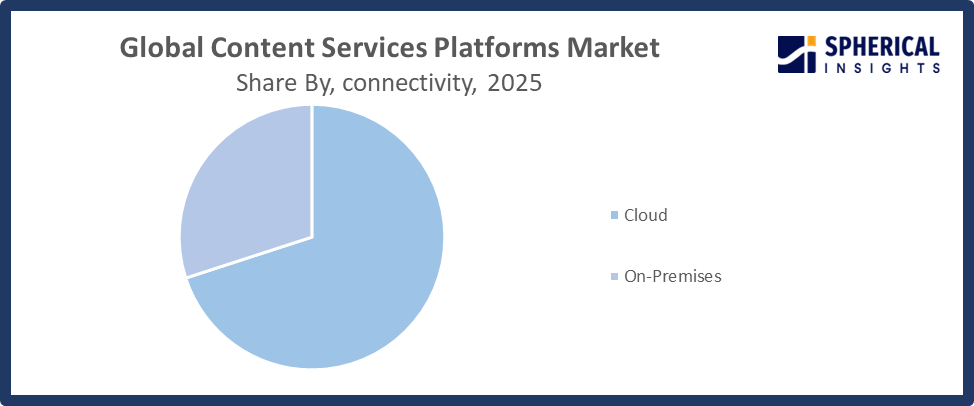
- The cloud segment accounted for the highest market revenue in 2025, approximately 70%, and is anticipated to grow at a significant CAGR during the forecast period.
Based on the deployment, the global content services platforms market is divided into cloud and on-premises. Among these, the cloud segment accounted for the highest market revenue in 2025, approximately 70%, and is anticipated to grow at a significant CAGR during the forecast period. This is because the cloud segment provides scalable and flexible solutions, reduces upfront infrastructure costs, enables remote access, simplifies maintenance, and supports seamless updates, making it an ideal choice for businesses seeking efficient, cost-effective, and easily manageable content services platforms.

Get more details on this report -
- The BFSI segment dominated the market in 2025, approximately 28%, and is projected to grow at a substantial CAGR during the forecast period.
Based on the end use, the global content services platforms market is divided into BFSI, government & public sector, IT & Telecommunication, healthcare, retail & consumer goods, and media & entertainment. Among these, the BFSI segment dominated the market in 2025, approximately 28%, and is projected to grow at a substantial CAGR during the forecast period. The dominance is driven by the need to manage large volumes of sensitive financial data securely and efficiently. Strict regulatory requirements, demand for compliance, and the necessity for streamlined document workflows encourage adoption. Additionally, increasing digital banking and customer interactions further boost the use of content services platforms in the BFSI sector.
Regional Segment Analysis of the Global Content Services Platforms Market
- North America (U.S., Canada, Mexico)
- Europe (Germany, France, U.K., Italy, Spain, Rest of Europe)
- Asia-Pacific (China, Japan, India, Rest of APAC)
- South America (Brazil and the Rest of South America)
- The Middle East and Africa (UAE, South Africa, Rest of MEA)
North America is anticipated to hold the largest share of the global content services platforms market over the predicted timeframe.

Get more details on this report -
North America is anticipated to hold the largest share of the global content services platforms market over the predicted timeframe, approximately 40% market share. The growth is driven by the strong presence of leading technology companies and the early adoption of advanced digital solutions across industries. High investment in cloud computing, AI, and data management supports market expansion. Additionally, strict regulatory requirements and the need for secure, compliant content handling encourage organizations to adopt content services platforms widely.
The Asia Pacific region is expected to grow at the fastest rate during the forecast period, with approximately 27% market share. The market growth is fueled by rapid digital transformation and increasing adoption of cloud-based technologies across developing economies. Expanding IT infrastructure, rising internet penetration, and growing enterprise demand for efficient content management drive adoption. Government initiatives promoting digitalization and smart technologies further accelerate market growth across sectors in the region.
Competitive Analysis:
The report offers the appropriate analysis of the key organizations/companies involved within the global content services platforms market, along with a comparative evaluation primarily based on their product offering, business overviews, geographic presence, enterprise strategies, segment market share, and SWOT analysis. The report also provides an elaborative analysis focusing on the current news and developments of the companies, which includes product development, innovations, joint ventures, partnerships, mergers & acquisitions, strategic alliances, and others. This allows for the evaluation of the overall competition within the market.
List of Key Companies
IBM Corporation
Microsoft Corporation
OpenText Corporation
Box Inc
Oracle Corporation
Hyland Software Inc
Laserfiche
Adobe Inc
M-Files Corporation
Newgen Software Technologies Limited
Fabasoft AG
Everteam Global Services
DocuWare GmbH
Alfresco Software Inc
Micro Focus International plc
Others
Key Target Audience
- Market Players
- Investors
- End-users
- Government Authorities
- Consulting and Research Firm
- Venture capitalists
- Value-Added Resellers (VARs)
Recent Development
- In November 2024, Box introduced AI-powered Intelligent Content Management innovations, including Box AI Studio and Box Apps, enabling enterprises to build custom workflows, metadata-driven processes, and advanced unstructured content management within its content services platform.
- In February 2024, Adobe introduced a generative AI Assistant (beta) in Acrobat and Reader, enabling conversational queries, document summaries, and intelligent navigation of PDFs and enterprise documents, enhancing Document Cloud capabilities and supporting advanced content services platform functionalities.
Market Segment
This study forecasts revenue at global, regional, and country levels from 2020 to 2035. Spherical Insights has segmented the global content services platforms market based on the below-mentioned segments:
Global Content Services Platforms Market, By Component
- Solutions
- Services
Global Content Services Platforms Market, By Deployment
- Cloud
- On-Premises
Global Content Services Platforms Market, By End Use
- BFSI
- Government & Public Sector
- IT & Telecommunication
- Healthcare
- Retail & Consumer Goods
- Media & Entertainment
Global Content Services Platforms Market, By Regional Analysis
- North America
- US
- Canada
- Mexico
- Europe
- Germany
- UK
- France
- Italy
- Spain
- Russia
- Rest of Europe
- Asia Pacific
- China
- Japan
- India
- South Korea
- Australia
- Rest of Asia Pacific
- South America
- Brazil
- Argentina
- Rest of South America
- Middle East & Africa
- UAE
- Saudi Arabia
- Qatar
- South Africa
- Rest of the Middle East & Africa
Frequently Asked Questions (FAQ)
-
1. What is a Content Services Platform (CSP)?A: CSP is a modern software solution that helps organizations manage the entire lifecycle of digital content, including creation, storage, sharing, and archiving, across multiple systems and users.
-
2. How do CSPs differ from traditional ECM systems?A: Unlike traditional enterprise content management (ECM), CSPs are more flexible, cloud-enabled, and support integration with multiple applications, offering better scalability and user experience.
-
3. Which industries benefit the most from CSP solutions?A: Industries such as banking, healthcare, government, and retail benefit significantly due to their need for secure document handling, compliance, and efficient information access.
-
4. What role does cloud technology play in CSP adoption?A: Cloud technology allows businesses to access content remotely, reduce infrastructure costs, and scale operations easily, making CSPs more accessible and efficient.
-
5. How does AI enhance content services platforms?A: AI improves content classification, automates document processing, enables smart search, and provides insights, helping organizations manage data more effectively.
-
6. What are the key challenges in implementing CSP solutions?A: Common challenges include integration with legacy systems, data migration complexity, user adoption issues, and ensuring data security and compliance.
-
7. What future trends are shaping the CSP market?A: The market is evolving with trends like AI-driven automation, low-code/no-code platforms, enhanced data governance, and increased focus on personalized content experiences.
Need help to buy this report?