Global Combat Aircraft Swarm Radars Market Size, Share, and COVID-19 Impact Analysis, By Radar Type (AESA (Active Electronically Scanned Array), PESA (Passive Electronically Scanned Array), Hybrid AESA-PESA, Phased Array with AI-Assisted Swarm Detection, and Others), By Application (Swarm Detection & Counter-UAS, Air-to-Air Target Tracking, Terrain Following & Obstacle Avoidance, Electronic Warfare Support, and Others), and By Region (North America, Europe, Asia-Pacific, Latin America, Middle East, and Africa), Analysis and Forecast 2025 - 2035
Industry: Aerospace & Defense
Global Combat Aircraft Swarm Radars Market Insights Forecasts to 2035
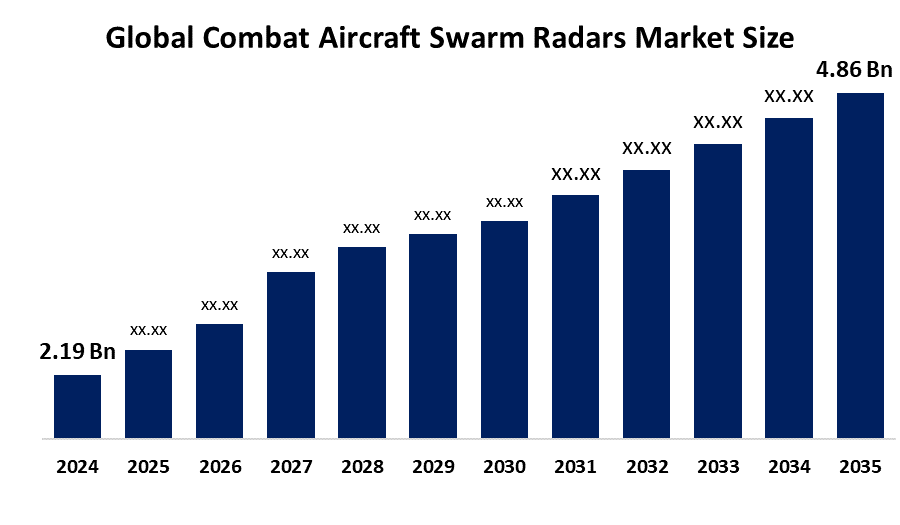
- The Global Combat Aircraft Swarm Radars Market Size Was Estimated at USD 2.19 Billion in 2024
- The Market Size is Expected to Grow at a CAGR of around 7.52% from 2025 to 2035
- The Worldwide Combat Aircraft Swarm Radars Market Size is Expected to Reach USD 4.86 Billion by 2035
- Asia Pacific is expected to grow the fastest during the forecast period.
Get more details on this report -
According to a research report published by Spherical Insights and Consulting, the global combat aircraft swarm radars market size was worth around USD 2.19 billion in 2024 and is predicted to grow to around USD 4.86 billion by 2035 with a compound annual growth rate CAGR of 7.52 from 2025 to 2035. The combat aircraft swarm radar market is growing rapidly, driven by the need to counter drone threats, rising geopolitical tensions, increased defense modernization, and the integration of AI-driven AESA technology for enhanced situational awareness and target detection
Combat Aircraft Swarm Radars Market Key Takeaways
- North America accounted for the largest market share in 2024.
- The Asia Pacific is expected to grow at the fastest CAGR during the forecast period.
- By radar type, the AESA segment held a dominant share of the market in 2024.
- By radar type, the PESA segment is expected to grow at the fastest CAGR in the market between 2024 and 2035.
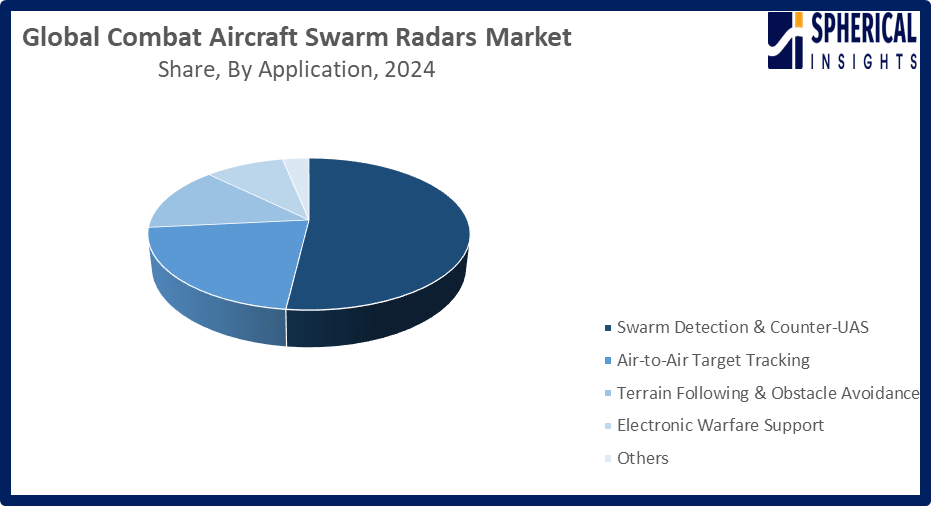
- By application, the swarm detection & counter-UAS segment accounted for a considerable revenue share in the market in 2024.
- By application, the air-to-air target tracking segment is expected to grow at the highest CAGR in the market during the studied years.
Market Overview
The global combat aircraft swarm radars market refers to advanced radar systems integrated into military aircraft to detect, track, and respond to large numbers of aerial threats, especially coordinated swarm attacks by drones or unmanned aerial systems, in complex combat environments. These radars use technologies like Active Electronically Scanned Arrays AESA and AI assisted signal processing for high resolution situational awareness, multi target tracking, and rapid decision making across air to air electronic warfare, and counter UAS missions.
In February 2026, the Defense Innovation Unit launched a rapid initiative for counter UAS sensing systems to detect small drones across U S. installations. The project mandates radar-based, multi sensor solutions capable of identifying low weight UAVs within 2 km, with demonstrations scheduled for spring 2026.
Primary market drivers are the proliferation of low cost drone swarms as asymmetric threats, rising defense budgets for next generation air dominance, rapid adoption of collaborative combat aircraft CCA programs, and the need for radars capable of handling hundreds of simultaneous targets with low false alarms. Opportunities lie in GaN-based AESA upgrades, AI/ML-enhanced swarm discrimination, export to allied nations, and integration with hypersonic/electronic warfare suites in Asia Pacific and Middle East modernization programs.
Combat Aircraft Swarm Radars Market Trends
- Increasing integration of AI and machine learning is enabling real-time multi-target tracking and faster threat response against drone swarms. These technologies significantly enhance detection accuracy and decision-making in complex combat environments.
- Growing adoption of AESA Active Electronically Scanned Array radars is improving range, resolution, and simultaneous tracking capabilities. This trend supports advanced swarm detection and electronic warfare resilience.
- Rising focus on counter UAS unmanned aerial system) capabilities is driving demand for swarm capable radar systems. Militaries are prioritizing solutions to address emerging drone swarm threats.
- Expansion of network-centric and sensor fusion technologies is enabling seamless data sharing across platforms. This enhances situational awareness and coordinated defense responses in modern warfare.
- Increasing defense modernization programs and budgets globally are accelerating procurement of next-generation radar systems. Governments are investing heavily in advanced surveillance technologies to maintain air superiority.
How is AI influencing the combat aircraft swarm radars market?
AI is revolutionizing the combat aircraft swarm radars market by enabling autonomous target discrimination, allowing systems to distinguish individual drones from complex swarms in real time. It enhances cognitive decision-making, reducing pilot workload through predictive threat analysis and coordinated countermeasure execution. Furthermore, AI facilitates adaptive beamforming and software defined reconfiguration, allowing radars to dynamically shift between surveillance, electronic warfare, and engagement modes without hardware changes.
Report Coverage
This research report categorizes the combat aircraft swarm radars market based on various segments and regions, forecasts revenue growth, and analyzes trends in each submarket. The report analyses the key growth drivers, opportunities, and challenges influencing the combat aircraft swarm radars market. Recent market developments and competitive strategies, such as expansion, type launch, development, partnership, merger, and acquisition, have been included to draw the competitive landscape in the market. The report strategically identifies and profiles the key market players and analyses their core competencies in each sub-segment of the combat aircraft swarm radars market.
Global Combat Aircraft Swarm Radars Market Report Coverage
| Report Coverage | Details |
|---|---|
| Base Year: | 2024 |
| Market Size in 2024: | USD 2.19 billion |
| Forecast Period: | 2025-2035 |
| Forecast Period CAGR 2025-2035 : | CAGR of 7.52% |
| 2035 Value Projection: | USD 4.86 billion |
| Historical Data for: | 2020-2023 |
| No. of Pages: | 248 |
| Tables, Charts & Figures: | 90 |
| Segments covered: | By Radar Type, By Application |
| Companies covered:: | RTX,Northrop,Leonardo,BAE,Anduril And Others Players |
| Pitfalls & Challenges: | COVID-19 Empact, Challenges, Future, Growth, & Analysis |
Get more details on this report -
Driving Factors
The market is supported by rising demand for advanced threat detection and tracking systems in modern warfare. The increasing use of drone swarms and unmanned aerial systems has created a strong need for radars capable of monitoring multiple fast-moving targets simultaneously. Defense modernization initiatives and rising military spending across major economies are accelerating the deployment of next-generation radar technologies. Innovations such as AESA radars, AI-based signal processing, and sensor fusion are enhancing detection accuracy and battlefield awareness. Furthermore, the shift toward network-centric warfare and integrated air defense systems is driving demand for advanced swarm radar solutions worldwide. In June 2025, Alpine Eagle unveiled the Sentinel system, the world’s first drone-based counter-UAS swarm solution. Featuring radar-equipped drones and interceptor capabilities, the system enhances detection and neutralization of hostile drones, redefining aerial defense and addressing evolving challenges in modern counter-drone operations.
Restraining Factors
The global combat aircraft swarm radars market faces constraints due to high development and deployment costs, challenges in integrating with legacy aircraft systems, and strict defense procurement procedures that cause delays. In addition, vulnerabilities to electronic warfare, maintenance complexities, and fluctuating defense budgets in developing economies are limiting the broader adoption of advanced swarm radar technologies.
Market Segmentation
Radar Type Insights
Why did the AESA segment lead the combat aircraft swarm radars market?
The AESA segment led the market while holding a major 44% in 2024, with an approximate share. AESA technology drives market growth due to its superior performance, offering faster scanning, higher resolution, and improved accuracy over traditional radars. Its electronically steered beams enable multi-target tracking and strong anti-jamming capabilities. Widely used in advanced fighter jets, AESA radars enhance real-time targeting, situational awareness, and defense, while seamlessly integrating with modern avionics systems.
The PESA segment is expected to show the fastest growth over the forecast period. PESA radars are widely adopted due to cost-effectiveness, simplicity, and adaptability. Cheaper than AESA, they offer reliable detection and tracking, easy maintenance, and retrofitting. Their affordability supports deployment in budget-constrained programs, driving adoption across developed and developing defense markets.
Application Insights
Why did the swarm detection & counter-UAS segment dominate the market?
The swarm detection & counter-UAS segment dominated the combat aircraft swarm radars market with the 52% share in 2024. Segment growth is driven by rising swarm tactics using multiple unmanned aerial systems that overwhelm defenses. Combat aircraft with advanced radars, especially AESA and hybrid AESA-PESA, enable real-time multi-target tracking, threat identification, and coordinated countermeasures. Increasing military drone usage and surveillance needs are boosting investments in radar solutions, while growing focus on electronic warfare and critical infrastructure protection further accelerates demand for swarm detection and counter-UAS capabilities.
The air-to-air target tracking segment is expected to witness the fastest growth in the market over the forecast period. Growth is driven by demand for precise aerial threat monitoring amid high-speed maneuvers. AI-enabled algorithms improve tracking accuracy and real-time threat prioritization. Modernization of fighter fleets, network-centric warfare, and missile integration support adoption, while emerging markets seek cost-effective, high-performance air-to-air tracking solutions.
Get more details on this report -
Regional Segment Analysis of the Combat Aircraft Swarm Radars Market
- North America (U.S., Canada, Mexico)
- Europe (Germany, France, U.K., Italy, Spain, Rest of Europe)
- Asia-Pacific (China, Japan, India, Rest of APAC)
- South America (Brazil and the Rest of South America)
- The Middle East and Africa (UAE, South Africa, Rest of MEA)
Why has North America dominated the combat aircraft swarm radars market?

Get more details on this report -
North America dominated the combat aircraft swarm radars market by holding the largest share of 38% in 2024. The region's dominance in the market is due to its high defense spending, accounting for over 35-40% of global military expenditure, and the strong presence of leading defense contractors. The U.S. invests in advanced radar technologies, AI integration, and counter-drone capabilities to address evolving aerial threats. Ongoing modernization programs, adoption of network-centric warfare, and continuous R&D funding further strengthen regional leadership in developing and deploying next-generation swarm radar systems. In January 2026, the Department of Homeland Security launched a new office for drone and counter-drone technologies, committing 115 million to enhance airspace security. The initiative focuses on protecting major events like America250 and the 2026 FIFA World Cup from evolving unmanned aerial threats.
U.S. Combat Aircraft Swarm Radars Market Trends
The U.S. combat aircraft swarm radars market is witnessing strong growth driven by rising investments in AI-enabled AESA radars, increasing focus on counter-drone capabilities, and ongoing fighter aircraft modernization programs. Expanding adoption of network-centric warfare, integration with electronic warfare systems, and continuous defense R&D funding are further accelerating advanced radar deployment across U.S. military platforms.
Why is Asia Pacific the fastest-growing region in the combat aircraft swarm radars market?
Asia Pacific is expected to experience the fastest growth during the predicted timeframe. The region in the combat aircraft swarm radars market is expected to grow owing to rising defence budgets, increasing geopolitical tensions, and rapid military modernization in countries like China, India, Japan, and South Korea. Growing deployment of drones and counter-UAS systems, along with investments in AI-enabled radar technologies and indigenous defense programs, is accelerating demand for advanced swarm radar solutions across the region. In December 2025, India’s Ministry of Defence advanced procurement of low-level lightweight radars and integrated surveillance systems. The initiative enhances air defense, strengthens multi-target tracking capabilities, and supports effective swarm detection, aligning with ongoing defense modernization efforts and improving national security infrastructure.
China Combat Aircraft Swarm Radars Market Trends
China’s combat aircraft swarm radars market is growing rapidly due to rising defense spending, expansion of indigenous fighter programs, and strong focus on counter-drone capabilities. Increasing adoption of AI-enabled AESA radars, integration with network-centric warfare systems, and continuous advancements in electronic warfare technologies are accelerating deployment across modern Chinese military aviation platforms.
How is the opportunistic rise of Europe in the combat aircraft swarm radars market?
Europe’s rise in the combat aircraft swarm radars market is driven by increasing defense collaboration, higher military budgets, and the urgent need to counter drone threats amid regional tensions. Programs supported by the European Defence Fund and joint fighter initiatives are accelerating the adoption of AI-enabled AESA radars, strengthening indigenous capabilities and boosting regional competitiveness. In October 2025, the European Defence Fund attracted a record 410 proposals for its €1.065 billion call, up 38% from 2024. Emphasis included next-generation military radars and sensors for air defence and counter-drone capabilities, while €336 million under the Defence Innovation Scheme supported SMEs and startups developing advanced defence technologies.
UK Combat Aircraft Swarm Radars Market Trends
The UK combat aircraft swarm radars market is growing steadily, driven by investments in advanced AESA radar programs like ECRS Mk2, increasing focus on counter-drone capabilities, and fighter jet modernization. Rising defense budgets, integration of AI-enabled radar systems, and participation in collaborative European defense initiatives are accelerating innovation and deployment across military aviation platforms. In December 2025, UK Defence Innovation invested over £142 million in drone and counter-drone systems, including £30 million for homeland protection. Supporting SMEs and academia, the initiative strengthens UK Armed Forces capabilities and accelerates innovation, addressing rising drone threats and enhancing NATO readiness.
Competitive Analysis:
The report offers the appropriate analysis of the key organizations/companies involved within the combat aircraft swarm radars market, along with a comparative evaluation primarily based on their type of offering, business overviews, geographic presence, enterprise strategies, segment market share, and SWOT analysis. The report also provides an elaborative analysis focusing on the current news and developments of the companies, which includes type development, innovations, joint ventures, partnerships, mergers & acquisitions, strategic alliances, and others. This allows for the evaluation of the overall competition within the market.
List of Key Companies
- RTX Corporation
- Lockheed Martin Corporation
- Northrop Grumman Corporation
- Leonardo S.p.A.
- BAE Systems
- Anduril Industries
- Elbit Systems Ltd.
- Israel Aerospace Industries Ltd.
- Thales Group
- Aselsan A.S.
- Saab AB
- General Atomics Aeronautical Systems
- Kratos Defense & Security Solutions
- Others
Key Target Audience
- Market Players
- Investors
- End-users
- Government Authorities
- Consulting and Research Firm
- Venture capitalists
- Value-Added Resellers (VARs)
Recent Development
- In February 2026, Raytheon secured a U.S. Air Force contract to equip the X-62A VISTA with its PhantomStrike radar. Compact, air-cooled, and GaN-based, the radar supports UAVs, light-attack, and rotary aircraft, integrating machine learning for autonomous operations, enhanced air superiority, and cost-effective advanced fire-control capabilities.
- In December 2025, Leonardo secured a contract with TELEDIFE to develop and deliver four next-generation radars for Italy’s Michelangelo Dome long-range ballistic defence system. Designed to counter threats up to 3,000 km, the project follows successful SAMP/T NG missile tests with Leonardo’s KRONOS Grand Mobile High-Power radar.
- In November 2025, ELTA Systems, part of Israel Aerospace Industries, unveiled its advanced Multi-Sensor MMR radar, evolving from the ELM-2084. The system integrates multiple sensors for precise detection, tracking, and classification of diverse threats, including low-flying drones, cruise missiles, and long-range ballistic projectiles, enhancing modern air and naval defense.
- In October 2025, Northrop Grumman enhanced F-16 capabilities by integrating IVEWS electronic warfare and SABR AESA radar. The systems operate seamlessly on the same spectrum, providing unmatched survivability, advanced targeting, and lethality, enabling pilots to safely conduct high-stakes missions in contested airspace.
- In October 2025, Israel Aerospace Industries unveiled its next-generation C-UAS Swarm system at AUSA 2025. Designed to detect, identify, disrupt, and intercept drone swarms, the system integrates AI-driven autonomous C4I technology, delivering real-time threat analysis and response, reflecting operational insights from ongoing conflict scenarios.
Market Segment
This study forecasts revenue at global, regional, and country levels from 2020 to 2035. Spherical Insights has segmented the combat aircraft swarm radars market based on the below-mentioned segments:
Global Combat Aircraft Swarm Radars Market, By Radar Type
- AESA (Active Electronically Scanned Array)
- PESA (Passive Electronically Scanned Array)
- Hybrid AESA-PESA
- Phased Array with AI-Assisted Swarm Detection
- Others
Global Combat Aircraft Swarm Radars Market, By Application
- Swarm Detection & Counter-UAS
- Air-to-Air Target Tracking
- Terrain Following & Obstacle Avoidance
- Electronic Warfare Support
- Others
Global Combat Aircraft Swarm Radars Market, By Regional Analysis
- North America
- US
- Canada
- Mexico
- Europe
- Germany
- UK
- France
- Italy
- Spain
- Russia
- Rest of Europe
- Asia Pacific
- China
- Japan
- India
- South Korea
- Australia
- Rest of Asia Pacific
- South America
- Brazil
- Argentina
- Rest of South America
- Middle East & Africa
- UAE
- Saudi Arabia
- Qatar
- South Africa
- Rest of the Middle East & Africa
Frequently Asked Questions (FAQ)
-
1. How is the increasing threat of drone swarms impacting demand for combat aircraft swarm radars globally?The increasing threat of drone swarms, evidenced by over 35 countries developing swarm capabilities and incidents like 273-drone attacks in a single operation, is driving demand for advanced swarm radars capable of tracking multiple targets simultaneously and countering saturation attacks effectively.
-
2. Which technological innovations are shaping the evolution of swarm radar systems in combat aircraft?Technological innovations shaping swarm radar systems include AI-driven target classification, sensor fusion, and AESA radars, enabling real-time tracking of thousands of targets; next-gen systems can process data at 64 gigasamples/second and track 10,000+ targets simultaneously.
-
3 What role does AESA radar technology play in advancing swarm detection capabilities?AESA radar technology enhances swarm detection by enabling simultaneous multi-target tracking, rapid beam steering, and high resistance to jamming, with modern systems capable of tracking over 1,000 targets at once and improving detection accuracy by 30-40%.
-
4. How are network-centric warfare strategies boosting the demand for advanced radar systems?Network-centric warfare strategies boost demand for advanced radars by enabling real-time data sharing across platforms, improving situational awareness by 40%+ and supporting multi-domain operations; defense digitization investments are rising at 6-8% annually globally.
-
5. What economic factors are supporting investment in next-generation swarm radar technologies?Rising global defense spending, exceeding USD 1.3 trillion among NATO countries in 2024, and increasing capital outlays (e.g., India’s 13% YoY growth in defense electronics) are supporting investments in next-generation swarm radar technologies, alongside modernization programs and geopolitical tensions.
-
6. How are collaborative combat aircraft (CCA) programs influencing market expansion?Collaborative Combat Aircraft (CCA) programs drive market expansion by integrating swarm-capable radars and AI-enabled coordination, with over 150 CCAs planned globally by 2030, boosting radar system demand for multi-aircraft networked operations.
-
7. What are the latest technological advancements in multi-target tracking and detection?Latest advancements in multi‑target tracking include AI‑enabled sensor fusion, predictive algorithms, and high‑resolution AESA radars, enabling systems to simultaneously track 10,000+ objects, improve detection accuracy by 30–50%, and reduce latency in complex environments.
Need help to buy this report?