Global Citrus Fiber Market Size, Share, By Form (Lemon and Lime, Orange, Mandarins, and Grapefruits), By Function (Thickening Agent, Stabilizer, Gelling Agent, Fat Replacement, and Others), By Application (Food and Beverage Industry, Pharmaceutical and Nutraceutical Industry, Personal Care and Cosmetics Industry, Animal Feed Industry, and Others), and By Region (North America, Europe, Asia-Pacific, Latin America, Middle East, and Africa), Analysis and Forecast 2026 - 2035.
Industry: Food & Beverages
Global Citrus Fiber Market Insights and Forecasts to 2035
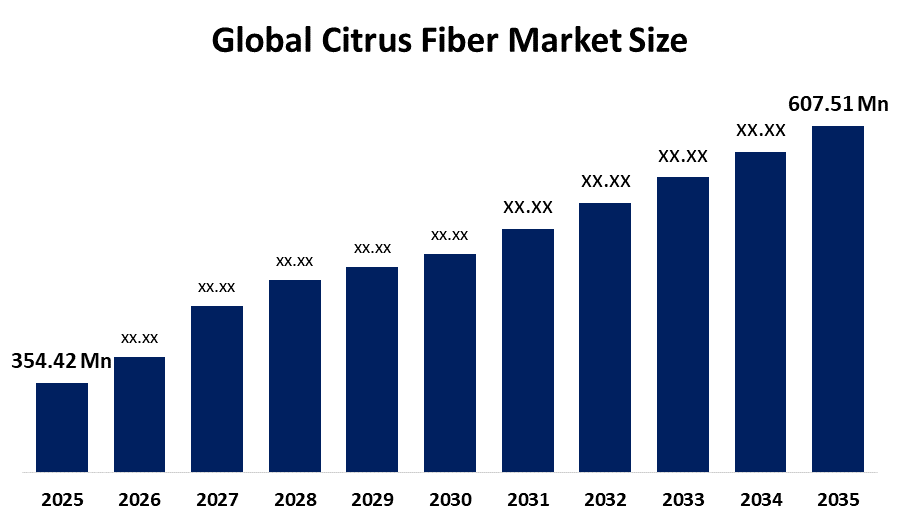
- The Global Citrus Fiber Market Size Was Estimated at USD 354.42 million in 2025
- The Market Size is Expected to Grow at a CAGR of around 5.54% from 2026 to 2035
- The Worldwide Citrus Fiber Market Size is Expected to Reach USD 607.51 million by 2035
- Asia Pacific is expected to grow the fastest during the forecast period.
Get more details on this report -
According to a research report published by Spherical Insights, the global citrus fiber market size was worth around USD 354.42 million in 2025 and is predicted to grow to around USD 607.51 million by 2035 with a compound annual growth rate (CAGR) of 5.54% from 2026 to 2035. The global citrus fiber market is driven by rising demand for clean-label ingredients, growing health awareness, increasing adoption in plant-based foods, multifunctional properties, and expanding applications in food, beverages, nutraceuticals, and personal care industries.
Market Overview
The global citrus fiber market refers to the production and use of natural dietary fiber extracted from citrus fruit peels such as orange, lemon, and lime, which food and beverage industry and personal care product manufacturers use for its functional and health benefits. The market experiences growth because consumers demand clean-label plant-based ingredients while they become more aware of their digestive health needs. In April 2024, CP Kelco USA completed a USD 60 million expansion of its citrus fiber production capacity for its NUTRAVA and KELCOSENS citrus fiber lines at its Matão, Brazil, facility to meet strong customer demand and market growth. The investment supports the global citrus fiber market by increasing capacity for sustainably sourced, upcycled citrus peel fiber used in food, beverage, and personal care applications. Government initiatives that support sustainable food processing and waste reduction activities enable the utilization of citrus by-products. The main development in the market involves increasing use of vegan and gluten-free products, which contain functional food ingredients. The product quality and performance improvements result from advanced technological developments, which include better drying, milling, and enzymatic extraction methods. Nutraceuticals, cosmetics, and new markets now provide increasing business opportunities because customers prefer natural, sustainable, multifunctional materials that can be used in different industrial sectors.
Report Coverage
This research report categorizes the global citrus fiber market based on various segments and regions, forecasts revenue growth, and analyzes trends in each submarket. The report analyses the key growth drivers, opportunities, and challenges influencing the global citrus fiber market. Recent market developments and competitive strategies, such as expansion, product launch, development, partnership, merger, and acquisition, have been included to draw the competitive landscape in the market. The report strategically identifies and profiles the key market players and analyzes their core competencies in each sub-segment of the citrus fiber market.
Global Citrus Fiber Market Report Coverage
| Report Coverage | Details |
|---|---|
| Base Year: | 2025 |
| Market Size in 2025: | USD 354.42 Million |
| Forecast Period: | 2026 – 2035 |
| Forecast Period CAGR 2026 – 2035 : | CAGR of 5.54% |
| 026 – 2035 Value Projection: | USD 607.51 Million |
| Historical Data for: | 2020-2024 |
| No. of Pages: | 240 |
| Tables, Charts & Figures: | 95 |
| Segments covered: | By Form By Function |
| Companies covered:: | CP Kelco Inc., Cargill Inc., Fiberstar Inc., Ingredion Incorporated, Tate & Lyle PLC, DuPont de Nemours Inc., Archer Daniels Midland Company, Kerry Group plc, Florida Food Products LLC, Herbafood Ingredients GmbH, Golden Health Group Limited, Naturex S.A., CEAMSA, Lemont, Lucid Colloids Ltd., and Others. |
| Pitfalls & Challenges: | COVID-19 Empact, Challenge, Future, Growth, & Analysis |
Get more details on this report -
Driving Factors
The global demand for citrus fiber products has increased because consumers prefer natural ingredients that have transparent product labels. The demand for products has increased because people now recognize the health benefits of maintaining good digestive health through proper dietary fiber consumption. The market continues to grow because plant-based and vegan products have increased their demand for citrus fiber, which acts as a sustainable replacement for synthetic food additives. The product becomes essential for production processes because its various functions enable companies to achieve water-binding, emulsification, and texture enhancement. The market experiences rapid expansion because personal care and nutraceuticals increase their usage of sustainable and upcycled ingredients that come from citrus waste
Restraining Factors
The global citrus fiber market faces restraints because its advanced extraction techniques require expensive production and processing costs. Developing regions lack awareness of the product, and the availability of inexpensive synthetic fibers and alternative fibers will impede its adoption. The raw material supply to the business varies because it relies on seasonal citrus production. Businesses face difficulty because they need to achieve consistent quality and functionality throughout their food and industrial applications.
Market Segmentation
The global citrus fiber market share is classified into form, function, and application.
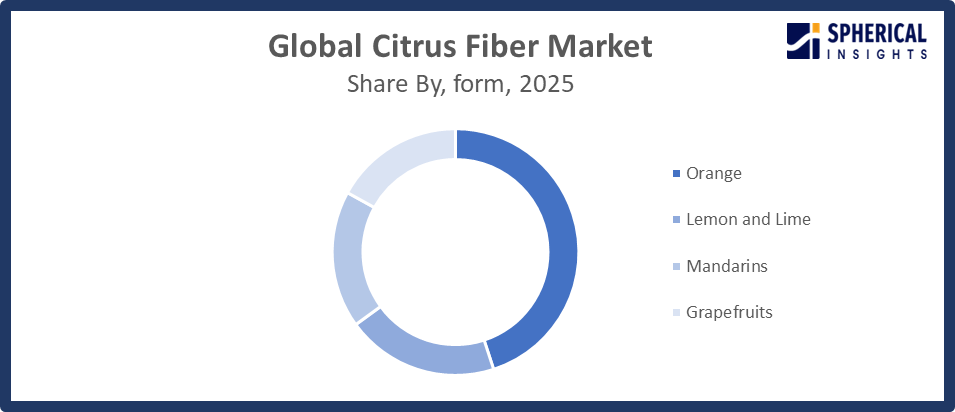
- The orange segment accounted for the largest share in 2025, approximately 45%, and is anticipated to grow at a significant CAGR during the forecast period.
Based on the form, the global citrus fiber market is divided into lemon and lime, orange, mandarins, and grapefruits. Among these, the orange segment accounted for the largest share in 2025, approximately 45%, and is anticipated to grow at a significant CAGR during the forecast period. This is because of its abundant availability, cost-effective extraction, and widespread use in food and beverage applications due to its superior functional properties, such as water-binding, texture enhancement, and clean-label appeal.
Get more details on this report -
- The thickening agent segment accounted for the highest market revenue in 2025, approximately 38%, and is anticipated to grow at a significant CAGR during the forecast period.
Based on the function, the global citrus fiber market is divided into thickening agent, stabilizer, gelling agent, fat replacement, and others. Among these, the thickening agent segment accounted for the highest market revenue in 2025, approximately 38%, and is anticipated to grow at a significant CAGR during the forecast period. This is because citrus fiber naturally enhances viscosity, texture, and stability in a wide range of food and beverage products. Its multifunctional properties allow it to act as a natural alternative to synthetic additives, supporting clean-label formulations and meeting growing consumer demand for healthier, plant-based, and sustainable ingredients.
- The food and beverage industry segment dominated the market in 2025, approximately 60%, and is projected to grow at a substantial CAGR during the forecast period.
Based on the application, the global citrus fiber market is divided into the food and beverage industry, pharmaceutical and nutraceutical industry, personal care and cosmetics industry, animal feed industry, and others. Among these, the food and beverage industry segment dominated the market in 2025, approximately 60%, and is projected to grow at a substantial CAGR during the forecast period. The dominance is driven by rising demand for clean-label, plant-based ingredients, the multifunctional properties of citrus fiber in improving texture, stability, and mouthfeel, and its increasing use in bakery, dairy, beverages, and processed food products to meet consumer preference for healthier, natural alternatives.
Regional Segment Analysis of the Global Citrus Fiber Market
- North America (U.S., Canada, Mexico)
- Europe (Germany, France, U.K., Italy, Spain, Rest of Europe)
- Asia-Pacific (China, Japan, India, Rest of APAC)
- South America (Brazil and the Rest of South America)
- The Middle East and Africa (UAE, South Africa, Rest of MEA)
Get more details on this report -
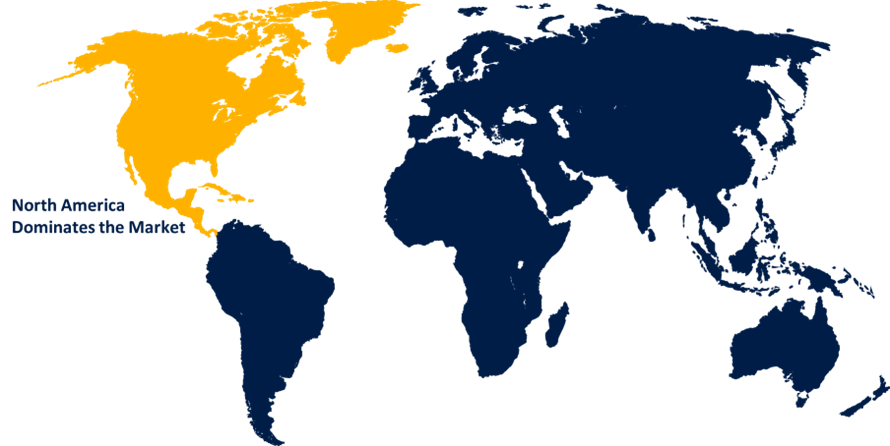
North America is anticipated to hold the largest share of the global citrus fiber market over the predicted timeframe.
North America is anticipated to hold the largest share of the global Citrus Fiber market over the predicted timeframe, approximately 38% market share. The growth is driven by strong demand for clean-label and functional ingredients, advanced food processing technologies, high consumer health awareness, and widespread adoption across food, beverage, and nutraceutical applications. Established infrastructure and premium product pricing further support market dominance, making the region the largest revenue contributor globally during the forecast period.
The Asia Pacific region is expected to grow at the fastest rate during the forecast period, approximately 20% market share. The market growth is fueled by rapid urbanization, rising disposable incomes, increasing health consciousness, expanding food and beverage industries, and growing demand for natural, plant-based, multifunctional ingredients. Abundant citrus production and increasing adoption of clean-label formulations make it the fastest-growing market in terms of volume and growth potential.
Competitive Analysis:
The report offers the appropriate analysis of the key organizations/companies involved within the global citrus fiber market, along with a comparative evaluation primarily based on their product offering, business overviews, geographic presence, enterprise strategies, segment market share, and SWOT analysis. The report also provides an elaborative analysis focusing on the current news and developments of the companies, which includes product development, innovations, joint ventures, partnerships, mergers & acquisitions, strategic alliances, and others. This allows for the evaluation of the overall competition within the market.
List of Key Companies
- CP Kelco Inc.
- Cargill Inc.
- Fiberstar Inc.
- Ingredion Incorporated
- Tate & Lyle PLC
- DuPont de Nemours Inc.
- Archer Daniels Midland Company
- Kerry Group plc
- Florida Food Products LLC
- Herbafood Ingredients GmbH
- Golden Health Group Limited
- Naturex S.A.
- CEAMSA
- Lemont
- Lucid Colloids Ltd.
- Others
Key Target Audience
- Market Players
- Investors
- End-users
- Government Authorities
- Consulting and Research Firm
- Venture capitalists
- Value-Added Resellers (VARs)
Recent Development
- In January 2026, CEAMSA expanded its citrus fiber solutions by acquiring the citrus fiber line and intellectual property from the Dutch firm PeelPioneers, strengthening its CEAMFIBRE range and broadening its upcycled natural fiber offerings for food and industrial applications
- In July 2024, Ingredion USA announced the expansion of its FIBERTEX CF 500 and FIBERTEX CF 100 multi-benefit citrus fiber ingredients, which provide enhanced texture, viscosity, and clean-label claims for food and beverage applications.
- In February 2024, the No. 1 Central Document was issued, emphasizing agricultural modernization, green development, and value addition through rural industrialization. It promotes sustainable practices and the utilization of agricultural by-products, supporting initiatives such as converting citrus waste into value-added ingredients like citrus fiber, in alignment with global trends in upcycling and sustainable food processing.
Market Segment
This study forecasts revenue at global, regional, and country levels from 2020 to 2035. Spherical Insights has segmented the global citrus fiber market based on the below-mentioned segments:
Global Citrus Fiber Market, By Form
- Lemon and Lime
- Orange
- Mandarins
- Grapefruits
Global Citrus Fiber Market, By Function
- Thickening Agent
- Stabilizer
- Gelling Agent
- Fat Replacement
- Others
Global Citrus Fiber Market, By Application
- Food and Beverage Industry
- Pharmaceutical and Nutraceutical Industry
- Personal Care and Cosmetics Industry
- Animal Feed Industry
- Others
Global Citrus Fiber Market, By Regional Analysis
- North America
- US
- Canada
- Mexico
- Europe
- Germany
- UK
- France
- Italy
- Spain
- Russia
- Rest of Europe
- Asia Pacific
- China
- Japan
- India
- South Korea
- Australia
- Rest of Asia Pacific
- South America
- Brazil
- Argentina
- Rest of South America
- Middle East & Africa
- UAE
- Saudi Arabia
- Qatar
- South Africa
- Rest of the Middle East & Africa
Frequently Asked Questions (FAQ)
-
1. What is citrus fiber and how is it made?A: Citrus fiber is a natural dietary fiber extracted from the peels and by‑products of citrus fruits. It is typically produced through processes like washing, drying, milling, and sometimes enzymatic treatment to yield a functional ingredient for food and beverage formulations.
-
2. What are the primary benefits of using citrus fiber in food products?A: Citrus fiber improves water holding capacity, texture, mouthfeel, and stability, while also supporting clean‑label claims and contributing to dietary fiber content, making it desirable in processed foods.
-
3. Which industries use citrus fiber the most?A: The food and beverage sector is the largest user, especially in bakery, dairy, meat analogues, beverages, and sauces. It is also increasingly used in nutraceuticals, animal feed, and personal care products.
-
4. How does citrus fiber support clean‑label trends?A: Citrus fiber is plant‑based, recognizable to consumers, and replaces synthetic additives, helping manufacturers meet clean‑label and natural ingredient demands.
-
5. Are there regulatory approvals for citrus fiber as a dietary ingredient?A: In many markets, including the U.S. and EU, citrus fiber is recognized as a dietary fiber and qualifies for labeling as a natural ingredient when meeting specific regulatory criteria.
-
6. What challenges affect the citrus fiber market?A: Challenges include seasonal variability in raw material supply, high processing costs, competition from other plant fibers, and maintaining consistent quality across batches.
-
7. What future applications could drive citrus fiber demand?A: Emerging opportunities include use in functional beverages, plant‑based meat alternatives, high‑fiber snacks, dietary supplements, and sustainable packaging materials due to its fibrous structure.
Need help to buy this report?