Global Chlorine Market Size, Share, By Form (Liquid and Gas), By Application (EDC/PVC, Organic Chemicals, Inorganic Chemicals, Isocyanates, Chlorinated Intermediates, Propylene Oxide, Pulp & Paper, C1/C2, Aromatics & Water Treatment), By End User Industry (Water Treatment, Pharmaceutical, Chemicals, Paper and Pulp, Plastic, Pesticides, and Others), and By Region (North America, Europe, Asia-Pacific, Latin America, Middle East, and Africa), Analysis and Forecast 2025 - 2035
Industry: Chemicals & Materials
Global Chlorine Market Insights Forecasts to 2035
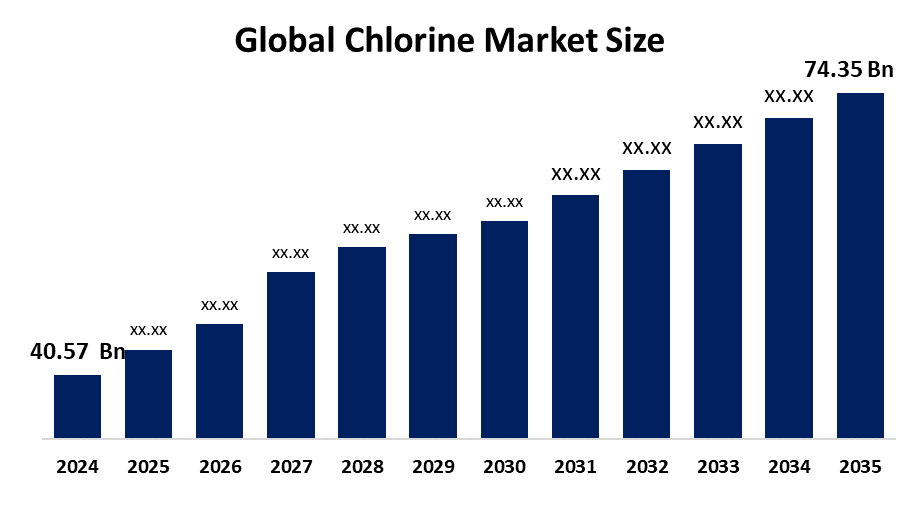
- The Global Chlorine Market Size Was Estimated at USD 40.57 billion in 2024
- The Market Size is Expected to Grow at a CAGR of around 5.66% from 2025 to 2035
- The Worldwide Chlorine Market Size is Expected to Reach USD 74.35 billion by 2035
- Europe is expected to grow the fastest during the forecast period.
Get more details on this report -
According to a research report published by Spherical Insights, the global chlorine market size was worth around USD 40.57 billion in 2024 and is predicted to grow to around USD 74.35 billion by 2035 with a compound annual growth rate (CAGR) of 5.66% from 2025 to 2035. The global chlorine market is driven by rising demand for disinfectants, expanding industrial chemical production, growing food processing requirements, and increased focus on safe water supply in emerging economies.
Market Overview
The chlorine market refers to the global industry that produces and sells chlorine and its derivatives, which serve purposes in water treatment, PVC and chemical manufacturing, pharmaceuticals, and sanitation. The market expands because people require safe drinking water while infrastructure development proceeds, and companies implement polyvinyl chloride and healthcare chemical products. Governments support water and wastewater system upgrades while they create quality standards that permit chlorine use for disinfection and sanitation purposes. Regulatory agencies require companies to adopt environmentally
Report Coverage
This research report categorizes the global chlorine market based on various segments and regions, forecasts revenue growth, and analyzes trends in each submarket. The report analyses the key growth drivers opportunities, and challenges influencing the global chlorine market. Recent market developments and competitive strategies, such as expansion, product launch, development, partnership, merger, and acquisition, have been included to draw the competitive landscape in the market. The report strategically identifies and profiles the key market players and analyzes their core competencies in each sub segment of the chlorine market.
Global Chlorine Market Report Coverage
| Report Coverage | Details |
|---|---|
| Base Year: | 2024 |
| Market Size in 2024: | USD 40.57 billion |
| Forecast Period: | 2025-2035 |
| Forecast Period CAGR 2025-2035 : | CAGR of 5.66% |
| 2035 Value Projection: | USD 74.35 billion |
| Historical Data for: | 2020-2023 |
| No. of Pages: | 240 |
| Tables, Charts & Figures: | 90 |
| Segments covered: | By Form,By End User |
| Companies covered:: | Olin, Dow,Occidental,BASF ,Solvay And Others Players |
| Pitfalls & Challenges: | COVID-19 Empact, Challenges, Future, Growth, & Analysis |
Get more details on this report -
Driving Factors
The chlorine market is increasing because people need safe drinking water and various industries need chlorine for making PVC products and chemical materials. The rising demand in developing countries for urban infrastructure and industrial facilities drives increased consumption of products. The healthcare and sanitation sectors drive demand through their need for disinfectants and pharmaceutical products. The development of energy efficient production methods through technological progress leads to better supply management and reduced production expenses. The market expansion occurs because government programs improve water treatment facilities, and people become more conscious about maintaining hygienic conditions and protecting water resources.
Restraining Factors
The chlorine market faces restraints from environmental concerns and strict regulations because of its hazardous nature. The companys financial performance suffers because of expensive production costs and manufacturing procedures that require excessive energy consumption. Market growth is also challenged by the availability of alternative disinfectants and chemicals. Safety risks and storage problems and fluctuations in raw material costs create additional limitations on business growth in particular areas.
Market Segmentation
The global chlorine market share is classified into form, application, and end user.
- The liquid segment accounted for the largest share in 2024, approximately 60%, and is anticipated to grow at a significant CAGR during the forecast period.
Based on the form, the global chlorine market is divided into liquid and gas. Among these, the liquid segment accounted for the largest share in 2024, approximately and is anticipated to grow at a significant CAGR during the forecast period. This is because liquid chlorine is easier to store, transport, and handle, making it safer for use across applications. It is widely used in water treatment, sanitation, and various industrial processes, offering greater convenience and efficiency compared to gaseous chlorine.
- The EDC/PVC segment accounted for the highest market revenue in 2024, approximately 40%, and is anticipated to grow at a significant CAGR during the forecast period.
Based on the application, the global chlorine market is divided into organic chemicals, inorganic chemicals, isocyanates, chlorinated intermediates, propylene oxide, pulp & paper, , aromatics & water treatment. Among these, the segment accounted for the highest market revenue in 2024, approximately and is anticipated to grow at a significant CAGR during the forecast period. This is because chlorine is a key raw material in ethylene dichloride EDC and polyvinyl chloride PVC production, which are extensively used in construction, piping systems, electrical cables, and various infrastructure applications, driving strong and consistent demand.
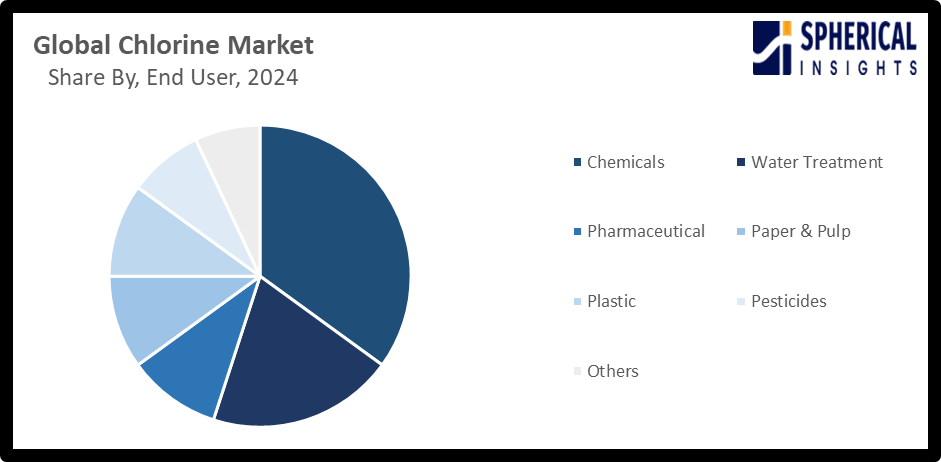
- The chemicals segment dominated the market in 2024, approximately 35%, and is projected to grow at a substantial CAGR during the forecast period.
Based on the end user, the global chlorine market is divided into water treatment, pharmaceutical, chemicals, paper and pulp, plastic, pesticides, and others. Among these, the chemicals segment dominated the market in 2024, approximately and is projected to grow at a substantial CAGR during the forecast period. The market dominance is due to the extensive use of chlorine as a key raw material in producing a wide range of industrial chemicals and intermediates, including solvents, plastics, and specialty compounds, supporting diverse applications across manufacturing, construction, and chemical processing industries.
Get more details on this report -
Regional Segment Analysis of the Global Chlorine Market
- North America U.S., Canada, Mexico
- Europe Germany, France, U.K., Italy, Spain, Rest of Europe
- Asia-Pacific China, Japan, India, Rest of APAC
- South America Brazil and the Rest of South America
- The Middle East and Africa UAE, South Africa, Rest of MEA
Asia Pacific is anticipated to hold the largest share of the global chlorine market over the predicted timeframe.

Get more details on this report -
Asia Pacific is anticipated to hold the largest share of the global chlorine market over the predicted timeframe, approximately market share. This growth is driven by rapid urbanization, large scale infrastructure projects, and a growing manufacturing sector in countries like China and India. Strong demand for polyvinyl chloride PVC in construction, coupled with rising needs for water treatment chemicals, further fuels chlorine consumption, establishing the region as the largest market globally.
The Europe region is expected to grow at the fastest rate during the forecast period, driven by investments in advanced water treatment infrastructure, adoption of energy efficient and environmentally friendly production technologies, and rising demand for high-purity chlorine in pharmaceuticals and specialty chemical applications.
Competitive Analysis:
The report offers the appropriate analysis of the key organizations/companies involved within the global chlorine market, along with a comparative evaluation primarily based on their product offering, business overviews, geographic presence, enterprise strategies, segment market share, and SWOT analysis. The report also provides an elaborative analysis focusing on the current news and developments of the companies, which includes product development, innovations, joint ventures, partnerships, mergers & acquisitions, strategic alliances, and others. This allows for the evaluation of the overall competition within the market.
List of Key Companies
- Olin
- Dow
- Occidental
- BASF
- INEOS
- Formosa
- Solvay
- Tosoh
- Hanwha
- Westlake
- Ercros
- Tata
- Covestro
- Gujarat
- Vynova
- Others
Key Target Audience
- Market Players
- Investors
- End-users
- Government Authorities
- Consulting and Research Firm
- Venture capitalists
- Value-Added Resellers (VARs)
Recent Development
In June 2025 , INEOS Inovyn launched an Ultra Low Carbon product range , including chlorine that can reduce CO emissions by up to compared with typical industry levels through the use of renewable energy.
In March 2023 Occidental Petroleum Corps chemical division OxyChem as it strengthens supply efficiency and sustainability at a major US chlorine production site
Market Segment
This study forecasts revenue at global, regional, and country levels from 2020 to 2035. Spherical Insights has segmented the global kidney transplant market based on the below-mentioned segments:
Global Chlorine Market, By Form
- Liquid
- Gas
Global Chlorine Market, By Application
- EDC/PVC
- Organic Chemicals
- Inorganic Chemicals
- Isocyanates
- Chlorinated Intermediates
- Propylene Oxide
- Pulp & Paper
- C1/C2
- Aromatics & Water Treatment
Global Chlorine Market, By End User
- Water Treatment
- Pharmaceutical
- Chemicals
- Paper and Pulp
- Plastic
- Pesticides
- Others
Global Chlorine Market, By Regional Analysis
- North America
- US
- Canada
- Mexico
- Europe
- Germany
- UK
- France
- Italy
- Spain
- Russia
- Rest of Europe
- Asia Pacific
- China
- Japan
- India
- South Korea
- Australia
- Rest of Asia Pacific
- South America
- Brazil
- Argentina
- Rest of South America
- Middle East & Africa
- UAE
- Saudi Arabia
- Qatar
- South Africa
- Rest of the Middle East & Africa
Frequently Asked Questions (FAQ)
-
What are the main drivers of chlorine demand globally?Growing industrial applications, water treatment needs, pharmaceutical production, and increasing sanitation requirements drive global chlorine demand.
-
Which industries use the most chlorine?Key industries include PVC and plastics manufacturing, chemical intermediates, water treatment, pharmaceuticals, and pulp & paper.
-
What are the environmental concerns associated with chlorine production?Chlorine production can generate hazardous by-products, high energy consumption, and potential risks to water and air quality if not properly managed.
-
How is chlorine being produced more sustainably?Energy-efficient electrolyzers, membrane cell technology, and renewable energy integration are reducing emissions and energy use in modern chlorine production.
-
. What are the challenges in transporting and storing chlorine?Chlorine is highly reactive and toxic; handling requires specialized containers, strict safety protocols, and regulatory compliance to prevent leaks and accidents.
-
. What technological trends are shaping the chlorine market?Innovations include smart chemical dosing in water treatment, process automation in chlor-alkali plants, low-carbon production methods, and advanced monitoring for safety and efficiency.
Need help to buy this report?