China Virtual Reality Market Size, Share, By Component (Hardware, Software, and Content), By Device Type (Head Mounted Display, VR Simulator, VR Glasses, Treadmills and Haptic Gloves, and Others), By Industry (Gaming, Entertainment, Automotive, Retail, Healthcare, Education, Aerospace and Defence, Manufacturing, and Others), and China Virtual Reality Market Insights, Industry Trend, Forecasts to 2035.
Industry: Electronics, ICT & Media
China Virtual Reality Market Insights Forecasts to 2035
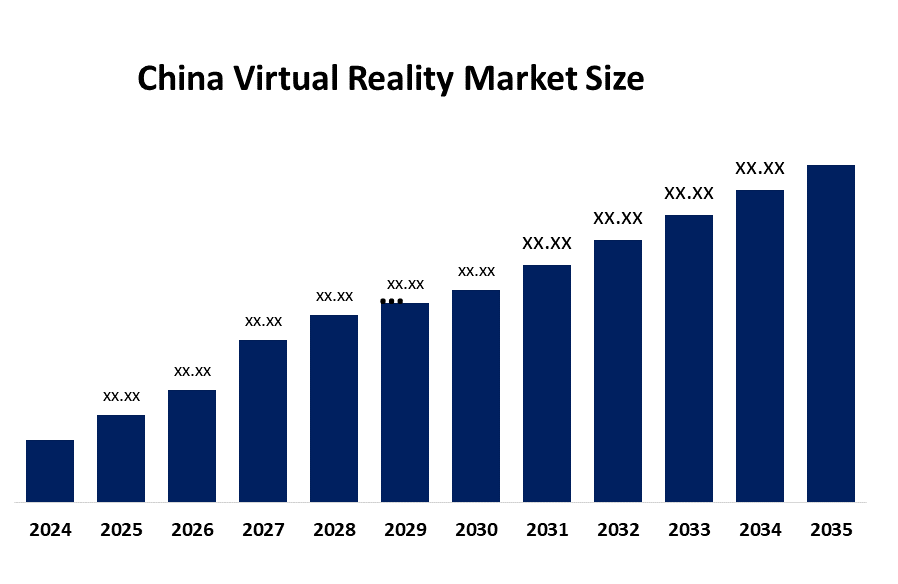
- China Virtual Reality Market CAGR: 31.4%
- China Virtual Reality Market Segments: Component, Type, and Industry
Get more details on this report -
The virtual reality market in China is made up of hardware, software, and content solutions that leverage gadgets like head-mounted displays, VR simulators, and haptic equipment to create realistic, computer-generated experiences for users. The market serves multiple industries, including gaming, entertainment, education, healthcare, manufacturing, automotive, and aerospace & defense, where immersive visualization, training, and simulation enhance user experience and operational efficiency.
The Chinese government actively supports the development of virtual reality through policies such as the “Virtual Reality and Industry Application Integration Development Action Plan” and broader digital economy and new-generation information technology initiatives. These initiatives promote the use of VR in smart manufacturing, healthcare, education, and industrial training. Domestic VR technology development and commercialization are being accelerated by financial incentives, R&D funding, and support for innovation parks and pilot projects.
China's VR ecosystem is changing due to technological advancements in high-resolution displays, sophisticated motion tracking, AI-driven interaction, 5G connectivity, and cloud-based VR platforms. User comfort and accessibility are rising thanks to advancements in lightweight headsets, reduced latency, improved realism, and improved content development tools. China's competitiveness in the global VR market is being strengthened by these developments, which are increasing VR adoption across consumer and business applications.
Market Dynamics of the China Virtual Reality Market:
The growing use of virtual reality in gaming, entertainment, education, healthcare, manufacturing, and training applications is propelling the market's rapid expansion in China. With China's sizable customer base, growing desire for immersive experiences, and ongoing advancements in VR gear like head-mounted displays, the gaming and entertainment sectors continue to be important development drivers. By allowing low-latency and high-quality immersive content, government support for digital technologies, smart education, and industrial simulation, coupled with the deployment of 5G networks, is further pushing the adoption of virtual reality.
The market is constrained by several factors, notwithstanding these factors. Widespread consumer adoption of advanced VR systems and peripherals is hampered by their high initial costs, especially in price-sensitive markets. Growth is also hampered by technical issues like motion sickness, the scarcity of content in specialized applications, and the requirement for high-performance computing infrastructure. Adoption in some industries may also be slowed by worries about content control and data protection.
China virtual reality market has significant opportunities for growth when VR is combined with cutting-edge technology like augmented reality, artificial intelligence, and the metaverse. New revenue streams are anticipated when VR is used more widely in industrial design, healthcare training, education, and virtual tourism. Long-term market development is also anticipated to be fueled by growing corporate use and the worldwide expansion of Chinese VR makers.
China Virtual Reality Market Report Coverage
| Report Coverage | Details |
|---|---|
| Base Year: | 2024 |
| Forecast Period: | 2025-2035 |
| Forecast Period CAGR 2025-2035 : | CAGR of 31.4 % |
| Historical Data for: | 2020-2023 |
| No. of Pages: | 210 |
| Tables, Charts & Figures: | 95 |
| Segments covered: | By Component, By Device Type |
| Companies covered:: | ByteDance, Tencent Holdings Ltd, Huawei Technologies Co., Ltd., Pimax Innovation Inc., DPVR, Goertek Group, Baofeng Mojing, ANTVR, Others, and Key Players. |
| Pitfalls & Challenges: | COVID-19 Empact, Challenge, Future, Growth, & Analysis |
Get more details on this report -
Market Segmentation
The China virtual reality market share is classified into component, type, and industry.
By Component:
On the basis of components, the China virtual reality market is categorized into hardware, software, and content. Among these, the hardware segment held the largest market share in 2024 and is predicted to grow at a remarkable rate during the forecast period. Due to the high demand for VR headsets, sensors, and display devices across gaming, entertainment, education, and business applications, the hardware segment leads the Chinese virtual reality market.
By Type:
Based on type, the China virtual reality market is divided into head-mounted display, VR simulator, VR glasses, treadmills, haptic gloves, and others. Among these, the head-mounted display segment accounted for the largest market share in 2024 and is expected to grow at a significant rate of CAGR during the projected period. This dominance is driven by extensive use in gaming, entertainment, education, and business applications as well as ongoing improvements in motion-tracking and display resolution technologies.
By Industry:
The China virtual reality market is classified by industry into gaming, entertainment, automotive, retail, healthcare, education, aerospace and defence, manufacturing, and others. Among these, the gaming segment dominated the market share in 2024 and is anticipated to grow at a remarkable CAGR during the forecast period. Dominance is influenced by a strong desire for engaging and interactive gaming experiences and the nation's sizable gaming population. Adoption has been further driven by ongoing improvements in VR gear, high-caliber content creation, and growing investments from game firms.
Competitive Analysis:
The report offers the appropriate analysis of the key organisations/companies involved within the China virtual reality market, along with a comparative evaluation primarily based on their product offering, business overviews, geographic presence, enterprise strategies, segment market share, and SWOT analysis. The report also provides an elaborative analysis focusing on the current news and developments of the companies, which includes product development, innovations, joint ventures, partnerships, mergers & acquisitions, strategic alliances, and others. This allows for the evaluation of the overall competition within the market.
Top Key Companies in the China Virtual Reality Market:
- ByteDance
- Tencent Holdings Ltd
- Huawei Technologies Co., Ltd.
- Pimax Innovation Inc.
- DPVR
- Goertek Group
- Baofeng Mojing
- ANTVR
- Others
Key Target Audience
- Market Players
- Investors
- End-users
- Government Authorities
- Consulting and Research Firm
- Venture capitalists
- Value-Added Resellers (VARs)
Market Segment
This study forecasts revenue at the China, regional, and country levels from 2020 to 2035. Spherical Insights has segmented the China virtual reality market based on the following segments:
China Virtual Reality Market, By Component
- Hardware
- Software
- Content
China Virtual Reality Market, By Type
- Head-Mounted Display
- VR Simulator
- VR Glasses
- Treadmills and Haptic Gloves
- Others
China Virtual Reality Market, By Industry
- Gaming, Entertainment
- Automotive
- Retail
- Healthcare
- Education
- Aerospace and Defence
- Manufacturing
- Others
Frequently Asked Questions (FAQ)
-
1.What is the China virtual reality market?The China virtual reality market comprises hardware, software, and content solutions that create immersive, computer-generated environments using devices such as head-mounted displays, VR simulators, and haptic equipment. It serves industries including gaming, entertainment, education, healthcare, manufacturing, automotive, and aerospace & defense.
-
2.What is the expected growth rate of the China virtual reality market?The market is expected to grow at a strong CAGR of 31.4% during the forecast period 2025–2035, driven by rapid technological advancements and expanding application areas.
-
3.What are the key drivers of China virtual reality market growth?Major drivers include rising adoption of VR in gaming and entertainment, government support for digital technologies, expanding use in education and industrial training, and the rollout of 5G networks enabling high-quality immersive experiences.
Need help to buy this report?