China Smart Home Market Size, Share, By Product Type (Security & Access Controls, Entertainment Devices, HVAC), By Connectivity Technology (Wi-Fi, Bluetooth, Zigbee), By Installation Type (New Construction, Retrofit), By Distribution Channel (Online, Offline, Specialty Stores), By End Use Industry (Residential, Commercial), China Smart Home Market Insights, Industry Trend, Forecasts to 2035.
Industry: Information & Technology
China Smart Home Market Size Insights Forecasts to 2035
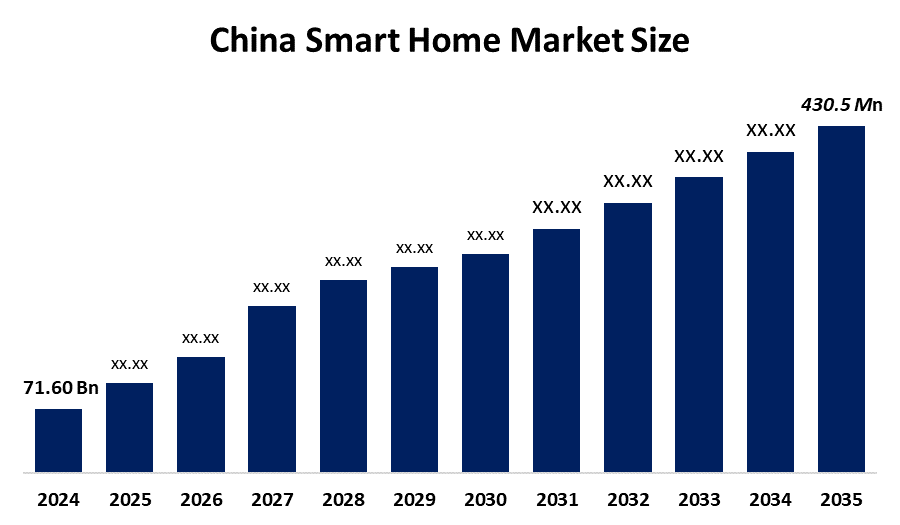
- China Smart Home Market Size 2024: USD 71.60 Billion
- China Smart Home Market Size 2035: USD 430.5 Billion
- China Smart Home Market CAGR 2024: 17.71%
- China Smart Home Market Segments: Product Type, Connectivity Technology, Installation Type, Distribution Channel, and End Use Industry.
Get more details on this report -
The China Smart Home Market Size includes multiple devices that work together through IoT and AI technologies to enable remote home monitoring, energy control, security management and appliance operation. Smart home solutions integrate devices such as smart speakers, lighting systems, security cameras, smart appliances, and home hubs to create a connected living environment. Government initiatives in China that support digital infrastructure development, smart city projects and green building standards development are driving the growth of smart home technology adoption. The establishment of policies that support energy efficiency and IoT technology implementation will lead to faster development of connected home systems.
The market is driven by increasing consumer demand for convenience, home security, and energy-efficient living solutions, along with rising smartphone penetration and widespread internet connectivity. The growth in middle-class households, together with rapid urbanization has led to increased adoption of smart home devices throughout China. The development of AI-powered voice assistants, together with cloud-based automation systems and advanced sensor technologies, and better interoperability standards, has improved device capabilities while creating a better user experience which leads to continuous growth of the smart home ecosystem.
Market Dynamics of the China Smart Home Market:
The driving forces behind this market include urban areas, the increase in people's income levels, people wanting both security and convenience, and large-scale smart city development projects that are underway. The Chinese government offers support through the 14th Five-Year Plan and digital economy strategy, which functions as a vital force for current initiatives. Home automation, together with energy management solutions achieve fast development through technological advancements in AI-powered voice control, 5G-enabled devices, Matter interoperability standard, and cloud-based platforms.
The challenges faced by the market include data privacy issues and cybersecurity threats, together with incomplete brand interoperability and expensive upfront expenses. Technical issues, consumer awareness gaps, and standardization hurdles are other drawbacks.
China's smart home market shows positive growth potential through its applications in precise living spaces, elderly assistance, energy-efficient building design and integrated smart city systems. The growth of IoT deployments, together with venture capital funding and supportive regulatory frameworks for digital infrastructure have led to this situation.
China Smart Home Market Report Coverage
| Report Coverage | Details |
|---|---|
| Base Year: | 2024 |
| Market Size in 2024: | USD 71.60 Billion |
| Forecast Period: | 2025-2035 |
| Forecast Period CAGR 2025-2035 : | 17.71% |
| 2035 Value Projection: | USD 430.5 Billion |
| Historical Data for: | 2020-2023 |
| No. of Pages: | 220 |
| Tables, Charts & Figures: | 110 |
| Segments covered: | By Installation Type, By Distribution |
| Companies covered:: | Xiaomi Corporation, Huawei Technologies Co., Ltd., Haier Smart Home Co., Ltd., Alibaba Group Holding Limited, Tencent Holdings Limited, Midea Group, Hikvision Digital Technology Co., Ltd., TP-Link Technologies Co., Ltd., Tuya Smart, Samsung Electronics Co., Ltd., LG Electronics, Lenovo Group Limited, Schneider Electric, Honeywell International Inc., ABB Ltd., Siemens AG |
| Pitfalls & Challenges: | COVID-19 Empact, Challenge, Future, Growth, & Analysis |
Get more details on this report -
Market Segmentation
The China smart home market share is classified into product type, connectivity technology, installation type, distribution channel, and end-use industry.
By Product Type:
The China Smart Home Market Size is divided by product type into security & access controls, entertainment devices, and HVAC. Among these, the security & access controls segment dominated the share in 2024 and is anticipated to grow at a remarkable CAGR during the forecast period. Security & access controls lead the way mainly because of surging demand for home safety amid urbanization, seamless AI and camera integration, strong consumer preference in high-density cities, and regulatory support for smart city initiatives in China. Thus, it is naturally the choice for residential safety and commercial security applications nationwide.
By Connectivity Technology:
The China Smart Home Market Size is divided by connectivity technology into Wi-Fi, Bluetooth, and Zigbee. Among these, the Wi-Fi segment dominated in 2024 and is anticipated to grow at a remarkable CAGR during the forecast period. Wi-Fi offers the most benefits because it provides high-speed, stable connections for multiple devices across large homes, thus drastically reducing latency in real-time control. Consequently, user experience is improved, and on top of that, Wi-Fi technology is thus the preferred solution in urban households and smart apartments in China, where it is used the most.
By Installation Type:
The China Smart Home Market Size is divided by installation type into new construction and retrofit. Among these, the retrofit segment dominated in 2024 and is anticipated to grow at a remarkable CAGR during the forecast period. The main factors driving this include the vast stock of existing homes needing upgrades, cost-effective retrofitting solutions, compatibility with legacy infrastructure as well as the number of urban renewal projects that utilize smart home technology platforms to modernize buildings at a much faster pace.
By Distribution Channel:
TheChina Smart Home Market Size is divided by distribution channel into online, offline, and speciality stores. Among these, the online segment dominated the share in 2024 and is anticipated to grow at a remarkable CAGR during the forecast period. By leveraging e-commerce platforms, companies can reach millions of consumers instantly, offer competitive pricing, provide detailed product comparisons, and accelerate delivery. Hence, platforms in China can reduce time-to-market and expand smart home penetration across tier-2 and tier-3 cities rapidly.
By End Use Industry:
TheChina Smart Home Market Size is divided by end use industry into residential and commercial. Among these, the residential segment dominated the share in 2024 and is anticipated to grow at a remarkable CAGR during the forecast period. The reason this segment has come out on top is that rising middle-class incomes, focus on family convenience, personal safety, and energy savings in private homes have all fueled the need for advanced smart home technologies across urban and suburban China.
Competitive Analysis:
The report offers the appropriate analysis of the key organisations/companies involved within the China smart home market, along with a comparative evaluation primarily based on their product offering, business overviews, geographic presence, enterprise strategies, segment market share, and SWOT analysis. The report also provides an elaborative analysis focusing on the current news and developments of the companies, which includes product development, innovations, joint ventures, partnerships, mergers & acquisitions, strategic alliances, and others. This allows for the evaluation of the overall competition within the market.
Top Key Companies in China Smart Home Market:
- Xiaomi Corporation
- Huawei Technologies Co., Ltd.
- Haier Smart Home Co., Ltd.
- Alibaba Group Holding Limited
- Tencent Holdings Limited
- Midea Group
- Hikvision Digital Technology Co., Ltd.
- TP-Link Technologies Co., Ltd.
- Tuya Smart
- Samsung Electronics Co., Ltd.
- LG Electronics
- Lenovo Group Limited
- Schneider Electric
- Honeywell International Inc.
- ABB Ltd.
- Siemens AG
Recent Developments in China Smart Home Market:
In October 2025, Xiaomi Corporation launched its first smart home appliance factory in Wuhan, China, aimed at producing AI-enabled smart air conditioners and expanding its smart home ecosystem manufacturing capabilities.
In June 2025, Xiaomi launched a new lineup of AI-powered smart home appliances including smart air conditioners, refrigerators, and washing machines to strengthen its AIoT smart home ecosystem.
Key Target Audience
- Market Players
- Investors
- End-users
- Government Authorities
- Consulting and Research Firm
- Venture capitalists
- Value-Added Resellers (VARs)
Market Segment
This study forecasts revenue at the China, regional, and country levels from 2020 to 2035.Spherical Insights has segmented the China smart home market based on the below-mentioned segments:
China Smart Home Market, By Product Type
- Security & Access Controls
- Entertainment Devices
- HVAC
China Smart Home Market, By Connectivity Technology
- Wi-Fi
- Bluetooth
- Zigbee
China Smart Home Market, By Installation Type
- New Construction
- Retrofit
China Smart Home Market, By Distribution Channel
- Online
- Offline
- Specialty Stores
China Smart Home Market, By End Use Industry
- Residential
- Commercial
Frequently Asked Questions (FAQ)
-
1. What is the projected size of the China smart home market by 2035?The China smart home market is projected to grow from USD 71.60 billion in 2024 to USD 430.5 billion by 2035, registering a CAGR of 17.71% during the forecast period 2025–2035. The rapid expansion is driven by the growing adoption of IoT-enabled devices, increasing urbanization, and strong government initiatives supporting digital infrastructure and smart city development.
-
2. What are the key factors driving the China smart home market?The market is primarily driven by rising consumer demand for convenience, enhanced home security, and energy-efficient living solutions. Increasing smartphone penetration, rapid urbanization, and the expansion of middle-class households in China are also encouraging the adoption of smart home devices. Additionally, government policies promoting smart cities and digital transformation are accelerating market growth.
-
3. Which product segment dominates the China smart home market?The security & access controls segment dominates the China Smart Home Market. This growth is attributed to increasing demand for home safety solutions, widespread adoption of AI-enabled surveillance systems, and the integration of smart cameras and access control technologies within urban residential environments.
-
4. What connectivity technology is most widely used in China’s smart home market?Wi-Fi is the most widely used connectivity technology in the China Smart Home Market. It provides high-speed connectivity, supports multiple devices simultaneously, and enables seamless integration with smartphones, cloud platforms, and IoT ecosystems, making it the preferred choice for smart home applications.
-
5. Which installation type holds the largest share in the China smart home market?The retrofit segment holds the largest share in the market. The dominance of this segment is due to the large number of existing residential buildings in China that are being upgraded with smart home technologies, along with cost-effective retrofit solutions and urban renovation projects.
-
6. Which distribution channel leads the China smart home market?The online distribution channel dominates the China Smart Home Market. The rapid growth of e-commerce platforms, digital payment systems, and efficient logistics networks enables consumers to easily purchase smart home products, compare prices, and access a wider range of devices.
-
7. Which end-use industry accounts for the largest market share?The residential segment accounts for the largest share of the China Smart Home Market. Rising disposable income, increasing home ownership, and consumer interest in automated living environments are encouraging the adoption of smart home solutions across households.
-
8. What challenges affect the growth of the China smart home market?The market faces challenges such as data privacy concerns, cybersecurity risks, lack of interoperability among different device brands, high initial installation costs, and limited consumer awareness regarding advanced smart home technologies.
-
9. Who are the major companies operating in the China smart home market?Key companies operating in the China Smart Home Market include Xiaomi Corporation, Huawei Technologies Co., Ltd., Haier Smart Home Co., Ltd., Alibaba Group Holding Limited, Tencent Holdings Limited, Midea Group, Hikvision Digital Technology Co., Ltd., TP-Link Technologies Co., Ltd., Tuya Smart, Samsung Electronics Co., Ltd., LG Electronics, Lenovo Group Limited, Schneider Electric, Honeywell International Inc., ABB Ltd., and Siemens AG.
-
10. What are the future opportunities in the China smart home market?Future opportunities in the market include the integration of AI and IoT technologies in home automation, development of energy-efficient smart homes, elderly assistance systems, and the expansion of smart city projects. Continuous technological innovation and government support for digital infrastructure are expected to create strong growth opportunities for smart home solutions in China.
Need help to buy this report?