China Optical Character Recognition Market Size, Share, By Type (Software, desktop-based OCR, mobile-based OCR, Private, Public, Services, Consulting, Outsourcing, and Others), By Vertical (Retail, BFSI, Government, Education, Transport and Logistics, Healthcare, IT and Telecom, and Manufacturing), and China Optical Character Recognition Market Insights, Industry Trend, Forecasts to 2035
Industry: Information & Technology
China Optical Character Recognition Market Insights Forecasts to 2035
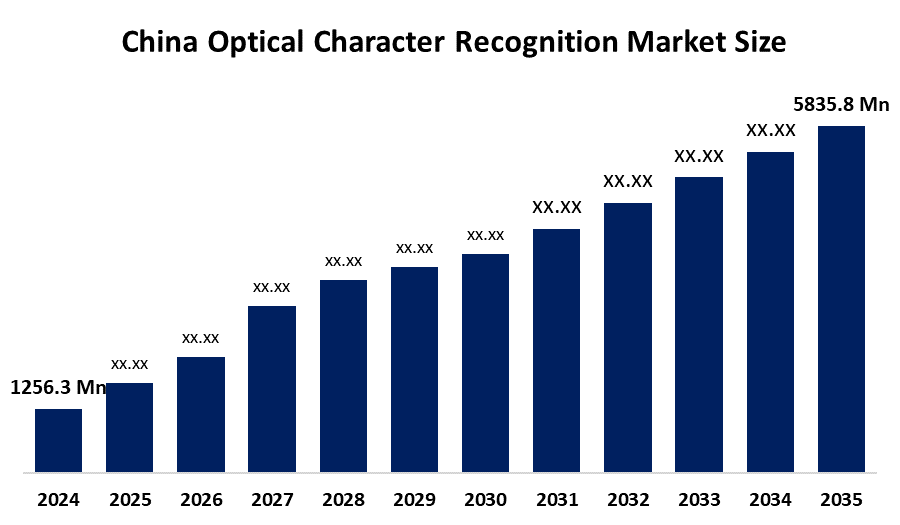
- China Optical Character Recognition Market Size 2024: USD 1256.3 Mn
- China Optical Character Recognition Market Size 2035: USD 5835.8 Mn
- China Optical Character Recognition Market CAGR: 14.98%
- China Optical Character Recognition Market Segments: Type and Vertical
Get more details on this report -
The technology and solutions that transform printed or handwritten text into machine-readable digital data, making it simpler to edit, store, search, and analyze documents like invoices, forms, books, and licenses, are referred to as the China Optical Character Recognition OCR market. In sectors like banking, shipping, government, and healthcare, OCR is essential to document digitization and automation. It helps businesses decrease human labor and boost productivity. The strong demand for automatic text extraction solutions was reflected in the substantial revenue generated by the China OCR market in 2024, with software holding the greatest share of the market value.
OCR usage is increasing in China thanks to government programs focused on smart infrastructure and digital transformation. Public organizations are encouraged to digitize records and services through national initiatives like digital government and more general digitization objectives in the 14th Five Year Plan, where OCR plays a crucial enabling role by transforming enormous archives of paper documents into searchable digital formats. The need for OCR technology in public sector workflows is further increased by investments in e-government and industrial digitalization.
Chinas OCR scene is rapidly changing due to technological advancements. Innovative advancements include deep learning and AI-driven models that enable multilingual and handwritten text, integrate with wider AI ecosystems for semantic understanding, and significantly increase recognition accuracy for complicated scripts and difficult situations. While advancements in model designs and hardware capture technologies continue to increase OCR performance and applications, domestic companies, such as those improving OCR into cloud and edge devices, are pushing innovation customized to local use cases.
Market Dynamics of the China Optical Character Recognition Market:
The fast digital transformation of Chinas public and private sectors is the main factor propelling the countrys optical character recognition OCR market. To digitize massive amounts of paper-based documents and automate data extraction procedures, businesses in banking, government, logistics, healthcare, and retail are progressively implementing OCR solutions. The integration of artificial intelligence and machine learning has significantly improved OCR accuracy for complex Chinese characters, multilingual text, and real-time image recognition. Additionally, businesses are being encouraged to switch from manual data entry to automated OCR-based workflows due to growing labor costs and the need to increase operational efficiency.
The market has a number of obstacles that could prevent adoption despite its promising growth prospects. Low quality scans, handwritten documents, and non-standard fonts are common problems for OCR systems, which can lower recognition accuracy and necessitate manual verification. For many organizations, the intricacy of integrating OCR solutions with current legacy IT infrastructure presents additional difficulties. Adoption in extremely sensitive industries like government and finance may also be hampered by worries about data security, privacy, and regulatory compliance, especially when utilizing cloud based OCR platforms.
The growth of cloud-based and mobile OCR solutions, which offer scalable and affordable deployment options, is driving the market's substantial opportunities. OCR technology is finding new applications as a result of increased investments in smart cities, digital government programs, intelligent transportation systems, and education digitization. Over the course of the projection period, it is anticipated that ongoing developments in AI powered recognition and rising need for real time data processing will further open up growth prospects in the China OCR market.
China Optical Character Recognition Market Report Coverage
| Report Coverage | Details |
|---|---|
| Base Year: | 2024 |
| Market Size in 2024: | USD 5835.8 Million |
| Forecast Period: | 2025-2035 |
| Forecast Period CAGR 2025-2035 : | CAGR of 14.98% |
| 2035 Value Projection: | USD 5835.8 Million |
| Historical Data for: | 2020-2023 |
| No. of Pages: | 210 |
| Tables, Charts & Figures: | 90 |
| Segments covered: | By Type, By Vertical |
| Companies covered:: | Baidu,Alibaba Group,Tencent,iFLYTEK,Hanwang,SenseTime,Megvii,SuperMap,Pax Technology And Others Players |
| Pitfalls & Challenges: | COVID-19 Empact, Challenge, Future, Growth, & Analysis |
Get more details on this report -
Market Segmentation
The China optical character recognition market share is classified into type and vertical.
By Type:
Based on type, the China optical character recognition market is divided into software, desktop based OCR, mobile-based OCR, private, public, services, consulting, outsourcing, and others. Among these, the software segment accounted for the largest market share in 2024 and is expected to grow at a significant rate of CAGR during the projected period. This segment leads due to widespread enterprise use, simple interaction with cloud and AI platforms, and high accuracy made possible by deep-learning-based OCR. Growth is further fueled by its affordability, scalability, and robust demand from banking, e-commerce, and government digitalization projects.
By Vertical:
The China optical character recognition market is classified by vertical into retail, BFSI, government, education, transport and logistics, healthcare, it and telecom, and manufacturing. Among these, the BFSI segment dominated the market share in 2024 and is anticipated to grow at a remarkable CAGR during the forecast period. This dominance is influenced by widespread usage of OCR technologies in document-intensive processes like loan processing, claims management, client onboarding, KYC verification, and transaction record digitization.
Competitive Analysis:
The report offers the appropriate analysis of the key organisations/companies involved within the China optical character recognition market, along with a comparative evaluation primarily based on their product offering, business overviews, geographic presence, enterprise strategies, segment market share, and SWOT analysis. The report also provides an elaborative analysis focusing on the current news and developments of the companies, which includes product development, innovations, joint ventures, partnerships, mergers & acquisitions, strategic alliances, and others. This allows for the evaluation of the overall competition within the market.
Top Key Companies in the China Optical Character Recognition Market:
- Baidu
- Alibaba Group
- Tencent
- iFLYTEK
- Hanwang
- SenseTime
- Megvii
- SuperMap
- Pax Technology
- Others
Key Target Audience
- Market Players
- Investors
- End users
- Government Authorities
- Consulting and Research Firm
- Venture capitalists
- Value-Added Resellers (VARs)
Market Segment
This study forecasts revenue at the China, regional, and country levels from 2020 to 2035. Spherical Insights has segmented the China optical character recognition market based on the following segments:
China Optical Character Recognition Market, By Type
- Software
- Desktop-Based OCR
- Mobile-Based OCR
- Private
- Public
- Services
- Consulting
- Outsourcing,
- Others
China Optical Character Recognition Market, By Vertical
- Retail
- BFSI
- Government
- Education
- Transport and Logistics
- Healthcare
- IT and Telecom
- Manufacturing
Frequently Asked Questions (FAQ)
-
1. What is the market size and growth outlook of the China OCR market?The China OCR market was valued at USD 1,256.3 million in 2024 and is projected to reach USD 5,835.8 million by 2035. The market is expected to grow at a strong CAGR of 14.98% during the forecast period from 2025 to 2035, driven by rapid digital transformation and AI adoption.
-
2. Which factors are driving the growth of the China OCR market?Key growth drivers include increasing demand for document automation, rising labor costs, and widespread adoption of AI and machine learning technologies. Government-led digitalization initiatives, such as digital government programs and smart infrastructure development, are also significantly boosting OCR adoption across public and private sectors.
-
3. How do government initiatives impact the China OCR market?Government initiatives such as the “14th Five-Year Plan” and digital government programs encourage the digitization of public records and services. These initiatives significantly increase OCR adoption by enabling large-scale conversion of paper-based documents into searchable digital formats
-
4.What technological advancements are shaping the China OCR market?Advancements in deep learning, AI-driven OCR models, and semantic text recognition have greatly improved accuracy for complex Chinese characters, handwritten text, and multilingual content. The integration of OCR with cloud and edge computing is further expanding its applications and improving performance.
Need help to buy this report?