China Luxury Car Market Size, Share, and COVID-19 Impact Analysis, By Vehicle Type (Hatchback, Sedan, and SUV), By Drive Type (IC Engine and Electric Vehicles), and China Luxury Car Market Insights, Industry Trend, Forecasts to 2033
Industry: Automotive & Transportation
China Luxury Car Market Insights Forecasts to 2033
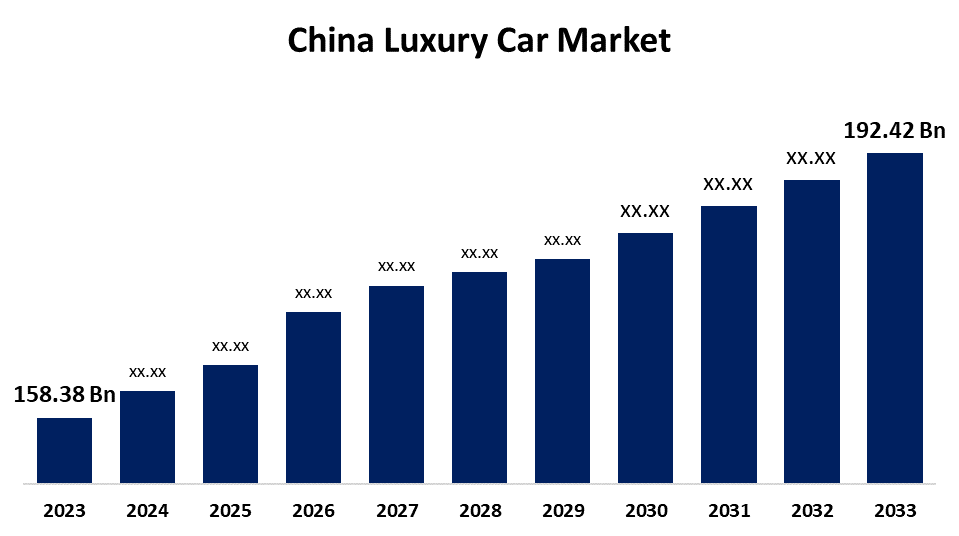
- The China Luxury Car Market Size was valued at USD 158.38 Billion in 2023.
- The Market Size is Growing at a CAGR of 1.97% from 2023 to 2033
- The China Luxury Car Market Size is Expected to Reach USD 192.42 Billion by 2033
Get more details on this report -
The China Luxury Car Market Size is Anticipated to Reach USD 192.42 Billion by 2033, Growing at a CAGR of 1.97% from 2023 to 2033
Market Overview
A luxury car is a broad category of contemporary vehicles that stress the comfort of the driver and passengers through plush interiors, increased functionality, and state-of-the-art safety measures. These cars are more technologically advanced and convenient than moderately priced traditional automobiles. A luxury car has better aesthetics, is more configurable, and has features like sensors, cameras, anti-lock brakes, Bluetooth or wireless fidelity (Wi-Fi) entertainment systems. Using the provision of a rear-view mirror and security alerts, these devices improve overall vehicle performance and lower the chance of collisions. The China luxury car market is being driven by the increasing availability of tangible luxurious features within cars, as well as the changing preference of customers for branded autonomous luxury vehicles over traditional modes of transportation. Increased discretionary income and consumer awareness of the advantages of luxury cars such as safety, prestige, resale value, the ability to combine comfort and beauty, and the capacity to add customized flair are more factors driving the China luxury car market.
Report Coverage
This research report categorizes the market for China luxury car market based on various segments and regions forecasts revenue growth and analyzes trends in each submarket. The report analyses the key growth drivers, opportunities, and challenges influencing the China luxury car market. Recent market developments and competitive strategies such as expansion, product launch, and development, partnership, merger, and acquisition have been included to draw the competitive landscape in the market. The report strategically identifies and profiles the key market players and analyses their core competencies in each sub-segment of the China luxury car market.
China Luxury Car Market Report Coverage
| Report Coverage | Details |
|---|---|
| Base Year: | 2023 |
| Market Size in 2023: | USD 158.38 Billion |
| Forecast Period: | 2023-2033 |
| Forecast Period CAGR 2023-2033 : | 1.97% |
| 2033 Value Projection: | USD 192.42 Billion |
| Historical Data for: | 2019-2022 |
| No. of Pages: | 162 |
| Tables, Charts & Figures: | 100 |
| Segments covered: | By Vehicle Type, By Drive Type |
| Companies covered:: | Daimler AG, Zhejiang Geely Holding Group, Geely Holding Group, Dongfeng Motor Company, SAIC Motor Corp. Ltd, BMW AG, Volkswagen Group, General Motor Company, Acura (Honda Motor Co. Ltd), and Others. |
| Pitfalls & Challenges: | Covid-19 Empact, Challenges, Growth, Analysis. |
Get more details on this report -
Driving Factors
The market in China is primarily driven by the growing availability of tangible luxurious qualities within cars and the changing preference of consumers for branded autonomous luxury vehicles over traditional forms of transportation. The primary factor driving the market growth is the increasing demand for improved security systems and a comfortable driving experience to guarantee the maximum safety of passengers. The increasing integration of machine learning (ML) and artificial intelligence (AI) solutions with entertainment, self-driving security, and seat massagers is driving the growth of the China luxury car market. The increasing sales of automobiles, particularly cars, have increased, which has ultimately driven the growth of China luxury car market.
Restraining Factors
The cost of producing cars with luxurious features and extras is far more than the cost of producing cars properly. Luxury cars are not particularly popular, and a significant portion of their selling price goes toward funding their development, which drives up the cost of these vehicles. As a result, it is anticipated that the high price of luxury cars will restrict market growth.
Market Segmentation
The China luxury car market share is classified into vehicle type and drive type.
- The SUV segment is expected to hold a significant market share through the forecast period.
The China luxury car market is segmented by vehicle type into hatchback, sedans, and SUV. Among these, the SUV segment is expected to hold a significant market share through the forecast period. The SUV includes more space, a smoother ride, and higher ground clearance. The growing trend of SUV purchases is driving market growth.
- The electric vehicles segment is expected to dominate the China luxury car market during the forecast period.
Based on the drive type, the China luxury car market is divided into IC engines and electric vehicles. Among these, the electric vehicles segment is expected to dominate the China luxury car market during the forecast period. Considering the rising demand for electric vehicles, the market has a lot of unused potential. Premium automakers reported robust sales growth, driven by an increase in young people's demand for expensive electric vehicles.
Competitive Analysis:
The report offers the appropriate analysis of the key organizations/companies involved within the China luxury car market along with a comparative evaluation primarily based on their product offering, business overviews, geographic presence, enterprise strategies, segment market share, and SWOT analysis. The report also provides an elaborative analysis focusing on the current news and developments of the companies, which includes product development, innovations, joint ventures, partnerships, mergers & acquisitions, strategic alliances, and others. This allows for the evaluation of the overall competition within the market.
List of Key Companies
- Daimler AG
- Zhejiang Geely Holding Group
- Geely Holding Group
- Dongfeng Motor Company
- SAIC Motor Corp. Ltd
- BMW AG
- Volkswagen Group
- General Motor Company
- Acura (Honda Motor Co. Ltd)
- Others
Key Target Audience
- Market Players
- Investors
- End-users
- Government Authorities
- Consulting And Research Firm
- Venture capitalists
- Value-Added Resellers (VARs)
Recent Developments
- In May 2024, China's SAIC Motor Corp. Ltd. and Volkswagen AG's Audi collaborated to develop three new all-electric vehicles and a new car platform for the Chinese market. The three BEV models would target the rapidly expanding electric car market in China by covering the B and C categories. It is anticipated that these models will be launched in 2025.
Market Segment
This study forecasts revenue at China, regional, and country levels from 2020 to 2033. Spherical Insights has segmented the China luxury car market based on the below-mentioned segments:
China Luxury Car Market, By Vehicle Type
- Hatchback
- Sedan
- SUV
China Luxury Car Market, By Drive Type
- IC Engine
- Electric Vehicles
Frequently Asked Questions (FAQ)
-
1. What is the current size of the China luxury car market?The China luxury car market was valued at USD 199.8 billion in 2024, making it one of the largest luxury automotive markets globally. The market is driven by increasing demand for premium SUVs, electric luxury vehicles, and executive sedans across major metropolitan areas. Rising disposable income, rapid urbanization, and growing interest in technologically advanced vehicles continue to strengthen market expansion.
-
2. What is the projected growth of the China luxury car market by 2035?The market is expected to reach USD 426.9 billion by 2035, growing at a CAGR of 7.15% during the forecast period from 2025 to 2035. Growth is primarily supported by electrification trends, strong government support for new energy vehicles, increasing adoption of intelligent mobility solutions, and premium consumer spending patterns across both tier-1 and emerging lower-tier cities.
-
3. What are the major growth drivers of the China luxury car market?Key growth drivers include the rapid expansion of the affluent middle-class population, rising high-net-worth individuals, increasing demand for premium mobility experiences, and strong penetration of electric vehicles. Government incentives for new energy vehicles, advancements in battery technology, and the integration of AI-powered driver assistance and connected vehicle systems are also accelerating adoption of luxury electric vehicles.
-
4. Which vehicle type dominates the China luxury car market?The SUV segment dominates the China luxury car market due to strong consumer preference for spacious interiors, higher seating positions, enhanced safety features, and premium comfort. Luxury SUVs are particularly popular among family buyers and urban professionals, and the electrification of SUV models further strengthens their market leadership position.
-
5. Which propulsion type leads the China luxury car market?Electric vehicles, including battery electric vehicles (BEVs) and plug-in hybrid electric vehicles (PHEVs), lead the market due to expanding charging infrastructure, supportive government policies, and growing environmental awareness among consumers. Domestic and international automakers are aggressively launching high-performance electric luxury models tailored to Chinese consumer preferences.
-
6. What are the key price segments in the China luxury car market?The market is segmented into entry-level luxury, mid-level luxury, and ultra-luxury categories. The mid-level luxury segment holds the largest share, driven by aspirational buyers upgrading from mass-market vehicles to premium brands that offer advanced technology, enhanced comfort, and strong brand value at relatively accessible price points.
-
7. Who are the major players in the China luxury car market?Major players operating in the China luxury car market include Mercedes-Benz Group AG, BMW AG, Audi AG, Porsche AG, Lexus, Tesla, Inc., Volvo Car Corporation, NIO Inc., Li Auto Inc., and Hongqi. These companies compete through localized manufacturing, electrification strategies, advanced intelligent vehicle features, and expansion of dealership and digital sales networks.
-
8. What challenges does the China luxury car market face?The market faces challenges such as high import duties on fully assembled vehicles, macroeconomic volatility, intense price competition among premium EV manufacturers, and regulatory uncertainties related to emissions and data protection. Supply chain disruptions, semiconductor shortages, and rising raw material costs also impact production efficiency and profitability.
-
9. How does government policy impact the China luxury car market?Government initiatives such as new energy vehicle subsidies, electric vehicle tax incentives, and policies aligned with the Made in China 2025 strategy play a significant role in accelerating electric luxury vehicle adoption. These policies encourage domestic manufacturing, promote technological innovation, and support the expansion of charging infrastructure.
-
10. What future trends will shape the China luxury car market?Future growth will be driven by increasing electrification, rising demand for intelligent and autonomous vehicles, expansion into lower-tier cities, subscription-based ownership models, and deeper integration of AI-powered smart cockpit systems. Strategic partnerships focused on battery innovation, software ecosystems, and localized production are expected to define the next phase of competitive advantage in the Chinese luxury automotive sector.
Need help to buy this report?