China Home Loan Market Size, Share, By Loan Type (Fixed-Rate Home Loans, Floating-Rate Home Loans, Hybrid Home Loans), By Provider (Public Sector Banks, Private Banks, Non-Banking Financial Companies, Digital Lending Platforms), By Tenure (Up to 10 Years, 11-20 Years, above 20 Years), By Interest Rate Type (Benchmark Linked, LPR Linked, Fixed Interest), China Home Loan Market Insights, Industry Trend, Forecasts to 2035.
Industry: Banking & Financial
China Home Loan Market Size Insights Forecasts to 2035
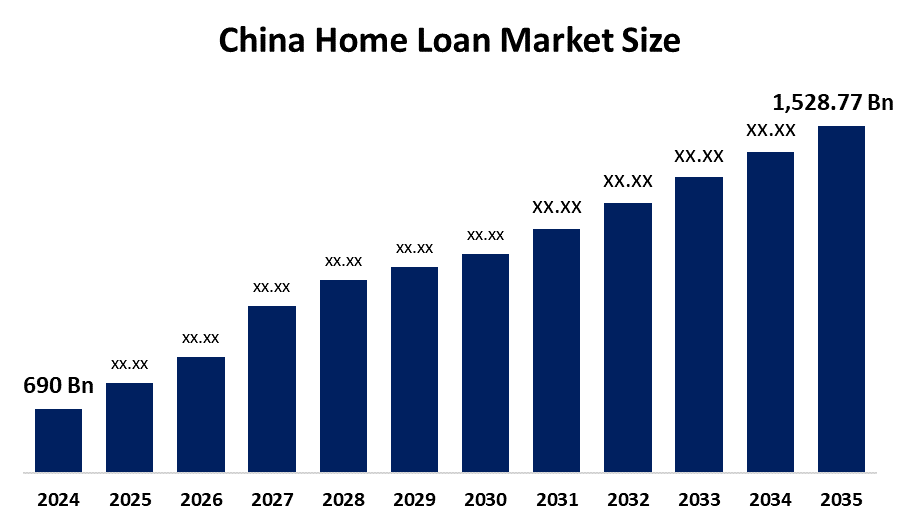
- China Home Loan Market Size 2024: USD 690 Billion
- China Home Loan Market Size 2035: USD 1,528.77 Billion
- China Home Loan Market CAGR 2024: 7.5%
- China Home Loan Market Segments: Loan Type, Provider, Tenure, Interest Rate Type, and End User.
Get more details on this report -
The China Home Loan Market Size comprises mortgage financing solutions provided to individuals and investors for the acquisition of residential real estate by banks, non-banking financial organizations, and online lending platforms. These loans are intended to meet the requirements of primary housing demand, refinance, and investment-driven real estate purchases. They have different interest rate systems, tenures, and repayment plans. The market is an essential part of China's larger financial services ecosystem and supports the country's housing sector, urbanisation, and residential infrastructure development.
The market is driven by expansion in urbanization, rising income levels of the middle class, supportive housing policies, and government actions aimed at stabilizing the real estate sector. Mortgage demand has been influenced by policy changes related to the Loan Prime Rate, incentives for home purchases, and loosened down payment requirements in some locations. However, macroeconomic volatility, developer debt problems, and regulatory restrictions on speculative investments continue to be structural obstacles affecting loan volumes and growth.
Market Dynamics of the China Home Loan Market:
he driving forces behind this market include growing urban populations, the need for inexpensive housing, the growth of tier-2 and tier-3 city developments, and the digitization of mortgage processes. The demand for residential loans has increased as a result of lower interest rate modifications associated with the LPR method and government assistance for first-time buyers. Mortgage penetration across a range of income levels has been strengthened by the increasing use of fintech-based underwriting tools and online loan approvals, which have increased accessibility and shortened processing times.
The challenges in the market include high levels of consumer debt, strict regulations on speculative purchasing, volatility in the real estate market, and more stringent credit risk evaluations by financial institutions. credit culture has also been impacted by dropping property values in some areas and liquidity limitations among real estate developers. Additionally, as macroeconomic conditions and policy interventions change, banks are under pressure to strike a balance between risk management and loan growth goals.
The future prospects for the China home loan market are encouraging, supported by increased refinancing activity, policy-driven measures, and a measured improvement in the housing market. It is anticipated that risk-based pricing methods, flexible repayment plans, and the growth of digital mortgage platforms will improve market growth. Mortgage lending is expected to continue to be a key pillar of the financial services industry as China concentrates on affordable housing and sustainable urban development.
China Home Loan Market Report Coverage
| Report Coverage | Details |
|---|---|
| Base Year: | 2024 |
| Market Size in 2024: | USD 690 Billion |
| Forecast Period: | 2025-2035 |
| Forecast Period CAGR 2025-2035 : | 7.5% |
| 2035 Value Projection: | USD 1,528.77 Billion |
| Historical Data for: | 2020-2023 |
| No. of Pages: | 220 |
| Tables, Charts & Figures: | 110 |
| Segments covered: | By Loan Type, By Provider |
| Companies covered:: | Industrial and Commercial Bank of China (ICBC), China Construction Bank (CCB), Agricultural Bank of China (ABC), Bank of China (BOC), Bank of Communications, Postal Savings Bank of China, China Merchants Bank, Ping An Bank, China Minsheng Banking Corp., Shanghai Pudong Development Bank, Industrial Bank Co., Ltd., China CITIC Bank |
| Pitfalls & Challenges: | COVID-19 Empact, Challenge, Future, Growth, & Analysis |
Get more details on this report -
Market Segmentation
The China home loan market share is classified into loan type, provider, tenure, interest rate type, and end user.
By Loan Type:
The China Home Loan Market Size is divided by loan type into fixed-rate home loans, floating-rate home loans, and hybrid home loans. Among these, floating-rate home loans dominated the share in 2024 and are anticipated to grow at a remarkable CAGR during the forecast period. Floating-rate loans are widely linked to the Loan Prime Rate (LPR), allowing borrowers to benefit from periodic interest rate adjustments. This flexibility makes them attractive in fluctuating interest environments and aligns with policy-driven monetary adjustments in China’s housing finance sector.
By Provider:
The market is divided by provider into public sector banks, private banks, non-banking financial companies, and digital lending platforms. Among these, public sector banks dominated in 2024 and are anticipated to grow at a remarkable CAGR during the forecast period. Large state-owned banks hold a significant share due to strong capital reserves, nationwide branch networks, and regulatory backing. However, private banks and fintech platforms are increasingly competing by offering faster approvals, customized mortgage products, and enhanced digital user experiences.
By Tenure:
The market is divided by tenure into up to 10 years, 11–20 years, and above 20 years. Among these, loans above 20 years dominated the share in 2024 and are anticipated to grow at a remarkable CAGR during the forecast period. Longer tenures reduce monthly repayment burdens, making homeownership more accessible to middle-income households. These loans are particularly common in major urban centers where property prices are high, requiring extended repayment schedules for financial feasibility.
By Interest Rate Type:
The market is divided by interest rate type into benchmark-linked, LPR-linked, and fixed interest. Among these, LPR-linked loans dominated the share in 2024 and are anticipated to grow at a remarkable CAGR during the forecast period. The LPR framework enhances transparency and aligns mortgage pricing with monetary policy adjustments. Borrowers increasingly prefer LPR-linked loans due to their structured interest revision mechanisms and government-led financial reforms promoting standardized lending practices.
By End User:
The market is divided by end user into first-time homebuyers, existing homeowners, and real estate investors. Among these, first-time homebuyers dominated the share in 2024 and are anticipated to grow at a remarkable CAGR during the forecast period. Government incentives, reduced down-payment ratios in selected regions, and supportive mortgage policies encourage first-time buyers. This segment plays a critical role in sustaining residential demand, especially in rapidly urbanizing cities across China.
Competitive Analysis:
The report offers the appropriate analysis of the key organisations/companies involved within the China home loan market, along with a comparative evaluation primarily based on their product offering, business overviews, geographic presence, enterprise strategies, segment market share, and SWOT analysis. The report also provides an elaborative analysis focusing on the current news and developments of the companies, which includes product development, innovations, joint ventures, partnerships, mergers & acquisitions, strategic alliances, and others. This allows for the evaluation of the overall competition within the market.
Top Key Companies in China Home Loan Market:
- Industrial and Commercial Bank of China (ICBC)
- China Construction Bank (CCB)
- Agricultural Bank of China (ABC)
- Bank of China (BOC)
- Bank of Communications
- Postal Savings Bank of China
- China Merchants Bank
- Ping An Bank
- China Minsheng Banking Corp.
- Shanghai Pudong Development Bank
- Industrial Bank Co., Ltd.
- China CITIC Bank
Recent Developments in China Home Loan Market:
In March 2025, GenScript Biotech Corp. announced that it had entered into a licensing deal with the In March 2025, Industrial and Commercial Bank of China (ICBC) collaborated with major real estate developers to introduce preferential mortgage packages for first-time homebuyers in selected tier-2 cities. The collaboration focuses on offering reduced interest margins linked to the Loan Prime Rate (LPR) and streamlined digital approval processes to stimulate residential property demand and support housing market stabilization.
In January 2025, China Construction Bank (CCB) launched a fully digital home loan product integrated with AI-based credit assessment and remote documentation verification systems. The product launch aims to accelerate mortgage approvals, enhance underwriting efficiency, and improve borrower accessibility across urban and semi-urban regions in China.
Key Target Audience
- Market Players
- Investors
- End-users
- Government Authorities
- Consulting and Research Firm
- Venture capitalists
- Value-Added Resellers (VARs)
Market Segment
This study forecasts revenue at the China, regional, and country levels from 2020 to 2035. Spherical Insights has segmented the China home loan market based on the below-mentioned segments:
China Home Loan Market, By Loan Type
- Fixed-Rate Home Loans
- Floating-Rate Home Loans
- Hybrid Home Loans
China Home Loan Market, By Provider
- Public Sector Banks
- Private Banks
- Non-Banking Financial Companies
- Digital Lending Platforms
China Home Loan Market, By Tenure
- Up to 10 Years
- 11–20 Years
- Above 20 Years
China Home Loan Market, By Interest Rate Type
- Benchmark Linked
- LPR Linked
- Fixed Interest
China Home Loan Market, By End User
- First-Time Homebuyers
- Existing Homeowners
- Real Estate Investors
Frequently Asked Questions (FAQ)
-
1. What is the size of the China home loan market in 2024?The China home loan market was valued at USD 690 billion in 2024, driven by urbanization, rising housing demand, and strong mortgage lending activity.
-
2. What is the projected size of the China home loan market by 2035?The market is projected to reach USD 1,528.77 billion by 2035, supported by refinancing growth, digital mortgage expansion, and government housing stabilization policies.
-
3. What is the CAGR of the China home loan market?The China Home Loan Market is expected to grow at a CAGR of 7.5% during 2025–2035, supported by LPR-linked lending and housing demand.
-
4. Which loan type dominates the China home loan market?Floating-rate home loans dominate the market, primarily linked to the Loan Prime Rate, offering flexibility and alignment with monetary policy adjustments.
-
5. Who are the leading providers in the China home loan market?Public sector banks dominate, including ICBC, CCB, ABC, and Bank of China, due to strong capital positions and nationwide branch networks.
-
6. What factors drive growth in the China home loan market?Urbanization, first-time buyer incentives, LPR interest adjustments, fintech-based underwriting systems, and digital mortgage platforms are major growth drivers.
-
7. What are the key challenges in the China home loan market?Challenges include high household debt, property market volatility, regulatory tightening, developer liquidity constraints, and stricter credit risk management practices.
-
8. How is digitalization influencing the China home loan market?Digital mortgage platforms, AI-based credit assessment, remote verification systems, and online approvals improve efficiency, accessibility, transparency, and borrower experience across China.
Need help to buy this report?