China Hair Care Market Size, Share, By Product Type (Shampoo, Conditioner, Hair Oil, Hair Styling Products, Hair Colorants), By Distribution Channel (Supermarkets & Hypermarkets, Specialty Stores, Online Retail, Pharmacies), By Application (Household, Professional Salon), By Gender (Male, Female, Unisex), By End Use (Individual Consumers, Salons & Spas), China Hair Care Market Insights, Industry Trend, Forecasts to 2035.
Industry: Consumer Goods
China Hair Care Market Size Insights Forecasts to 2035
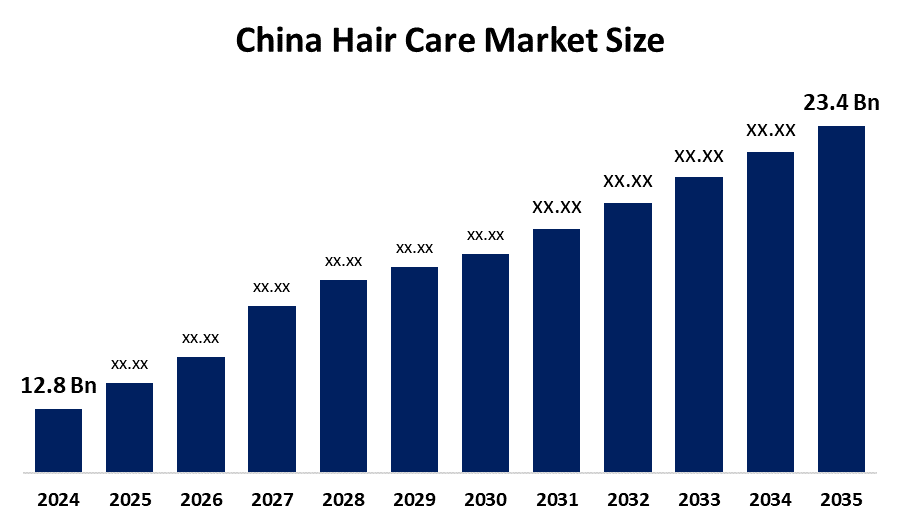
- China Hair Care Market Size 2024: USD 12.8 Billion
- China Hair Care Market Size 2035: USD 23.4 Billion
- China Hair Care Market CAGR 2024: 5.64%
- China Hair Care Market Segments: Product Type, Distribution Channel, Application, Gender, and End Use.
Get more details on this report -
The China hair care market comprises a diverse range of personal care products designed to cleanse, condition, nourish, style, and treat hair and scalp concerns, including shampoos, conditioners, hair oils, styling products, colorants, and specialized treatments like anti-hair loss serums and scalp essences. The products serve both routine upkeep needs and particular solutions that treat dandruff problems, hair loss issues, dry hair situations, pollution-related hair damage, and scalp disease through their distribution to customers who live in cities and rural areas and earn different income levels. The market is driven by rising disposable incomes, increasing beauty consciousness among younger demographics, urbanization leading to pollution-related hair problems, the Skinification trend applying skincare principles to hair routines, demand for premium and functional formulations, growing male grooming, and rapid e-commerce penetration with live-streaming sales.
Presently, initiatives by the government, such as the Cosmetics Supervision and Administration Regulation (CSAR), which the National Medical Products Administration (NMPA) established, together with its newest labelling standards that demand full ingredient declaration and safety details, and its streamlined registration system, which covers standard cosmetic products that include numerous hair care products. The measures enable product entry into the market at higher speeds while establishing secure consumer protection standards that build customer confidence through complete testing processes, which in turn leads to product innovations in natural-based and functional product development and boosts market demand for premium products. The regulatory framework and supportive environment enable market development by eliminating entry obstacles that are present in the current system.
Market Dynamics of the China Hair Care Market:
The driving forces behind this market include rising consumer interest in personal appearance, growing demand for premium organic products, and the fast development of online beauty retail platforms. Consumers purchase specialized hair care products, which include shampoos and conditioners and treatment products, because they experience rising concerns about hair damage, pollution and scalp health. The male grooming market and professional salon industry create increasing customer demand for their products. Urban and semi-urban markets experience growth because companies continue to develop new products that use herbal and traditional ingredients.
The challenges faced by the market include strong competition between domestic and international brands, price sensitivity among customers in lower-tier cities and the need to meet regulatory compliance standards. Brand reputation and profitability face threats from two main factors, which include counterfeit products and the changing costs of raw materials. The beauty industry needs to create new products because consumer preferences and beauty trends are constantly changing. The Chinese beauty industry creates distribution challenges and marketing expenses, which result in smaller emerging brands losing profitability in the competitive market.
The China hair care market forecasts positive growth because customers increasingly demand personalized products, sustainable packaging, and clean-label formulations. The market will experience new growth opportunities through technological advancements, which include scalp diagnostics, AI-based product recommendations and premium salon services. The market will expand during the forecast period because of three factors, which include increased penetration in rural areas, the growth of live-stream commerce and the expansion of domestic premium brands.
China Hair Care Market Report Coverage
| Report Coverage | Details |
|---|---|
| Base Year: | 2024 |
| Market Size in 2024: | USD 12.8 Billion |
| Forecast Period: | 2025-2035 |
| Forecast Period CAGR 2025-2035 : | 5.64% |
| 2035 Value Projection: | USD 23.4 Billion |
| Historical Data for: | 2020-2023 |
| No. of Pages: | 220 |
| Tables, Charts & Figures: | 110 |
| Segments covered: | By Product Type, By Distribution Channel |
| Companies covered:: | Procter & Gamble Co., L’Oréal S.A., Unilever PLC, Shiseido Company, Limited, Amorepacific Corporation, Shanghai Jahwa United Co., Ltd., Henkel AG & Co. KGaA, Kao Corporation, Beiersdorf AG, Johnson & Johnson, The Estée Lauder Companies Inc. |
| Pitfalls & Challenges: | COVID-19 Empact, Challenge, Future, Growth, & Analysis |
Get more details on this report -
Market Segmentation
The China hair care market share is classified into product type, distribution channel, application, gender, and end use.
By Product Type:
The China hair care market is divided by product type into shampoo, conditioner, hair oil, hair styling products, and hair colorants. Among these, the shampoo segment dominated the share in 2024 and is anticipated to grow at a remarkable CAGR during the forecast period. Shampoos lead due to their essential daily usage, wide availability, and product variety targeting concerns such as dandruff control, hair fall prevention, scalp nourishment, and moisture repair. Continuous product innovation, herbal formulations, and premium positioning further strengthen shampoo demand across urban and rural markets in China.
By Distribution Channel:
The market is divided by distribution channel into supermarkets & hypermarkets, speciality stores, online retail, and pharmacies. Among these, online retail dominated in 2024 and is anticipated to grow at a remarkable CAGR during the forecast period. The rapid growth of e-commerce platforms, live-streaming sales channels, and influencer-driven marketing significantly boost online hair care sales. Consumers benefit from product comparisons, discounts, convenience, and access to international brands. Expanding digital payment systems and logistics networks further enhance online distribution growth throughout China.
By Application:
The market is divided by application into household and professional salon. Among these, the household dominated in 2024 and is anticipated to grow at a remarkable CAGR during the forecast period. Most consumers purchase hair care products for personal use at home, driven by convenience and affordability. The increasing availability of professional-grade products for home usage, combined with DIY beauty trends and online tutorials, supports this segment’s dominance. Urban consumers increasingly invest in advanced treatment and styling products for routine personal grooming.
By Gender:
The market is divided by gender into male, female, and unisex. Among these, the female segment dominated the share in 2024 and is anticipated to grow at a remarkable CAGR during the forecast period. Female consumers demonstrate higher spending on premium shampoos, conditioners, hair colorants, and treatment products. Beauty consciousness, fashion trends, and product innovation targeting specific hair concerns such as coloring, damage repair, and scalp care significantly drive demand. However, the male grooming segment is rapidly emerging as an additional growth contributor.
By End Use:
The market is divided by end use into individual consumers and salons & spas. Among these, individual consumers dominated the share in 2024 and are anticipated to grow at a remarkable CAGR during the forecast period. The widespread availability of retail and online channels enables direct access to various hair care brands. Rising disposable income, increased awareness of hair health, and demand for personalized solutions contribute to strong consumer-level purchases, reinforcing the dominance of this segment in the Chinese hair care market.
Competitive Analysis:
The report offers the appropriate analysis of the key organisations/companies involved within the China hair care market, along with a comparative evaluation primarily based on their product offering, business overviews, geographic presence, enterprise strategies, segment market share, and SWOT analysis. The report also provides an elaborative analysis focusing on the current news and developments of the companies, which includes product development, innovations, joint ventures, partnerships, mergers & acquisitions, strategic alliances, and others. This allows for the evaluation of the overall competition within the market
Top Key Companies in China Hair Care Market:
- Procter & Gamble Co.
- L'Oréal S.A.
- Unilever PLC
- Shiseido Company, Limited
- Amorepacific Corporation
- Shanghai Jahwa United Co., Ltd.
- Henkel AG & Co. KGaA
- Kao Corporation
- Beiersdorf AG
- Johnson & Johnson
- The Estée Lauder Companies Inc.
Recent Developments in China Hair Care Market:
In March 2025, L'Oréal S.A. launched a new premium scalp-care product line in China under its professional haircare portfolio, focusing on anti-hair fall solutions and microbiome-friendly formulations. The launch targets rising consumer demand for dermatologically tested and science-backed scalp treatment products in urban markets.
In February 2025, Procter & Gamble Co. introduced upgraded variants of its Head & Shoulders and Pantene ranges in China featuring advanced Pro-V repair technology and improved sustainable packaging. The product launch aims to strengthen its mass-premium positioning and expand market share through innovation-led differentiation.
In January 2025, Unilever PLC collaborated with major Chinese e-commerce platforms to introduce personalized hair diagnostic tools powered by AI technology. This initiative integrates customized product recommendations with digital retail strategies to enhance online consumer engagement.
Key Target Audience
- Market Players
- Investors
- End-users
- Government Authorities
- Consulting and Research Firm
- Venture capitalists
- Value-Added Resellers (VARs)
Market Segment
This study forecasts revenue at the China, regional, and country levels from 2020 to 2035. Spherical Insights has segmented the China hair care market based on the below-mentioned segments
China Hair Care Market, By Product Type
- Shampoo
- Conditioner
- Hair Oil
- Hair Styling Products
- Hair Colorants
China Hair Care Market, By Distribution Channel
- Supermarkets & Hypermarkets
- Specialty Stores
- Online Retail
- Pharmacies
China Hair Care Market, By Application
- Household
- Professional Salon
China Hair Care Market, By Mode
- Male
- Female
- Unisex
China Hair Care Market, By End Use
- Individual Consumers
- Salons & Spas
Frequently Asked Questions (FAQ)
-
1. What is the market size of the China hair care market in 2024?The China hair care market is valued at USD 12.8 billion in 2024. The market reflects strong consumer demand for shampoos, conditioners, styling products, hair oils, colorants, and advanced scalp treatment solutions across both urban and rural regions.
-
2. What is the projected size of the China hair care market by 2035?The market is expected to reach USD 23.4 billion by 2035, supported by premiumization trends, digital commerce expansion, male grooming growth, and increasing awareness of scalp and hair health.
-
3. What is the CAGR of the China hair care market from 2025 to 2035?The China Hair Care Market is projected to grow at a CAGR of 5.64% during the forecast period 2025–2035, driven by innovation in functional products, rising disposable income, and expanding online retail penetration.
-
4. What are the key product segments in the China hair care market?The major product segments include Shampoo, Conditioner, Hair Oil, Hair Styling Products, and Hair Colorants. Among these, shampoo dominates due to its daily usage and broad availability targeting dandruff, hair fall, scalp care, and moisture repair.
-
5. Which distribution channel dominates the China hair care market?Online retail leads the market due to rapid e-commerce growth, live-streaming sales, influencer marketing, and digital payment systems. Consumers benefit from competitive pricing, product variety, and convenient home delivery.
-
6. What are the major growth drivers of the China hair care market?Key drivers include increasing beauty consciousness among younger consumers, rising pollution-related hair issues, the “skinification” trend in haircare, demand for premium and organic formulations, male grooming expansion, and strong digital commerce growth.
-
7. What challenges affect the China hair care market?The market faces intense competition from domestic and international brands, regulatory compliance requirements under CSAR, price sensitivity in lower-tier cities, counterfeit product risks, and fluctuating raw material costs impacting profit margins.
-
8. Which application segment dominates the China hair care market?The household segment dominates due to widespread personal use of shampoos, conditioners, and treatments. DIY beauty trends and increased access to professional-grade products for home use further support its dominance.
-
9. How is regulation influencing the China hair care market?The Cosmetics Supervision and Administration Regulation (CSAR) and NMPA guidelines have strengthened ingredient transparency, safety compliance, and product registration processes. These regulations enhance consumer confidence and encourage innovation in safe and functional hair care products.
-
10. Who are the key players in the China hair care market?Major companies operating in the market include Procter & Gamble Co., L'Oréal S.A., Unilever PLC, Shiseido Company, Limited, Amorepacific Corporation, Shanghai Jahwa United Co., Ltd., Henkel AG & Co. KGaA, Kao Corporation, Beiersdorf AG, Johnson & Johnson, and The Estée Lauder Companies Inc.
Need help to buy this report?