China Dynamic Random Access Memory (DRAM) Market Size, Share, By Architecture (DDR4, DDR5, DDR3, Others), By Application (Smartphones/Tablets, PCs/Laptops, Data Centres, Graphics, Consumer Products, Automotive), By End Use (Consumer Electronics, Data Centres & Servers, Automotive, Industrial, Telecommunications), China Dynamic Random Access Memory (DRAM) Market Insights, Industry Trend, Forecasts to 2035.
Industry: Information & Technology
China Dynamic Random Access Memory (DRAM) Market Insights Forecasts to 2035
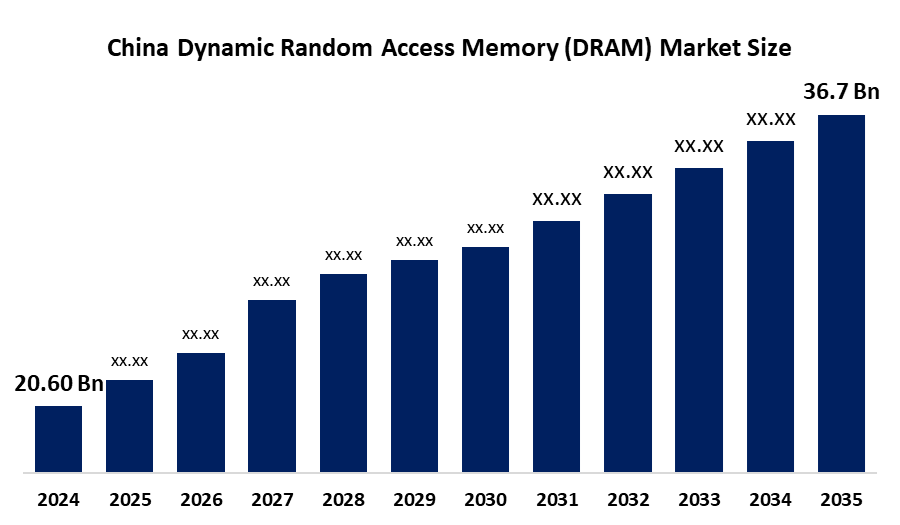
- China Dynamic Random Access Memory (DRAM) Market Size 2024: USD 20.60 Bn
- China Dynamic Random Access Memory (DRAM) Market Size 2035: USD 36.7 Bn
- China Dynamic Random Access Memory (DRAM) Market CAGR 2024: 4.1%
- China Dynamic Random Access Memory (DRAM) Market Segments: Architecture, Application, End Use.
Get more details on this report -
The China DRAM market refers to dynamic random-access memory (DRAM), a highly volatile memory technology used for temporary data storage in computing systems. DRAM technology is essential in smartphones, personal computers, servers, gaming consoles, AI accelerators, and automotive electronics. The China DRAM market includes mainstream DDR4 and DDR5 memory modules, low-power LPDDR modules for mobile applications, and GDDR modules for graphics-intensive applications. The increasing digital transformation, cloud computing, 5G networks, AI adoption, and investments in data centres are fuelling the demand for high-density and high-speed memory solutions in China.
Government initiatives such as the semiconductor self-sufficiency strategy and the national integrated circuit industry investment funds are boosting the country’s manufacturing prowess. Chinese DRAM vendors are stepping up capacity expansion and pursuing process technologies below 20nm to decrease import dependence. Simultaneously, increasing demands for AI training, edge computing, electric vehicles, and high-performance computing are driving changes in memory architecture. Future demand will be driven by technological innovation, yield enhancement, supply-demand alignment, and geopolitical trade patterns affecting equipment and intellectual property availability.
China Dynamic Random Access Memory (DRAM) Market Report Coverage
| Report Coverage | Details |
|---|---|
| Base Year: | 2024 |
| Market Size in 2024: | USD 20.60 Billion |
| Historical Data for: | 2020-2023 |
| No. of Pages: | 210 |
| Tables, Charts & Figures: | 110 |
| Segments covered: | By Architecture, By End Use |
| Companies covered:: | Samsung Electronics Co., Ltd., SK Hynix Inc., Micron Technology, Inc., ChangXin Memory Technologies (CXMT), Fujian Jinhua Integrated Circuit Co., Ltd., Nanya Technology Corporation, Winbond Electronics Corporation, |
| Pitfalls & Challenges: | COVID-19 Empact, Challenge, Future, Growth, & Analysis |
Get more details on this report -
Market Dynamics of the China Dynamic Random Access Memory (DRAM) Market:
The China DRAM industry growth forces relate back to the exponential amounts of data within data centres, artificial intelligence (AI) workloads, smartphones, automotive electronics, and backing from governments’ investments into domestic manufacturing rather than relying on foreign suppliers. At the same time, advancements in DDR5 technology, the integration of high-bandwidth memory, and an increase in fab capacities from domestic companies help accelerate the growth rate for high-performance computing, along with consumer electronics.
The key challenges in this industry arise from geopolitical restrictions on the acquisition of advanced equipment, the expense of research & development (R&D), yield issues with cutting-edge technology nodes, a severely competitive global marketplace amongst other established technology leaders, and cyclical price volatility as affected by imbalances between supply and demand.
The future prospects remain bright and include opportunities within the areas of AI-optimised servers, electric vehicles, edge computing, and additional domestic manufacturing capabilities. Additionally, continued growth in equivalent clinical trials for technology adoption, venture capital funding for semiconductor companies, and policies that enable combinatorial growth will allow China to see an increase in self-reliance and global market share.
Market Segmentation
The China dynamic random access memory (DRAM) market share is classified into architecture, application, and end use.
By Architecture:
The China DRAM market is divided by architecture into DDR4, DDR5, DDR3, and others. Among these, the DDR4 segment dominated the share in 2024 and is anticipated to grow at a remarkable CAGR during the forecast period. DDR4 maintains leadership due to its widespread adoption in existing devices, cost-effectiveness, mature production ecosystems, and compatibility across consumer electronics, PCs, and servers in China. Strong domestic manufacturing support and gradual transition to newer standards ensure its continued dominance in volume-driven applications despite emerging DDR5 advancements.
By Application:
The market is divided by application into smartphones/tablets, PCs/laptops, data centres, graphics, consumer products, and automotive. Among these, the smartphones/tablets segment dominated in 2024 and is anticipated to grow at a remarkable CAGR during the forecast period. High smartphone penetration, 5G rollout, and massive domestic production by brands drive demand for low-power, high-capacity DRAM. Rapid innovation in mobile devices, coupled with China's position as the world's largest smartphone market, sustains strong volume growth and positions this segment as a key revenue contributor.
By End Use:
The market is divided by end use into consumer electronics, data centres & servers, automotive, industrial, and telecommunications. Among these, consumer electronics dominated the share in 2024 and is anticipated to grow at a remarkable CAGR during the forecast period. Extensive use in smartphones, Smart TVs, wearables, and home appliances, combined with China's massive manufacturing base and export volume, fuels leadership. Rising disposable incomes, urbanisation, and demand for smart devices further accelerate adoption, making this end-use category pivotal for market expansion.
Competitive Analysis:
The report offers the appropriate analysis of the key organisations/companies involved within the China dynamic random-access memory (DRAM) Market, along with a comparative evaluation primarily based on their product offering, business overviews, geographic presence, enterprise strategies, segment market share, and SWOT analysis. The report also provides an elaborative analysis focusing on the current news and developments of the companies, which includes product development, innovations, joint ventures, partnerships, mergers & acquisitions, strategic alliances, and others. This allows for the evaluation of the overall competition within the market.
Top Key Companies in China Dynamic Random Access Memory (DRAM) Market:
- Samsung Electronics Co., Ltd.
- SK Hynix Inc.
- Micron Technology, Inc.
- ChangXin Memory Technologies (CXMT)
- Fujian Jinhua Integrated Circuit Co., Ltd.
- Nanya Technology Corporation
- Winbond Electronics Corporation
Recent Developments in China Dynamic Random Access Memory (DRAM) Market:
In December 2025, Samsung Electronics Co., Ltd. announced the expansion of its next-generation DDR5 and HBM production lines to address rising demand from AI-driven data centers and high-performance computing applications, strengthening supply to major cloud and enterprise customers operating in China.
In October 2025, ChangXin Memory Technologies (CXMT) initiated large-scale commercialization of DDR5 DRAM manufactured using advanced sub-20nm process technology, aiming to enhance domestic server memory supply and reduce reliance on imported high-performance DRAM solutions.
In August 2025, SK Hynix Inc. expanded collaboration with leading AI processor companies to integrate its HBM3 and high-capacity DDR5 memory into accelerator platforms deployed across hyperscale data centres in China.
Key Target Audience
- Market Players
- Investors
- End-users
- Government Authorities
- Consulting and Research Firm
- Venture capitalists
- Value-Added Resellers (VARs)
Market Segment
This study forecasts revenue at the China, regional, and country levels from 2020 to 2035. Decisions Advisors has segmented the China dynamic random access memory (DRAM) market based on the below-mentioned segments:
China Dynamic Random Access Memory (DRAM) Market, By Architecture
- DDR4
- DDR5
- DDR3
- Others
China Dynamic Random Access Memory (DRAM) Market, By Application
- Smartphones/Tablets
- PCs/Laptops
- Data Centers
- Graphics
- Consumer Products
- Automotive
China Dynamic Random Access Memory (DRAM) Market, By End Use
- Consumer Electronics
- Data Centres & Servers
- Automotive
- Industrial
- Telecommunications
Frequently Asked Questions (FAQ)
-
1. What is the projected growth of the China Dynamic Random Access Memory (DRAM) Market?The China dynamic random access memory (DRAM) market is projected to grow from USD 20.60 billion in 2024 to USD 36.7 billion by 2035, registering a CAGR of 4.1% during the forecast period 2025–2035. Growth is supported by increasing demand from smartphones, data centres, AI workloads, and automotive electronics, along with continued investments in domestic semionductor manufacturing capacity.
-
2. What is driving the growth of the China DRAM market?Key growth drivers include rapid expansion of data centres, rising AI and machine learning workloads, strong smartphone and PC manufacturing output, and government-backed semiconductor self-sufficiency programs. Advancements in DDR5 architecture, integration of high-bandwidth memory (HBM), and expansion of fabrication facilities by domestic manufacturers are further accelerating demand for high-performance memory solutions.
-
3. Which DRAM architecture segment dominates the China market?DDR4 currently dominates the China DRAM market due to its cost efficiency, widespread compatibility, and mature manufacturing ecosystem. While DDR5 adoption is increasing, especially in AI servers and high-performance computing, DDR4 remains the preferred choice for volume-driven applications in consumer electronics and mainstream computing systems.
-
4. Which application segment holds the largest share in China’s DRAM market?The smartphones and tablets segment holds the largest share in the China DRAM market. China’s position as the world’s largest smartphone manufacturing and consumption hub drives massive demand for low-power, high-capacity DRAM modules, particularly LPDDR solutions supporting 5G-enabled devices and advanced mobile applications.
-
4. Which application segment holds the largest share in China’s DRAM market?4. Which application segment holds the largest share in China’s DRAM market?
Need help to buy this report?