China Anti-Caking Market Size, Share, By Type (Calcium Compounds, Sodium Compounds, Magnesium Compounds, Silicon Dioxide), By Application (Food & Beverages, Fertilizers, Animal Feed, Cosmetics & Personal Care), By Source (Natural, Synthetic), By Form (Powder, Granules), By End Use (Food Industry, Agriculture Industry, Industrial Processing), China Anti-Caking Market Insights, Industry Trend, Forecasts to 2035
Industry: Chemicals & Materials
China Anti-Caking Market Size Insights Forecasts to 2035
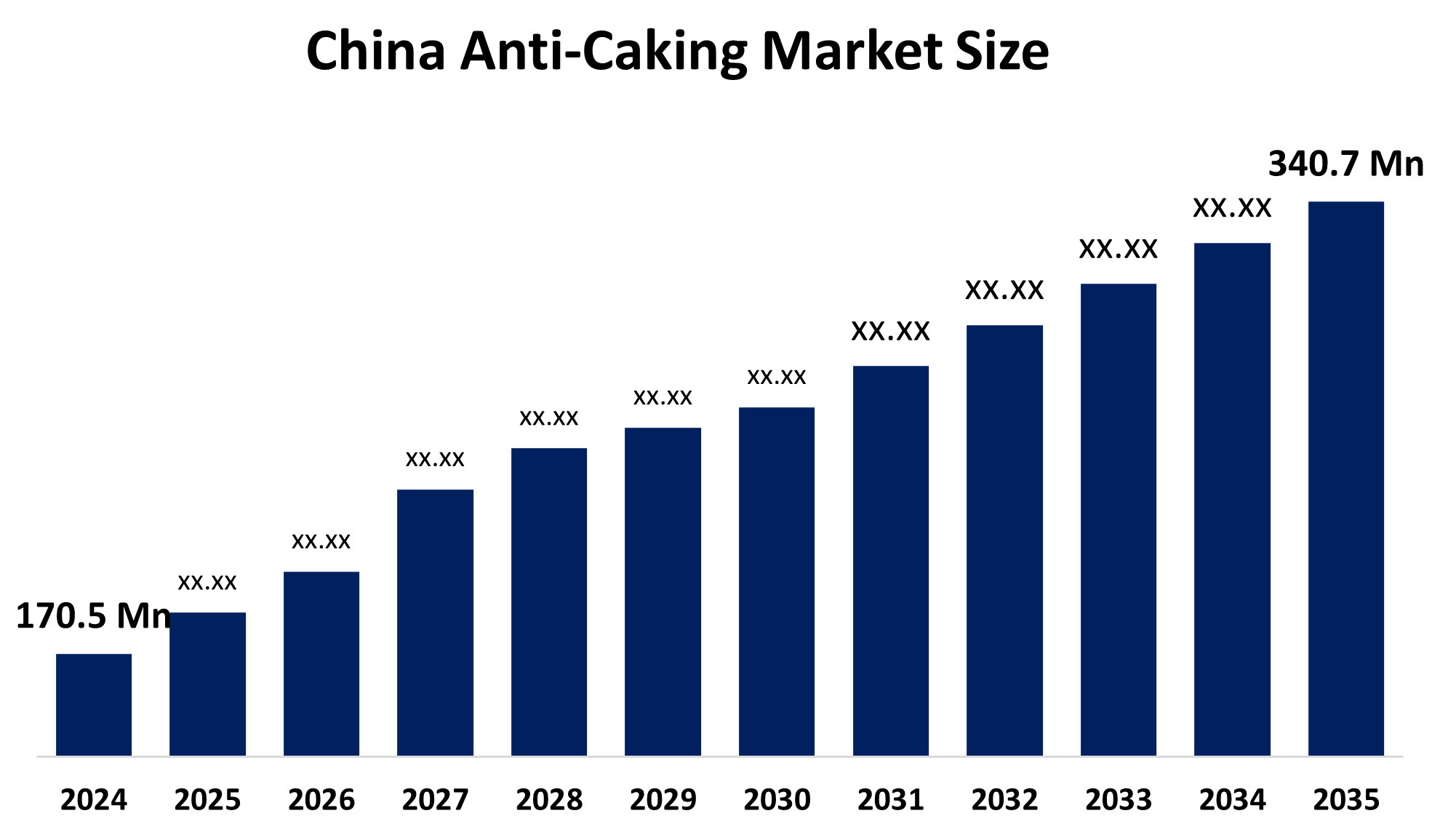
- China Anti-Caking Market Size 2024: USD 170.5 Million
- China Anti-Caking Market Size 2035: USD 340.7 Million
- China Anti-Caking Market CAGR 2024: 6.5%
- China Anti-Caking Market Segments: Type, Application, Source, Form, and End Use.
Get more details on this report -
The China Anti-Caking industry comprises chemical additives that prevent lump formation in powdered and granular materials to create products that flow smoothly and stay fresh for longer periods. The additives consist of calcium compounds, silicon dioxide, magnesium compounds and sodium-based agents, which find extensive application in food processing, fertilizers, animal feed and industrial powders. Anti-caking agents enhance product stability while increasing storage capacity and improving processing effectiveness. The market is progressing because people want packaged food products, farmers use more fertilizers and companies create better additive formulation technologies.
Presently, initiatives by the government include food safety regulations, agricultural modernization programs and chemical manufacturing development policies. China has established regulatory frameworks that control the safe application of food additives and industrial chemicals. Future developments will follow the rising need for processed foods and the expanding fertilizer industry, and the development of sustainable additive technologies, numerous industries are set to embrace.
Market Dynamics of the China Anti-Caking Market:
The driving forces behind this market include increasing demand for packaged foods, growing fertilizer usage in agricultural operations, and rising industrial processing activities. The market expansion process receives support from government policies, which enhance agricultural productivity and establish food safety regulations. The advancements in additive chemistry have enhanced moisture absorption and flowability performance, improving the operational efficiency of anti-caking agents across various applications.
The challenges faced by the market include the need for food additive safety testing, unpredictable raw material price changes, and the environmental impact of chemical production methods. The need for sustainable production methods, together with rising consumer knowledge about synthetic additives, creates manufacturing difficulties for producers.
The future prospects for the anti-caking market in China are positive, and these include demand for anti-caking products that manufacturers use in food processing, fertilizer production, and animal feed production, as well as cosmetics manufacturing. This is attributed to increased production of powdered and granular products, improved additive technology, and growing industrial need for better material handling systems, among others.
China Anti-Caking Market Report Coverage
| Report Coverage | Details |
|---|---|
| Base Year: | 2024 |
| Market Size in 2024: | USD 170.5 Million |
| Forecast Period: | 2025-2035 |
| Forecast Period CAGR 2025-2035 : | 6.5% |
| 2035 Value Projection: | USD 340.7 Million |
| Historical Data for: | 2020-2023 |
| No. of Pages: | 195 |
| Tables, Charts & Figures: | 102 |
| Segments covered: | By Type, By Application |
| Companies covered:: | Evonik Industries AG, PPG Industries Inc., BASF SE, Solvay S.A., Cabot Corporation, W. R. Grace & Co., PQ Corporation, IMERYS S.A., Huber Engineered Materials, Clariant AG, Hubei Forbon Technology and Other Key Players |
| Pitfalls & Challenges: | and COVID-19 Impact Analysis |
Get more details on this report -
Market Segmentation
The China anti-caking market share is classified into type, application, source, form, and end use.
By Type:
The China Anti-Caking Market is divided by type into calcium compounds, sodium compounds, magnesium compounds, and silicon dioxide. Among these, the silicon dioxide segment dominated the share in 2024 and is anticipated to grow at a remarkable CAGR during the forecast period. Silicon dioxide leads the way mainly because of its excellent moisture absorption capability, high chemical stability, and wide usage in food processing, pharmaceuticals, and industrial powder applications. Its effectiveness in maintaining product flowability and preventing clumping makes it one of the most commonly used anti-caking agents across several industries in China.
By Application:
The China Anti-Caking Market is divided by application into food & beverages, fertilizers, animal feed, and cosmetics & personal care. Among these, the food & beverages segment dominated in 2024 and is anticipated to grow at a remarkable CAGR during the forecast period. The main factors driving this include increasing consumption of packaged foods, powdered seasonings, instant beverages, and processed food ingredients. Anti-caking agents help maintain product texture, improve shelf stability, and ensure consistent quality during transportation and storage.
By Source:
The China Anti-Caking Market is divided by source into natural and synthetic. Among these, the synthetic segment dominated in 2024 and is anticipated to grow at a remarkable CAGR during the forecast period. Synthetic anti-caking agents offer consistent chemical composition, higher efficiency, and cost-effective production compared with natural alternatives. These advantages make them widely used in large-scale food processing, fertilizer production, and industrial manufacturing operations where reliable product performance is essential.
By Form:
The China Anti-Caking Market is divided by form into powder and granules. Among these, the powder segment dominated in 2024 and is anticipated to grow at a remarkable CAGR during the forecast period. Powder forms provide easy blending with powdered products and allow uniform distribution within manufacturing processes. Consequently, powder anti-caking agents are widely used in food ingredients, fertilizers, and feed formulations, helping maintain product quality and prevent clumping during packaging, storage, and transportation.
By End Use:
The China Anti-Caking Market is divided by end use into food industry, agriculture industry, and industrial processing. Among these, the food industry dominated the share in 2024 and is anticipated to grow at a remarkable CAGR during the forecast period. The increasing production of powdered food products such as salt, spices, instant soups, and dairy powders is driving demand for anti-caking agents. These additives help maintain product quality, improve processing efficiency, and ensure compliance with food safety regulations.
Competitive Analysis:
The report offers the appropriate analysis of the key organisations/companies involved within the China Anti-Caking Market, along with a comparative evaluation primarily based on their product offering, business overviews, geographic presence, enterprise strategies, segment market share, and SWOT analysis. The report also provides an elaborative analysis focusing on the current news and developments of the companies, which includes product development, innovations, joint ventures, partnerships, mergers & acquisitions, strategic alliances, and others. This allows for the evaluation of the overall competition within the market.
Top Key Companies in China Anti-Caking Market:
- Evonik Industries AG
- PPG Industries Inc.
- BASF SE
- Solvay S.A.
- Cabot Corporation
- W. R. Grace & Co.
- PQ Corporation
- IMERYS S.A.
- Huber Engineered Materials
- Clariant AG
- Hubei Forbon Technology
Recent Developments in China Anti-Caking Market:
- In March 2025, Evonik Industries AG launched an upgraded precipitated silica anti-caking solution designed to improve moisture control and powder flow performance in food processing and fertilizer applications across Asian markets including China.
- In November 2024, BASF SE announced a collaboration with regional food ingredient manufacturers in China to develop advanced anti-caking additive solutions aimed at improving stability and shelf life of powdered food products.
- In July 2024, Clariant AG introduced a new silica-based anti-caking additive designed for fertilizer and industrial powder applications, improving product flowability and reducing moisture-induced clumping.
Key Target Audience
- Market Players
- Investors
- End-users
- Government Authorities
- Consulting and Research Firm
- Venture capitalists
- Value-Added Resellers (VARs)
Market Segment
This study forecasts revenue at the China, regional, and country levels from 2020 to 2035. Spherical Insights has segmented the China Anti-Caking Market based on the below-mentioned segments:
China Anti-Caking Market, By Type
- Calcium Compounds
- Sodium Compounds
- Magnesium Compounds
- Silicon Dioxide
China Anti-Caking Market, By Application
- Food & Beverages
- Fertilizers
- Animal Feed
- Cosmetics & Personal Care
China Anti-Caking Market, By Source
- Natural
- Synthetic
China Anti-Caking Market, By Form
- Powder
- Granules
China Anti-Caking Market, By End Use
- Food Industry
- Agriculture Industry
- Industrial Processing
Frequently Asked Questions (FAQ)
-
1. What is the projected size of the China anti-caking market by 2035?The China anti-caking market is projected to grow from USD 170.5 million in 2024 to USD 340.7 million by 2035, expanding at a CAGR of 6.5% during the forecast period 2025–2035. Market growth is supported by increasing demand for packaged food products, expansion of fertilizer production, and rising industrial applications of powdered and granular materials.
-
2. What factors are driving the growth of the China anti-caking market?The market growth is driven by rising consumption of packaged and processed food products, increasing fertilizer use in agriculture, and expanding industrial processing activities. Government policies promoting food safety, agricultural productivity, and chemical manufacturing are also contributing to the demand for anti-caking additives across multiple industries.
-
3. Which type segment dominates the China anti-caking market?The silicon dioxide segment dominates the China anti-caking market due to its excellent moisture absorption capability, chemical stability, and effectiveness in preventing lump formation in powdered materials. It is widely used in food processing, pharmaceuticals, fertilizers, and industrial powder applications.
-
4. Which application segment holds the largest share in the China anti-caking market?The food & beverages segment holds the largest market share because anti-caking agents are widely used in powdered food products such as spices, dairy powders, seasoning mixes, and instant beverages. These additives help maintain product texture, improve shelf life, and ensure product quality during storage and transportation.
-
5. Which source segment dominates the China anti-caking market?Synthetic anti-caking agents dominate the market due to their consistent composition, higher efficiency, and cost-effective manufacturing. These properties make them widely used in large-scale food processing, fertilizer production, and industrial manufacturing applications.
-
6. Which form of anti-caking agents is most commonly used in China?Powder form anti-caking agents are the most commonly used because they blend easily with powdered products and ensure uniform distribution during manufacturing processes. They are widely applied in food processing, fertilizer production, and animal feed formulations.
-
7. Which end-use industry leads the China anti-caking market?The food industry leads the China anti-caking market due to increasing production of powdered food products such as salt, dairy powders, spices, and instant food ingredients. Anti-caking agents help improve processing efficiency and maintain product stability.
-
8. What challenges affect the China anti-caking market?The market faces challenges including strict food additive safety regulations, fluctuating raw material prices, environmental concerns related to chemical manufacturing, and increasing consumer awareness regarding synthetic additives.
-
9. Who are the key companies operating in the China anti-caking market?Major companies in the China anti-caking market include Evonik Industries AG, PPG Industries Inc., BASF SE, Solvay S.A., Cabot Corporation, W. R. Grace & Co., PQ Corporation, IMERYS S.A., Huber Engineered Materials, Clariant AG, and Hubei Forbon Technology.
-
10. What are the future opportunities in the China anti-caking market?Future opportunities include growing demand for anti-caking additives in processed foods, fertilizers, animal feed, and cosmetics. Advancements in additive formulation technologies, sustainable ingredient development, and increasing production of powdered products are expected to support market growth.
Need help to buy this report?