Global Chiller Control Panel Market Size, and Share, By Type (Standard Control Panel and Customized Control Panel), By Control System (Programmable Logic Controller (PLC) Control Panel, Microcontroller-based Control Panel, Computer-based Control Panel, and Analog Control Panel), By Chiller Type (Air-cooled Chiller Control Panel and Water-cooled Chiller Control Panel), By End-use (Manufacturing, Pharmaceuticals, Food & Beverages, Data Center, Hospital, and Others (Laboratory, Cold Storage, etc.)), and By Region (North America, Europe, Asia-Pacific, Latin America, Middle East, and Africa), Analysis and Forecast 2026 - 2035
Industry: Machinery & Equipment
Global Chiller Control Panel Market Insights Forecasts to 2035
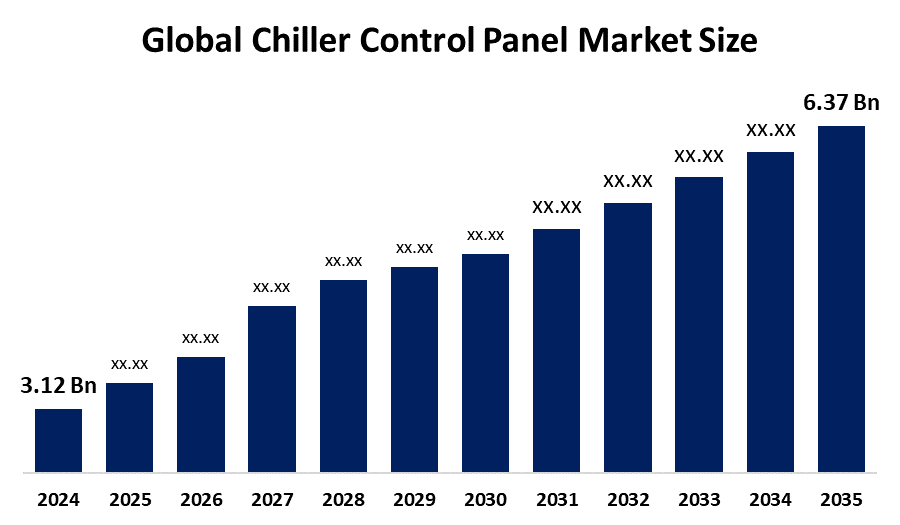
- The Global Chiller Control Panel Market Size Was Estimated at USD 3.12 Billion in 2025
- The Market Size is Expected to Grow at a CAGR of around 7.4% from 2026 to 2035
- The Worldwide Chiller Control Panel Market Size is Expected to Reach USD 6.37 Billion by 2035
- North America is expected to grow the fastest during the forecast period.
Get more details on this report -
According to a research report published by Spherical Insights and Consulting, the global chiller control panel market size was worth around USD 3.12 billion in 2025 and is predicted to grow to around USD 6.37 billion by 2035 with a compound annual growth rate (CAGR) of 7.4% from 2026 to 2035. The global chiller control panel market is growing because environmental standards require energy-efficient, smart HVAC systems that use Internet of Things technology to operate. Industrial sectors, including pharmaceuticals and food, demand accurate temperature control as urban development drives the need for more commercial data centre facilities.
Chiller Control Panel Market Key Takeaways
- Asia Pacific dominated the market with the largest share of 45% in 2025.
- North America is expected to grow at the fastest CAGR during the forecast period.
- By type, the customized control panel segment held a dominant share of the market in 2025, with an approximate 66% share.
- By type, the standard control panel segment is expected to grow at the fastest CAGR in the market between 2026 and 2035.
- By control system, the programmable logic controller (PLC) control panel segment accounted for a considerable revenue share in the market in 2025.
- By control system, the microcontroller-based control panel segment is expected to grow at the highest CAGR in the market during the studied years.
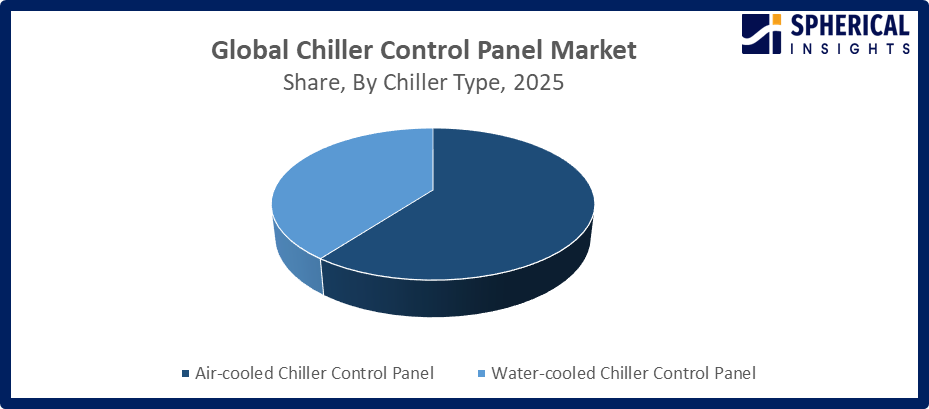
- By chiller type, the air-cooled chiller control panel segment led the global market in 2025.
- By chiller type, the water-cooled chiller control panel segment is expected to grow with the highest CAGR in the market during the studied years.
- By end-use, the manufacturing segment registered its dominance in the market in 2025.
- By end-use, the data center segment is expected to witness the fastest growth in the market over the forecast period.
Market Overview
The global chiller control panel market comprises systems used to monitor, regulate, and optimize the operation of industrial and commercial chillers, which achieve effective temperature control and energy management. The panels find extensive application across HVAC systems, food processing and pharmaceuticals, data centres, and manufacturing industries. Market growth is driven by rising demand for energy-efficient cooling systems and increasing urbanization and expansion of data centres, which use cooling systems to support about 40% of their total energy requirements. The strict environmental regulations that promote energy optimization practices lead to faster adoption of energy-efficient technologies.
The market benefits from intelligent control solutions, Internet of Things device integration and automated system development. Intelligent control panels, which include remote monitoring capabilities and predictive maintenance functions, present a business opportunity because they can decrease operational expenses by 20-30%. The market experiences strong growth potential because emerging economies invest heavily in both infrastructure development and industrial growth. In February 2026, Singapore amended MEES for water-cooled chilled water systems, effective April 1, 2026. The stricter efficiency standard for new buildings mandates advanced control panels with enhanced monitoring, requiring permanent meters and sensors integrated with building automation and energy management systems to ensure compliance and performance.
Chiller Control Panel Market Trends
- Smart & IoT-enabled control systems: Integration of IoT and smart technologies allows real-time monitoring, predictive maintenance, and remote operation. These systems can reduce downtime by 30-40% and improve energy efficiency significantly.
- Rising demand for energy-efficient solutions: Stringent energy regulations and sustainability goals are driving adoption of advanced control panels that optimize energy use, cutting consumption by 15-25% in commercial and industrial facilities.
- Growth of smart buildings & data centers: Rapid expansion of smart infrastructure and data centers is increasing demand for precise temperature control systems, boosting the need for advanced, automated chiller control panels worldwide.
Report Coverage
This research report categorizes the chiller control panel market based on various segments and regions, forecasts revenue growth, and analyzes trends in each submarket. The report analyses the key growth drivers, opportunities, and challenges influencing the chiller control panel market. Recent market developments and competitive strategies, such as expansion, type launch, development, partnership, merger, and acquisition, have been included to draw the competitive landscape in the market. The report strategically identifies and profiles the key market players and analyses their core competencies in each sub-segment of the chiller control panel market.
Global Chiller Control Panel Market Report Coverage
| Report Coverage | Details |
|---|---|
| Base Year: | 2025 |
| Market Size in 2025: | USD 3.12 billion |
| Forecast Period: | 2026-2035 |
| Forecast Period CAGR 2026-2035 : | CAGR of 7.4% |
| 2035 Value Projection: | USD 6.37 billion |
| Historical Data for: | 2020-2024 |
| No. of Pages: | 200 |
| Tables, Charts & Figures: | 121 |
| Segments covered: | By Type,By Control System,By Chiller Type |
| Companies covered:: | Daikin Industries, Johnson Controls, Mitsubishi Electric, Carrier Corporation, Schneider Electric, Trane Technologies, LG Electronics, Smardt Chiller Group, Danfoss, Midea Group, Siemens, Thermax Limited, PolyScience, Filtrine Manufacturing Company,and Others key players |
| Pitfalls & Challenges: | COVID-19 Empact, Challenge, Future, Growth, & Analysis |
Get more details on this report -
Driving Factors
The global chiller control panel market experiences growth because commercial and industrial sectors require energy-efficient HVAC systems. Emerging economies experience increased installation rates because their urban areas and infrastructure development need more construction work, which now exceeds 5% annual growth. Organizations implement advanced control panels to meet strict energy requirements and sustainability goals because these systems can enhance operational efficiency by 15-25%. The industrial sector experiences higher cooling demands because data centres develop at a rapid pace. The market expansion develops from technological innovations that use IoT monitoring and automated systems to improve performance while decreasing operational expenses and system failure times.
Restraining Factors
The global chiller control panel market encounters adoption challenges because its first-time installation and system upgrade expenses prove too costly for small and medium enterprises. Our organization faces operational difficulties because we must connect advanced HVAC systems to outdated HVAC components. The lack of skilled technicians exists because IoT-enabled panels have cybersecurity vulnerabilities, which prevent organizations from using the technology, particularly in developing areas that lack proper technical resources.
Market Segmentation
Type Insights
Why do the customized control panel hold the largest share in the chiller control panel industry?
The customized control panel segment led the market, holding a major 66% share in 2025. Customized control panels growing in the chiller control panel industry owing to their ability to meet specific operational requirements across diverse industries. They offer better integration with existing HVAC systems, enhanced energy efficiency, and compatibility with IoT and automation technologies. Their flexibility, scalability, and improved performance make them ideal for complex industrial and commercial applications, driving higher adoption.
The standard control panel segment is expected to show the fastest growth over the forecast period. The segment is rapidly growing due to its cost-effectiveness, easy installation, and suitability for small and mid-sized applications. Increasing demand from commercial buildings and budget-conscious users is driving rapid adoption across emerging markets.
Control System Insights
Why did the programmable logic controller (PLC) control panel segment dominate the market?
The programmable logic controller (PLC) control panel segment dominated the chiller control panel market with the 56% share in 2025. The segment dominance is attributed to their high reliability, precision, and ability to handle complex industrial processes. They enable real-time monitoring, automation, and seamless integration with advanced HVAC systems. Their scalability, durability, and support for IoT-based applications make them ideal for large-scale commercial and industrial environments, driving widespread adoption.
The microcontroller-based control panel segment is expected to witness the fastest growth in the market over the forecast period. The microcontroller-based control panel segment growth is owing to its low cost, compact design, and energy efficiency. Increasing adoption in small and mid-sized HVAC systems and smart buildings is accelerating demand across emerging markets.
Chiller Type Insights
How does the air-cooled chiller control panel segment dominate the chiller control panel market?
The air-cooled chiller control panel segment held the 60% market share in 2025. The air-cooled chiller control panel segment led the market due to lower installation and maintenance costs, ease of deployment, and minimal water dependency. These systems are widely adopted in commercial buildings and small to mid-sized industries. Their flexibility, energy efficiency improvements, and suitability for regions with water scarcity drive steady growth and widespread market preference.
The water-cooled chiller control panel segment is expected to gain the highest market share between 2025 and 2035, as superior energy efficiency, rising adoption in large industrial and commercial facilities, and increasing demand from data centers requiring high-capacity, continuous, and cost-effective cooling solutions.
Get more details on this report -
End-use Insights
Which end-use segment dominated the chiller control panel market?
The manufacturing segment contributed 38% of the market share in 2025. The manufacturing segment significantly contributes to chiller control panel market growth due to high demand for precise temperature control in processes such as chemicals, electronics, and metal processing. Continuous operations and the need for energy-efficient systems drive adoption. Increasing automation and industrial expansion, especially in emerging economies, further boost demand for advanced control panels.
The data center segment is expected to expand rapidly in the market in the coming years, as rising cloud computing, AI workloads, and digitalization. The increasing need for reliable, high-capacity cooling systems and energy-efficient infrastructure is driving strong demand for advanced chiller control panels globally.
Regional Segment Analysis of the Chiller Control Panel Market
- North America (U.S., Canada, Mexico)
- Europe (Germany, France, U.K., Italy, Spain, Rest of Europe)
- Asia-Pacific (China, Japan, India, Rest of APAC)
- South America (Brazil and the Rest of South America)
- The Middle East and Africa (UAE, South Africa, Rest of MEA)
What factors have led to Asia Pacific dominance in the chiller control panel market?
Asia Pacific dominated the chiller control panel market by holding the largest share of 45% in 2025. The region's growth in the market is due to rapid industrialization, urbanization, and large-scale infrastructure development across countries like China, India, and Japan. Strong growth in manufacturing, data centers, and commercial construction drives demand for advanced cooling systems. Government initiatives promoting energy efficiency and smart cities further support adoption. Additionally, cost-effective manufacturing, availability of skilled labor, and increasing foreign investments enhance regional production and deployment of chiller control panels. In January 2026, India’s HVAC industry sought Budget support for domestic manufacturing and affordability. New Bureau of Energy Efficiency star-rating norms raised efficiency standards, increasing AC prices by 7-10%. Industry demands include expanded PLI incentives and GST rationalisation to boost local production and energy-efficient cooling adoption.
China Chiller Control Panel Market Trends
China’s chiller control panel market is growing steadily, driven by rapid industrialization, expanding commercial construction, and rising demand for energy-efficient HVAC systems. Increasing investments in pharmaceuticals and data centers further boost adoption. The broader chiller market is reflecting strong demand for advanced cooling technologies. China implemented the GB 19577-2024 energy efficiency standard on February 1, 2025, setting stricter performance requirements for chillers and heat pumps. The policy drives adoption of advanced control panels. Updated energy labeling rules give manufacturers until February 1, 2027, to ensure full compliance.
Why is North America the fastest-growing region in the chiller control panel market?
North America is expected to experience the fastest growth over the forecast period, with an approximate 25% market share. The region is rapidly growing the chiller control panel market owing to the rapid expansion of data centers, increasing adoption of smart buildings, and strong demand for energy-efficient HVAC systems. Strict regulatory standards on energy consumption and emissions drive upgrades to advanced control panels. Additionally, high investments in industrial automation, healthcare infrastructure, and retrofitting of aging buildings, along with early adoption of IoT-enabled technologies, accelerate market growth across the region. Illinois enacted HB2476, requiring state-funded facilities, including daycare centers and nursing homes, to install permanent cooling systems meeting defined temperature and humidity standards by May 2025. The mandate is expected to drive demand for chiller systems and control panels, supporting improved indoor comfort, safety, and regulatory compliance statewide.

Get more details on this report -
U.S. Chiller Control Panel Market Trends
The U.S. chiller control panel market is growing steadily, driven by rising demand for energy-efficient HVAC systems and smart building technologies. Increasing investments in data centers, commercial construction, and industrial automation are boosting adoption. Strict environmental regulations and growing use of IoT-enabled, predictive maintenance solutions further support market expansion, with overall cooling demand rising significantly. In March 2026, the U.S. AIM Act significantly reshaped the HVAC sector by mandating an 85% HFC phase-down. Rising refrigerant costs (up 40-70% since 2022) and stricter compliance rules are driving adoption of low-GWP alternatives and transforming system economics for contractors and facility managers nationwide.
How is the opportunistic rise of Europe in the chiller control panel market?
Europe’s opportunistic rise in the chiller control panel market is driven by strict energy-efficiency regulations, carbon reduction targets, and widespread adoption of sustainable HVAC systems. Increasing retrofitting of aging infrastructure and smart building initiatives boost demand. Additionally, growth in data centers and industrial automation, along with government incentives for green technologies, supports steady market expansion across the region. In April 2026, England launched the Warm Homes: Local Grant, offering free energy-efficient upgrades to eligible households. The government-funded scheme provides insulation, heat pumps, solar panels, and smart controls, aiming to reduce energy bills, tackle fuel poverty, and support the UK’s net-zero goals.
Competitive Analysis:
The report offers the appropriate analysis of the key organizations/companies involved within the chiller control panel market, along with a comparative evaluation primarily based on their type of offering, business overviews, geographic presence, enterprise strategies, segment market share, and SWOT analysis. The report also provides an elaborative analysis focusing on the current news and developments of the companies, which includes type development, innovations, joint ventures, partnerships, mergers & acquisitions, strategic alliances, and others. This allows for the evaluation of the overall competition within the market.
List of Key Companies
- Daikin Industries
- Johnson Controls
- Mitsubishi Electric
- Carrier Corporation
- Schneider Electric
- Trane Technologies
- LG Electronics
- Smardt Chiller Group
- Danfoss
- Midea Group
- Siemens
- Thermax Limited
- PolyScience
- Filtrine Manufacturing Company
- Others
Key Target Audience
- Market Players
- Investors
- End-users
- Government Authorities
- Consulting and Research Firm
- Venture capitalists
- Value-Added Resellers (VARs)
Recent Development
- In March 2026, Trane Technologies launched the HSAG air-cooled magnetic bearing centrifugal chiller for the Asia Pacific market. Featuring oil-free magnetic levitation and low-GWP refrigerants, it delivers high energy efficiency, operational reliability, and environmental compliance, addressing extreme data center cooling demands sustainably.
- In February 2026, Carrier launched the AquaEdge 30CF air-cooled centrifugal chiller for data centers. Delivering over 3 MW of cooling, it ensures reliable operation from 20°F to 140°F, rapid recovery during power interruptions, and continuous uptime for AI, cloud, and high-performance computing workloads.
- In February 2026, Johnson Controls launched next-generation Smart Ready YORK Chillers with factory-installed connectivity. Featuring real-time monitoring, advanced fault detection, and diagnostics, these chillers reduce unplanned service calls by 32%, enhance reliability, lower costs, and improve operational efficiency for centrifugal, screw, and scroll models.
- In January 2026, Daikin Applied Americas, Inc. showcased advanced HVAC innovations at the AHR Expo 2026. New solutions, including high-capacity chillers and fan systems, focus on energy efficiency, sustainability, and reliability, addressing growing cooling demands in data centers, healthcare, and residential applications.
- In October 2025, Daikin Applied unveiled advanced data center cooling innovations, including the Magnitude WME-C Quad Chiller. Featuring high capacity and magnetic-bearing technology, the solutions enhance efficiency, reliability, and scalability, addressing growing cooling demands for AI, cloud, and next-generation digital infrastructure.
- In June 2024, Carrier India launched the Made-in-India 30 RB Air-Cooled Modular Scroll Chiller. Designed for Indian industrial and infrastructure needs, it offers scalable modules, efficient cooling from 10°C to 48°C, Shell-&-Tube heat exchangers, and aligns with the “Vocal for Local” initiative, enhancing reliability and adaptability.
Market Segment
This study forecasts revenue at global, regional, and country levels from 2020 to 2035. Spherical Insights has segmented the chiller control panel market based on the below-mentioned segments:
Global Chiller Control Panel Market, By Type
- Standard Control Panel
- Customized Control Panel
Global Chiller Control Panel Market, By Control System
- Programmable Logic Controller (PLC) Control Panel
- Microcontroller-based Control Panel
- Computer-based Control Panel
- Analog Control Panel
Global Chiller Control Panel Market, By Chiller Type
- Air-cooled Chiller Control Panel
- Water-cooled Chiller Control Panel
Global Chiller Control Panel Market, By End-use
- Manufacturing
- Pharmaceuticals
- Food & Beverages
- Data Center
- Hospital
- Others (Laboratory, Cold Storage, etc.)
Global Chiller Control Panel Market, By Regional Analysis
- North America
- US
- Canada
- Mexico
- Europe
- Germany
- UK
- France
- Italy
- Spain
- Russia
- Rest of Europe
- Asia Pacific
- China
- Japan
- India
- South Korea
- Australia
- Rest of Asia Pacific
- South America
- Brazil
- Argentina
- Rest of South America
- Middle East & Africa
- UAE
- Saudi Arabia
- Qatar
- South Africa
- Rest of the Middle East & Africa
Frequently Asked Questions (FAQ)
-
1. What are the latest technological advancements driving automation in chiller control panels?Latest advancements include IoT sensors, AI-based predictive analytics, and cloud-integrated automation enabling real-time control. These technologies reduce HVAC energy consumption by up to 20-25% and improve efficiency by 5-8%, enhancing automated chiller performance.
-
2. How are stringent environmental regulations influencing innovation in chiller control panel technologies?Stringent environmental regulations drive innovation in chiller control panels by promoting energy-efficient designs and smart automation. Advanced systems reduce energy consumption by 15-25% and emissions, accelerating the adoption of eco-friendly, high-performance HVAC technologies globally.
-
3. How is the expansion of data centers affecting demand for advanced chiller control panels?Expansion of data centers is significantly boosting demand for advanced chiller control panels, as cooling accounts for nearly 40% of total energy use. Rising data center power consumption (up to 176 TWh in the U.S.) drives adoption of efficient, automated cooling systems.
-
4. What economic factors are influencing pricing and adoption of chiller control panels globally?Rising energy prices, tariffs, and high installation costs significantly influence pricing and adoption of chiller control panels. Production costs have increased by 7%, raising equipment prices by 20-40%, while energy-efficient systems can reduce operating costs by 22%, encouraging long-term adoption despite high upfront investment.
-
5. What impact does rising energy cost have on the adoption of efficient chiller control panels?Rising energy costs significantly boost the adoption of efficient chiller control panels, as HVAC accounts for 40% of building energy use. Advanced systems can cut cooling costs by 20-30%, helping businesses offset rising utility expenses and improve ROI.
-
6. How are smart city projects contributing to the demand for intelligent HVAC control systems?Smart city projects drive demand for intelligent HVAC control systems by optimizing energy use, with over 45% of urban infrastructure initiatives incorporating IoT-enabled panels, reducing energy consumption by 20-25% in commercial buildings.
-
7. What challenges are associated with integrating modern control panels into legacy HVAC systems?Integrating modern control panels with legacy HVAC systems faces challenges like incompatible protocols and outdated hardware, requiring gateways that increase costs by 15-20%. Data inconsistency, cybersecurity risks, and a shortage of skilled technicians (over 110,000 gap) further complicate seamless integration.
-
8. What role do government incentives and policies play in accelerating market growth?Government incentives and policies accelerate market growth by reducing upfront HVAC costs through tax credits and rebates (often 10-30% savings), boosting adoption, with over 54% of consumers considering incentives a key driver, while stimulating innovation and demand for energy-efficient control panels.
Need help to buy this report?