Global Chemical Depolymerization Market Size, Share, and COVID-19 Impact Analysis, By Process Type (Glycolysis & Methanolysis, Solvolysis, Hydrolysis, and Others), By End-Use (Food & Beverage Packaging, Consumer Goods & Textiles, Industrial Packaging, High-Purity Resin Supply, Emerging Chemical Recycling, and Others), and By Region (North America, Europe, Asia-Pacific, Latin America, Middle East, and Africa), Analysis and Forecast 2025 - 2035
Industry: Chemicals & Materials
Global Chemical Depolymerization Market Size Insights Forecasts to 2035
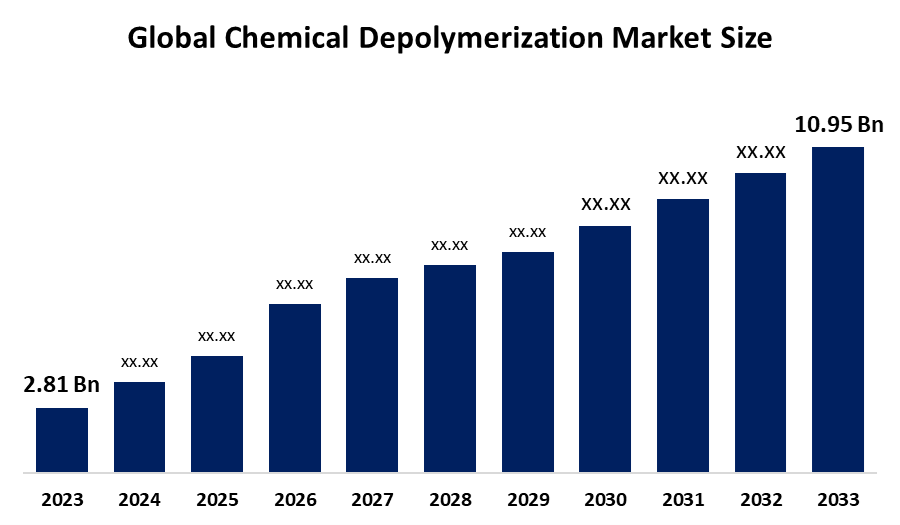
- The Global Chemical Depolymerization Market Size Was Estimated at USD 2.81 Billion in 2024
- The Market Size is Expected to Grow at a CAGR of around 13.16% from 2025 to 2035
- The Worldwide Chemical Depolymerization Market Size is Expected to Reach USD 10.95 Billion by 2035
- North America is expected to grow the fastest during the forecast period.
Get more details on this report -
According to a Research Report Published by Spherical Insights and Consulting, The Global Chemical Depolymerization Market Size was worth around USD 2.81 Billion in 2024 and is predicted to grow to around USD 10.95 Billion by 2035 with a compound annual growth rate (CAGR) of 13.16% from 2025 and 2035. The market for chemical depolymerization has a number of opportunities to grow due to the development of new analytical methods for depolymerization and advancement in chemical recycling.
Market Overview
The global Chemical Depolymerization Market Size refers to the industry involving technologies that break down complex plastic polymers into their original monomers or oligomers, enabling the creation of new, virgin-quality plastics. Chemical depolymerization ultimately facilitates the production of renewable fuels and chemicals. It is required to handle mixed, contaminated, or multi-layer plastics that mechanical recycling cannot process, ultimately supporting a circular economy, particularly in packaging and textiles. They are emphasizing on converting waste plastic (particularly PET and polyolefins) back into high-quality, virgin environment monomers. The use of advanced catalysts, AI-driven optimization, and hybrid methods enhances selectivity and reduces energy consumption.
Innovation and market expansion are anticipated as a result of major players' growing R&D expenditures and the expanding partnerships between industries. For instance, in June 2021, SK Global Chemical announced a strategic investment in Loop Industries to recycle waste PET plastic and polyester fiber.
Report Coverage
This research report categorizes the Chemical Depolymerization Market Size based on various segments and regions, forecasts revenue growth, and analyzes trends in each submarket. The report analyses the key growth drivers, opportunities, and challenges influencing the Chemical Depolymerization Market Size. Recent market developments and competitive strategies such as expansion, type launch, development, partnership, merger, and acquisition have been included to draw the competitive landscape in the market. The report strategically identifies and profiles the key market players and analyses their core competencies in each sub-segment of the Chemical Depolymerization Market Size.
Chemical Depolymerization Market Report Coverage
| Report Coverage | Details |
|---|---|
| Base Year: | 2024 |
| Market Size in 2024: | USD 2.81 Billion |
| Forecast Period: | 2025-2035 |
| Forecast Period CAGR 2025-2035 : | CAGR of 13.16% |
| 2035 Value Projection: | USD 10.95 Billion |
| Historical Data for: | 2020-2023 |
| No. of Pages: | 220 |
| Tables, Charts & Figures: | 120 |
| Segments covered: | By Process Type, By End-Use |
| Companies covered:: | BASF SE, JEPLAN, Inc., Eastman Chemical Company, Loop Industries, Inc., GEM, Wankai New Materials, Teijin Limited, Mitsubishi Chemical Group Corporation, and other key players |
| Pitfalls & Challenges: | COVID-19 Empact, Challenge, Future, Growth, & Analysis |
Get more details on this report -
Driving Factors
An increasing demand and policy frameworks supporting the recycling of hard-to-recycle plastics, with the demand for more sustainable waste management, are primarily driving the Chemical Depolymerization Market Size. Recycling complex, colored, and contaminated plastic waste into high-purity feedstocks for applications like food-contact, textile, and engineering polymers, driving the need for chemical depolymerization, which ultimately leads to market growth. In addition, usage of chemically recycled plastics across automotive, electrical & electronics, packaging, textiles, and building and construction industries is driving the market demand.
Restraining Factors
The Chemical Depolymerization Market Size is restricted by factors like increased capital requirements and uneven availability of suitable waste feedstocks. Further, technical complexity and economic uncertainty, especially during the scale-up from pilot to commercial operations, are hampering the market growth.
Market Segmentation
The Chemical Depolymerization Market Size share is classified into process type and end-use.
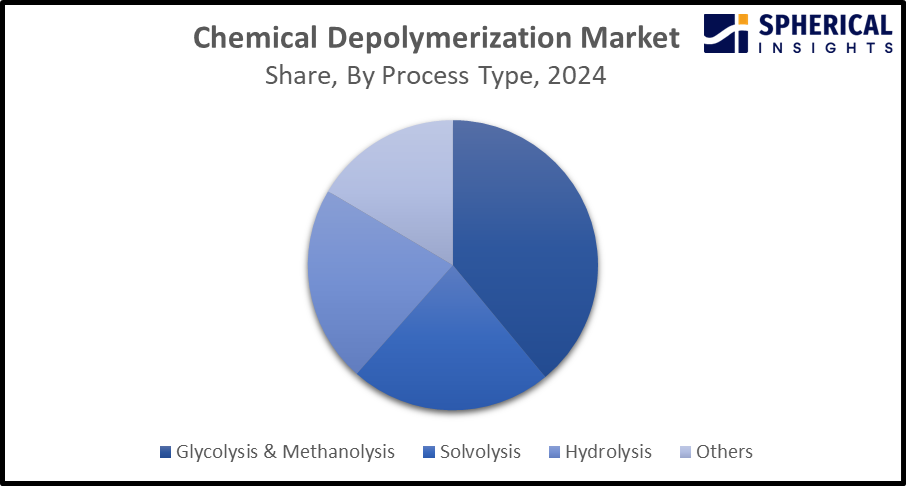
- The glycolysis and methanolysis segment dominated the market with about 35.5% share in 2024 and is projected to grow at a substantial CAGR during the forecast period.
Based on the process type, the Chemical Depolymerization Market Size is divided into glycolysis & methanolysis, solvolysis, hydrolysis, and others. Among these, the glycolysis and methanolysis segment dominated the market with about 35.5% share in 2024 and is projected to grow at a substantial CAGR during the forecast period. Glycolysis and methanolysis as depolymerization technique for polyethylene terephthalate (PET) waste into monomers for producing high-quality, virgin-like plastics, offering higher efficacy and better purity for contaminated feedstocks. Most of the large-scale programs rely on glycolysis and methanolysis as the primary processing backbone for chemical depolymerization operations, which is responsible for segmental market growth.
Get more details on this report -
- The food & beverage packaging segment accounted for the largest share of around 39.7% in 2024 and is anticipated to grow at a significant CAGR during the forecast period.
Based on the end-use, the Chemical Depolymerization Market Size is divided into food & beverage packaging, consumer goods & textiles, industrial packaging, high-purity resin supply, emerging chemical recycling, and others. Among these, the food & beverage packaging segment accounted for the largest share of around 39.7% in 2024 and is anticipated to grow at a significant CAGR during the forecast period. The packaging sector in this industry depends on stable resin specifications that align with depolymerization routes that help to rebuild feedstock to near virgin quality. Food companies like Coca-Cola, Danone, Unilever, PepsiCo, and Nestle are inclining towards increasing usage of recycled plastics in the packaging, which is propelling the market growth.
Regional Segment Analysis of the Chemical Depolymerization Market Size
- North America (U.S., Canada, Mexico)
- Europe (Germany, France, U.K., Italy, Spain, Rest of Europe)
- Asia-Pacific (China, Japan, India, Rest of APAC)
- South America (Brazil and the Rest of South America)
- The Middle East and Africa (UAE, South Africa, Rest of MEA)
Asia Pacific is anticipated to hold the largest share of the Chemical Depolymerization Market Size over the predicted timeframe.

Get more details on this report -
Asia Pacific is anticipated to hold the largest share of over 41.5% in the Chemical Depolymerization Market Size over the predicted timeframe. The market ecosystem in North America is strong, driven by regulations, sustainable packaging demand, and innovations in pyrolysis and depolymerization. Due to the establishment of waste recycling innovation, playing a significant role in propelling the market's expansion. For instance, in February 2025, SK chemicals to establish a waste plastic recycling innovation center in Korea. China leads the Asia Pacific Chemical Depolymerization Market Size, with the largest regional share and CAGR of approximately 14.8%, owing to the presence of large-scale polymer production, increasing plastic waste recovery, and industrial investment in depolymerization systems.
North America is expected to grow at a rapid CAGR of around 9.2% in the Chemical Depolymerization Market Size during the forecast period. The Asia Pacific area has a thriving market for chemical depolymerization due to the challenges faced by plastic pollution and demand for innovative waste management solutions. Further establishment of a chemical recycling plant is contributing to promoting the Chemical Depolymerization Market Size. For instance, in December 2025, Rohm awarded NextChem a feasibility study for the PMMA-polymer chemical recycling plant project. Leveraging NEXTCHEM's proprietary NXRe technology, an advanced and efficient molten metal depolymerization process enables the continuous chemical recycling of PMMA. The U.S. is dominating the regional market, with a nearly 14.8% CAGR, driven by large stock feedstock processing in industrial recycling plants, as well as adoption by packaging manufacturers, industrial polymer users, and corporate sustainability programs.
Competitive Analysis:
The report offers the appropriate analysis of the key organizations/companies involved within the Chemical Depolymerization Market Size, along with a comparative evaluation primarily based on their type of offering, business overviews, geographic presence, enterprise strategies, segment market share, and SWOT analysis. The report also provides an elaborative analysis focusing on the current news and developments of the companies, which includes type development, innovations, joint ventures, partnerships, mergers & acquisitions, strategic alliances, and others. This allows for the evaluation of the overall competition within the market.
List of Key Companies
- BASF SE
- JEPLAN, Inc.
- Eastman Chemical Company
- Loop Industries, Inc.
- GEM
- Wankai New Materials
- Teijin Limited
- Mitsubishi Chemical Group Corporation
- Others
Key Target Audience
- Market Players
- Investors
- End-users
- Government Authorities
- Consulting And Research Firm
- Venture capitalists
- Value-Added Resellers (VARs)
Recent Development
- In August 2025, SK Chemicals’ strong first-quarter earnings came as a surprise to investors, defying the ongoing slump in the domestic petrochemical industry following a global economic slowdown and an oversupply of low-priced Chinese products.
- In January 2025, Princeton Chem discovers that common plastic pigment promotes depolymerization. Researchers have shown that a common plastic additive called carbon black can depolymerize polystyrene and polyvinyl chloride (PVC), two of the least recycled plastics in the planet’s waste stream.
- In November 2024, ExxonMobil's Dollar 200 Million Investment Pioneering Chemical Recycling for a Circular Economy. This strategic investment is a great move towards sustainability and a solution to convert hard-to-recycle plastics into usable raw materials.
- In July 2024, Pennsylvania-based Trinseo opened its polymethyl methacrylate (PMMA) depolymerization facility in Rho, Italy, for wider production after inaugurating the plant. The pilot facility is equipped with chemical recycling depolymerization technology designed to convert end-of-life acrylic products to a constituent monomer, methyl methacrylate (MMA).
- In June 2023, BASF Venture Capital GmbH (BVC), the corporate venture company of the BASF Group, announced an investment in the Swiss startup DePoly SA (DePoly), a sustainable plastic solutions provider developing a unique chemical recycling technology.
Market Segment
This study forecasts revenue at global, regional, and country levels from 2020 to 2035. Spherical Insights has segmented the Chemical Depolymerization Market Size based on the below-mentioned segments:
Global Chemical Depolymerization Market Size, By Process Type
- Glycolysis & Methanolysis
- Solvolysis
- Hydrolysis
- Others
Global Chemical Depolymerization Market Size, By End-Use
- Food & Beverage Packaging
- Consumer Goods & Textiles
- Industrial Packaging
- High-Purity Resin Supply
- Emerging Chemical Recycling
- Others
Global Chemical Depolymerization Market Size, By Regional Analysis
- North America
- US
- Canada
- Mexico
- Europe
- Germany
- UK
- France
- Italy
- Spain
- Russia
- Rest of Europe
- Asia Pacific
- China
- Japan
- India
- South Korea
- Australia
- Rest of Asia Pacific
- South America
- Brazil
- Argentina
- Rest of South America
- Middle East & Africa
- UAE
- Saudi Arabia
- Qatar
- South Africa
- Rest of the Middle East & Africa
Frequently Asked Questions (FAQ)
-
1. What is the market size of the Chemical Depolymerization Market Size?The global Chemical Depolymerization Market Size is expected to grow from USD 2.81 Billion in 2024 to USD 10.95 Billion by 2035, at a CAGR of 13.16% during the forecast period 2025-2035.
-
2. Which region holds the largest share of the Chemical Depolymerization Market Size?Asia Pacific is anticipated to hold the largest share of the Chemical Depolymerization Market Size over the predicted timeframe.
-
3. What is the forecasted CAGR of the Global Chemical Depolymerization Market Size from 2024 to 2035?The market is expected to grow at a CAGR of around 13.16% during the period 2024–2035.
-
4. Who are the top companies that are involved in the Global Chemical Depolymerization Market Size?Key players include BASF SE, JEPLAN, Inc., Eastman Chemical Company, Loop Industries, Inc., GEM, Wankai New Materials, Teijin Limited, and Mitsubishi Chemical Group Corporation.
-
5. What are the main drivers in the Chemical Depolymerization Market Size?The policy frameworks supporting the recycling of hard-to-recycle plastics, as well as usage of chemically recycled plastics across automotive, electrical & electronics, packaging, textiles, and building and construction industries are major market growth drivers of the Chemical Depolymerization Market Size.
-
6. What challenges are limiting the adoption of chemical depolymerization treatment?Increased capital requirements, uneven availability of suitable waste feedstocks, technical complexity, and economic uncertainty remain key restraints in the Chemical Depolymerization Market Size.
-
7. What are the key trends in the Chemical Depolymerization Market Size?Advancements in chemical recycling, along with the use of advanced catalysts, AI-driven optimization, and hybrid methods that enhance selectivity and reduce energy consumption, are a key trend in the market.
Need help to buy this report?