Global Cataplexy Treatment Market Size, Share, and COVID-19 Impact Analysis, By Treatment (Sodium Oxybate, Tricyclic Antidepressant, Amphetamines, Selective Serotonin Reuptake Inhibitors (SSRIs), and Modafinil), By Diagnosis (Physical Evaluation, Written Evaluation, Polysomnogram, and Multiple Sleep Latency Test (MSLT)), By Symptoms (Drooping Eyelids, Jaw Tremor, Facial Twitching, Flickering, Speech Difficulty, and Others), and By Region (North America, Europe, Asia-Pacific, Latin America, Middle East, and Africa), Analysis and Forecast 2025 - 2035
Industry: Healthcare
Global Cataplexy Treatment Market Size Insights Forecasts to 2035
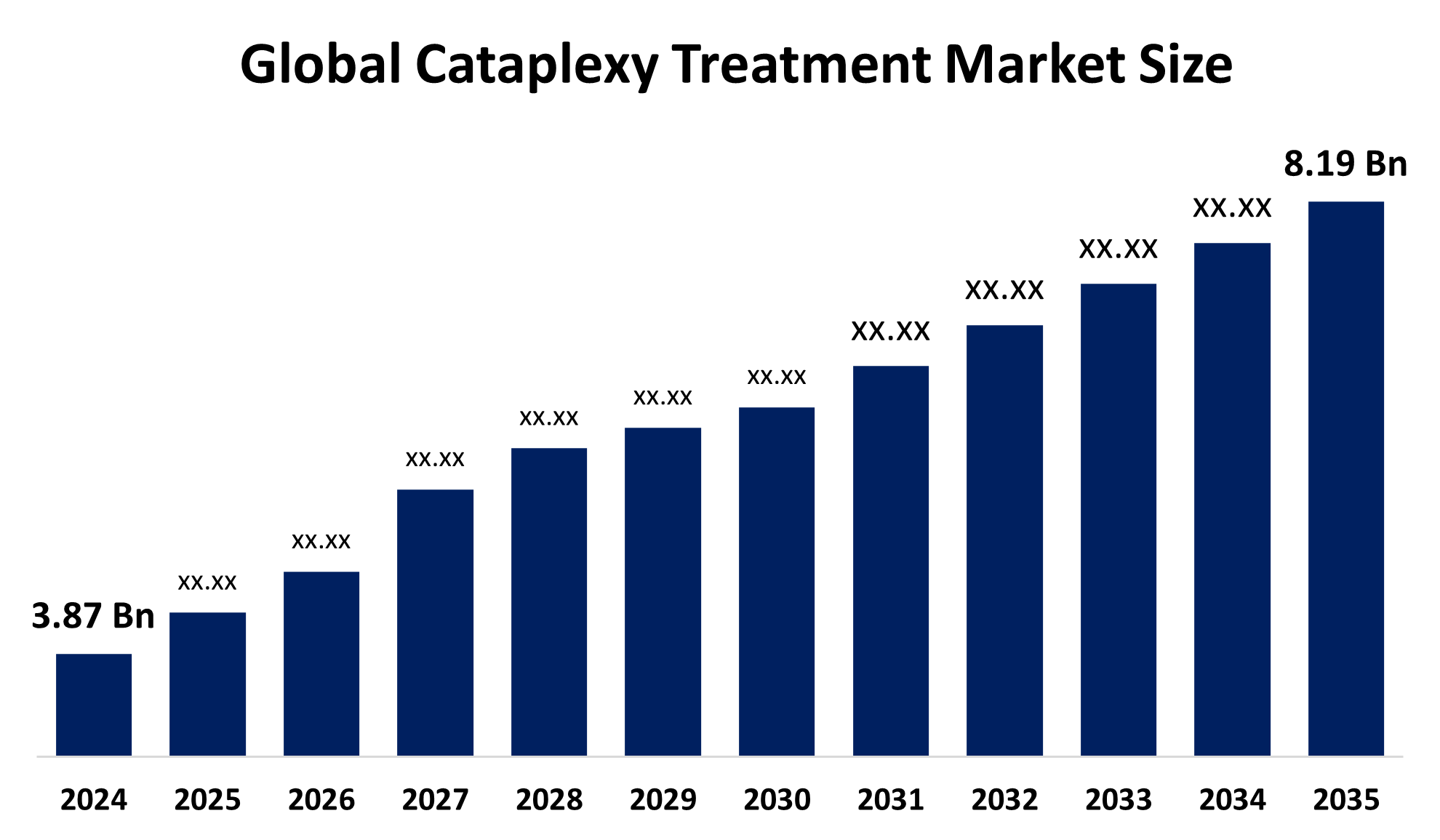
- The Global Cataplexy Treatment Market Size Was Estimated at USD 3.87 Billion in 2024
- The Market Size is Expected to Grow at a CAGR of around 7.05% from 2025 to 2035
- The Worldwide Cataplexy Treatment Market Size is Expected to Reach USD 8.19 Billion by 2035
- Asia Pacific is expected to grow the fastest during the forecast period.
Get more details on this report -
According to a research report published by Spherical Insights and Consulting, The Global Cataplexy Treatment Market Size was worth around USD 3.87 Billion in 2024 and is Predicted to Grow to around USD 8.19 Billion by 2035 with a Compound Annual Growth Rate (CAGR) of 7.05% from 2025 and 2035. The market for cataplexy treatment has a number of opportunities to grow due to increasing awareness, diagnosis, and demand for safer, more effective therapies, and personalized medicine approach. Further, the emergence of telemedicine and the digital sleep monitoring platforms in the cataplexy treatment is promoting the market growth.
Market Overview
The Global Cataplexy Treatment Market industry is associated with the broader narcolepsy therapeutics market, experiencing growth due to increasing diagnosis rates and new, targeted, or novel drugs. Cataplexy treatment mainly includes sodium oxybates and stimulants, with a strong emphasis on improving quality of life. Cataplexy is one of the main symptoms of narcolepsy type 1, involving sudden and brief muscle weakness triggered by strong emotions such as laughter, excitement or anger. About 75% of people with narcolepsy experience cataplexy as a part of the condition. Medication (mainly including sodium oxybate, lower sodium oxybate, and pitolisant) is the main treatment for cataplexy, while wake-promoting therapy often helps.
Innovation and market expansion are anticipated as a result of major players' growing R&D expenditures and the expanding partnerships between the pharmaceutical industries. For instance, in March 2023, Avadel Pharmaceuticals plc, a biopharmaceutical company, announced its entry into a royalty agreement with RTW Investments, LP and certain of its affiliates for up to 75 million to support the potential commercialization of LUMRYZ for the treatment of cataplexy or excessive daytime sleepiness (EDS) in adults with narcolepsy.
Report Coverage
This research report categorizes the Global Cataplexy Treatment Market based on various segments and regions, forecasts revenue growth, and analyzes trends in each submarket. The report analyses the key growth drivers, opportunities, and challenges influencing the cataplexy treatment market. Recent market developments and competitive strategies such as expansion, type launch, development, partnership, merger, and acquisition have been included to draw the competitive landscape in the market. The report strategically identifies and profiles the key market players and analyses their core competencies in each sub-segment of the cataplexy treatment market.
Global Cataplexy Treatment Market Report Coverage
| Report Coverage | Details |
|---|---|
| Base Year: | 2024 |
| Market Size in 2024: | USD 3.87 Billion |
| Forecast Period: | 2025-2035 |
| Forecast Period CAGR 2025-2035 : | 7.05% |
| 2035 Value Projection: | USD 8.19 Billion |
| Historical Data for: | 2020-2023 |
| No. of Pages: | 195 |
| Tables, Charts & Figures: | 102 |
| Segments covered: | By Treatment, By Diagnosis |
| Companies covered:: | Jazz Pharmaceuticals, Inc., Avadel, Axsome Therapeutics, Inc., Harmony Biosciences Management, Inc., Takeda Pharmaceutical Company Limited |
| Pitfalls & Challenges: | and COVID-19 Impact Analysis |
Get more details on this report -
Driving Factors
An increasing awareness sleep related disorder among patients with type 1 narcolepsy is contributing to driving the market demand for cataplexy treatment. Advancements in therapy targeting cataplexy, with the ongoing drug development focusing on histamine H3-receptor modulation, safer formulations of oxybate, and groundbreaking orexin (hypocretin) receptor agonists, are promoting market growth. In addition, the increased prevalence of cataplexy diagnosis is anticipated to propel the market demand. Prevalence studies have indicated rates ranging from 12.6 to 79.4 per 100,000 individuals, often with higher rates in females and adults aged 21-30.
Restraining Factors
The Global Cataplexy Treatment Market is restricted by factors like increased treatment costs and limited accessibility in emerging economies. Further, the lack of awareness, low diagnostic rates, strict regulations on narcolepsy drugs, and some side effects related to therapies are challenging the market growth.
Market Segmentation
The cataplexy treatment market share is classified into treatment, diagnosis, and symptoms.
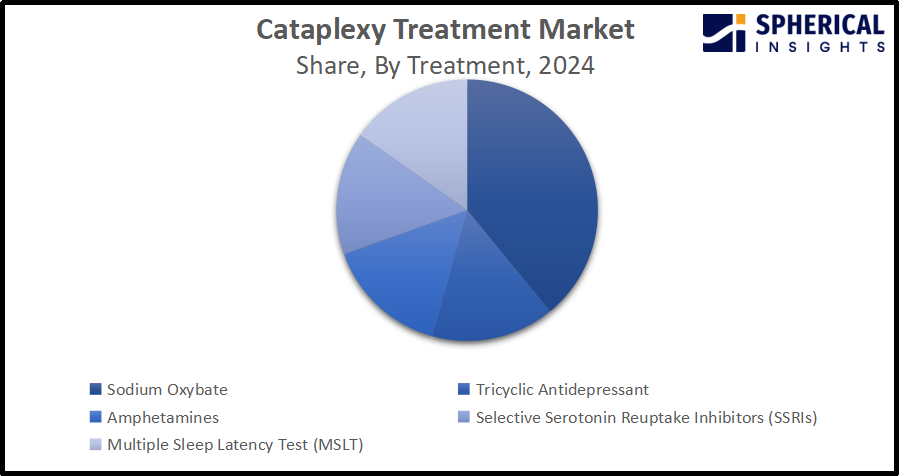
- The sodium oxybate segment dominated the market with the largest share of about 38.5% in 2024 and is projected to grow at a substantial CAGR during the forecast period.
Based on the treatment, the Global Cataplexy Treatment Market is divided into sodium oxybate, tricyclic antidepressant, amphetamines, selective serotonin reuptake inhibitors (SSRIs), and modafinil. Among these, the sodium oxybate segment dominated the market with the largest share of about 38.5% in 2024 and is projected to grow at a substantial CAGR during the forecast period. Sodium oxybate is a medication that helps manage and treat narcolepsy with cataplexy or excessive daytime sleepiness. The medication belongs to the central nervous system (CNS) depressant class of drugs. Its established efficacy in reducing cataplexy attacks and improving overall sleep in narcolepsy patients is responsible for driving the market demand.
Get more details on this report -
- The polysomnogram segment accounted for the dominant market share of over 50.0% in 2024 and is anticipated to grow at a significant CAGR during the forecast period.
Based on the diagnosis, the Global Cataplexy Treatment Market is divided into physical evaluation, written evaluation, polysomnogram, and multiple sleep latency test (MSLT). Among these, the polysomnogram segment accounted for the dominant market share of over 50.0% in 2024 and is anticipated to grow at a significant CAGR during the forecast period. Polysomnogram is a sleep study used for diagnosing sleep disorders, recording brain waves, the oxygen level in your blood, and your heart rate and breathing during sleep. Hospitals and sleep clinics heavily rely on this overnight test to develop personalized treatment plans. The diagnosis is widely regarded as the gold standard for clinical evaluation, for precise identification, enabling physicians to monitor therapy effectiveness over time.
- The drooping eyelids segment accounted for the dominant market share of over 50.0% in 2024 and is anticipated to grow at a significant CAGR during the forecast period.
Based on the symptoms, the Global Cataplexy Treatment Market is divided into drooping eyelids, jaw tremor, facial twitching, flickering, speech difficulty, and others. Among these, the drooping eyelids segment accounted for the dominant market share of over 50.0% in 2024 and is anticipated to grow at a significant CAGR during the forecast period. Ptosis (drooping eyelids) characterized by the upper eyelid drooping over the eye, that may be barely noticeable, or the eyelid can sag to such an extent that it covers your pupil (the black dot at the centre of your eye that lets light in). Ptosis can limit or even completely block normal vision and can affect both children and adults. With their increased prevalence, the strong awareness campaigns among caregivers and physicians, are driving the segmental market.
Regional Segment Analysis of the Cataplexy Treatment Market
- North America (U.S., Canada, Mexico)
- Europe (Germany, France, U.K., Italy, Spain, Rest of Europe)
- Asia-Pacific (China, Japan, India, Rest of APAC)
- South America (Brazil and the Rest of South America)
- The Middle East and Africa (UAE, South Africa, Rest of MEA)
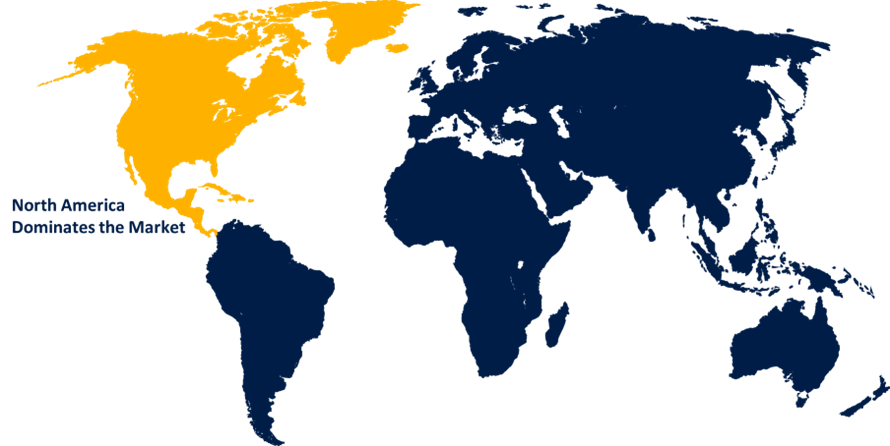
North America is anticipated to hold the largest share of the Cataplexy Treatment market over the predicted timeframe.
Get more details on this report -
North America is anticipated to hold the largest share of around 45.5% in the Global Cataplexy Treatment Market over the predicted timeframe. The demand for cataplexy treatment has been driven by the region's increased diagnostic cases of narcolepsy, healthcare amenities, and the presence of well-known healthcare industries. With increasing innovative cataplexy treatment products, partnerships with other pharma industries played a significant role in propelling the market's expansion. For instance, in August 2021, Harmony Biosciences Holdings, Inc. and Blackstone announced that they had entered into a strategic financing collaboration where funds managed by Blackstone have agreed to provide Harmony with up to $330 million of financing and growth capital. The US is dominating the North America market, with the largest share of about 82.5% in 2024, driven by an increasing awareness, access to advanced therapies such as sodium oxybate, SSRIs, and tricyclic antidepressants for effective symptom management, adoption of specialist sleep clinics, coupled with strong insurance coverage and government support programs.
Asia Pacific is expected to grow at a rapid CAGR of about 22.0% in the Global Cataplexy Treatment Market during the forecast period. The Asia Pacific area has a thriving market for cataplexy treatment due to its increasing incidence of sleep disorders, increasing number of senior people and obese people, working people's lifestyle, and chronic health conditions. The government's increasing focus of sleep aid manufacturers in R&D activities is contributing to escalate market. The promotion of strategic partnerships between global healthcare companies for the development and commercialization of innovative products is driving the regional market growth. For instance, in October 2025, Viatris Completes Acquisition of Aculys Pharma, Including Exclusive Rights to Pitolisant in Japan and to Spydia in Japan and Certain Other Markets in the Asia-Pacific Region. India cataplexy treatment market accounted for the largest revenue share in Asia-Pacific, owing to growing urbanization and disposable incomes that enable accessibility to specialized sleep therapies.
Competitive Analysis:
The report offers the appropriate analysis of the key organizations/companies involved within the Global Cataplexy Treatment Market, along with a comparative evaluation primarily based on their type of offering, business overviews, geographic presence, enterprise strategies, segment market share, and SWOT analysis. The report also provides an elaborative analysis focusing on the current news and developments of the companies, which includes type development, innovations, joint ventures, partnerships, mergers & acquisitions, strategic alliances, and others. This allows for the evaluation of the overall competition within the market.
List of Key Companies
- Jazz Pharmaceuticals Inc.
- Avadel
- Axsome Therapeutics Inc
- Harmony Biosciences Management Inc.
- Takeda Pharmaceutical Company Limited
- Teva Pharmaceutical Industries Ltd.
- NLS Pharmaceutics Ltd.
- Amneal Pharmaceuticals Ltd
Key Target Audience
- Market Players
- Investors
- End-users
- Government Authorities
- Consulting And Research Firm
- Venture capitalists
- Value-Added Resellers (VARs)
Recent Development
- In February 2026, Harmony Biosciences announced that the U.S. Food and Drug Administration (FDA) had approved its supplemental new drug application (sNDA) for WAKIX (pitolisant) tablets for the treatment of cataplexy in pediatric patients 6 years of age and older with narcolepsy.
- In December 2025, Tris Pharma, Inc. (Tris), a commercial-stage biopharmaceutical company focused on developing innovative therapies for unmet needs, announced that the U.S. Food and Drug Administration (FDA) had accepted the company’s New Drug Application (NDA) for TRN-257 for the treatment of cataplexy or excessive daytime sleepiness (EDS).
- In September 2025, US-based Amneal Pharmaceuticals secured approval from the US Food and Drug Administration (FDA) for its 500mg/mL sodium oxybate oral solution. The solution is prescribed for managing cataplexy and excessive daytime sleepiness (EDS) in individuals with narcolepsy.
- In June 2025, Jazz Pharmaceuticals plc announced late-breaking Phase 4 data evaluating treatment benefits of Xywav (calcium, magnesium, potassium, and sodium oxybates) oral solution in people with narcolepsy.
- In October 2024, The Food and Drug Administration (FDA) has expanded the approval of Lumryz (sodium oxybate) extended-release oral suspension to include treatment of cataplexy or excessive daytime sleepiness (EDS) in patients 7 years of age and older with narcolepsy.
Market Segment
This study forecasts revenue at global, regional, and country levels from 2020 to 2035. Spherical Insights has segmented the Global Cataplexy Treatment Market based on the below-mentioned segments:
Global Cataplexy Treatment Market, By Treatment
- Sodium Oxybate
- Tricyclic Antidepressant
- Amphetamines
- Selective Serotonin Reuptake Inhibitors (SSRIs)
- Modafinil
Global Cataplexy Treatment Market, By Diagnosis
- Physical Evaluation
- Written Evaluation
- Polysomnogram
- Multiple Sleep Latency Test (MSLT)
Global Cataplexy Treatment Market, By Symptoms
- Drooping Eyelids
- Jaw Tremor
- Facial Twitching
- Flickering
- Speech Difficulty
- Others
Global Cataplexy Treatment Market, By Regional Analysis
- North America
- US
- Canada
- Mexico
- Europe
- Germany
- UK
- France
- Italy
- Spain
- Russia
- Rest of Europe
- Asia Pacific
- China
- Japan
- India
- South Korea
- Australia
- Rest of Asia Pacific
- South America
- Brazil
- Argentina
- Rest of South America
- Middle East & Africa
- UAE
- Saudi Arabia
- Qatar
- South Africa
- Rest of the Middle East & Africa
Frequently Asked Questions (FAQ)
-
1.What is the market size of the cataplexy treatment market?The global cataplexy treatment market size is expected to grow from USD 3.87 Billion in 2024 to USD 8.19 Billion by 2035, at a CAGR of 7.05% during the forecast period 2025-2035.
-
2.Which region holds the largest share of the cataplexy treatment market?North America is anticipated to hold the largest share of the cataplexy treatment market over the predicted timeframe.
-
3.What is the forecasted CAGR of the Global Cataplexy treatment Market from 2024 to 2035?The market is expected to grow at a CAGR of around 7.05% during the period 2024–2035.
-
4.Who are the top companies that are involved in the Global Cataplexy treatment Market?Key players include Jazz Pharmaceuticals, Inc., Avadel, Axsome Therapeutics, Inc., Harmony Biosciences Management, Inc., Takeda Pharmaceutical Company Limited, Teva Pharmaceutical Industries Ltd., NLS Pharmaceutics Ltd., Amneal Pharmaceuticals LLC, Alkermes, Idorsia Pharmaceuticals Ltd, BIOPROJET, Eisai Co., Ltd., UCB S.A., Otsuka Pharmaceutical Co., Ltd., and Sosei Heptares Ltd.
-
5.What are the main drivers in the cataplexy treatment market?An increasing awareness sleep related disorder, advancements in therapy targeting cataplexy, and increased prevalence of cataplexy diagnosis, are major market growth drivers of the cataplexy treatment market.
-
6.What challenges are limiting the adoption of cataplexy treatment treatment?Increased treatment cost, limited accessibility, lack of awareness, low diagnostic rates, strict regulations, and some side effects related to therapies remain key restraints in the cataplexy treatment market.
-
7.What are the key trends in the cataplexy treatment market?The emergence of telemedicine and the digital sleep monitoring platforms, as well as advancements in therapy targeting cataplexy and in drug development, are key trends in the market.
Need help to buy this report?