Global Carbon Capture and Storage Market Size, Share, and COVID-19 Impact Analysis, By Technology (Post combustion, Industrial Process, Pre-combustion, and Oxy-Combustion), By Application (Power generation, Oil & Gas, Metal production, Cement, and Others), and by Region (North America, Europe, Asia-Pacific, Latin America, Middle East, and Africa), Analysis and Forecast 2025 - 2035
Industry: Energy & Power
Global Carbon Capture and Storage Market Insights Forecasts to 2035
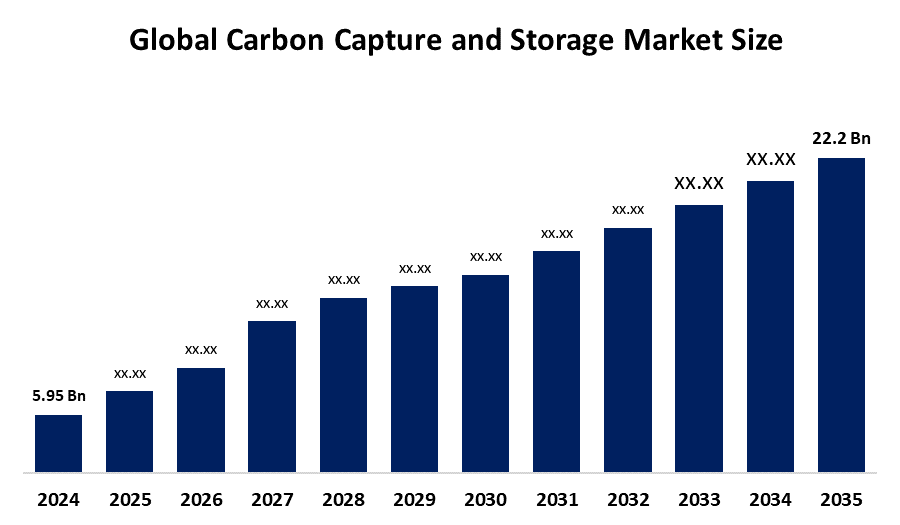
- The Global Carbon Capture and Storage Market Size Was Estimated at USD 5.95 Billion in 2024
- The Market Size is Expected to Grow at a CAGR of around 12.72 % from 2025 to 2035
- The Worldwide Carbon Capture and Storage Market Size is Expected to Reach USD 22.2 Billion by 2035
- North America is expected to grow the fastest during the forecast period.
Get more details on this report -
According to a research report published by Spherical Insights and Consulting, The Global Carbon Capture And Storage Market Size Was Worth Around USD 5.95 Billion in 2024 And is Predicted to Grow to Around USD 22.2 Billion by 2035 with a Compound Annual Growth Rate (CAGR) of 12.72% from 2025 to 2035. The carbon capture and storage market offers opportunities in reducing industrial emissions, scaling clean energy projects, enhancing oil recovery, regulatory carbon pricing benefits, and advancing climate goals. Growth is fueled by government incentives, technological innovation, and expanding global deployment across sectors.
Market Overview
The Carbon Capture and Storage (CCS) Market Size is gaining strong momentum as governments and industries intensify efforts to reduce greenhouse gas emissions and achieve net-zero targets. CCS involves capturing carbon dioxide from industrial processes and power generation, transporting it, and securely storing it underground to prevent atmospheric release. The market is driven by stringent climate regulations, rising carbon pricing mechanisms, and growing investments in low-carbon technologies across energy, cement, steel, and chemical sectors. Technological advancements in capture methods and storage monitoring are improving efficiency and cost-effectiveness. North America and Europe currently dominate due to supportive policies and large-scale projects, while Asia Pacific is emerging rapidly, supported by industrial expansion and increasing climate commitments from developing economies.
Report Coverage
This research report categorizes the Global Carbon Capture And Storage Market Size based on various segments and regions, forecasts revenue growth, and analyzes trends in each submarket. The report analyses the key growth drivers, opportunities, and challenges influencing the carbon capture and storage market. Recent market developments and competitive strategies, such as expansion, product launch, development, partnership, merger, and acquisition, have been included to draw the competitive landscape in the market. The report strategically identifies and profiles the key market players and analyzes their core competencies in each sub-segment of the carbon capture and storage market.
Carbon Capture and Storage Market Report Coverage
| Report Coverage | Details |
|---|---|
| Base Year: | 2024 |
| Market Size in 2024: | USD 5.95 Billion |
| Forecast Period: | 2024-2035 |
| Forecast Period CAGR 2024-2035 : | CAGR of 12.72% |
| 2035 Value Projection: | USD 22.2 Billion |
| Historical Data for: | 2020-2023 |
| No. of Pages: | 240 |
| Tables, Charts & Figures: | 104 |
| Segments covered: | By Technology, By Application |
| Companies covered:: | Aker Solutions ASA, Dakota Gasification, Equinor ASA, Fluor Corp, Linde PLC, Mitsubishi Corporation, Shell PLC, Sulzer AG, and Other Key Players |
| Pitfalls & Challenges: | COVID-19 Empact, Challenges, Future, Growth, & Analysis |
Get more details on this report -
Driving Factors
The growth of the Global Carbon Capture And Storage Market Size is driven by stringent climate change regulations, rising carbon emission penalties, and global net-zero commitments. Increasing industrial CO2 emissions from power generation, cement, steel, and chemical industries are accelerating CCS adoption. Government funding, tax incentives, and supportive policies further boost market growth. Additionally, technological advancements in capture efficiency, transportation infrastructure, and long-term storage safety are reducing operational costs and improving the commercial viability of CCS projects worldwide.
Restraining Factors
High capital and operational costs, complex infrastructure requirements, limited storage sites, regulatory uncertainties, and public concerns over long-term CO2 storage safety are key factors restraining widespread CCS adoption.
Market Segmentation
The carbon capture and storage market share is classified into technology and application.
- The post combustion segment accounted for the largest share in 2024 and is anticipated to grow at a significant CAGR during the forecast period.
Based on the technology, the Global Carbon Capture And Storage Market Size is divided into post combustion, industrial process, pre-combustion, and oxy-combustion. Among these, the post combustion segment accounted for the largest share in 2024 and is anticipated to grow at a significant CAGR during the forecast period. This is because post-combustion systems can be easily retrofitted to existing power plants and industrial facilities, making them widely adopted globally. Post-combustion is also anticipated to grow at a significant CAGR during the forecast period due to ongoing investments, technological improvements, and strong demand for retrofit solutions across sectors.
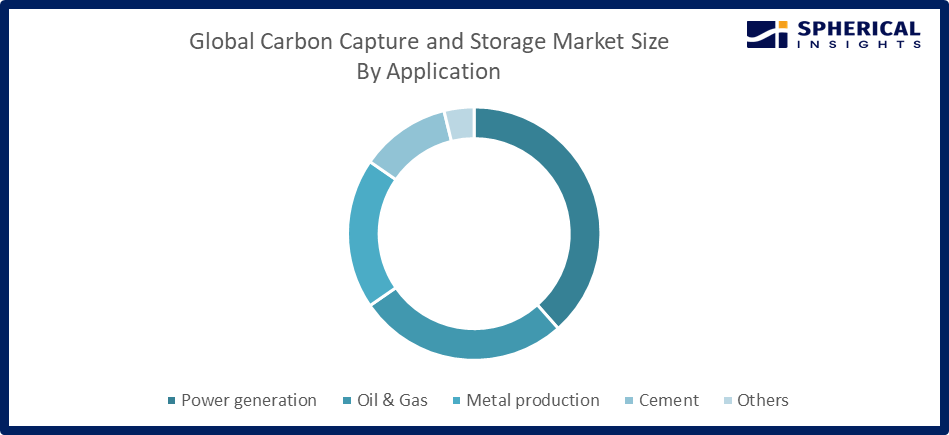
- The power generation segment accounted for the highest market revenue in 2024 and is anticipated to grow at a significant CAGR during the forecast period.
Based on the application, theGlobal Carbon Capture And Storage Market Size is divided into power generation, oil & gas, metal production, cement, and others. Among these, the power generation segment accounted for the highest market revenue in 2024 and is anticipated to grow at a significant CAGR during the forecast period. This dominance is due to extensive adoption of CCS in fossil fuel-based power plants to curb high CO2 emissions under stringent environmental regulations, making power generation the largest revenue contributor in the market. It is also anticipated to grow at a significant CAGR over the forecast period as decarbonization efforts and investments in cleaner energy systems continue to expand globally.
Get more details on this report -
Regional Segment Analysis of the Carbon Capture and Storage Market
- North America (U.S., Canada, Mexico)
- Europe (Germany, France, U.K., Italy, Spain, Rest of Europe)
- Asia-Pacific (China, Japan, India, Rest of APAC)
- South America (Brazil and the Rest of South America)
- The Middle East and Africa (UAE, South Africa, Rest of MEA)
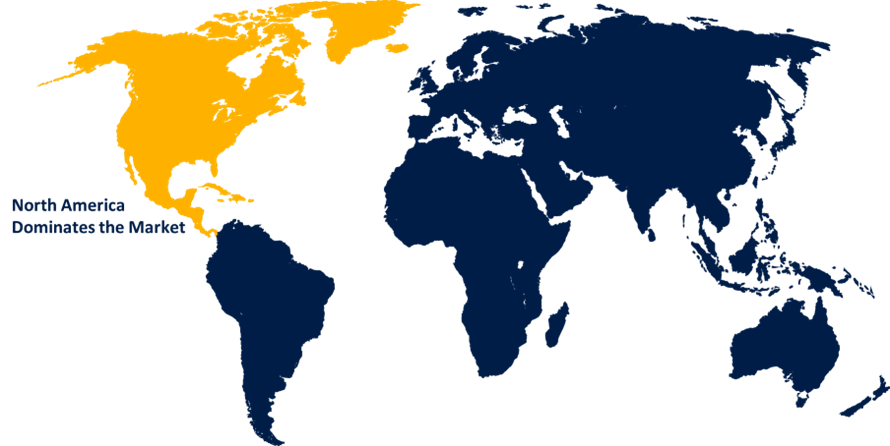
North America is anticipated to hold the largest share of the carbon capture and storage market over the predicted timeframe.
North America is anticipated to hold the largest share of the Global Carbon Capture And Storage Market Size over the predicted timeframe. The region has consistently led the global CCS market due to extensive infrastructure, supportive policy frameworks (such as tax incentives and regulatory mandates), and significant investment in large-scale carbon capture and storage projects in the United States and Canada. North America dominated in 2024 and is expected to maintain its leadership as demand for decarbonization technologies continues to grow across power generation, industrial, and energy sectors.
Get more details on this report -
Asia-Pacific is expected to grow at a rapid CAGR in the Global Carbon Capture And Storage Market Size during the forecast period. Asia-Pacific is expected to grow at a rapid CAGR in the carbon capture and storage market due to rapid industrialization, rising energy demand, and increasing CO2 emissions across power, cement, and steel sectors. Strong government climate commitments, expanding carbon reduction policies, growing investments in clean energy infrastructure, and international collaborations on decarbonization technologies further accelerate CCS adoption in countries such as China, India, and Australia.
Competitive Analysis:
The report offers the appropriate analysis of the key organizations/companies involved within the Global Carbon Capture And Storage Market Size ,along with a comparative evaluation primarily based on their product offering, business overviews, geographic presence, enterprise strategies, segment market share, and SWOT analysis. The report also provides an elaborative analysis focusing on the current news and developments of the companies, which includes product development, innovations, joint ventures, partnerships, mergers & acquisitions, strategic alliances, and others. This allows for the evaluation of the overall competition within the market.
List of Key Companies
- Aker Solutions ASA
- Dakota Gasification
- Equinor ASA
- Fluor Corp
- Linde PLC
- Mitsubishi Corporation
- Shell PLC
- Sulzer AG
Key Target Audience
- Market Players
- Investors
- End-users
- Government Authorities
- Consulting and Research Firm
- Venture capitalists
- Value-Added Resellers (VARs)
Market Segment
This study forecasts revenue at global, regional, and country levels from 2020 to 2035. Spherical Insights has segmented the Global Carbon Capture And Storage Market Size based on the below-mentioned segments:
Global Carbon Capture and Storage Market, By Technology
- Post combustion
- Industrial Process
- Pre-combustion
- Oxy-Combustion
Global Carbon Capture and Storage Market, By Application
- Power generation
- Oil & Gas
- Metal production
- Cement
- Others
Global Carbon Capture and Storage Market, By Regional Analysis
- North America
- US
- Canada
- Mexico
- Europe
- Germany
- UK
- France
- Italy
- Spain
- Russia
- Rest of Europe
- Asia Pacific
- China
- Japan
- India
- South Korea
- Australia
- Rest of Asia Pacific
- South America
- Brazil
- Argentina
- Rest of South America
- Middle East & Africa
- UAE
- Saudi Arabia
- Qatar
- South Africa
- Rest of the Middle East & Africa
Frequently Asked Questions (FAQ)
-
1. What is the CAGR of the carbon capture and storage market over the forecast period?The global carbon capture and storage market is projected to expand at a CAGR of 12.72% during the forecast period.
-
2. What is the market size of the carbon capture and storage market?The global carbon capture and storage market size is expected to grow from USD 5.95 billion in 2024 to USD 22.2 billion by 2035, at a CAGR of 12.72 % during the forecast period 2025-2035.
-
3. Which region holds the largest share of the carbon capture and storage market?North America is anticipated to hold the largest share of the carbon capture and storage market over the predicted timeframe.
-
4. Who are the top 10 companies operating in the global carbon capture and storage market?Aker Solutions ASA, Dakota Gasification, Equinor ASA, Fluor Corp, Linde PLC, Mitsubishi Corporation, Shell PLC, and Sulzer AG.
-
5. What factors are driving the growth of the carbon capture and storage market?Stringent climate regulations, net-zero targets, rising industrial emissions, carbon pricing mechanisms, government incentives, and technological advancements are driving the growth of the CCS market.
-
6. What are the market trends in the carbon capture and storage market?Key trends include large-scale CCS projects, strategic partnerships, advanced capture technologies, policy support, rising investments, and integration with hydrogen and utilization solutions.
-
7. What are the main challenges restricting the wider adoption of the carbon capture and storage market?High capital costs, complex infrastructure needs, limited storage sites, regulatory uncertainties, energy penalties, and public acceptance concerns restrict wider CCS adoption.
Need help to buy this report?