Canada Smart Home Security Market Size, Share, and COVID-19 Impact Analysis, By Component (Hardware, Software, and Services), By Device Type (Smart Alarms, Smart Locks, Smart Sensors and Detectors, Smart Cameras and Monitoring Systems, and Other Device Types), By Connectivity (Wireless, Wired, and Hybrid), and Canada Smart Home Security Market Insights, Industry Trend, Forecasts to 2035
Industry: Information & Technology
Canada Smart Home Security Market Size Insights Forecasts to 2035
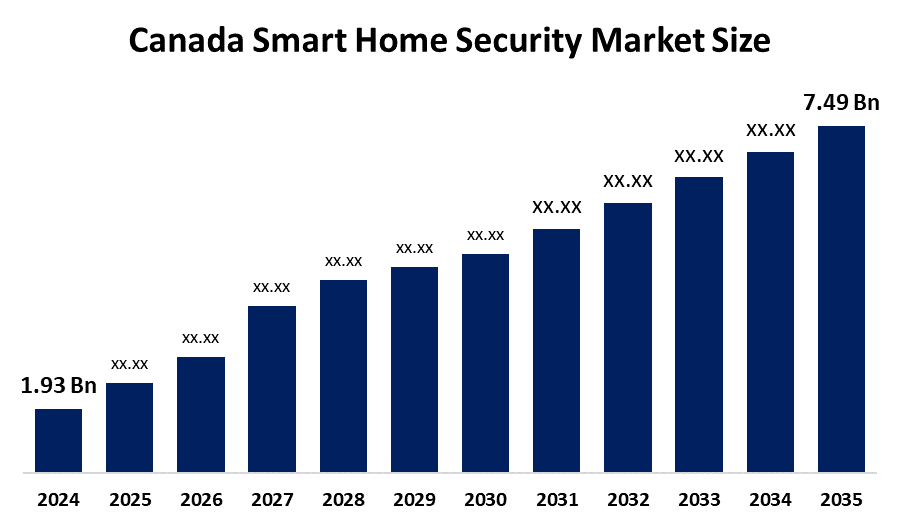
- The Canada Smart Home Security Market Size Was Estimated at USD 1.93 Billion in 2024
- The Market Size is Expected to Grow at a CAGR of Around 13.1% from 2025 to 2035
- The Canada Smart Home Security Market Size is Expected to Reach USD 7.49 Billion by 2035
Get more details on this report -
According to a research report published by Spherical Insights & Consulting, the Canada Smart Home Security market size is anticipated to reach USD 7.49 billion by 2035, growing at a CAGR of 13.1% from 2025 to 2035. The Canada Smart Home Security market is driven by the increasing adoption of smart homes, rising concerns about residential safety, the growth of IoT-connected devices, and the expansion of home automation ecosystems across Canada.
Market Overview
The Canada smart home security market refers to the industry focused on devices and platforms designed to monitor, detect, and prevent unauthorized access or safety threats within residential properties. The ecosystem comprises smart cameras together with doorbells and alarms, motion sensors, access control systems, monitoring software, and cloud-based security services. The market develops through technological progress of artificial intelligence, IoT connectivity, and remote monitoring applications, and smartphone-based home automation systems. People adopt smart security solutions because urban areas grow and their disposable income increases, and they become more aware of home security measures.
The Canadian home security market experiences rapid shifts in technology because artificial intelligence and connected living spaces bring new developments. The adoption of AI-powered monitoring solutions, which provide facial recognition and motion analytics and real-time threat detection capabilities, has increased because these systems deliver accurate results with minimal false alarms. The security devices establish connections with various smart home devices, which enables users to operate their entire smart home system through voice assistants, lighting systems, and home automation platforms. Homeowners can use mobile apps to monitor their properties through cloud-based subscription monitoring services, which include immediate security alert notifications.
The Canadian government supports the development of the smart home security market through its funding of smart city projects and digital infrastructure development, and the establishment of cybersecurity standards. The federal and provincial governments are promoting connected home technologies because they are expanding broadband internet access throughout the country.
Report Coverage
This research report categorizes the market for the Canada smart home security market based on various segments and regions, and forecasts revenue growth and analyses trends in each submarket. The report analyses the key growth drivers, opportunities, and challenges influencing the Canada smart home security market. Recent market developments and competitive strategies, such as expansion, product launch, development, partnership, merger, and acquisition have been included to draw the competitive landscape in the market. The report strategically identifies and profiles the key market players and analyses their core competencies in each sub-segment of the Canada smart home security market.
Canada Smart Home Security Market Report Coverage
| Report Coverage | Details |
|---|---|
| Base Year: | 2024 |
| Market Size in 2024: | USD 1.93 Billion |
| Forecast Period: | 2025-2035 |
| Forecast Period CAGR 2025-2035 : | 13.1% |
| 2035 Value Projection: | USD 7.49 Billion |
| Historical Data for: | 2020-2023 |
| No. of Pages: | 220 |
| Tables, Charts & Figures: | 110 |
| Segments covered: | By Component, By Device Type |
| Companies covered:: | ADT Inc., Vivint Smart Home Inc., Google Nest (Alphabet Inc.), Amazon (Ring LLC), Johnson Controls International plc, Honeywell International Inc., SimpliSafe Inc., Bosch Security Systems, Others |
| Pitfalls & Challenges: | COVID-19 Empact, Challenge, Future, Growth, & Analysis |
Get more details on this report -
Driving Factors
The smart home security market in Canada is mainly driven by the rising incidence of burglary and property crimes, which is increasing the demand for residential surveillance solutions. The growth in the number of IoT devices and smart homes is also promoting the convergence of security solutions with home automation solutions. The rising internet and smartphone penetration is also making remote surveillance possible. Moreover, insurance firms are promoting the adoption of smart security solutions, which is also contributing to the growth of the market.
Restraining Factors
The market is challenged by factors such as high installation costs and subscription charges for monitoring services. Privacy issues, including camera surveillance and data storage, are also a constraint for some consumers. Compatibility problems between devices and security threats from connected systems are also a hindrance to market growth.
Market Segmentation
The Canada smart home security market share is classified into components, device type, and connectivity.
- The hardware segment accounted for the largest revenue market in 2024 and is expected to grow at a significant CAGR during the forecast period.
The Canada smart home security market is segmented by components into hardware, software, and services. Among these, the hardware segment accounted for the largest revenue market in 2024 and is expected to grow at a significant CAGR during the forecast period. The dominance in the hardware segment is due to the high demand for physical security devices such as smart cameras, video doorbells, motion sensors, and smart locks, which incur a purchase cost, thus being the key revenue-generating factor in the market. Additionally, the rising number of new housing units being built is further contributing to the installation of security hardware.
- The smart cameras and monitoring systems segment accounted for the largest share in 2024 and is expected to grow at a significant CAGR during the forecast period.
The Canada smart home security market is segmented by device type into smart alarms, smart locks, smart sensors and detectors, smart cameras and monitoring systems, and other device types. Among these, the smart cameras and monitoring systems segment accounted for the largest share in 2024 and is expected to grow at a significant CAGR during the forecast period. The dominance of this segment is fueled by the rising demand for real-time video surveillance, remote surveillance through smartphones, and crime prevention through visual evidence and AI-based detection capabilities. Furthermore, the rising use of video doorbells in residential apartments in urban areas is fueling the growth of this segment.
- The wireless segment accounted for the largest share in 2024 and is expected to grow at a significant CAGR during the forecast period.
The Canada smart home security market is segmented by connectivity into wireless, wired, and hybrid. Among these, the wireless segment accounted for the largest share in 2024 and is expected to grow at a significant CAGR during the forecast period. The dominance of wireless systems is because of easy installation, low maintenance cost, flexibility, and compatibility with Wi-Fi and mobile applications, making them highly preferred among homeowners and renters. Additionally, the increasing availability of high-speed internet and 5G connectivity is enhancing the performance and reliability of wireless security systems.
Competitive Analysis:
The report offers the appropriate analysis of the key organizations/companies involved within the Canada smart home security market, along with a comparative evaluation primarily based on their product offering, business overviews, geographic presence, enterprise strategies, segment market share, and SWOT analysis. The report also provides an elaborate analysis focusing on the current news and developments of the companies, which includes product development, innovations, joint ventures, partnerships, mergers & acquisitions, strategic alliances, and others. This allows for the evaluation of the overall competition within the market.
List of Key Companies
- ADT Inc.
- Vivint Smart Home Inc.
- Google Nest (Alphabet Inc.)
- Amazon (Ring LLC)
- Johnson Controls International plc
- Honeywell International Inc.
- SimpliSafe Inc.
- Bosch Security Systems
- Others
Key Target Audience
- Market Players
- Investors
- End-users
- Government Authorities
- Consulting and Research Firm
- Venture capitalists
- Value-Added Resellers (VARs)
Recent Developments:
In March 2025, Johnson Controls unveiled the IQ Panel 5 with a 13-megapixel camera and PowerG+ wireless security.
In Feb 2025, Lauritz Knudsen Electrical and Automation launched the enConnect line of smart Wi-Fi switches and controls.
Market Segment
This study forecasts revenue at the Canada, regional, and country levels from 2020 to 2035. Spherical Insights has segmented the Canada smart home security market based on the below-mentioned segments:
Canada Smart Home Security Market, By Component
- Hardware
- Software
- Services
Canada Smart Home Security Market, By Device Type
- Smart Alarms
- Smart Locks
- Smart Sensors and Detectors
- Smart Cameras and Monitoring Systems
- Other Device Types
Canada Smart Home Security Market, By Connectivity
- Wireless
- Wired
- Hybrid
Frequently Asked Questions (FAQ)
-
1. What is the Canada smart home security market?The Canada smart home security market refers to technologies and services used to monitor and protect residential properties through connected security devices and automation systems.
-
1. What is the Canada smart home security market size?The Canada smart home security market refers to the industry involved in the production, supply, and distribution of marine fuels used by ships and vessels in Brazilian waters.
-
3. What are the key drivers of the Canada smart home security market?The market is driven by increasing smart home adoption, safety concerns, IoT expansion, and remote monitoring demand.
-
4. Which device types dominate the Canada smart home security market?Smart cameras and monitoring systems currently dominate the market share.
-
5. What are the major trends in the Canada smart home security market?Key trends include AI surveillance, smart ecosystem integration, and cloud monitoring services.
-
6. Who are the key companies operating in the Canada smart home security market?Major players include ADT Inc., Vivint Smart Home Inc., Google Nest (Alphabet Inc.), Amazon (Ring LLC), Johnson Controls International plc, Honeywell International Inc., SimpliSafe Inc., and Bosch Security Systems
-
7. What is the future outlook for the Canada smart home security market?The market is expected to grow steadily, driven by connected homes, AI technology, and increasing residential safety awareness.
Need help to buy this report?